PROCESS Worldwide brings to you the ‘Top 10 plant engineering projects of August 2026’ from all over the world. Right from Ineos’ Project One modules arriving safely in Antwerp from the Strait of Hormuz to Maire winning multiple contracts worth 50 million euros, find out all the projects making headlines here.
At a glance: Plant engineering projects from across the globe.
1. Ineos Project One Modules Arrive Safely in Antwerp from Strait of Hormuz
The modules were built in Abu Dhabi but their transport to Antwerp was disrupted by the war in Iran and the blockade of the Strait of Hormuz.
(Source: Ineos)
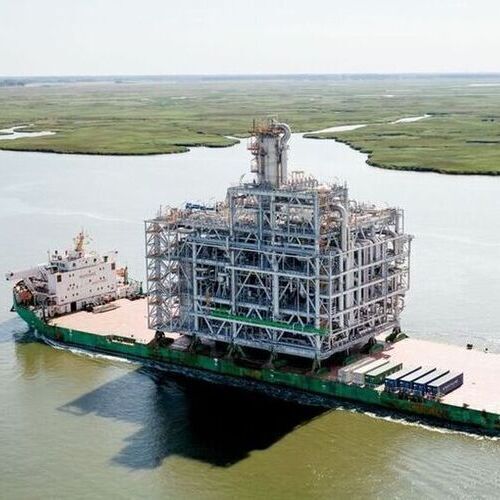
August 6 – Ineos has recently taken delivery of the first of the last two modules, at the Port of Antwerp, to complete the Project One cracker. The modules were built in Abu Dhabi but their transport to Antwerp was disrupted by the war in Iran and the blockade of the Strait of Hormuz. After being trapped for months, the two ships carrying the modules managed to safely pass through the Strait, during the one- week ceasefire in mid-June, arriving in Antwerp six weeks later, via the Suez Canal.
The module transported weighs 6,920 tonnes and is 55 metres high. As such it combines the weight of almost the entire steel structure of the Eiffel Tower with the height of a medium-sized skyscraper, making it one of the most impressive project cargoes to have arrived at the Port of Antwerp in recent years. The module exceeds the weight of the Project One furnaces which, arrived at the Port of Antwerp last year.
The second and final module, weighing 7,200 tonnes, is due to arrive shortly allowing Ineos to complete the plant.
The vessel will remain moored at the quay for a little while longer, as the steel structures protecting the module during overseas transport need to be removed. It will then be placed in position at the heart of the plant.
The mechanical completion of the entire site is scheduled for next summer. The firm aims to start up the cracker in the second half of 2027.
2. Get H2 Nukleus Project: First Hydrogen Reaches Marl in Germany
RWE is commissioning 200 megawatts of electrolysis capacity in Lingen by the end of 2026.
(Source: RWE)
August 11 – The first hydrogen produced in the electrolysis in Lingen, Lower Saxony, has reached Marl in the northern Ruhr area. This marks the successful interaction of all components of the integrated Get H2 Nukleus hydrogen project.
As part of the ongoing commissioning process for two 100-megawatt electrolysis plants operated by RWE in Lingen, initial quantities of renewable hydrogen are being produced in accordance with EU rules. They are transported through a pipeline network spanning around 120 kilometres, operated by transmission system operators Nowega and OGE as well as Syneqt, a subsidiary of Evonik, to Evonik’s Marl Chemical Park where the hydrogen is available for industrial production processes.
Parts of Get H2 Nkleus are being funded by the German federal government and the states of Lower Saxony and North Rhine-Westphalia as part of the IPCEI programme (Important Projects of Common European Interest) Hy2Infra. The pipelines are among the first sections of the hydrogen core network that is being developed across Germany.
RWE is commissioning 200 megawatts of electrolysis capacity in Lingen by the end of 2026. From 2027, the entire plant is scheduled to operate at a capacity of 300 megawatts. The hydrogen produced in RWE’s electrolysis plants complies with the EU requirements for renewable fuels of non-biological origin (RFNBO). Customers will receive proof of sustainability, enabling them to include the hydrogen in their decarbonization accounting.
Further pipeline projects linked to Get H2 Nukleus have already been completed or are currently being implemented. These include the 10-kilometre new-build pipeline from Heek to Epe, completed by OGE and Nowega at the end of 2025, connecting the hydrogen storage facility. At the end of 2026, RWE Gas Storage West will begin filling the first commercial cavern storage facility for hydrogen in Europe. The facility is scheduled to start operations in mid-2027. To connect additional industrial customers, OGE and Nowega are also converting an existing pipeline between Legden and Dorsten to carry hydrogen by 2027. In addition, they are constructing a new pipeline from Dorsten to Marl. A further pipeline linking Syneqt’s Marl Chemical Park with the refinery in Gelsenkirchen-Scholven has already been completed.
Date: 08.12.2025
Naturally, we always handle your personal data responsibly. Any personal data we receive from you is processed in accordance with applicable data protection legislation. For detailed information please see our privacy policy.
Consent to the use of data for promotional purposes
I hereby consent to Vogel Communications Group GmbH & Co. KG, Max-Planck-Str. 7-9, 97082 Würzburg including any affiliated companies according to §§ 15 et seq. AktG (hereafter: Vogel Communications Group) using my e-mail address to send editorial newsletters. A list of all affiliated companies can be found here
Newsletter content may include all products and services of any companies mentioned above, including for example specialist journals and books, events and fairs as well as event-related products and services, print and digital media offers and services such as additional (editorial) newsletters, raffles, lead campaigns, market research both online and offline, specialist webportals and e-learning offers. In case my personal telephone number has also been collected, it may be used for offers of aforementioned products, for services of the companies mentioned above, and market research purposes.
Additionally, my consent also includes the processing of my email address and telephone number for data matching for marketing purposes with select advertising partners such as LinkedIn, Google, and Meta. For this, Vogel Communications Group may transmit said data in hashed form to the advertising partners who then use said data to determine whether I am also a member of the mentioned advertising partner portals. Vogel Communications Group uses this feature for the purposes of re-targeting (up-selling, cross-selling, and customer loyalty), generating so-called look-alike audiences for acquisition of new customers, and as basis for exclusion for on-going advertising campaigns. Further information can be found in section “data matching for marketing purposes”.
In case I access protected data on Internet portals of Vogel Communications Group including any affiliated companies according to §§ 15 et seq. AktG, I need to provide further data in order to register for the access to such content. In return for this free access to editorial content, my data may be used in accordance with this consent for the purposes stated here. This does not apply to data matching for marketing purposes.
Right of revocation
I understand that I can revoke my consent at will. My revocation does not change the lawfulness of data processing that was conducted based on my consent leading up to my revocation. One option to declare my revocation is to use the contact form found at https://contact.vogel.de. In case I no longer wish to receive certain newsletters, I have subscribed to, I can also click on the unsubscribe link included at the end of a newsletter. Further information regarding my right of revocation and the implementation of it as well as the consequences of my revocation can be found in the data protection declaration, section editorial newsletter.
3. Cambrex Begins Construction of New R&D Facility in Italy
Cambrex recently announced the start of construction on a new research and development facility at its Milan, Italy site.
(Source: Pixabay)
August 18 – Cambrex recently announced the start of construction on a new research and development (R&D) facility at its Milan, Italy site. This 30-million-dollar investment will add advanced analytical development and process R&D capabilities, alongside upgrades to multiple production plants, reinforcing Cambrex’s commitment to supporting the pharmaceutical industry’s most complex small molecule development.
The Milan R&D expansion is expected to be completed in the second half of 2027. To accommodate future growth and rising demand for CDMO services, Cambrex has also acquired additional land adjacent to the site, ensuring the capacity to expand and innovate for years to come.
The Cambrex Profarmico Milano site, which marks its 80th anniversary this year, has a distinguished legacy of supporting pharmaceutical development and manufacturing for its global client base. The Milan team recently gathered to celebrate this milestone, reflecting on eight decades of scientific achievement and dedication to advancing human health.
The investment builds on Cambrex’s legacy of scientific expertise and manufacturing excellence while positioning the company for its next chapter of growth. By expanding R&D capabilities in Milan, Cambrex is strengthening its ability to address the increasing complexity of today’s small molecule therapies.
4. Biobtx to Build World’s First Fully Sustainable Aromatic Plant
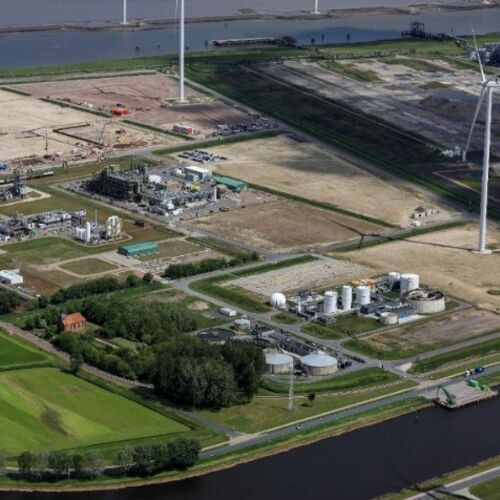
Petra is the first commercial-scale application of Biobtx’s proprietary ICCP (Integrated Catalytic Cracking Process) technology.
(Source: Biobtx)
August 18 – Biobtx recently announced that it has taken a positive Final Investment Decision (FID) for its Petra project: the world’s first commercial-scale plant converting plastic waste directly into renewable aromatics.
Petra is the first commercial-scale application of Biobtx’s proprietary ICCP (Integrated Catalytic Cracking Process) technology. The plant will produce approximately 10,000 to;nnes of renewable aromatic oil per year, consisting of benzene, toluene and xylenes (BTX), along with 8,000 tonnes of sustainable byproducts. Reaching this milestone concludes a 14-year journey from Biobtx’s initial idea in 2012, through lab and pilot scale, to commercial execution and will accelerate the commercialization of renewable aromatics worldwide.
With this key milestone, Biobtx is the first company in the world to realize a fully renewable aromatics plant, an important step on the path to defossilizing the chemical industry. With permits approved and engineering and financing agreements in place, the project now moves into execution. The main equipment suppliers, contractors and partners have been selected, and manufacturing of the process equipment modules has started. On-site construction starts in the beginning of 2027 and start-up of the plant is expected mid-2028.
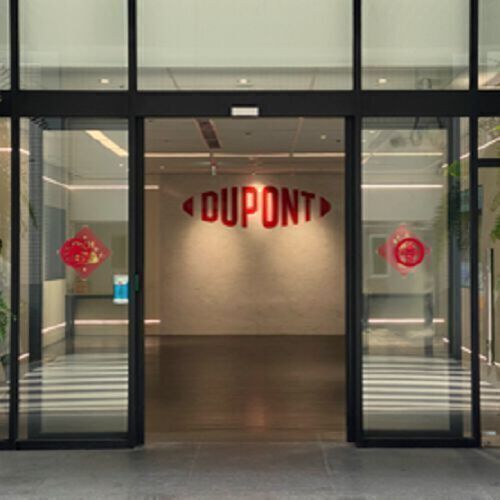
5. Dupont Selects MBR System for Australia’s Largest Inland Wastewater Treatment Facility
Dupont has recently announced that a MBR system has been selected to support the upgrade of the Lower Molonglo Water Quality Control Centre in Canberra, Australia.
(Source: Dupont)
August 18 – Dupont has recently announced that a Memcor membrane bioreactor (MBR) system has been selected to support the upgrade of the Lower Molonglo Water Quality Control Centre (LMWQCC) in Canberra, Australia, the largest inland wastewater treatment facility in the country. The Memcor MBR system will significantly expand treatment capacity and continue to produce high-quality effluent for safe discharge.
Owned and operated by Icon Water, the facility is currently undergoing a major upgrade project in collaboration with Seymour Whyte and Vinci Construction Grands Projects to address increasing demand due to population growth. The upgrade includes construction of an additional new secondary treatment process centered on advanced membrane technology. At the core of this process is a Memcor MBR system with a treatment capacity of approximately 97 million liters per day, enhancing the plant’s ability to serve the Canberra region while supporting future growth.
The Lower Molonglo facility has been in operation since the late 1970s and is the primary wastewater treatment plant for the Australian Capital Territory. As Canberra continues to grow, LMWQCC needs to grow with it. The implementation of the MBR technology will provide increased treatment capacity to meet rising demand and equip the city with future-ready infrastructure designed for long-term resilience.
6. KBR Technology Selected for Kazakhstan’s First SAF Production Plant
The project holds significant strategic importance as it supports the President of Kazakhstan’s directive to transform the country into an international aviation hub with strong transit potential.
(Source: Unsplash)
August 25 – KBR has recently been awarded a contract by Kazmunaygas-Aero (KMG-Aero), a subsidiary of NC Kazmunaygas JSC, and Kazfoodproducts (KFP) for Kazakhstan’s first Sustainable Aviation Fuel (SAF) production plant.
Under the terms of the contract, KBR will license the proprietary Pure SAF technology, invented and developed by Swedish Biofuels, and provide proprietary engineering design. The plant will leverage the alcohol-to-jet (AtJ) process for producing aviation fuel from alcohol-based feedstocks.
The project holds significant strategic importance as it supports the President of Kazakhstan’s directive to transform the country into an international aviation hub with strong transit potential. It will also enable the integration of domestically produced agricultural feedstocks into high-value, low-carbon fuel production value chains.
This award builds on other recent Pure SAF project wins, reinforcing KBR’s position at the forefront of aviation decarbonization through continued process innovation and low-carbon technology deployment.
7. Saipem Wins EPCI Contract in the Middle East
Saipem’s scope encompasses the Engineering, Procurement, Construction and Installation of offshore and subsea facilities.
(Source: Pixabay)
August 25 – Saipem has been awarded an offshore EPCI contract in the Middle East, valued at approximately 1.8 billion dollars.
Saipem’s scope encompasses the Engineering, Procurement, Construction and Installation (EPCI) of offshore and subsea facilities.
The project will leverage Saipem’s proven regional track record in delivering pipeline and offshore infrastructure, supported by its regional vessels and advanced engineering capabilities.
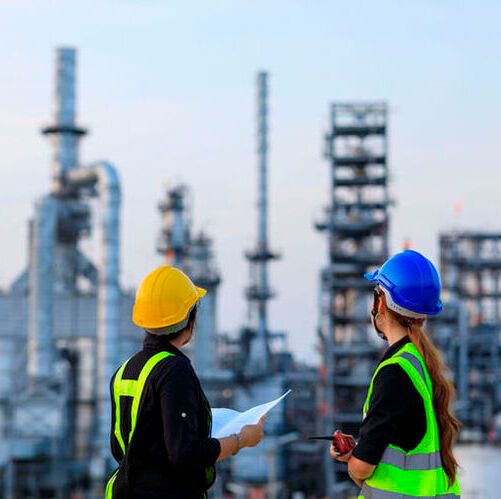
8. Axens, Raízen Announce Successful Start-Up of Gasoline Desulfurization Unit
Axens and Raízen have announced the successful start-up of a Prime-G+ FCC gasoline desulfurization unit at Raízen’s refinery in Argentina.
(Source: Unsplash)
August 27 – Axens and Raízen have announced the successful start-up of a Prime-G+ FCC gasoline desulfurization unit at Raízen’s refinery in Argentina, marking the 300th Prime-G+ unit licensed worldwide in 25 years.
The commissioning and start-up of the unit have been completed successfully, enabling Raízen to produce cleaner gasoline in line with stringent environmental specifications. This achievement highlights both companies’ commitment to operational excellence and to reducing the environmental footprint of refining activities.
As part of this project, the unit was delivered using a modular approach, with key process modules engineered and fabricated under Axens responsibility. Despite the challenges posed by the Covid-19 period, all modules were successfully delivered and installed, enabling a safe, smooth, and accelerated start-up. This modular execution significantly reduced onsite activities and allowed faster project delivery compared to conventional stick-built units.
Axens’ Prime-G+ technology is widely recognized as the leading solution for FCC gasoline desulfurization. Today, around 70 % of low-sulfur gasoline globally is produced using Prime-G+ technology, demonstrating its strong market adoption and proven industrial performance.
The technology enables deep desulfurization of gasoline downstream of the FCC unit while ensuring optimal octane retention, a key differentiator for refiners seeking to comply with fuel specifications without compromising product value.
Beyond its superior desulfurization performance, Prime-G+ helps refiners improve energy efficiency while lowering the environmental footprint of FCC gasoline treatment on their sites. This milestone further confirms Axens’ ability to deliver high-performance, flexible and modular refining solutions, tailored to the evolving needs of the industry.
9. Maire Wins Multiple Contracts Worth 50 Million Euros
Maire has recently announced new awards in its Sustainable Technology Solutions business unit for a total amount of approximately 50 million euros.
(Source: Pixabay)
August 27 – Maire has recently announced new awards in its Sustainable Technology Solutions (STS) business unit for a total amount of approximately 50 million euros, with projects located across Asia, Europe and North America.
Stamicarbon, Nextchem’s nitrogen technology licensing subsidiary, will provide licensing, Process Design Package (PDP), and proprietary equipment for an around 3,500 metric tons per day (MTPD) grassroots urea plant in Asia based on its proprietary Ultra-Low Energy (ULE) design, part of the NX Stami Urea technology portfolio. The Ultra-Low Energy design is among the most energy-efficient urea technologies available on the market, enabling significantly lower steam consumption and operating costs compared to conventional urea processes. The solution incorporates advanced process features and proprietary materials aimed at enhancing equipment reliability, extending asset lifetime, and supporting safe and stable long-term operations.
Furthermore, Stamicarbon has been awarded a proprietary equipment contract in Germany by SKW Stickstoffwerke Piesteritz, a leading German fertilizer producer and operator of one of Europe's largest integrated ammonia and urea production sites. Under the scope of the contract, Stamicarbon will supply three high-pressure urea strippers based on its proprietary NX Stami Urea technology, incorporating advanced design features to deliver significant process improvements. These include debottlenecking, reduced high-pressure steam consumption, and enhanced reliability of the liquid distribution system, incorporating advanced design features to deliver significant process improvements.
Also, Stamicarbon has been awarded a Process Design Package (PDP) contract for a new grassroots urea plant in Canada. The project will be based on its proprietary Launch Melt Conventional Total Recycle technology and will have a production capacity of approximately 1,150 short tons per day (STPD). Under the scope of the contract, Stamicarbon will deliver the Process Design Package for the Feed phase, supporting the advancement of the project toward final investment and execution decisions.
10. Sunfire Breaks Ground for Green Hydrogen Test Facility
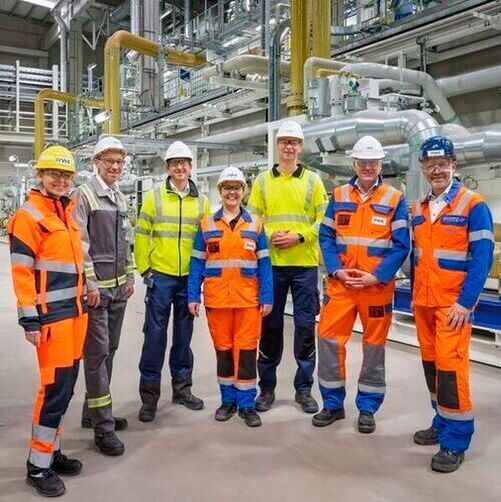
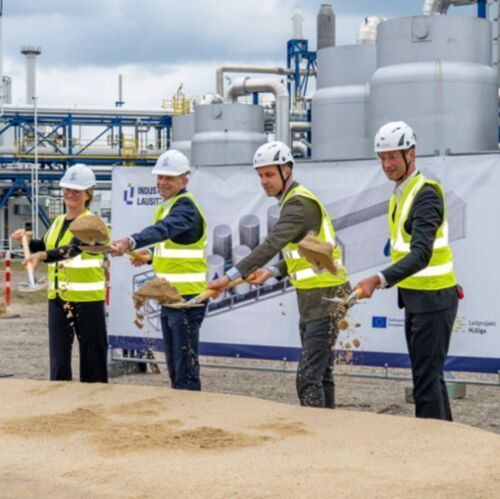
From left to right: Anne Francken, Kaufmännische Geschäftsführerin BASF InfraService & Solutions Lausitz; Jürgen Fuchs, Vorsitzender der Geschäftsführung BASF InfraService & Solutions Lausitz; Nils Aldag, CEO Sunfire; and Christian von Olshausen, CTO Sunfire.
August 31 – Industrial Park Lausitz and Sunfire officially broke ground on a green hydrogen test facility in the presence of representatives from government, business, and industry. At the BASF site, Sunfire will validate its latest and most powerful SOEC product generation in an industrial environment.
Solid Oxide Electrolysis Cell (SOEC) technology operates at high temperatures of around 850 degrees Celsius and achieves electrical efficiencies of up to 89 % LHV, AC. As a result, Sunfire’s SOEC electrolyzers enable the lowest levelized costs of hydrogen (LCOH). As a pioneer in SOEC development, Sunfire has implemented more industrial SOEC demonstration projects than any other company worldwide. By establishing the SOEC testing facility in Schwarzheide, the project further strengthens the Lausitz region as a location for future technologies.
Nils Aldag, CEO of Sunfire: “Sunfire stands for green hydrogen technologies ‘Made in Germany’. While our pressurized alkaline electrolyzers are already being successfully deployed in large-scale industrial projects across Europe, we also see high-temperature electrolysis as a critical enabler of the energy transition. SOEC technology has the potential to become another key technology for industrial decarbonization. As the global market leader in SOEC, we are playing a key role in shaping this development. With the test facility at BASF’s Schwarzheide site, we are consistently executing our SOEC strategy and advancing the commercialization of this technology. The site offers ideal conditions to further accelerate the market ramp-up of high-temperature electrolysis.”




:quality(80)/p7i.vogel.de/wcms/20/9b/209b81269c3b7255e1f49c5771cfc303/0133747923v2.jpeg "Under the theme \"Step into Cognitive Manufacturing\", Ima will present its vision of a new generation of manufacturing, where Artificial Intelligence, advanced Robotics, Digital Vision Systems and Human Expertise work together to create smarter, more connected and adaptive production environments. (Source: Ima)")
:quality(80)/p7i.vogel.de/wcms/e5/87/e587bb7a91212bcc1ae875ef1bbb6edf/0133471290v2.jpeg "Physical AI marks a shift from machines that follow fixed instructions to embodied systems that perceive, reason, and act autonomously. (Source: Pixabay)")
:quality(80)/p7i.vogel.de/wcms/8b/a5/8ba5d7e346543b30d3066de20e059c59/0133394741v2.jpeg "Currently under construction in Delfzijl, the new SAF facility will support the Netherlands’ efforts to meet the EU’s sustainable aviation fuel mandate. (Source: Emerson )")
:quality(80)/p7i.vogel.de/wcms/6f/90/6f90a6bb14694e7597ec1234110da041/0133293480v2.jpeg "Under the MOU, Aramco will provide domain knowledge, data, and infrastructure to evaluate Sony’s technologies in real-world industrial settings. (Source: Aramco )")
:quality(80)/p7i.vogel.de/wcms/5e/0f/5e0f355d4e90ad6e1af1c997b8789b7d/0133748771v2.jpeg "Elkem Rana’s second furnace will operate as normal during the period. (Source: Elkem )")
:quality(80)/p7i.vogel.de/wcms/c8/30/c830ea0047f500d4c8e9b1a39744d05c/0133653487v2.jpeg "Technip Energies has been awarded contracts by Petkim, a subsidiary of Socar, in connection with the development of a proposed integrated petrochemical complex in Aliağa, Türkiye. (Source: Pixabay)")
:quality(80)/p7i.vogel.de/wcms/56/9d/569db69474e60a709992a9ae5a94ff78/0133613642v2.jpeg "Avantium has successfully produced the first batch of FDCA at its FDCA flagship plant in Delfzijl, the world's first commercial-scale plant for the production of FDCA. (Source: Unsplash)")
:quality(80)/p7i.vogel.de/wcms/2d/ff/2dff64eb5e03d787ed12706e1f344da7/0133613610v2.jpeg "The scope of work includes the development of the engineering design package, the definition of the key technical requirements and the cost estimation for the project. (Source: Pixabay)")
:quality(80)/p7i.vogel.de/wcms/c3/40/c340a3cd06990549f48cf68ae3c5ffff/0133748269v2.jpeg "Bayer has plans to invest 2.2 billion dollars in a new pharmaceutical manufacturing site in New Albany, Ohio, U.S. (Source: Bayer )")
:quality(80)/p7i.vogel.de/wcms/87/4a/874ac98c92c3cab99c0cb57a812caa80/0133555719v2.jpeg "The VPHP Bioindicator is based on spores of Geobacillus stearothermophilus ATCC 12980 and uses packaging permeable to VPHP. (Source: Ima)")
:quality(80)/p7i.vogel.de/wcms/53/a4/53a447ccf82236286a9c98307cd7fa81/0133438889v2.jpeg "The OEB5-contained capsule filling machine is integrated with an isolator and processes solid and liquid oral formulations. (Source: Marchesini)")
:quality(80)/p7i.vogel.de/wcms/02/2c/022cab680492112fbf0ef42892dddd63/0133748297v2.jpeg "In addition to production of green hydrogen, the H2future-Follow-Up project is now increasingly focusing on its treatment and provision for industrial applications. (Source: Verbund)")
:quality(80)/p7i.vogel.de/wcms/54/b9/54b9798cdc66e4aa54009dcd5fd2a682/0133616385v2.jpeg "Hydrogen production plant using water electrolysis powered by renewable energy. (Source: Hyundai E&C/AI-generated image)")
:quality(80)/p7i.vogel.de/wcms/c5/03/c5039bd2b47b209d1112fcc5227d04fc/0133537580v2.jpeg "The facility is expected to strengthen Manatee County’s position as a strategic energy and logistics hub. (Source: Unsplash)")
:quality(80)/p7i.vogel.de/wcms/67/ef/67efeaefe508d0fba36d39f65e0ff406/0133485604v2.jpeg "Once captured, CO₂ is liquefied, delivered by truck to a dedicated CO₂ terminal at Port Esbjerg, shipped aboard Carbon Destroyer 1 - the EU's first purpose-built CO₂ carrier - and injected into the Nini West reservoir. (Source: Ineos Energy )")
:quality(80)/p7i.vogel.de/wcms/7f/1b/7f1b02563e4803ee7f3764ffd1720d8c/0132842468v3.jpeg "The new EZJetFlo™ in-line mixing system solves the production bottleneck using highly efficient Venturi powder induction. (Source: ILC DOver)")
:quality(80)/p7i.vogel.de/wcms/02/fb/02fbe7296b87b2c110ad17e983d7d87a/0132963781v2.jpeg "MAAG’s Extrex6 EC gear pump is specifically designed for the continuous conveying of rigid PVC (polyvinyl chloride). (Bild: Maag)")
:quality(80)/p7i.vogel.de/wcms/69/8c/698c17b920244559c08f28261636fee5/0132816720v2.jpeg "Xylem has entered into an agreement to acquire the Cornell Pump and Roper Pump businesses from Indicor for 1.46 billion dollars. (Source: Pixabay)")
:quality(80)/p7i.vogel.de/wcms/89/47/8947595eafaa6ad27c8552a5f9ad48e1/0129967379v1.jpeg "Biogas and biomethane currently provide approximately 5.5 GW of stable electrical capacity and could be expanded to up to 20 GW without requiring additional land – an enormous potential. (Source: license free via Pixabay)")
:quality(80)/p7i.vogel.de/wcms/fe/5d/fe5d9bb106dfb20c1d69c90d74e78f58/0133648325v2.jpeg "Under the ‘National Water Strategy 2030’, Saudi Arabia is securing sustainable water resources, protecting the natural environment and providing high-quality services. (Source: Malika - stock.adobe.com)")
:quality(80)/p7i.vogel.de/wcms/88/c4/88c457f86fb2842cbcee21c320c44bd9/0133541916v2.jpeg "The RO membrane elements will be used for the Changi Newater Factory (CNF3), a large-scale used water treatment plant in Singapore. (Source: Unsplash)")
:quality(80)/p7i.vogel.de/wcms/1b/2b/1b2b80c989067b50c687314515948806/0133161547v2.jpeg "Acwa has signed a MOU with Veolia, committing the two leading companies to optimizing seawater desalination across the entire value chain. (Source: Acwa)")
:quality(80)/p7i.vogel.de/wcms/21/2e/212e079dcb99d9fd36e85dae0db3141a/0132929532v2.jpeg "Aerial view of the Kawasaki Works. (Source: Asahi Kasei )")
:quality(80)/p7i.vogel.de/wcms/79/31/7931cc94924b4c2ebc7087e9cec2f801/0130490720v2.jpeg "The new Pulsar Model R80 solids antenna delivers improved measurement capability through its high-frequency signal, narrow beam angle, and advanced configuration software. (Source: Ametek )")
:quality(80)/p7i.vogel.de/wcms/6b/cc/6bcc3d26e1c7c74d90a10bc3ca296ae1/0128362351v2.jpeg "A look into Bayer's new tablet production, Solida 1, during construction: The robots and lift columns for material handling are being installed. (Source: Bayer)")
:quality(80)/p7i.vogel.de/wcms/24/c8/24c84ab6b1bcd24468a87820a07a85aa/0128194707v2.jpeg "Ajax Equipment has supplied Binding Solutions with a feed system comprising buffer hopper, screw feeder and agitated screw feeder for a pilot plant handling iron ore and additives. (Source: Ajax Equipment )")
:quality(80)/p7i.vogel.de/wcms/00/17/0017bdaa28fe66816199a4eb71c02e72/0133748786v2.jpeg "Located at the heart of the Rhône-Alpes Research Center, the Battery Center of Excellence is entering a new phase of its development. (Source: Arkema)")
:quality(80)/p7i.vogel.de/wcms/9e/e7/9ee7a88325e1356fd9fc14f3e6074ecb/0133654724v2.jpeg "LG Chem has signed a MOU with the Volkswagen Group to develop and expand the application of next-generation, eco-friendly mobility materials. (Source: LG Chem)")
:quality(80)/p7i.vogel.de/wcms/4f/5a/4f5a1993844fdceffa2539843257241a/0133654083v2.jpeg "The agreement expands the long-standing cooperation between the two companies and combines Sabic’s industry-leading technology with Technip Energies’ extensive experience in Polyolefins. (Source: Technip Energies )")
:quality(80)/p7i.vogel.de/wcms/53/9d/539d2658dc14be6d960b22b2dda224b6/0133618284v2.jpeg "Sulzer has delivered its Devo purification technology to Beyondpoly's Version 2.0, 100,000-ton-per-year polyolefin elastomer plant in China. (Source: Sulzer)")
:quality(80)/p7i.vogel.de/wcms/f8/29/f8298429c1638b949a6f76346f6709c7/0118701710v2.jpeg "Bosch Industrial Heat will be presenting sustainable steam and heat solutions for global industrial use at the Achema trade fair in Frankfurt, Germany. (Source: Bosch Industriekessel)")
:quality(80)/p7i.vogel.de/wcms/07/24/07242664ab2b1c7841c9d9d0a127670c/0116045959.jpeg "A look inside the GEA machine room. (Bild: Magnavale)")
:quality(80)/p7i.vogel.de/wcms/c9/79/c979a20b32395ddfa93fe7ead90578a0/0108386061.jpeg "Production residues, lime, salt and suspended solids quickly clog the pipes. (Source:©Tanakorn - stock.adobe.com)")
:quality(80)/p7i.vogel.de/wcms/9e/5c/9e5c92d942ed046a27562d6e3d730c92/0103483548.jpeg "It is almost ten metres high and extends over three floors: the world's first multiple dividing wall column is located in the new technical centre at the University of Ulm. (Bild: Eberhardt, kiz Universität Ulm)")
:quality(80)/p7i.vogel.de/wcms/90/f3/90f351201dd4ea7e2439ce19019bf318/0133013227v2.jpeg "Adnoc, in collaboration with SLB, has deployed its AI-enabled RTOC platform across its fleet of more than 120 rigs. (Source: Adnoc)")
:quality(80)/p7i.vogel.de/wcms/aa/9d/aa9dc332257fbc96a2d2ec20b40781a5/0132005469v2.jpeg "Qatar Energy would like to emphasize that this was an operational accident and not sabotage or hostile in nature. (Source: Qatar Energy)")
:quality(80)/p7i.vogel.de/wcms/57/da/57da73af9c35d633196afd46348182b2/0130820106v2.jpeg "Today, the world is witnessing a deepening energy crisis. The Iran–US war has exposed the vulnerability of the global oil, gas, and petrochemicals industry. Its impact is not confined to one region—it has triggered a domino effect across continents. (Source: © Rayhan - stock.adobe.com)")
:quality(80)/p7i.vogel.de/wcms/20/36/20366ffa57a841882fd165e4dc885c09/0130491929v2.jpeg "With the US and Israel jointly firing the first shot on Iran, the world is now witnessing major cascading effects—from soaring global oil and gas prices, to industry leaders declaring force majeure, and even predictions that the war could trigger a global economic recession! (Source: © FOYSAL - stock.adobe.com)")
:quality(80)/p7i.vogel.de/wcms/a8/4e/a84e8039a90a5cf4751d01ebcf6ba1a9/0127510172v2.jpeg "After six years, Achemasia, the international trade fair and innovation forum for sustainable chemical production, has returned with renewed vigor, bringing together global expertise, Chinese innovation, and a shared commitment to a greener industrial future—according to the organizers of the fair. (Source:PROCESS China)")
:quality(80)/p7i.vogel.de/wcms/17/c7/17c703445f134eb3d7ecc7918dda2762/0124596096v2.jpeg "Achema Middle East will launch in Saudi Arabia in 2026. (Bild: Dechema/ Hannibal)")
:quality(80)/p7i.vogel.de/wcms/2a/2c/2a2cffc07f51019065387cd63241b5ce/0119463370v1.jpeg "The Injecta 36 fills and seals RTU (Ready-to-Use) syringes at high speed. The image shows the robotic arm. (Source: IMA)")
:quality(80)/p7i.vogel.de/wcms/b1/7e/b17ea8c62ccafad1d1fb072d6199bbd6/0118578446.jpeg "“Star in the ring”: Vegapuls 6X radar level sensors are the solution of choice for Renolit for many applications on the way to the perfect plastic product. (Source: © MR Design - stock.adobe.com; Vega)")
:quality(80)/p7i.vogel.de/wcms/e0/95/e095767c9e3dc27fc37d5e635ef85303/0133843743v1.jpeg "The Strait of Hormuz crisis has shown how a single chokepoint can turn an energy shock into a manufacturing and food shock. (Source: © Gowrob - stock.adobe.com)")
:quality(80)/p7i.vogel.de/wcms/ff/f6/fff6f0d51831655bdd781e08681d74a3/0133747018v2.jpeg "His Excellency Saad Sherida Al-Kaabi, the Minister of State for Energy Affairs, the President and CEO of Qatar Energy at the Qatar Economic Forum Special Edition in New York, USA. (Source: Qatar Energy )")
:quality(80)/p7i.vogel.de/wcms/a4/48/a4483a8e8b44b896e15e44c2fb680cc4/0133647880v2.jpeg "UAE’s industrial strategy – Operation 300bn aims to advance the UAE’s industrial sector and strengthen its role in driving the national economy. (Source: © HISTOCK - stock.adobe.com)")
:fill(fff,0)/images.vogel.de/vogelonline/companyimg/2000/2093/65.jpg "Glatt_Logo_ND4c-RGB (5x3cm).jpg ()")
:fill(fff,0)/p7i.vogel.de/companies/61/f9/61f9439b7cbe4/logo-edl.png "logo-edl (EDL Anlagenbau Gesellschaft mbH)")
:fill(fff,0)/p7i.vogel.de/companies/66/9f/669f700d3b118/cac-2023-poslogo-idea-ahead.png "cac-2023-poslogo-idea-ahead (CAC ENGINEERING GMBH)")





:quality(80)/p7i.vogel.de/wcms/fc/96/fc96e896f549e6917ba6352fea21e67d/0133051280v2.jpeg "Axens and Raízen have announced the successful start-up of a Prime-G+ FCC gasoline desulfurization unit at Raízen’s refinery in Argentina. (Source: Unsplash )")
:quality(80)/p7i.vogel.de/wcms/93/9b/939b4ca6969859a7487f02e55c587c9c/0133092690v2.jpeg "From left to right: Anne Francken, Kaufmännische Geschäftsführerin BASF InfraService & Solutions Lausitz; Jürgen Fuchs, Vorsitzender der Geschäftsführung BASF InfraService & Solutions Lausitz; Nils Aldag, CEO Sunfire; and Christian von Olshausen, CTO Sunfire. (Source: © BASF InfraService & Solutions Lausitz )")