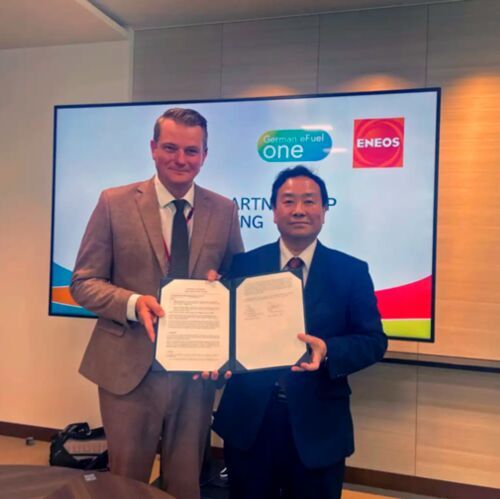
Under a strategic cooperation between Eneos and German eFuel One, both the parties aim to support the introduction of synthetic fuels in Japan and to advance the development of international value chains for low-carbon fuels.
The cooperation builds on the existing relationship between Eneos and eFuel and enters a new phase of industrial and commercial collaboration within the GEF1 project structure.
(Source: Eneos)
Tokyo/Japan – Eneos Corporation (Eneos) and German eFuel One (GEF1) have recently announced the launch of a strategic cooperation to support the introduction of synthetic fuels in Japan and to advance the development of international value chains for low-carbon fuels.
The cooperation builds on the existing relationship between Eneos and eFuel and enters a new phase of industrial and commercial collaboration within the GEF1 project structure. As part of this cooperation, Eneos and eFuel have entered into a Sale and Purchase Agreement (SPA) covering future supplies of eGasoline. eFuel is a shareholder and strategic partner of GEF1 and GEF1 is developing the first large-scale industrial eGasoline plant in Germany.
The agreement marks Eneos’ first import of synthetic fuels into Japan and represents an important step toward promoting their adoption in the Japanese market. For GEF1/eFuel, it also marks their first export beyond Europe, contributing to the development of an international synthetic fuels value chain and strengthening energy cooperation between Germany and Japan.
Synthetic fuels are produced from feedstocks such as green hydrogen generated from renewable electricity and recycled CO₂, or from synthesis gas derived from biomass gasification. When produced in accordance with strict sustainability and regulatory requirements, these fuels can significantly reduce CO₂ emissions over their entire lifecycle while remaining fully compatible with existing infrastructure, engines and distribution systems.
Strategic Importance for Eneos
For Eneos, the partnership with GEF1 is an important building block in its strategy to advance the energy transition and establish new low carbon fuel supply chains for the Japanese market. Synthetic fuels are positioned as a key decarbonization measure under Eneos’ Carbon Neutrality Plan. By importing synthetic fuels from GEF1, Eneos will gain early practical experience in the introduction, distribution, and use of synthetic fuels in Japan, preparing for potential future scaling of volumes as demand and regulation continue to evolve.
The agreement enables Eneos to offer customers in the transport and mobility sector an additional low net CO₂ emission fuel option, underscoring the company’s commitment to contributing to a carbon-neutral society through the energy transition.
Stay up to Date
Do you want the latest news, specialist articles and information on new products? Then you can register for our free newsletter:
With this agreement, GEF1 secures its first offtake partner in Asia, creating an important reference case for further international supply contracts. The synthetic fuels are produced at Germany’s first large-scale eGasoline production facility.
By combining green hydrogen with recycled CO₂, the project replaces fossil energy sources and contributes to achieving German, European and Japanese climate targets, while simultaneously strengthening Germany’s role as a location for the production and export of sustainable fuels.
Towards a Global Market for Synthetic Fuels
With increasing global pressure to decarbonize the transport sector, synthetic fuels are gaining attention as a practical solution with low net CO₂ emissions, particularly for applications that are difficult to electrify. In Europe, the implementation of the Red III framework further increases the importance of advanced biofuels and renewable fuels of non-biological origin (RFNBOs). GEF1’s production concept is designed to meet these European sustainability and classification requirements.
Through the cooperation, Eneos and GEF1 aim to contribute to the development of a global market for synthetic fuels by linking European production capacities with demand in Japan. The agreement is a concrete example of how cross-border partnerships can accelerate the deployment of new technologies and support the decarbonization of existing vehicle fleets and infrastructure.
Date: 08.12.2025
Naturally, we always handle your personal data responsibly. Any personal data we receive from you is processed in accordance with applicable data protection legislation. For detailed information please see our privacy policy.
Consent to the use of data for promotional purposes
I hereby consent to Vogel Communications Group GmbH & Co. KG, Max-Planck-Str. 7-9, 97082 Würzburg including any affiliated companies according to §§ 15 et seq. AktG (hereafter: Vogel Communications Group) using my e-mail address to send editorial newsletters. A list of all affiliated companies can be found here
Newsletter content may include all products and services of any companies mentioned above, including for example specialist journals and books, events and fairs as well as event-related products and services, print and digital media offers and services such as additional (editorial) newsletters, raffles, lead campaigns, market research both online and offline, specialist webportals and e-learning offers. In case my personal telephone number has also been collected, it may be used for offers of aforementioned products, for services of the companies mentioned above, and market research purposes.
Additionally, my consent also includes the processing of my email address and telephone number for data matching for marketing purposes with select advertising partners such as LinkedIn, Google, and Meta. For this, Vogel Communications Group may transmit said data in hashed form to the advertising partners who then use said data to determine whether I am also a member of the mentioned advertising partner portals. Vogel Communications Group uses this feature for the purposes of re-targeting (up-selling, cross-selling, and customer loyalty), generating so-called look-alike audiences for acquisition of new customers, and as basis for exclusion for on-going advertising campaigns. Further information can be found in section “data matching for marketing purposes”.
In case I access protected data on Internet portals of Vogel Communications Group including any affiliated companies according to §§ 15 et seq. AktG, I need to provide further data in order to register for the access to such content. In return for this free access to editorial content, my data may be used in accordance with this consent for the purposes stated here. This does not apply to data matching for marketing purposes.
Right of revocation
I understand that I can revoke my consent at will. My revocation does not change the lawfulness of data processing that was conducted based on my consent leading up to my revocation. One option to declare my revocation is to use the contact form found at https://contact.vogel.de. In case I no longer wish to receive certain newsletters, I have subscribed to, I can also click on the unsubscribe link included at the end of a newsletter. Further information regarding my right of revocation and the implementation of it as well as the consequences of my revocation can be found in the data protection declaration, section editorial newsletter.




:quality(80)/p7i.vogel.de/wcms/e5/87/e587bb7a91212bcc1ae875ef1bbb6edf/0133471290v2.jpeg "Physical AI marks a shift from machines that follow fixed instructions to embodied systems that perceive, reason, and act autonomously. (Source: Pixabay)")
:quality(80)/p7i.vogel.de/wcms/8b/a5/8ba5d7e346543b30d3066de20e059c59/0133394741v2.jpeg "Currently under construction in Delfzijl, the new SAF facility will support the Netherlands’ efforts to meet the EU’s sustainable aviation fuel mandate. (Source: Emerson )")
:quality(80)/p7i.vogel.de/wcms/6f/90/6f90a6bb14694e7597ec1234110da041/0133293480v2.jpeg "Under the MOU, Aramco will provide domain knowledge, data, and infrastructure to evaluate Sony’s technologies in real-world industrial settings. (Source: Aramco )")
:quality(80)/p7i.vogel.de/wcms/d3/d3/d3d35ace50cb3b0fcd075baa25e84884/0133106707v2.jpeg "Flyability’s Elios 2 is a drone used for internal inspection of tanks or boilers. (Source: Flyability )")
:quality(80)/p7i.vogel.de/wcms/8d/ba/8dba0d697e950364bef2864e46b5212d/0133534238v2.jpeg "With the start-up of the Delayed Coker Unit, the refinery is now capable of processing heavy residues into higher-value products. (Source: MOL Group)")
:quality(80)/p7i.vogel.de/wcms/06/5f/065ffb4390570a4f18cd4c01a2e051b2/0133483279v2.jpeg "Shell Indonesia has officially inaugurated its Grease Manufacturing Plant in Indonesia. (Source: Shell)")
:quality(80)/p7i.vogel.de/wcms/cd/96/cd96a9c305ef1143d1728db9fcc85efa/0133472936v2.jpeg "Emerson will deliver measurement instrumentation technologies and services across Equinor’s global offshore and onshore operations. (Source: Jan Arne Wold and Øyvind Gravås / © Equinor)")
:quality(80)/p7i.vogel.de/wcms/84/61/846149746d7bd5fa1d73f7c07dbbfe30/0133472101v2.jpeg "The final investment decision will be based on the outcome of the feasibility study and will remain subject to all necessary approvals. (Source: Pixabay)")
:quality(80)/p7i.vogel.de/wcms/87/4a/874ac98c92c3cab99c0cb57a812caa80/0133555719v2.jpeg "The VPHP Bioindicator is based on spores of Geobacillus stearothermophilus ATCC 12980 and uses packaging permeable to VPHP. (Source: Ima)")
:quality(80)/p7i.vogel.de/wcms/53/a4/53a447ccf82236286a9c98307cd7fa81/0133438889v2.jpeg "The OEB5-contained capsule filling machine is integrated with an isolator and processes solid and liquid oral formulations. (Source: Marchesini)")
:quality(80)/p7i.vogel.de/wcms/4a/ff/4aff5dd041a8038e27ac80de15072290/0133349979v2.jpeg "From left to right: Heiko Mennerich (Head of Next Generation Technologies at Evonik); Marco Trisciuzzi (Managing Director of the German-Slovak Chamber of Commerce); Guido Skudlarek (Head of Evonik Health Care Business Line); Lauren Kjeldsen (Member of the Executive Board of Evonik and Chief Operating Officer Custom Solutions); Ondrej Lunter (Regional President of the Banská Bystrica Self-Governing Region); Miroslav Havlik (General Manager of Evonik Fermas s.r.o).; and Roland Lamper (Mayor of Slovenská Ľupča) (Source: Evonik)")
:quality(80)/p7i.vogel.de/wcms/80/ab/80abf829caefbaf16132122c8a8985b3/0133154853v2.jpeg "Under the terms of the agreement, Lilly will acquire Merida and pay up to 2.875 billion dollars in cash, inclusive of an upfront payment, and contingent milestone payments. (Source: Pixabay)")
:quality(80)/p7i.vogel.de/wcms/c5/03/c5039bd2b47b209d1112fcc5227d04fc/0133537580v2.jpeg "The facility is expected to strengthen Manatee County’s position as a strategic energy and logistics hub. (Source: Unsplash)")
:quality(80)/p7i.vogel.de/wcms/67/ef/67efeaefe508d0fba36d39f65e0ff406/0133485604v2.jpeg "Once captured, CO₂ is liquefied, delivered by truck to a dedicated CO₂ terminal at Port Esbjerg, shipped aboard Carbon Destroyer 1 - the EU's first purpose-built CO₂ carrier - and injected into the Nini West reservoir. (Source: Ineos Energy )")
:quality(80)/p7i.vogel.de/wcms/59/de/59de9947b3231c56827bd27116b2c1a0/0133401833v2.jpeg "The facility will produce about one million metric tons of green ammonia annually for supply to domestic and international markets. (Source: AA+W - stock.adobe.com)")
:quality(80)/p7i.vogel.de/wcms/7f/1b/7f1b02563e4803ee7f3764ffd1720d8c/0132842468v3.jpeg "The new EZJetFlo™ in-line mixing system solves the production bottleneck using highly efficient Venturi powder induction. (Source: ILC DOver)")
:quality(80)/p7i.vogel.de/wcms/02/fb/02fbe7296b87b2c110ad17e983d7d87a/0132963781v2.jpeg "MAAG’s Extrex6 EC gear pump is specifically designed for the continuous conveying of rigid PVC (polyvinyl chloride). (Bild: Maag)")
:quality(80)/p7i.vogel.de/wcms/69/8c/698c17b920244559c08f28261636fee5/0132816720v2.jpeg "Xylem has entered into an agreement to acquire the Cornell Pump and Roper Pump businesses from Indicor for 1.46 billion dollars. (Source: Pixabay)")
:quality(80)/p7i.vogel.de/wcms/89/47/8947595eafaa6ad27c8552a5f9ad48e1/0129967379v1.jpeg "Biogas and biomethane currently provide approximately 5.5 GW of stable electrical capacity and could be expanded to up to 20 GW without requiring additional land – an enormous potential. (Source: license free via Pixabay)")
:quality(80)/p7i.vogel.de/wcms/88/c4/88c457f86fb2842cbcee21c320c44bd9/0133541916v2.jpeg "The RO membrane elements will be used for the Changi Newater Factory (CNF3), a large-scale used water treatment plant in Singapore. (Source: Unsplash)")
:quality(80)/p7i.vogel.de/wcms/1b/2b/1b2b80c989067b50c687314515948806/0133161547v2.jpeg "Acwa has signed a MOU with Veolia, committing the two leading companies to optimizing seawater desalination across the entire value chain. (Source: Acwa)")
:quality(80)/p7i.vogel.de/wcms/21/2e/212e079dcb99d9fd36e85dae0db3141a/0132929532v2.jpeg "Aerial view of the Kawasaki Works. (Source: Asahi Kasei )")
:quality(80)/p7i.vogel.de/wcms/c0/49/c04967ef45d44bc86baaa3326f05acd2/0132883356v2.jpeg "Dupont has recently announced that a MBR system has been selected to support the upgrade of the Lower Molonglo Water Quality Control Centre in Canberra, Australia. (Source: Dupont )")
:quality(80)/p7i.vogel.de/wcms/79/31/7931cc94924b4c2ebc7087e9cec2f801/0130490720v2.jpeg "The new Pulsar Model R80 solids antenna delivers improved measurement capability through its high-frequency signal, narrow beam angle, and advanced configuration software. (Source: Ametek )")
:quality(80)/p7i.vogel.de/wcms/6b/cc/6bcc3d26e1c7c74d90a10bc3ca296ae1/0128362351v2.jpeg "A look into Bayer's new tablet production, Solida 1, during construction: The robots and lift columns for material handling are being installed. (Source: Bayer)")
:quality(80)/p7i.vogel.de/wcms/24/c8/24c84ab6b1bcd24468a87820a07a85aa/0128194707v2.jpeg "Ajax Equipment has supplied Binding Solutions with a feed system comprising buffer hopper, screw feeder and agitated screw feeder for a pilot plant handling iron ore and additives. (Source: Ajax Equipment )")
:quality(80)/p7i.vogel.de/wcms/89/72/8972cb334baa518929da52ac0f34cea1/0133544514v2.jpeg "Praj Industries and Gevo have recently announced the signing of a Development & Commercialization Agreement for Bio-Isobutanol technology in India. (Source: Unsplash)")
:quality(80)/p7i.vogel.de/wcms/21/d6/21d6233a6a2c03783ebaf18d6cea3d64/0133536010v2.jpeg "The agreements have the potential to deepen cooperation by combining the UAE’s expertise in energy and long-term capital with Germany’s industrial and technological capabilities. (Source: Adnoc )")
:quality(80)/p7i.vogel.de/wcms/d7/1f/d71ff0d7073c457dd301def628ba27d0/0133534529v2.jpeg "This long-term financing was provided by OCBC Bank, Bank of China, Bank of Communications Co., Bangkok Bank (China) Company and China CITIC Bank Co., OCBC Bank acted as Coordinator and Facility Agent, and Sumitomo Mitsui Banking Corporation (China) acted as Security Agent. (Source: Indorama)")
:quality(80)/p7i.vogel.de/wcms/a0/97/a097c426446edfc8c87d7de9464b2b8b/0133482068v2.jpeg "The Indian Government is promoting the development of the semiconductor industry as a national strategic priority. (Source: Deposit Photos )")
:quality(80)/p7i.vogel.de/wcms/f8/29/f8298429c1638b949a6f76346f6709c7/0118701710v2.jpeg "Bosch Industrial Heat will be presenting sustainable steam and heat solutions for global industrial use at the Achema trade fair in Frankfurt, Germany. (Source: Bosch Industriekessel)")
:quality(80)/p7i.vogel.de/wcms/07/24/07242664ab2b1c7841c9d9d0a127670c/0116045959.jpeg "A look inside the GEA machine room. (Bild: Magnavale)")
:quality(80)/p7i.vogel.de/wcms/c9/79/c979a20b32395ddfa93fe7ead90578a0/0108386061.jpeg "Production residues, lime, salt and suspended solids quickly clog the pipes. (Source:©Tanakorn - stock.adobe.com)")
:quality(80)/p7i.vogel.de/wcms/9e/5c/9e5c92d942ed046a27562d6e3d730c92/0103483548.jpeg "It is almost ten metres high and extends over three floors: the world's first multiple dividing wall column is located in the new technical centre at the University of Ulm. (Bild: Eberhardt, kiz Universität Ulm)")
:quality(80)/p7i.vogel.de/wcms/90/f3/90f351201dd4ea7e2439ce19019bf318/0133013227v2.jpeg "Adnoc, in collaboration with SLB, has deployed its AI-enabled RTOC platform across its fleet of more than 120 rigs. (Source: Adnoc)")
:quality(80)/p7i.vogel.de/wcms/aa/9d/aa9dc332257fbc96a2d2ec20b40781a5/0132005469v2.jpeg "Qatar Energy would like to emphasize that this was an operational accident and not sabotage or hostile in nature. (Source: Qatar Energy)")
:quality(80)/p7i.vogel.de/wcms/57/da/57da73af9c35d633196afd46348182b2/0130820106v2.jpeg "Today, the world is witnessing a deepening energy crisis. The Iran–US war has exposed the vulnerability of the global oil, gas, and petrochemicals industry. Its impact is not confined to one region—it has triggered a domino effect across continents. (Source: © Rayhan - stock.adobe.com)")
:quality(80)/p7i.vogel.de/wcms/20/36/20366ffa57a841882fd165e4dc885c09/0130491929v2.jpeg "With the US and Israel jointly firing the first shot on Iran, the world is now witnessing major cascading effects—from soaring global oil and gas prices, to industry leaders declaring force majeure, and even predictions that the war could trigger a global economic recession! (Source: © FOYSAL - stock.adobe.com)")
:quality(80)/p7i.vogel.de/wcms/a8/4e/a84e8039a90a5cf4751d01ebcf6ba1a9/0127510172v2.jpeg "After six years, Achemasia, the international trade fair and innovation forum for sustainable chemical production, has returned with renewed vigor, bringing together global expertise, Chinese innovation, and a shared commitment to a greener industrial future—according to the organizers of the fair. (Source:PROCESS China)")
:quality(80)/p7i.vogel.de/wcms/17/c7/17c703445f134eb3d7ecc7918dda2762/0124596096v2.jpeg "Achema Middle East will launch in Saudi Arabia in 2026. (Bild: Dechema/ Hannibal)")
:quality(80)/p7i.vogel.de/wcms/2a/2c/2a2cffc07f51019065387cd63241b5ce/0119463370v1.jpeg "The Injecta 36 fills and seals RTU (Ready-to-Use) syringes at high speed. The image shows the robotic arm. (Source: IMA)")
:quality(80)/p7i.vogel.de/wcms/b1/7e/b17ea8c62ccafad1d1fb072d6199bbd6/0118578446.jpeg "“Star in the ring”: Vegapuls 6X radar level sensors are the solution of choice for Renolit for many applications on the way to the perfect plastic product. (Source: © MR Design - stock.adobe.com; Vega)")
:quality(80)/p7i.vogel.de/wcms/30/8d/308d155447665e72b8c7500f2bd8afcb/0133185520v2.jpeg "Alesya Deyanova, Show Manager of Achema Middle East at Messe Frankfurt Middle East (Source: Copyright: Marc Jacquemin | www.marc-jacquemin.com)")
:quality(80)/p7i.vogel.de/wcms/dc/5f/dc5f56ec161d3bc7f434e4a84e380dd1/0133000164v2.jpeg "Saipem’s scope encompasses the Engineering, Procurement, Construction and Installation of offshore and subsea facilities. (Source: Pixabay)")
:quality(80)/p7i.vogel.de/wcms/e4/af/e4af1b0a0b4eeb5aa37f35d3ebefeb82/0132727431v2.jpeg "The World Bank’s 'Global Gas Flaring Tracker Report' shares that global gas flaring increased from 157 bcm in 2024 to 167 bcm in 2025, a 6 % increase. (Source: © JAYDA RIN - stock.adobe.com)")
:fill(fff,0)/p7i.vogel.de/companies/68/07/6807ad98568ce/logo-elementar-rgb.jpeg "logo-elementar-rgb (Elementar Analysensysteme GmbH)")
:fill(fff,0)/images.vogel.de/vogelonline/companyimg/2000/2093/65.jpg "Glatt_Logo_ND4c-RGB (5x3cm).jpg ()")
:fill(fff,0)/p7i.vogel.de/companies/61/f9/61f9439b7cbe4/logo-edl.png "logo-edl (EDL Anlagenbau Gesellschaft mbH)")
:quality(80)/p7i.vogel.de/wcms/91/d3/91d363e4abe71708f00b7205b2d32eff/0129746143v2.jpeg "HIF Global and German e-fuel One have signed a Heads of Agreement for the long‑term offtake of e‑methanol. (Source: Pixabay)")
:quality(80)/p7i.vogel.de/wcms/9a/e1/9ae1f45dcf1c9dacb9f97de21b845e4b/0133293028v2.jpeg "Europe’s largest industrial carbon capture facility was recently inaugurated at Yara’s plant in Sluiskil, the Netherlands. (Source: Yara International )")