PROCESS Worldwide brings to you the ‘Top 10 plant engineering projects of June 2023’ from all over the world. Right from Indorama Ventures developing the world’s first PET biorecycling plant to Sasa Polyester Sanayi establishing the world’s largest PDH unit in Turkey, find out all the projects making headlines here.
At a glance: Plant engineering projects from across the globe.
(Source: Алина Бузунова - stock.adobe.com)
Total Energies, Tree Energy Solutions to Build e-NG Production Unit in USA
The project is expected to produce 100,000 to 200,000 metric tons of e-NG per year.
(Source: bannafarsai - stock.adobe.com)
June 02 – Total Energies is joining forces with Tree Energy Solutions (TES) to study and develop a large-scale production unit in the United States for e-natural gas (e-NG), a synthetic gas produced from renewable hydrogen and CO2.
The project, which is expected to produce 100,000 to 200,000 metric tons of e-NG per year, will be equally owned by the partners and operated by Total Energies. This partnership combines TES’ e-NG know-how with Total Energies’ expertise in renewable power generation, large-scale project management and natural gas liquefaction.
The e-NG will be produced in two steps:
• to produce renewable hydrogen, a 1-gigawatt (GW) electrolyzer will be powered by approximately 2 GW of wind and solar energy supplied by Total Energies through long-term power purchase agreements (PPAs).
• this renewable hydrogen will then be combined with biogenic CO2 to obtain the e-NG.
The resulting e-NG produced can be transported and/or liquefied, then sold like natural gas, using existing infrastructure, and end customers will be able to use it without any adaptation to their facilities.
Total Energies and TES will carry out the preliminary studies and aim to reach a Final Investment Decision (FID) in 2024. The project is expected to benefit from tax credits under the 2022 Inflation Reduction Act (IRA).
Brightmark, Chevron to Develop Mega Renewable Natural Gas Project in USA
The Castor Project, which processes manure from one large digester, is Brightmark and Chevron’s second-largest RNG project.
(Source: Pixabay)
June 05 – Brightmark RNG Holdings is positioned to expand renewable natural gas (RNG) production with five new anaerobic digestion dairy farm projects in western Michigan, designed to convert animal waste to renewable fuels. Brightmark RNG Holdings is a joint venture between Chevron U.S.A., a subsidiary of Chevron Corporation, and Brightmark Fund Holdings, a subsidiary of Brightmark. The Chevron-Brightmark renewable natural gas joint venture operates a nationwide system of RNG joint venture projects.
The Castor Project, which processes manure from one large digester, is Brightmark and Chevron’s second-largest RNG project. Other Michigan projects in the joint venture include Meadow Rock, Red Arrow, Willow Point, and Sunryz.
Anaerobic digestion is a circular technology that captures animal manure from partner sites and converts it into renewable natural gas, fertilizer, and water that can be recycled back into agricultural and energy systems for reuse. Including these Michigan projects, the Chevron-Brightmark RNG joint venture has a total of 20 RNG projects across the country.
“Transitioning to a lower carbon future is dependent, in part, on ambitious innovations and pragmatic solutions," said Andy Walz, president of Chevron Americas Products. “Launching these anaerobic digestion projects with Brightmark can help us develop new solutions for transportation, industry, and customers who rely on our products.”
The net reduction of greenhouse gas emissions from the manure processed at the anaerobic digestion dairy farm projects in Michigan is equivalent to planting over 179,000 acres of forest each year. Additionally, these projects are expected to reduce land application of raw manure and improve odor, water quality, and nutrient management practices at farms.
Indorama Ventures, Carbios to Develop World’s First PET Biorecycling Plant
The total capital investment for the new plant is re-estimated to be around 230 million euros, taking into account recent impact from inflation.
(Source: Pixabay)
June 06 – Indorama Ventures and Carbios, a biotech company developing and industrializing biological solutions to reinvent the life cycle of plastic and textiles, have recently announced the signing of a non-binding Memorandum of Understanding (MOU) to form a Joint Venture for the construction of the world’s first PET biorecycling plant in France.
Based on and subject to the comprehensive terms set out in the MOU, Indorama Ventures plans to mobilize about 110 million euros for the Joint Venture in equity and non-convertible loan financing, pending final engineering documentation and final economic feasibility studies. Both parties have acknowledged their mutual support for the implementation of the project and their intent to finalize contract documentation before end 2023.
Date: 08.12.2025
Naturally, we always handle your personal data responsibly. Any personal data we receive from you is processed in accordance with applicable data protection legislation. For detailed information please see our privacy policy.
Consent to the use of data for promotional purposes
I hereby consent to Vogel Communications Group GmbH & Co. KG, Max-Planck-Str. 7-9, 97082 Würzburg including any affiliated companies according to §§ 15 et seq. AktG (hereafter: Vogel Communications Group) using my e-mail address to send editorial newsletters. A list of all affiliated companies can be found here
Newsletter content may include all products and services of any companies mentioned above, including for example specialist journals and books, events and fairs as well as event-related products and services, print and digital media offers and services such as additional (editorial) newsletters, raffles, lead campaigns, market research both online and offline, specialist webportals and e-learning offers. In case my personal telephone number has also been collected, it may be used for offers of aforementioned products, for services of the companies mentioned above, and market research purposes.
Additionally, my consent also includes the processing of my email address and telephone number for data matching for marketing purposes with select advertising partners such as LinkedIn, Google, and Meta. For this, Vogel Communications Group may transmit said data in hashed form to the advertising partners who then use said data to determine whether I am also a member of the mentioned advertising partner portals. Vogel Communications Group uses this feature for the purposes of re-targeting (up-selling, cross-selling, and customer loyalty), generating so-called look-alike audiences for acquisition of new customers, and as basis for exclusion for on-going advertising campaigns. Further information can be found in section “data matching for marketing purposes”.
In case I access protected data on Internet portals of Vogel Communications Group including any affiliated companies according to §§ 15 et seq. AktG, I need to provide further data in order to register for the access to such content. In return for this free access to editorial content, my data may be used in accordance with this consent for the purposes stated here. This does not apply to data matching for marketing purposes.
Right of revocation
I understand that I can revoke my consent at will. My revocation does not change the lawfulness of data processing that was conducted based on my consent leading up to my revocation. One option to declare my revocation is to use the contact form found at https://contact.vogel.de. In case I no longer wish to receive certain newsletters, I have subscribed to, I can also click on the unsubscribe link included at the end of a newsletter. Further information regarding my right of revocation and the implementation of it as well as the consequences of my revocation can be found in the data protection declaration, section editorial newsletter.
Subject to the successful performance of this first plant in France, Indorama Ventures confirms its intention to potentially expand the technology to other PET sites for future developments.
Under the agreement signed, Carbios, which filed for plant permitting in December 2022, should acquire 13ha land from Indorama Ventures’ existing PET plant at Longlaville and expects to be granted permits by Q3 2023, allowing start of construction by end of 2023 and targeted commissioning in 2025. The land surface offers the possibility to double capacity. Pursuant to this MOU, Indorama Ventures shall ensure 100 % of output repolymerization and both partners shall collaborate to secure feedstock supply.
The total capital investment for the new plant is re-estimated to be around 230 million euros, taking into account recent impact from inflation. Project costs shall be financed by the sums mobilized by Indorama Ventures, the French State and Grand-Est Region subsidies available for the project, and by equity capitalization of the Joint Venture by Carbios. Part of Carbios’ equity injection into the Joint Venture shall be financed by a portion of Carbios’ current cash position (i.e. 86 million euros as of 30 April 2023). Carbios is actively examining the best options to finance its remaining equity injection into the Joint Venture and will choose the most appropriate solution and timeline based on market conditions.
Carbios has developed a disruptive enzymatic depolymerization technology that enables efficient and solvent-free recycling of PET plastic and textile waste into virgin-like products with an aim to achieve true circularity. After successful ongoing operations in its demonstration plant in Clermont-Ferrand in France, Carbios has been collaborating with Indorama Ventures for over a year to assess the commercial and technical feasibility of the technology. The world’s first industrial-scale enzymatic PET recycling plant at Longlaville will have a capacity to process about 50,000 tons of post-consumer PET waste per year, including waste that is not recyclable mechanically, equivalent to 2 billion PET colored bottles or 2.5 billion PET trays.
Consortium Wins 300-Million-Dollar EPC Contract in Egypt
The plant will produce 600 tons per day of nitric acid that will be fully transformed into 800 tons per day of fertilizer-grade, granulated, ammonium nitrate.
(Source: Sean Gladwell - stock.adobe.com)
June 13 – Maire has recently announced that a consortium composed by its Integrated E&C Solutions (IE&CS) subsidiary Tecnimont and Orascom Construction has been awarded a Lump Sum Turn-Key Engineering Procurement and Construction contract for a nitric acid and ammonium nitrate plant by Kima, Egyptian Chemical Industries Company.
The contract value to the consortium is approximately 300 million dollars, of which about 220 million dollars pertains to Tecnimont. The finalization of the contract is subject to successful execution of the financing package. The scope of work includes mainly engineering, supply of all materials and equipment – to be performed by Tecnimont – as well as construction activities to be carried out by Orascom Construction. The plant, whose completion is expected in the first half of 2026, will produce 600 tons per day of nitric acid, that will be fully transformed into 800 tons per day of fertilizer-grade, granulated, ammonium nitrate, which will be sold to local farmers, increasing the yields of their crops, as well as exported to international markets.
This project follows Kima’s ammonia and urea large plant built by Tecnimont and Orascom Construction and successfully started up in 2020 in the same industrial complex, located in the Aswan Governorship, in Upper Egypt.
Aker Carbon Capture Wins 200 Million Euro Contract for Carbon Capture Project
Aker Carbon Capture and Ørsted have recently signed a contract to develop a large-scale carbon capture project for the Ørsted Kalundborg Hub in Denmark.
(Source: Aker Carbon Capture)
June 16 – Aker Carbon Capture and Ørsted have recently signed a contract to develop a large-scale carbon capture project for the Ørsted Kalundborg Hub in Denmark. Aker Carbon Capture will deliver five Just Catch units, additional equipment such as liquefaction systems, and temporary CO2 storage and on-/offloading facilities with an expected total contract value above 200 million euros.
The carbon capture facilities will be delivered to Ørsted’s wood chip-fired Asnæs Power Station and the Avedøre Power Station’s straw-fired boiler, where the signing ceremony took place. Combined, these facilities will have an installed design capture capacity of 500,000 tonnes CO2 per year.
On 15 May, Aker Carbon Capture announced it had been awarded a large-scale carbon capture project by Ørsted for its Ørsted Kalundborg Hub in Denmark. This followed the 20-year contract award to Ørsted by the Danish Energy Agency (DEA) for its carbon capture and storage (CCS) project, which was officially signed on 31 May, after expiry of the mandatory standstill period.
The funding from the DEA will enable the realization of the first full-scale carbon capture and storage value chain in Denmark, delivered by Ørsted, Aker Carbon Capture, Microsoft and Northern Lights.
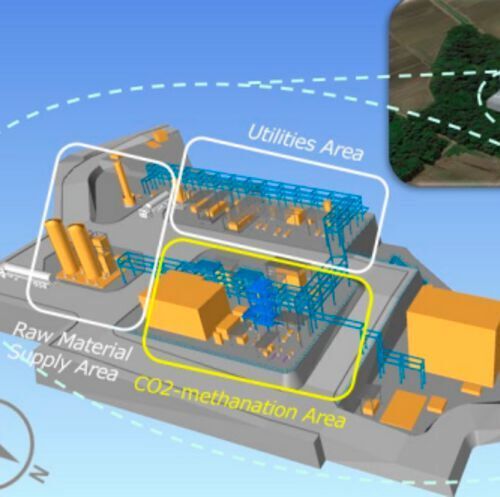
Inpex, Osaka Gas to Develop One of the World’s Largest CO2-Methanation Test Units
3D model of the test facility.
(Source: Inpex Corporation)
June 20 – Inpex Corporation (Inpex) and Osaka Gas Co. have recently announced that they will jointly commence construction of one the world’s largest CO2-methanation test facilities capable of producing 400 normal cubic meters of methane per hour, equivalent to the amount of methane consumed by about 10,000 households in Japan per day. The construction work will be carried out by Chiyoda Corporation based on an engineering, procurement and construction (EPC) contract signed between the parties.
This project is part of a joint technical development initiative that Inpex and Osaka Gas launched in 2021 targeting the practical application of a CO2-methanation system aimed at the carbon neutralization of natural gas. In turn, the initiative is based on a subsidized project commissioned to Inpex by the New Energy and Industrial Technology Development Organization (Nedo).
The test facility will consist of methanation, raw material supply, utility equipment and other components, and is planned to be connected to the Koshijihara Plant at Inpex’s Nagaoka Field Office in Nagaoka City, Niigata Prefecture, Japan. The Project is scheduled to consist of a demonstration test involving the production of synthetic methane (e-methane) using CO2 extracted from Inpex’s Nagaoka Field Office beginning in fiscal year 2025 and introducing the synthetic methane into Inpex’s natural gas trunk pipeline network.
In November 2022, the Japan Gas Association announced it will standardize reference of synthetic methane to ‘e-methane’ to improve international recognition. Since 2017, Inpex has conducted basic technical development of CO2 methanation at its Nagaoka Field Office, achieving a synthetic methane production capacity of eight normal cubic meters per hour. Inpex will leverage this experience to oversee the joint technical development initiative and operate the test facility.
Meanwhile, Osaka Gas will make use of its engineering capabilities including its design know-how concerning catalytic technology to produce synthetic methane while saving energy as well as scale ups, having nurtured these capabilities since the time it produced city gas and alternative natural gas from crude oil-based resources, to oversee the design of the CO2 methanation facilities as well as the optimization of the process.
Through the joint technical development initiative, Inpex and Osaka Gas will work toward the early-stage adoption of city gas carbon-neutralized through CO2 methanation.
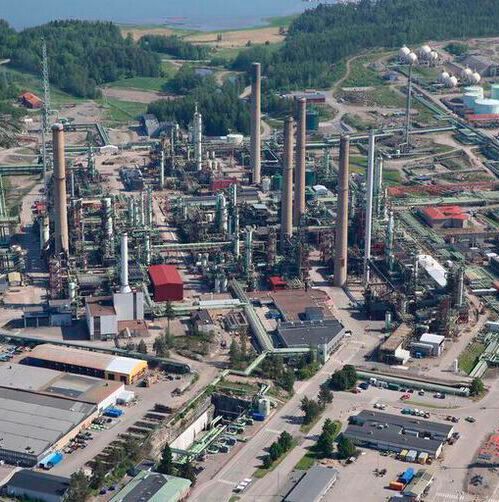
Neste to Invest 111 Million Euros for Upgrading Liquefied Plastic Waste Units
Neste's complex refinery in Finland offers excellent opportunities for transforming and reusing existing assets and processes for new purposes, such as upgrading liquefied waste plastic into high-quality petrochemical feedstock.
(Source: Neste)
June 20 – Neste has made the final investment decision to commence construction of upgrading facilities for liquefied plastic waste at its Porvoo refinery in Finland. With the investment of 111 million euros, Neste will build the capacity to upgrade 150,000 tons of liquefied waste plastic per year. Upgrading is one of the three processing steps turning liquefied waste plastic into high-quality feedstock for new plastics: pretreatment, upgrading and refining. The investment is part of a broader project (Pulse – Pretreatment and upgrading of liquefied waste plastic to scale up circular economy), which has received an EU Innovation Fund grant of 135 million euros if fully implemented and is targeting a total capacity of 400,000 tons per year.
Pretreatment and upgrading of liquefied waste plastic play an important role in Neste’s approach to chemical recycling. They allow the company to increase flexibility for processing lower-quality plastic waste and scale up processing the liquefied waste plastic into high-quality petrochemical feedstock in its existing refinery in Porvoo.
“We have developed our capability to process circular raw material at the Porvoo refinery over the recent years and are now set to build a respective facility. The new facility processing 150,000 tons of liquefied waste plastic, is planned to be finalized in the first half of 2025,” states Markku Korvenranta, Executive Vice President in Neste’s Oil Products.
The project will see Neste building new assets at the Porvoo refinery, but also leveraging existing assets through retrofitting, to scale-up chemical recycling fast and efficiently. The upgraded liquefied waste plastic will then be processed in the conventional refinery in which it will replace a portion of the fossil resources processed at the Porvoo refinery.
Required preparation works at the Porvoo refinery were successfully completed during the first half of 2023, enabling the construction work to commence without any delay.
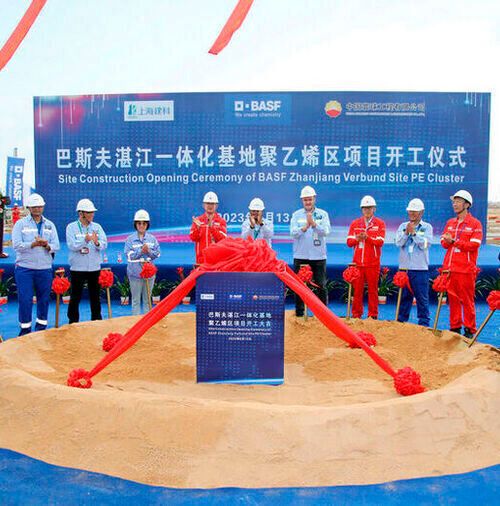
BASF Holds Groundbreaking Ceremony for New Polyethylene Plant
BASF has broken ground on a polyethylene plant at its Verbund site in Zhanjiang, China.
(Source: BASF)
June 21 – BASF has broken ground on a polyethylene (PE) plant at its Verbund site in Zhanjiang, China. The new plant with a capacity of 500,000 metric tons of PE annually will serve the fast-growing demand in China. The plant is scheduled to start up in 2025. “China's demand for PE has experienced rapid growth and is going to outpace the rest of the world,” said Bir Darbar Mehta, Senior Vice President of Petrochemicals Asia Pacific at BASF. “With the groundbreaking ceremony, BASF will enter the PE market in China via a competitive production footprint in its fully integrated production site in Zhanjiang, catering to our customers in the consumer goods, packaging, construction and transportation industries.”
“Strategically located close to our customers, the Zhanjiang Verbund site is fully backward integrated to provide them with high quality and reliable PE products for a wide range of durable applications, including pipes, specialty films and blow molded parts for household and industrial chemical containers, especially in the South China market,” said Bejoy Chandran, Vice President of Basic Business Management & China Sales Management, Petrochemicals Asia Pacific at BASF.
Polyethylene is a light, versatile thermoplastic polymer produced from ethylene. It is used in a wide range of applications from heavy-duty storage tanks and pipelines to flexible packaging and films.
Aramco, Total Energies Award EPC Contracts for Amiral Complex
Aramco and Total Energies recently awarded Engineering, Procurement and Construction (EPC) contracts for the 11 billion dollar ‘Amiral’ complex.
(Source: Aramco)
June 26 – Aramco and Total Energies recently awarded Engineering, Procurement and Construction (EPC) contracts for the 11 billion dollar ‘Amiral’ complex, a future world scale petrochemicals facility expansion at the Satorp refinery in the Kingdom of Saudi Arabia. A signing ceremony took place in Dhahran which was attended by Amin H. Nasser, Aramco President and CEO, and Patrick Pouyanné, Total Energies Chairman and CEO.
The award of EPC contracts for main process units and associated utilities marks the start of construction work on this joint project, following the final investment decision in December 2022. Integrated with the Satorp existing refinery in Jubail, the new petrochemical complex will house the largest mixed-load steam cracker in the Gulf, with a capacity to produce 1.65 million tons of ethylene and other industrial gases per year.
This expansion is expected to attract more than 4 billion dollars in additional investment in a variety of industrial sectors (carbon fibers, lubes, drilling fluids, detergents, food additives, automotive parts and tires) and create around 7,000 direct and indirect jobs in the country.
The EPC contracts were awarded to:
Hyundai Engineering & Construction Co. — for a mixed feed cracker and utilities, with a nameplate capacity of 1,650 kta of ethylene and related industrial gases, and utilities, flares and interconnecting systems that support main packages within the facilities
Maire Tecnimont — for two polyethylene units using Advanced Dual Loop technology, with a nameplate capacity of 500 kta each, and the derivative units.
Sinopec Engineering Group Saudi Co. — for Tank Farm and Satorp integration
Gulf Consolidated Contractors Co. — for the transfer pipelines
Mohammed Ali Al-Suwailem Trading & Contracting Co. – for industrial support facilities
Mofarreh Marzouq Al Harbi & Partners Co. – for site preparation
Mobarak M. Al Salomi & Partners for Contracting Co. – for temporary construction facilities
Sasa Polyester Sanayi to Develop World’s Largest PDH Unit in Turkey
The Honeywell UOP Oleflex process is used to produce light olefins through the catalytic dehydrogenation of light paraffin.
(Source: Honeywell International)
June 26 – Honeywell recently announced that Sasa Polyester Sanayi will build the world’s largest Propane Dehydrogenation (PDH) unit in Yumurtalık, Türkiye using the latest generation of Honeywell Oleflex technology. The facility will have the capacity to produce 1-million-tons of propylene per year.
The Honeywell UOP Oleflex process is used to produce light olefins through the catalytic dehydrogenation of light paraffin and provides users with an on-purpose source of polymer grade propylene and/or isobutylene. The Honeywell UOP Oleflex technology is a low-energy consumption, lower-emission technology that utilizes a catalyst with recyclable platinum with lower environmental impacts relative to comparable alternatives.
The project will take place between 2023 and 2026 and includes the construction of a 1-million-ton capacity PDH production facility and liquid and container port construction.
“Sasa is the first and largest polyester and polymer manufacturer of Türkiye, with a sustainable growth perspective, Sasa aims to make Türkiye one of the top three polyester manufacturers in the world and to become one of the leading players on a global scale, this vision is now a reality with the help of Honeywell’s Oleflex technology,” said İbrahim Erdemoğlu, Chairman of the Board of Erdemoğlu Holding, Sasa’s majority shareholder. “This is Sasa’s first technology award for our new crude oil to chemicals development and this project will allow us to develop ourselves continuously as we maintain the spirit of innovation.”




:quality(80)/p7i.vogel.de/wcms/54/f4/54f4b4e2a86b203e0dfd84221602bdb5/0130367283v2.jpeg "Anybotics' Anymal robot combines depth cameras, LiDAR, thermal imaging, acoustic sensors, and gas detectors into a single inspection round. (Source: Anybotics)")
:quality(80)/p7i.vogel.de/wcms/e9/64/e964996410967c124c2cf01a8623068e/0130285341v1.jpeg "Geht unter die Oberfläche: Die Offshore-Ölförderung erfordert hochenergetische Pumpen – doch diese sind im Wesentlichen eine Black Box. Bisher zumindest. (Source: Kistler Group)")
:quality(80)/p7i.vogel.de/wcms/54/ae/54aece5dff672ce1651470eecd9f2589/0130138090v2.jpeg "The new Ionchromatograph “Nexera IC“ (Source: Shimadzu)")
:quality(80)/p7i.vogel.de/wcms/49/5c/495c651fabd24a437c98bde6a3d71ecc/0130060419v2.jpeg "Enfinium has successfully piloted Wasteer’s groundbreaking visual AI technology at its Ferrybridge 2 facility in West Yorkshire and Parc Adfer facility in North Wales. (Source: Chris Parkes Photographer Ltd.)")
:quality(80)/p7i.vogel.de/wcms/1e/15/1e15b0e20cf5ede83e0749260dfda733/0130465044v2.jpeg "Energy X has recently announced the successful commissioning of a first-of-its-kind, U.S.-based lithium production facility at Project Lonestar, marking a major milestone toward commercial-scale domestic lithium production. (Source: Pixabay)")
:quality(80)/p7i.vogel.de/wcms/36/36/36369e6e59d4c660893cc04a4d257cfc/0130465035v2.jpeg "Wacker has successfully completed the second expansion phase at its production site in Panagarh, India. In addition to silicone rubber, the site now also operates a production complex (left) for silicone emulsions. (Source: Wacker)")
:quality(80)/p7i.vogel.de/wcms/1f/1e/1f1eba3731af22e1d9946e2897f134da/0130464799v2.jpeg "Aerial view of the BASF production site in Zhanjiang, China. (Source: BASF )")
:quality(80)/p7i.vogel.de/wcms/64/bb/64bb4812390b6491ce0bd4fe53597086/0130333812v2.jpeg "The solar power plant produces 30 GWh per year of renewable electricity, which is self-consumed by Holcim’s industrial facilities, making it the largest floating solar power plant in Europe dedicated to self-consumption. (Source: Pixabay)")
:quality(80)/p7i.vogel.de/wcms/41/c9/41c96e0244221ad38daa73bdd8231477/0130477173v2.jpeg "The „ORBITA‑L“-system is designed for filling and capping non‑injectable liquid products. (Source: Marchesini)")
:quality(80)/p7i.vogel.de/wcms/7a/50/7a501f6d8f87a4524dc3aaceb04eacb4/0130333829v2.jpeg "The Clear Lake facility represents Clariant's first U.S. manufacturing site dedicated to producing pharmaceutical-grade PEG excipients, marking a pivotal milestone in the company's healthcare growth strategy. (Source: Clariant)")
:quality(80)/p7i.vogel.de/wcms/26/12/261210e5920899e5c35c4f905d3be8bd/0129399814v2.jpeg "Powders used in DPI formulations are often highly potent and administered in very low doses. (Source: Ima)")
:quality(80)/p7i.vogel.de/wcms/6b/3f/6b3f057c83c494e4732337d870d52b21/0130006927v2.jpeg "Lonza will realize upfront cash proceeds of 2.2 billion dollars and retain a 40 % stake in the business, with additional preferential participation in its future exit. (Source: Lonza)")
:quality(80)/p7i.vogel.de/wcms/df/35/df3526a6f7aba41fdd2bb2051954e0d8/0130163620v2.jpeg "The SPA, valued at more than 3 billion dollars, is one of the largest binding long-term green ammonia off-take agreements globally. (Source: Pixabay)")
:quality(80)/p7i.vogel.de/wcms/af/73/af7394d9f8900024c5ee7fca459c4eeb/0130080328v2.jpeg "Axens has signed a MOU with Airbus to strengthen their cooperation in the development and deployment of SAF, a key pillar for decarbonizing the aviation sector. (Source: Pixabay)")
:quality(80)/p7i.vogel.de/wcms/0e/19/0e19f0cf0379c3af4c2fe02629db63f1/0130079229v2.jpeg "Thyssenkrupp Uhde has been selected by CSBP to deliver its patented Envinox technology for two nitric acid plants at CSBP’s Kwinana site in Western Australia. (Source: Thyssenkrupp Uhde)")
:quality(80)/p7i.vogel.de/wcms/a6/84/a68477d4ef879cc9cedeae332ca57c49/0129893677v2.jpeg "Siemens and Caphenia sign the partnership agreement. From left to right: Nicky Ahnert, Jürgen Giegerich, Frank Knauf (all Siemens), Dr. Mark Misselhorn, Dr. Andreas Waibel (both Caphenia) (Source: Siemens)")
:quality(80)/p7i.vogel.de/wcms/1c/39/1c39433f4bb4de2e5e6c5311c3236d09/0130110254v2.jpeg "The new pumps of the Omega type series have been designed for handling water and fluids with a low solids content efficiently. (Source: KSB)")
:quality(80)/p7i.vogel.de/wcms/be/e1/bee13b8d51a419b9b8f0685e2b9d47bf/0128917673v1.jpeg "The Centerwave 6000 measures pipes from 32 to 1,600 mm. (Source: Maag Group)")
:quality(80)/p7i.vogel.de/wcms/51/7a/517a4e83c5827663b4839f5ddb98f434/0128872953v1.jpeg "The Tigron in SIL version can be flexibly configured for different safety requirements. (Source: Auma)")
:quality(80)/p7i.vogel.de/wcms/60/ef/60efa975d1dd123c1afbfb6ccc060461/0130263955v2.jpeg "Aquaclean (Source: Oko-tech)")
:quality(80)/p7i.vogel.de/wcms/07/62/0762f20b1821ee2724c97989374d6397/0130257651v2.jpeg "Oleksandr Sadchykov in front of the water treatment unit (Source: Grundfos)")
:quality(80)/p7i.vogel.de/wcms/98/98/989863664c7b65e87caf74a08239d487/0130167217v2.jpeg "Keller 26KyX Level Probe (Source: © Keller Pressure)")
:quality(80)/p7i.vogel.de/wcms/64/4e/644e22b71e8d35a63f051f781eb13886/0130163451v2.jpeg "Vega will present level and pressure measurement technology for the water industry at Ifat 2026. (Source: Vega)")
:quality(80)/p7i.vogel.de/wcms/6b/cc/6bcc3d26e1c7c74d90a10bc3ca296ae1/0128362351v2.jpeg "A look into Bayer's new tablet production, Solida 1, during construction: The robots and lift columns for material handling are being installed. (Source: Bayer)")
:quality(80)/p7i.vogel.de/wcms/24/c8/24c84ab6b1bcd24468a87820a07a85aa/0128194707v2.jpeg "Ajax Equipment has supplied Binding Solutions with a feed system comprising buffer hopper, screw feeder and agitated screw feeder for a pilot plant handling iron ore and additives. (Source: Ajax Equipment )")
:quality(80)/p7i.vogel.de/wcms/1d/3e/1d3e2788eb37c1e974f36337c8d33cb5/0128191010v2.jpeg "Ajax Equipment has supplied IGI Systems with a stainless-steel conical hopper with gas purge capability, as part of a prototype Sublimation System for a low-pressure chemical vapour deposition application. (Source: Ajax Equipment)")
:quality(80)/p7i.vogel.de/wcms/19/76/1976928d7d0a2ed7c1eeba7ade8552c8/0126365603v1.jpeg "Detail of Valvedesign: It has an aktiv amd passive part (Bild: Italvacuum)")
:quality(80)/p7i.vogel.de/wcms/0c/a1/0ca135e0486c9af90a0552aea85de88c/0130439525v2.jpeg "Qatar Energy expects the damage to its Ras Laffan Industrial City caused by missile strikes, which occurred on Wednesday 18 March 2026, and in the early hours of Thursday 19 March 2026, to cost about 20 billion dollars a year in lost revenue. (Source: Pixabay)")
:quality(80)/p7i.vogel.de/wcms/d0/f7/d0f7d560dfce37c8371442d5b6120e3c/0130182478v1.jpeg "The Gelsenkirchen refinery primarily manufactures fuels for vehicles and aircraft, processing roughly 12 million tonnes of crude oil per year. (Source: BP)")
:quality(80)/p7i.vogel.de/wcms/7f/96/7f9628e43c99564fa6dfd8e76149425d/0130165852v2.jpeg "Pure titanium recycling process for chlor-alkali electrolysis cells. (Source: Asahi Kasei)")
:quality(80)/p7i.vogel.de/wcms/f8/29/f8298429c1638b949a6f76346f6709c7/0118701710v2.jpeg "Bosch Industrial Heat will be presenting sustainable steam and heat solutions for global industrial use at the Achema trade fair in Frankfurt, Germany. (Source: Bosch Industriekessel)")
:quality(80)/p7i.vogel.de/wcms/07/24/07242664ab2b1c7841c9d9d0a127670c/0116045959.jpeg "A look inside the GEA machine room. (Bild: Magnavale)")
:quality(80)/p7i.vogel.de/wcms/c9/79/c979a20b32395ddfa93fe7ead90578a0/0108386061.jpeg "Production residues, lime, salt and suspended solids quickly clog the pipes. (Source:©Tanakorn - stock.adobe.com)")
:quality(80)/p7i.vogel.de/wcms/9e/5c/9e5c92d942ed046a27562d6e3d730c92/0103483548.jpeg "It is almost ten metres high and extends over three floors: the world's first multiple dividing wall column is located in the new technical centre at the University of Ulm. (Bild: Eberhardt, kiz Universität Ulm)")
:quality(80)/p7i.vogel.de/wcms/7c/77/7c77e24fdcc9e1511e8e711eff161e28/0130175489v2.jpeg "The milestone confirms the fast pace of development of Eni’s deep water gas projects offshore East Kalimantan. (Source: Unsplash )")
:quality(80)/p7i.vogel.de/wcms/b3/2f/b32fb9f5aa54e9cb6c92e4b6c8665263/0130163018v2.jpeg "The decision to take emergency collective action was made following an extraordinary meeting of IEA Member governments, convened by the IEA Executive Director to assess market conditions amid the conflict in the Middle East and consider the options to address supply disruptions. (Source: © Sashkin - stock.adobe.com)")
:quality(80)/p7i.vogel.de/wcms/85/d2/85d2cb02c4ae45a99454b5405b0f2489/0130149909v2.jpeg "IEA Executive Director Fatih Birol issued a statement on the meeting of G7 Energy Ministers at its IEA headquarters in Paris. (Source: © Marko - stock.adobe.com)")
:quality(80)/p7i.vogel.de/wcms/a8/4e/a84e8039a90a5cf4751d01ebcf6ba1a9/0127510172v2.jpeg "After six years, Achemasia, the international trade fair and innovation forum for sustainable chemical production, has returned with renewed vigor, bringing together global expertise, Chinese innovation, and a shared commitment to a greener industrial future—according to the organizers of the fair. (Source:PROCESS China)")
:quality(80)/p7i.vogel.de/wcms/17/c7/17c703445f134eb3d7ecc7918dda2762/0124596096v2.jpeg "Achema Middle East will launch in Saudi Arabia in 2026. (Bild: Dechema/ Hannibal)")
:quality(80)/p7i.vogel.de/wcms/2a/2c/2a2cffc07f51019065387cd63241b5ce/0119463370v1.jpeg "The Injecta 36 fills and seals RTU (Ready-to-Use) syringes at high speed. The image shows the robotic arm. (Source: IMA)")
:quality(80)/p7i.vogel.de/wcms/b1/7e/b17ea8c62ccafad1d1fb072d6199bbd6/0118578446.jpeg "“Star in the ring”: Vegapuls 6X radar level sensors are the solution of choice for Renolit for many applications on the way to the perfect plastic product. (Source: © MR Design - stock.adobe.com; Vega)")
:quality(80)/p7i.vogel.de/wcms/09/e3/09e378194b496921d2a267a6752322eb/0130333473v2.jpeg "Under the terms of the contract, KBR will provide contract management, project management and supporting technical services throughout the EPC phases of the project. (Source: KBR)")
:quality(80)/p7i.vogel.de/wcms/77/9d/779db435e7f9d79bafe16101008a9cfa/0130263548v2.jpeg "The Kingdom of Saudi Arabia, the UAE and Turkey are three core countries in the region that are actively incorporating the plastics circular economy with the assistance of the chemical recycling technology. (Source: © Anastasiia - stock.adobe.com)")
:fill(fff,0)/images.vogel.de/vogelonline/companyimg/2000/2093/65.jpg "Glatt_Logo_ND4c-RGB (5x3cm).jpg ()")
:fill(fff,0)/p7i.vogel.de/companies/61/f9/61f9439b7cbe4/logo-edl.png "logo-edl (EDL Anlagenbau Gesellschaft mbH)")
:fill(fff,0)/images.vogel.de/vogelonline/companyimg/103000/103097/65.jpg "Pörner Gruppe mit Rand.jpg ()")






:quality(80)/p7i.vogel.de/wcms/c3/39/c339254836bad943c2743418974b6721/0128347001v2.jpeg "The two companies have signed on 2 December 2025 the shareholders’ agreement for their joint venture, dedicated to the construction and operation of a first PET biorecycling plant in China, with a processing capacity of 50,000 tons of PET waste. (Source: Pixabay)")
:quality(80)/p7i.vogel.de/wcms/05/a6/05a6aaf9ce906440aeefee1f37abb4bd/0126444227v3.jpeg "Technip Energies, in consortium with JGC, has been awarded two significant Feed contracts for Inpex Abadi LNG project, a landmark development for Indonesia’s energy landscape located in the Masela Block. (Source: Pixabay)")