PROCESS Worldwide brings to you the ‘Top 10 plant engineering projects of January 2026’ from all over the world. Right from BASF starting up its steam cracker at the Verbund site in China to Wood securing a contract for the world's first full-scale iron nitride permanent magnet plant, find out all the projects making headlines here.
At a glance: Plant engineering projects from across the globe.
(Source: Pixabay)
BASF Starts Up Steam Cracker at Verbund Site in China
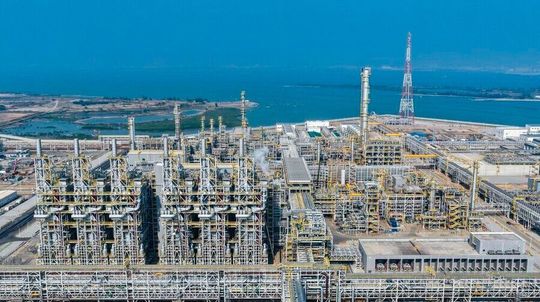
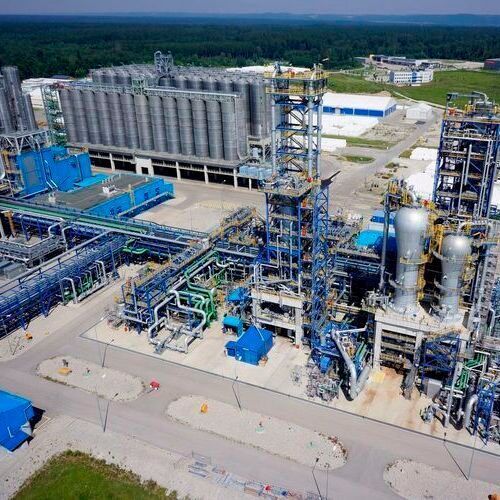
Start-up of the steam cracker at BASF’s Verbund site in Zhanjiang, China.
(Source: BASF)
Jan 13 – BASF has successfully commissioned the steam cracker at its newly built Verbund site in Zhanjiang in South China as scheduled. This is the first cracker in the world using 100 percent renewable energy to drive its main compressors (edrives).
As the heart of the Verbund, the steam cracker supplies important basic chemicals such as ethylene and propylene to multiple plants on site. It is the starting point for many chemical value chains: long chain hydrocarbons such as naphtha or butane are cracked with the help of steam. The ethylene capacity amounts to one million metric tons per year.
“This important milestone at our Zhanjiang Verbund site significantly strengthens BASF’s diversified value chains in China and positions us well to support customers across a wide range of industries,” said Dr. Stephan Kothrade, member of the Board of Executive Directors of BASF and Chief Technology Officer.
Wood Wins Contract for World's First Full-Scale Iron Nitride Permanent Magnet Plant
The groundbreaking plant will manufacture 1,500 tons of Iron Nitride permanent magnets annually once fully operational in 2027.
(Source: John Wood)
Jan 15 – Wood has secured the engineering, procurement and construction management (EPCM) contract for Niron Magnetics’ Plant 1 in Sartell, Minnesota, the world's first full-scale Iron Nitride permanent magnet facility.
This groundbreaking plant will manufacture 1,500 tons of Iron Nitride permanent magnets annually once fully operational in 2027, creating a resilient US supply chain for the magnets used in critical industries including automotive, defense systems, industrial motors, and consumer electronics.
Unlike traditional magnets that rely on rare earth materials and intensive mining, Niron Magnetics’ technology starts with iron and nitrogen- two abundant, easily sourced materials - to deliver magnets made with a fully-domestic supply chain and sustainable manufacturing processes. John Day, President of Projects Western Hemisphere at Wood, commented: “The Sartell Plant 1 project is a game-changer for sustainable magnet production at scale.”
“Having delivered the initial design, we’re now taking this project from concept to execution. Leveraging our EPCM expertise and first-of-a-kind scale-up experience, we’re enabling Niron Magnetics to deliver a high-production facility that reduces reliance on rare earths, helps power the future of sustainable energy and mobility, and creates a resilient supply chain for the U.S. economy.”
Wood’s scope will be delivered by a team of over 80 engineering and project delivery specialists based in the U.S.
Borouge Completes Proof of Concept for AI-Powered Autonomous Operations
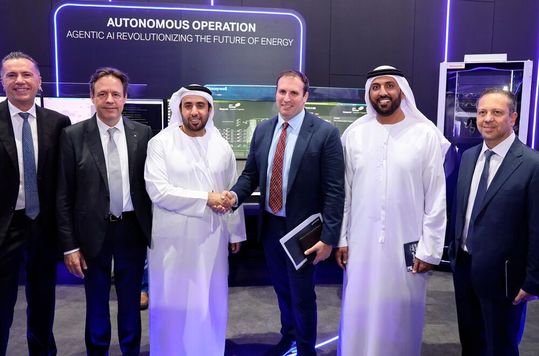
Conducted in a live production environment, the results indicate the potential to increase efficiency by up to 20 %, enhancement of reliability by reducing downtime by 20 %, and improve production performance while lowering operating costs by up to 15 %.
(Source: Borouge)
Jan 19 – Borouge has recently announced the successful completion of a proof of concept for AI-powered autonomous operations at its Ruwais facility, delivered in collaboration with Honeywell. The milestone supports Borouge’s strategy to enhance operational performance, strengthen long-term competitiveness, and contribute to Adnoc’s ambition to become the world’s most AI-enabled energy company.
Building on trials conducted in 2025, the proof-of-concept marks tangible progress toward developing the petrochemical industry’s first AI-driven control room for full-scale, real-time operations. Conducted in a live production environment, the results indicate the potential to increase efficiency by up to 20 %, enhancement of reliability by reducing downtime by 20 %, and improve production performance while lowering operating costs by up to 15 %. The technology also enhances process safety and supports more sustainable operations by significantly reducing energy consumption and associated emissions.
The initiative is a core component of Borouge's AI, Digitalization & Technology (AIDT) programme, which targeted 575 million dollars in value generation in 2025 through a portfolio of AI- and digital-led initiatives. The programme reflects the Company’s continued focus on disciplined execution, operational impact and long-term value creation.
Jim Masso, President and CEO of Honeywell Process Automation, added: “Our collaboration with Borouge demonstrates how AI-enabled autonomous operations can be deployed safely and effectively in a live production environment. This milestone highlights the potential of advanced connected solutions to deliver meaningful improvements in efficiency, reliability and operational performance at scale.”
Date: 08.12.2025
Naturally, we always handle your personal data responsibly. Any personal data we receive from you is processed in accordance with applicable data protection legislation. For detailed information please see our privacy policy.
Consent to the use of data for promotional purposes
I hereby consent to Vogel Communications Group GmbH & Co. KG, Max-Planck-Str. 7-9, 97082 Würzburg including any affiliated companies according to §§ 15 et seq. AktG (hereafter: Vogel Communications Group) using my e-mail address to send editorial newsletters. A list of all affiliated companies can be found here
Newsletter content may include all products and services of any companies mentioned above, including for example specialist journals and books, events and fairs as well as event-related products and services, print and digital media offers and services such as additional (editorial) newsletters, raffles, lead campaigns, market research both online and offline, specialist webportals and e-learning offers. In case my personal telephone number has also been collected, it may be used for offers of aforementioned products, for services of the companies mentioned above, and market research purposes.
Additionally, my consent also includes the processing of my email address and telephone number for data matching for marketing purposes with select advertising partners such as LinkedIn, Google, and Meta. For this, Vogel Communications Group may transmit said data in hashed form to the advertising partners who then use said data to determine whether I am also a member of the mentioned advertising partner portals. Vogel Communications Group uses this feature for the purposes of re-targeting (up-selling, cross-selling, and customer loyalty), generating so-called look-alike audiences for acquisition of new customers, and as basis for exclusion for on-going advertising campaigns. Further information can be found in section “data matching for marketing purposes”.
In case I access protected data on Internet portals of Vogel Communications Group including any affiliated companies according to §§ 15 et seq. AktG, I need to provide further data in order to register for the access to such content. In return for this free access to editorial content, my data may be used in accordance with this consent for the purposes stated here. This does not apply to data matching for marketing purposes.
Right of revocation
I understand that I can revoke my consent at will. My revocation does not change the lawfulness of data processing that was conducted based on my consent leading up to my revocation. One option to declare my revocation is to use the contact form found at https://contact.vogel.de. In case I no longer wish to receive certain newsletters, I have subscribed to, I can also click on the unsubscribe link included at the end of a newsletter. Further information regarding my right of revocation and the implementation of it as well as the consequences of my revocation can be found in the data protection declaration, section editorial newsletter.
Following the successful proof of concept with Honeywell, Borouge will advance work to further demonstrate the potential of autonomous operations and assess
opportunities to scale the technology across its Ruwais facilities.
Veolia Launches Multi-Energy Cogeneration Plant in Poland
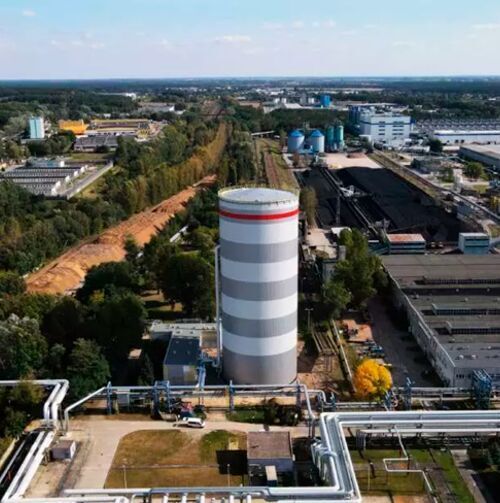
Veolia has recently unveiled a flagship district heating project in Poznań: a multi-energy cogeneration plant that supplies heat to 60 % of Poznań's 560,000 residents.
(Source: Veolia)
Jan 20 – Veolia has recently unveiled a flagship district heating project in Poznań: a multi-energy cogeneration plant that supplies heat to 60 % of Poznań's 560,000 residents. Thanks to an innovative technology, it has increased efficiency to 92 % and significantly advanced decarbonization, reducing CO₂ emissions by 25 %. This historic initiative in the city's coal phase-out strategy paves the way for the establishment of a completely coal-free district heating network by 2030, using biomethane, hydrogen, and other local energy sources.
This is the biggest change in the history of district heating in Poznań, improving air quality, enhancing energy security, and ensuring a stable heat supply for the city's residents.
"Leveraging Veolia's district heating expertise, we're taking a decisive step in Poland's energy transition. This two-phase project that we're unveiling will eliminate over 300,000 tons of coal use annually, ultimately reaching zero coal consumption. For Poznań, this means cleaner air, improved quality of life, and a more affordable, reliable & resilient energy network," said Estelle Brachlianoff, Chief Executive Officer of Veolia.
Jacobs Selected for Modernizing Mega Advanced Wastewater Treatment Plant in USA
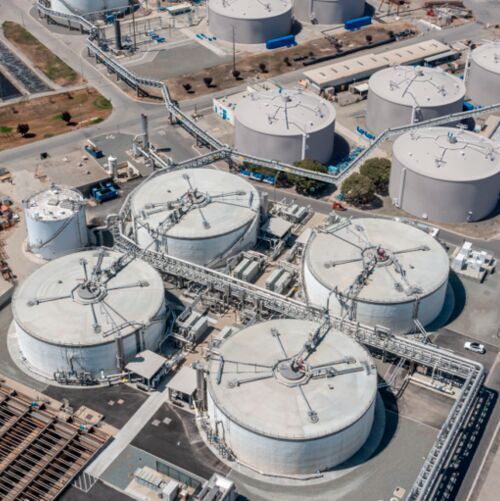
Jacobs has been selected as the progressive design-build contractor for upgrades to the San José–Santa Clara Regional Wastewater Facility in California.
(Source: Jacobs)
Jan 22 – Jacobs has been selected as the progressive design-build contractor for upgrades to the San José–Santa Clara Regional Wastewater Facility (RWF) in California. This 200-million-dollar project will modernize the city’s biosolids treatment infrastructure, delivering long-term reliability at the second largest advanced wastewater treatment plant in the western United States.
As the design-build partner, Jacobs will upgrade and replace aged mesophilic digesters. These digester improvements will reduce the amount of solids to be
hauled offsite for disposal while also enhancing the conversion of biogas produced which directly fuels the facility’s award-winning cogeneration system — also designed and built by Jacobs. A new Fats, Oils & Grease (Fog) receiving station will accept high-strength waste from local businesses and convert it to clean energy, cutting natural gas use and lowering greenhouse gas emissions.
Jacobs’ innovative design approach, including the potential integration of its Microbial Hydrolysis Process (MHP), is expected to increase biogas output by up to 36 % and reduce biosolids production by as much as 74 wet tons per day — about the weight of 50 mid-size cars. The project also prioritizes seismic resiliency and operational flexibility to meet future growth through 2077.
Jacobs will deliver the additional digester facility upgrades under a design-build contract, supported by Walsh Construction and Structural Technologies as lead contracting partners.
Borealis to Expand Polypropylene Production in Germany
Borealis invests 49 million euros in its production location Burghausen, to accelerate commercial scale-up of Borstar Nextension polypropylene technology.
(Source: Borealis)
Jan 23 – Borealis has announced a 49-million-euro strategic investment to scale up production of Borstar Nextension polypropylene (PP) at its manufacturing site in Burghausen, Germany. This will expand commercial production of next-generation single-site polypropylene (SSPP) grades that deliver enhanced purity, processability, and performance - supporting customers in key sectors including packaging, healthcare, mobility, and fibers, to meet evolving market and regulatory demands.
The investment will support the transition to high-performance monomaterial PP solutions. By integrating a tailored combination of performance properties into a single PP material, Borstar Nextension technology facilitates material substitution in complex multilayer structures – supporting design for circularity, reducing weight, and improving overall performance.
In packaging, this innovation enables brand owners and converters to comply with the EU Packaging and Packaging Waste Regulation (PPWR), including the target of achieving 100 % recyclable packaging by 2030. A growing portfolio of Borstar Nextension PP grades is already demonstrating these benefits in flexible packaging applications, combining improved processability with superior sustainability and a step change in purity, clarity and sealing performance.
“By scaling up Borstar Nextension PP production, we empower our customers to stay ahead in a rapidly changing regulatory and market landscape. It’s another example of our commitment to increase the availability of innovative, recyclable polymer materials suitable for a wide range of applications across multiple industries,” says Craig Arnold, Borealis EVP Polyolefins, Circular Economy Solutions and Base Chemicals.
Covestro Begins Production of Thermoplastic Polyurethanes at New Site in China
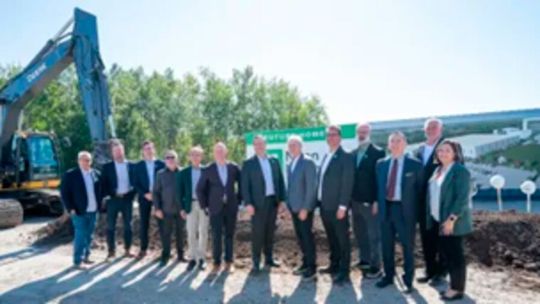
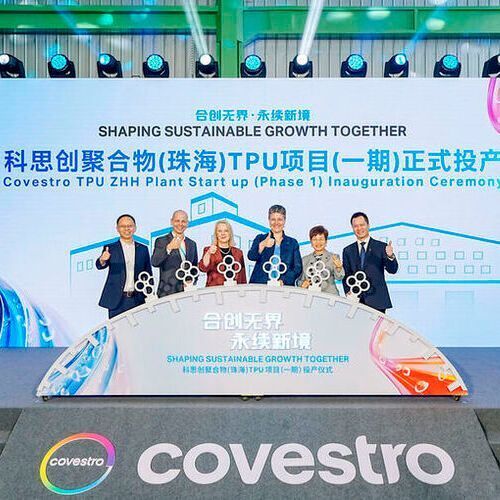
At the opening celebration of the new plant (from left to right): Edwin Wu, (Head of TPU Sales and Market Development South Korea, Southeast Asia and Greater China); Stephan Ehlers (Head of Operations TPU); Andrea Maier-Richter (Global Head of TPU); Monique Buch (Chief Commercial Officer); Holly Lei (President of Covestro China) and Kevin Ho (Head of TPU Sales and Market Development APAC).
(Source: Covestro)
Jan 27 – Covestro has commenced production at its new thermoplastic polyurethanes (TPU) manufacturing site in Zhuhai, a coastal city in South China. The first phase, representing a mid-double-digit million-euro investment, will produce approximately 30,000 tons of TPU annually, meeting growing demand for this versatile material across industries including IT, automotive and footwear.
The investment in this entirely new site, originally announced in 2023, marks a significant milestone in Covestro’s region-for-region strategy and its commitment to growth in its Solutions & Specialties business. The Zhuhai site will be developed in three phases across a 45,000-square-meter area, with maximum production capacity estimated to reach 120,000 tons a year upon completion of the final phase, expected in the 2030s. This will then make it the company’s largest TPU production facility globally.
The Zhuhai site will be strategically supported by a regional TPU R&D Center in Changhua and a new TPU application development (AD) center in nearby Guangzhou, which integrate technical acumen with innovative solutions and tailored services. Together, these facilities are expected to generate powerful regional synergies through collaborative and complementary strengths, positioning Covestro optimally to serve its customers throughout the region.
The Zhuhai site is capable of producing TPU with the label “CQ”. Covestro materials with this designation contain at least 25 percent alternative, non-fossil raw materials, supporting customers in reducing their carbon footprint in final products, especially important in sectors such as electronics where sustainability has become a global trend.
Topsoe Selected as Ammonia Technology Licensor for Saudi Project
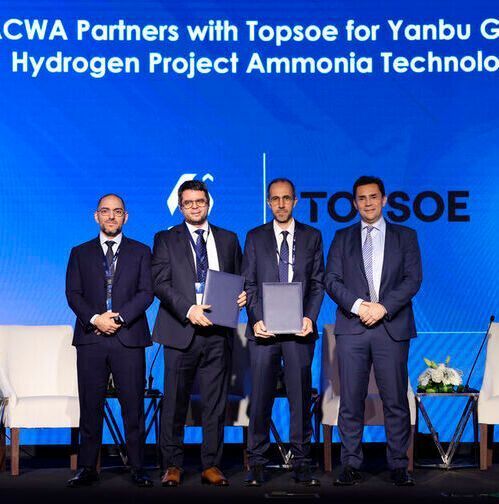
From left: Yassir Ghiyati, CCO, Topsoe; Mohammed Benchekchou, VP and Managing Director, Europe, Middle East, Africa and Central Asia, Topsoe; Alfons Juan, Vice President of Strategic Supply & Contracting, Acwa; and Thomas Altmann, Executive Vice President, Innovation & New Technology, Acwa.
(Source: Topsoe)
Jan 28 – Topsoe has recently announced its selection as the ammonia technology licensor for Acwa's Yanbu Green Hydrogen Project in the Kingdom of Saudi Arabia.
The technology delivered by Topsoe will enable the produced green hydrogen from the Yanbu Project to be converted into ammonia. Besides the dynamic ammonia technology, Topsoe will also deliver engineering, proprietary equipment and catalysts to Sinopec and Tecnicas Reunidas, who have jointly been awarded the Feed-contract (Front-End Engineering Design).
The agreement further strengthens the strategic partnership between Topsoe and Acwa, and by integrating Topsoe’s advanced dynamic ammonia technology, the project will support the production of green ammonia at scale.
Driss Berraho - EVP Business Development Green Hydrogen at Acwa, said: “As one of Saudi Arabia’s leading enablers of the green hydrogen economy, Acwa is developing full-scale, utility-level facilities. Our collaboration with Topsoe at the Yanbu Green Hydrogen Project will convert competitive renewable-energy into green hydrogen-based fuels, including green ammonia, at industrial scale. This development strengthens the hydrogen corridors that will connect competitive renewable resources with global demand centres and contribute to achieving the Kingdom’s Vision 2030 industrial transformation.”
The Yanbu Green Ammonia Project is a large-scale development for GW scale green hydrogen, and with Topsoe’s technology, Acwa will be able to convert the hydrogen into ammonia. The licensing agreement covers the first mega-scale green ammonia units in Yanbu, with a capacity of 2,700 metric tons per day (MTPD) and the interest to replicate the scheme in subsequent units.
Green Ammonia is expected to play a critical role in the journey towards net zero: It can be transported using existing infrastructure; and it has multiple end-uses, not only as a fuel or hydrogen carrier but also to help decarbonize industrial processes like steel and cement production.
Solvay Inaugurates Europe’s First Bio-Circular Silica Facility
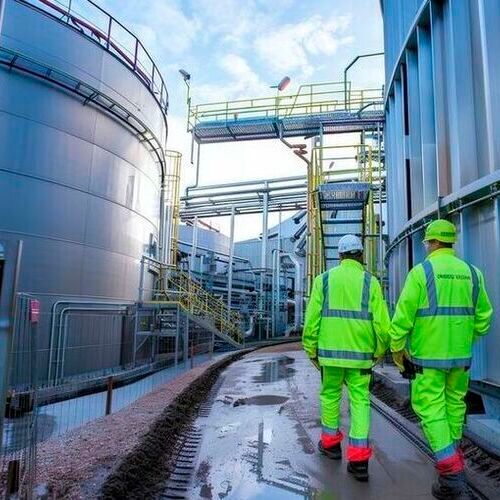
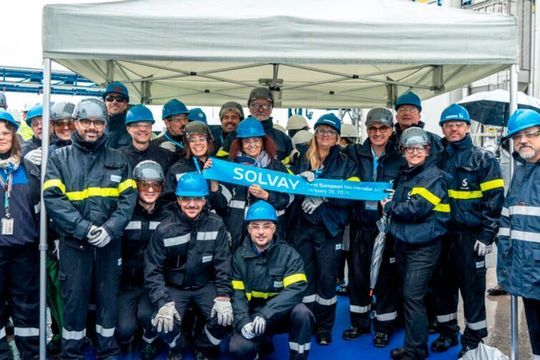
Solvay inaugurated its new bio-circular silica facility at its plant in Livorno, Italy, marking a major milestone in Europe’s industrial transformation toward sustainability.
(Source: Solvay)
Jan 29 – Solvay inaugurated its new bio-circular silica facility at its plant in Livorno, Italy, marking a major milestone in Europe’s industrial transformation toward sustainability. This investment positions Solvay as a proactive partner in achieving the European Green Deal objectives and the upcoming Ecodesign for Sustainable Products Regulation (ESPR), while reinforcing Italy’s role as a hub for green innovation.
The new unit produces highly dispersible silica (HDS) using bio-based sodium silicate derived from rice husk ash, an agricultural byproduct. This breakthrough process reduces CO₂ emissions by 35 % per ton of silica compared to traditional methods and creates a local circular value chain that benefits the agricultural sector, industry and communities.
Philippe Kehren, Chief Executive Officer of Solvay opines, “By acting now, Solvay is helping tire manufacturers prepare for future EU requirements and meet their own sustainability goals,” said Philippe Kehren, CEO of Solvay. “Livorno is a tangible example of how we turn circular economy principles into industrial reality, enabling progress for generations.”
"Solvay has managed to transform an agricultural byproduct into a high-performance material on an industrial scale. We are looking forward to integrating more and more rice husk ash silica as a recycled material in our tire production and are very satisfied with its performance. We are keen on innovative, renewable and recycled materials because they support our ambitious sustainability roadmap,” said Jana Striezel, Head of Purchasing at Continental Tires.
This inauguration is part of Solvay’s global circular silica strategy, which will convert other silica production sites worldwide to use ISCC Plus certified raw material by 2026. Livorno remains unique as the first site to use rice husk ash, while other sites will leverage other local industrial waste streams. By adopting Solvay’s circular silica, tire manufacturers can already achieve up to 15 % recycled or renewable materials in their tire composition, contributing significantly to their target of 40 % by 2030.
Lanzatech to Develop Next Generation Ethanol Facility
Lanzatech has been awarded a contract by Spray Engineering Devices to build a next generation ethanol facility using sugarcane.
(Source: Pixabay)
Jan 30 – Lanzatech Global (Lanzatech) has been awarded a contract by Spray Engineering Devices (SED) to build a next generation ethanol facility using sugarcane bagasse, a widely available agricultural waste product, for production of sustainable fuels and chemicals.
The facility, projected to process up to 300 tons per day of bagasse, will be in the state of Uttar Pradesh, India, and is a key component of the "SED Smart Village" concept. The SED Smart Village framework is designed to capture the full economic value of renewable power and carbon resources. The model anticipates that abundant low-cost power will shift carbon demand toward high-value products like green chemicals, polymers, aviation fuels, and e-fuels. In addition, the Lanzatech project is expected to generate nutrient-rich biochar (5–10 %), that can be used in local farming communities to improve soil fertility.
Lanzatech equips industrial facilities with bioreactor hardware that works like a brewery, but instead of using yeast to convert sugar into beer, proprietary microbes convert carbon-rich gases, including CO2 coupled with green H2, to ethanol, a key building block for the production of consumer goods and profitable fuels, including sustainable aviation fuel (including e-fuels) and renewable diesel.
By leveraging the existing supply chain, the facility will divert bagasse/biomass waste from being burned and enable local production of fuels, chemicals, and raw materials. This innovative approach supports circular economies and helps build a more resilient future for sugarcane-growing communities. The plant is expected to begin operations within two years.
This project will mark one of the first instances of a private company developing an ethanol project, using sugar industry by-product bagasse, under the PM JI-Van Yojana, an Indian government program designed to support the production of advanced bioethanol from agricultural and other industrial waste.




:quality(80)/p7i.vogel.de/wcms/54/f4/54f4b4e2a86b203e0dfd84221602bdb5/0130367283v2.jpeg "Anybotics' Anymal robot combines depth cameras, LiDAR, thermal imaging, acoustic sensors, and gas detectors into a single inspection round. (Source: Anybotics)")
:quality(80)/p7i.vogel.de/wcms/e9/64/e964996410967c124c2cf01a8623068e/0130285341v1.jpeg "Geht unter die Oberfläche: Die Offshore-Ölförderung erfordert hochenergetische Pumpen – doch diese sind im Wesentlichen eine Black Box. Bisher zumindest. (Source: Kistler Group)")
:quality(80)/p7i.vogel.de/wcms/54/ae/54aece5dff672ce1651470eecd9f2589/0130138090v2.jpeg "The new Ionchromatograph “Nexera IC“ (Source: Shimadzu)")
:quality(80)/p7i.vogel.de/wcms/49/5c/495c651fabd24a437c98bde6a3d71ecc/0130060419v2.jpeg "Enfinium has successfully piloted Wasteer’s groundbreaking visual AI technology at its Ferrybridge 2 facility in West Yorkshire and Parc Adfer facility in North Wales. (Source: Chris Parkes Photographer Ltd.)")
:quality(80)/p7i.vogel.de/wcms/7e/1f/7e1f3996f5b0ceaa2cd63e8f42c46e8b/0130491098v2.jpeg "At a glance: Plant engineering projects from across the globe. (Source: © Andi - stock.adobe.com)")
:quality(80)/p7i.vogel.de/wcms/1e/15/1e15b0e20cf5ede83e0749260dfda733/0130465044v2.jpeg "Energy X has recently announced the successful commissioning of a first-of-its-kind, U.S.-based lithium production facility at Project Lonestar, marking a major milestone toward commercial-scale domestic lithium production. (Source: Pixabay)")
:quality(80)/p7i.vogel.de/wcms/36/36/36369e6e59d4c660893cc04a4d257cfc/0130465035v2.jpeg "Wacker has successfully completed the second expansion phase at its production site in Panagarh, India. In addition to silicone rubber, the site now also operates a production complex (left) for silicone emulsions. (Source: Wacker)")
:quality(80)/p7i.vogel.de/wcms/1f/1e/1f1eba3731af22e1d9946e2897f134da/0130464799v2.jpeg "Aerial view of the BASF production site in Zhanjiang, China. (Source: BASF )")
:quality(80)/p7i.vogel.de/wcms/3b/86/3b86c49f99e3638ed9f42c6cc7732950/0130491017v2.jpeg "Turning liquids into powders enables storage at room-temperature. (Source: Glatt)")
:quality(80)/p7i.vogel.de/wcms/84/78/8478fcee08360056b226cb8d5032d50c/0130489771v2.jpeg "Saharsh Davuluri will assume the role of Chief Executive Officer and Managing Director, effective immediately, as the company moves into its next stage of CDMO growth. (Source: Neuland Laboratories)")
:quality(80)/p7i.vogel.de/wcms/ab/c2/abc21b4affa79498712fe95c16991828/0130489183v2.jpeg "Prange Pharma recently announced the successful completion of the acquisition of the MSD Animal Health manufacturing site in Aprilia, Italy. (Source: Pixabay)")
:quality(80)/p7i.vogel.de/wcms/41/c9/41c96e0244221ad38daa73bdd8231477/0130477173v2.jpeg "The „ORBITA‑L“-system is designed for filling and capping non‑injectable liquid products. (Source: Marchesini)")
:quality(80)/p7i.vogel.de/wcms/80/ae/80ae5dcaef8b78989454ddba5eb2f6a7/0130485693v2.jpeg "The Global Impact Coalition has recently announced that Siemens has joined the coalition as a member. (Source: Siemens)")
:quality(80)/p7i.vogel.de/wcms/df/35/df3526a6f7aba41fdd2bb2051954e0d8/0130163620v2.jpeg "The SPA, valued at more than 3 billion dollars, is one of the largest binding long-term green ammonia off-take agreements globally. (Source: Pixabay)")
:quality(80)/p7i.vogel.de/wcms/af/73/af7394d9f8900024c5ee7fca459c4eeb/0130080328v2.jpeg "Axens has signed a MOU with Airbus to strengthen their cooperation in the development and deployment of SAF, a key pillar for decarbonizing the aviation sector. (Source: Pixabay)")
:quality(80)/p7i.vogel.de/wcms/0e/19/0e19f0cf0379c3af4c2fe02629db63f1/0130079229v2.jpeg "Thyssenkrupp Uhde has been selected by CSBP to deliver its patented Envinox technology for two nitric acid plants at CSBP’s Kwinana site in Western Australia. (Source: Thyssenkrupp Uhde)")
:quality(80)/p7i.vogel.de/wcms/1c/39/1c39433f4bb4de2e5e6c5311c3236d09/0130110254v2.jpeg "The new pumps of the Omega type series have been designed for handling water and fluids with a low solids content efficiently. (Source: KSB)")
:quality(80)/p7i.vogel.de/wcms/be/e1/bee13b8d51a419b9b8f0685e2b9d47bf/0128917673v1.jpeg "The Centerwave 6000 measures pipes from 32 to 1,600 mm. (Source: Maag Group)")
:quality(80)/p7i.vogel.de/wcms/51/7a/517a4e83c5827663b4839f5ddb98f434/0128872953v1.jpeg "The Tigron in SIL version can be flexibly configured for different safety requirements. (Source: Auma)")
:quality(80)/p7i.vogel.de/wcms/60/ef/60efa975d1dd123c1afbfb6ccc060461/0130263955v2.jpeg "Aquaclean (Source: Oko-tech)")
:quality(80)/p7i.vogel.de/wcms/07/62/0762f20b1821ee2724c97989374d6397/0130257651v2.jpeg "Oleksandr Sadchykov in front of the water treatment unit (Source: Grundfos)")
:quality(80)/p7i.vogel.de/wcms/98/98/989863664c7b65e87caf74a08239d487/0130167217v2.jpeg "Keller 26KyX Level Probe (Source: © Keller Pressure)")
:quality(80)/p7i.vogel.de/wcms/64/4e/644e22b71e8d35a63f051f781eb13886/0130163451v2.jpeg "Vega will present level and pressure measurement technology for the water industry at Ifat 2026. (Source: Vega)")
:quality(80)/p7i.vogel.de/wcms/79/31/7931cc94924b4c2ebc7087e9cec2f801/0130490720v2.jpeg "The new Pulsar Model R80 solids antenna delivers improved measurement capability through its high-frequency signal, narrow beam angle, and advanced configuration software. (Source: Ametek )")
:quality(80)/p7i.vogel.de/wcms/6b/cc/6bcc3d26e1c7c74d90a10bc3ca296ae1/0128362351v2.jpeg "A look into Bayer's new tablet production, Solida 1, during construction: The robots and lift columns for material handling are being installed. (Source: Bayer)")
:quality(80)/p7i.vogel.de/wcms/24/c8/24c84ab6b1bcd24468a87820a07a85aa/0128194707v2.jpeg "Ajax Equipment has supplied Binding Solutions with a feed system comprising buffer hopper, screw feeder and agitated screw feeder for a pilot plant handling iron ore and additives. (Source: Ajax Equipment )")
:quality(80)/p7i.vogel.de/wcms/1d/3e/1d3e2788eb37c1e974f36337c8d33cb5/0128191010v2.jpeg "Ajax Equipment has supplied IGI Systems with a stainless-steel conical hopper with gas purge capability, as part of a prototype Sublimation System for a low-pressure chemical vapour deposition application. (Source: Ajax Equipment)")
:quality(80)/p7i.vogel.de/wcms/0f/11/0f11c60729f25db0ca0d301d9d4ca0ee/0130485703v2.jpeg "The signatories of the Joint Biomethane Declaration, leading European industry associations, are calling to scale biomethane as an important building block of the EU’s reindustrialization, energy security, and transition to climate neutrality. (Source: Pixabay)")
:quality(80)/p7i.vogel.de/wcms/0c/a1/0ca135e0486c9af90a0552aea85de88c/0130439525v2.jpeg "Qatar Energy expects the damage to its Ras Laffan Industrial City caused by missile strikes, which occurred on Wednesday 18 March 2026, and in the early hours of Thursday 19 March 2026, to cost about 20 billion dollars a year in lost revenue. (Source: Pixabay)")
:quality(80)/p7i.vogel.de/wcms/d0/f7/d0f7d560dfce37c8371442d5b6120e3c/0130182478v1.jpeg "The Gelsenkirchen refinery primarily manufactures fuels for vehicles and aircraft, processing roughly 12 million tonnes of crude oil per year. (Source: BP)")
:quality(80)/p7i.vogel.de/wcms/f8/29/f8298429c1638b949a6f76346f6709c7/0118701710v2.jpeg "Bosch Industrial Heat will be presenting sustainable steam and heat solutions for global industrial use at the Achema trade fair in Frankfurt, Germany. (Source: Bosch Industriekessel)")
:quality(80)/p7i.vogel.de/wcms/07/24/07242664ab2b1c7841c9d9d0a127670c/0116045959.jpeg "A look inside the GEA machine room. (Bild: Magnavale)")
:quality(80)/p7i.vogel.de/wcms/c9/79/c979a20b32395ddfa93fe7ead90578a0/0108386061.jpeg "Production residues, lime, salt and suspended solids quickly clog the pipes. (Source:©Tanakorn - stock.adobe.com)")
:quality(80)/p7i.vogel.de/wcms/9e/5c/9e5c92d942ed046a27562d6e3d730c92/0103483548.jpeg "It is almost ten metres high and extends over three floors: the world's first multiple dividing wall column is located in the new technical centre at the University of Ulm. (Bild: Eberhardt, kiz Universität Ulm)")
:quality(80)/p7i.vogel.de/wcms/20/36/20366ffa57a841882fd165e4dc885c09/0130491929v2.jpeg "With the US and Israel jointly firing the first shot on Iran, the world is now witnessing major cascading effects—from soaring global oil and gas prices, to industry leaders declaring force majeure, and even predictions that the war could trigger a global economic recession! (Source: © FOYSAL - stock.adobe.com)")
:quality(80)/p7i.vogel.de/wcms/7c/77/7c77e24fdcc9e1511e8e711eff161e28/0130175489v2.jpeg "The milestone confirms the fast pace of development of Eni’s deep water gas projects offshore East Kalimantan. (Source: Unsplash )")
:quality(80)/p7i.vogel.de/wcms/b3/2f/b32fb9f5aa54e9cb6c92e4b6c8665263/0130163018v2.jpeg "The decision to take emergency collective action was made following an extraordinary meeting of IEA Member governments, convened by the IEA Executive Director to assess market conditions amid the conflict in the Middle East and consider the options to address supply disruptions. (Source: © Sashkin - stock.adobe.com)")
:quality(80)/p7i.vogel.de/wcms/a8/4e/a84e8039a90a5cf4751d01ebcf6ba1a9/0127510172v2.jpeg "After six years, Achemasia, the international trade fair and innovation forum for sustainable chemical production, has returned with renewed vigor, bringing together global expertise, Chinese innovation, and a shared commitment to a greener industrial future—according to the organizers of the fair. (Source:PROCESS China)")
:quality(80)/p7i.vogel.de/wcms/17/c7/17c703445f134eb3d7ecc7918dda2762/0124596096v2.jpeg "Achema Middle East will launch in Saudi Arabia in 2026. (Bild: Dechema/ Hannibal)")
:quality(80)/p7i.vogel.de/wcms/2a/2c/2a2cffc07f51019065387cd63241b5ce/0119463370v1.jpeg "The Injecta 36 fills and seals RTU (Ready-to-Use) syringes at high speed. The image shows the robotic arm. (Source: IMA)")
:quality(80)/p7i.vogel.de/wcms/b1/7e/b17ea8c62ccafad1d1fb072d6199bbd6/0118578446.jpeg "“Star in the ring”: Vegapuls 6X radar level sensors are the solution of choice for Renolit for many applications on the way to the perfect plastic product. (Source: © MR Design - stock.adobe.com; Vega)")
:quality(80)/p7i.vogel.de/wcms/09/e3/09e378194b496921d2a267a6752322eb/0130333473v2.jpeg "Under the terms of the contract, KBR will provide contract management, project management and supporting technical services throughout the EPC phases of the project. (Source: KBR)")
:quality(80)/p7i.vogel.de/wcms/77/9d/779db435e7f9d79bafe16101008a9cfa/0130263548v2.jpeg "The Kingdom of Saudi Arabia, the UAE and Turkey are three core countries in the region that are actively incorporating the plastics circular economy with the assistance of the chemical recycling technology. (Source: © Anastasiia - stock.adobe.com)")
:fill(fff,0)/images.vogel.de/vogelonline/companyimg/2000/2093/65.jpg "Glatt_Logo_ND4c-RGB (5x3cm).jpg ()")
:fill(fff,0)/p7i.vogel.de/companies/61/f9/61f9439b7cbe4/logo-edl.png "logo-edl (EDL Anlagenbau Gesellschaft mbH)")
:fill(fff,0)/images.vogel.de/vogelonline/companyimg/103000/103097/65.jpg "Pörner Gruppe mit Rand.jpg ()")

:quality(80)/p7i.vogel.de/wcms/40/6d/406de78846e840f6c7cf7849cbf0ab08/0129163370v2.jpeg "Solvay inaugurated its new bio-circular silica facility at its plant in Livorno, Italy, marking a major milestone in Europe’s industrial transformation toward sustainability. (Source: Solvay )")
:quality(80)/p7i.vogel.de/wcms/ed/f5/edf53ff55a851c9ac29def00ae93c8a4/0126829730v2.jpeg "Solvay is accelerating its global circularity efforts by converting its highly dispersible silica production in Asia to circular raw materials. (Source: Solvay )")