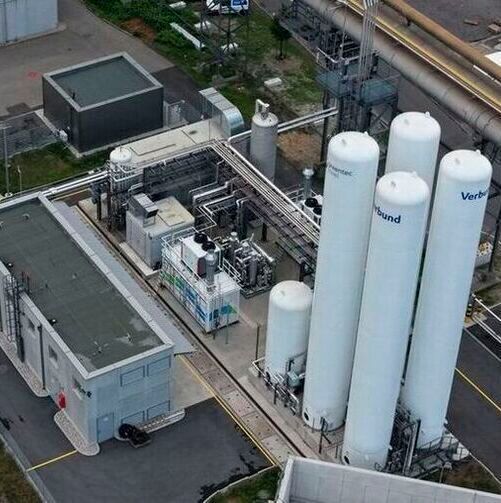
Voestalpine and Verbund have plans to expand the H2future green hydrogen pilot plant in Linz, Austria for 16.4 million euros. The expansion will include a compression and purification unit as well as five hydrogen storage tanks.
In addition to production of green hydrogen, the H2future-Follow-Up project is now increasingly focusing on its treatment and provision for industrial applications.
(Source: Verbund)
Linz/Austria – The internationally renowned H2future research project at the voestalpine site in Linz is entering the next expansion stage. Enhancements to the pilot plant made over the past three years allow the two project partners—international steel and technology group voestalpine and Austria’s leading energy company Verbund—to conduct research not only into production but also the compression, purification, storage, loading, and further use of green hydrogen. To this end, the plant at the voestalpine site, which went into operation in 2019 as the world’s largest hydrogen pilot plant, will be expanded to include a compression and purification unit as well as five hydrogen storage tanks. The expansion costs amount to 16.4 million euros.
In addition to production of green hydrogen, the H2future-Follow-Up project is now increasingly focusing on its treatment and provision for industrial applications, particularly with regard to such quality characteristics as purity and pressure. Specifically, the hydrogen generated by electrolysis is compressed, purified, and temporarily stored in the expanded H2future plant. Four of the five new hydrogen storage tanks will balance out the fluctuating levels of hydrogen production and consumption, thus contributing to security of supply. From the end of 2027, the fifth (shipping) tank will directly supply the Hy4smelt industrial-scale demonstration plant—Austria’s largest climate protection research project at voestalpine’s Linz site—with hydrogen via an approximately 1 kilometer-long pipeline.
“With greentec steel we have a clear strategy to transform our steel production. In the first half of 2027, one green electricity-powered electric arc furnace at each of the Linz and Donawitz sites will go into operation, enabling us to save up to 30 % of our CO2 emissions by 2029 as a first step. In the long term, we aim to achieve net-zero CO2 emissions in steel production by 2050. Hydrogen will play an important role in this process. Together with our partner Verbund, we will gain further crucial insights thanks to this research infrastructure, the only one of its kind in Europe,” says Herbert Eibensteiner, CEO of voestalpine.
In addition, the hydrogen can be compressed to up to 500 bar using high-pressure compressors and filled into trailers for road transport. As a result, it will also be available to external customers and other research and industrial projects, such as the Susteel research project at the voestalpine site in Donawitz (which sources hydrogen supplied from a trailer provided by research partner K1-Met).
Stay up to Date
Do you want the latest news, specialist articles and information on new products? Then you can register for our free newsletter:
“With H2future, together with our long-standing partner voestalpine we are implementing an important reference project for the development of a green hydrogen economy. On an industrial scale, the project shows how renewable electricity can be converted into green hydrogen and harnessed for specific industrial applications. Thus, H2future directly supports our role as a leading producer of renewable energy and as a partner for decarbonizing energy-intensive industries,” says Michael Strugl, CEO of Verbund.
The first functional tests in the H2future follow-up project have already been launched. First research results are expected by the end of 2026. The project will end in December 2030 and will be funded by the Austrian Federal Ministry of Economy, Energy and Tourism.
H2future—the world’s longest-running hydrogen pilot facility
The H2future plant, which has been in operation since 2019, is one of the world’s longest-running proton exchange membrane (PEM) electrolysis plants. It consists of 12 stacks, each containing 50 electrolysis cells, and has a connected load of six megawatts. The plant can produce 1,200 cubic meters of green hydrogen per hour. Since going into operation, it has produced almost 2,000 tons of green hydrogen and carried out numerous test programs. A “stress test” confirmed the load capacity of the plant in continuous operation and its ability to react quickly to large load changes. It is used in particular to balance out frequency fluctuations in the power grid caused by the irregular availability of renewable energy or varying electricity demand.
Date: 08.12.2025
Naturally, we always handle your personal data responsibly. Any personal data we receive from you is processed in accordance with applicable data protection legislation. For detailed information please see our privacy policy.
Consent to the use of data for promotional purposes
I hereby consent to Vogel Communications Group GmbH & Co. KG, Max-Planck-Str. 7-9, 97082 Würzburg including any affiliated companies according to §§ 15 et seq. AktG (hereafter: Vogel Communications Group) using my e-mail address to send editorial newsletters. A list of all affiliated companies can be found here
Newsletter content may include all products and services of any companies mentioned above, including for example specialist journals and books, events and fairs as well as event-related products and services, print and digital media offers and services such as additional (editorial) newsletters, raffles, lead campaigns, market research both online and offline, specialist webportals and e-learning offers. In case my personal telephone number has also been collected, it may be used for offers of aforementioned products, for services of the companies mentioned above, and market research purposes.
Additionally, my consent also includes the processing of my email address and telephone number for data matching for marketing purposes with select advertising partners such as LinkedIn, Google, and Meta. For this, Vogel Communications Group may transmit said data in hashed form to the advertising partners who then use said data to determine whether I am also a member of the mentioned advertising partner portals. Vogel Communications Group uses this feature for the purposes of re-targeting (up-selling, cross-selling, and customer loyalty), generating so-called look-alike audiences for acquisition of new customers, and as basis for exclusion for on-going advertising campaigns. Further information can be found in section “data matching for marketing purposes”.
In case I access protected data on Internet portals of Vogel Communications Group including any affiliated companies according to §§ 15 et seq. AktG, I need to provide further data in order to register for the access to such content. In return for this free access to editorial content, my data may be used in accordance with this consent for the purposes stated here. This does not apply to data matching for marketing purposes.
Right of revocation
I understand that I can revoke my consent at will. My revocation does not change the lawfulness of data processing that was conducted based on my consent leading up to my revocation. One option to declare my revocation is to use the contact form found at https://contact.vogel.de. In case I no longer wish to receive certain newsletters, I have subscribed to, I can also click on the unsubscribe link included at the end of a newsletter. Further information regarding my right of revocation and the implementation of it as well as the consequences of my revocation can be found in the data protection declaration, section editorial newsletter.




:quality(80)/p7i.vogel.de/wcms/41/94/41949062564d72e59086f4a104a24488/0134182192v2.jpeg "Launching first at Dangote’s petroleum refinery in Lekki, Nigeria, the project is targeting an increase in throughput while strengthening the capabilities of its local engineering and operations teams. (Source: Pixabay)")
:quality(80)/p7i.vogel.de/wcms/46/68/4668c1a83d20864c2af5d0e594148828/0133903971v2.jpeg "The collaborations focus on project support, capacity building and capability development, technology transfer and innovation, and supply chain resilience. (Source: Aramco )")
:quality(80)/p7i.vogel.de/wcms/49/da/49dad8d8a13c0e70277ffa923b71544a/0133891190v2.jpeg "For the 100 MW hydrogen facility of the first project phase, Siemens is deploying its software portfolio for the hydrogen industry, enabling smarter operations and optimizing the value of the plant. (Source: Siemens)")
:quality(80)/p7i.vogel.de/wcms/20/9b/209b81269c3b7255e1f49c5771cfc303/0133747923v2.jpeg "Under the theme \"Step into Cognitive Manufacturing\", Ima will present its vision of a new generation of manufacturing, where Artificial Intelligence, advanced Robotics, Digital Vision Systems and Human Expertise work together to create smarter, more connected and adaptive production environments. (Source: Ima)")
:quality(80)/p7i.vogel.de/wcms/f7/4f/f74f9632844a977ce2765122aafda7ca/0134170227v2.jpeg "KBR will also modernize the existing steam reforming sections at both plants, bringing them to the highest industry performance standards through the integration of KBR’s proprietary KRES technology. (Source: KBR)")
:quality(80)/p7i.vogel.de/wcms/b5/9f/b59f01da159bb0f18d6bac70ad1d1c8d/0134100853v2.jpeg "Led by Chandra Asri Group, the facility is designed to produce approximately 400 KTA of caustic soda and 500 KTA of ethylene dichloride, two essential chemicals used in a wide range of industrial applications. (Source: Danantara Indonesia)")
:quality(80)/p7i.vogel.de/wcms/85/c9/85c93a505bcebbee80b20087d5ecab3f/0134099356v2.jpeg "Air Liquide will build, own and operate several production units to deliver large volumes of ultra-pure nitrogen, oxygen, argon and hydrogen, including significant backup storage capacity. (Source: Air Liquide )")
:quality(80)/p7i.vogel.de/wcms/5a/ef/5aef43ac911c2232b0cb38d7f53a2967/0134094454v2.jpeg "The CSR initiative aims to establish a structured ecosystem for the collection, segregation, recycling, and repurposing of post-industrial polyurethane waste from the footwear industry. (Source: BASF )")
:quality(80)/p7i.vogel.de/wcms/50/95/509548cafc37c66c1f9a6aa00d78a347/0133898207v2.jpeg "Manufactured at Nouryon’s facility in Finland, Cekol CMC-Na is a water-soluble polymer that gives drugmakers a plant-based alternative to synthetic excipients. (Source: Nouryon)")
:quality(80)/p7i.vogel.de/wcms/96/24/9624790c4a1710995de488021bf93c4c/0133846001v1.jpeg "When tableting tools are manufactured closer to the market, supply chains can respond more quickly. With a new production site in Pune, India, Fette Compacting is bringing punches and dies closer to one of the pharmaceutical industry’s fastest-growing markets. (Source: Fette Compacting)")
:quality(80)/p7i.vogel.de/wcms/c3/40/c340a3cd06990549f48cf68ae3c5ffff/0133748269v2.jpeg "Bayer has plans to invest 2.2 billion dollars in a new pharmaceutical manufacturing site in New Albany, Ohio, U.S. (Source: Bayer )")
:quality(80)/p7i.vogel.de/wcms/75/65/75650a54df1db90dd14db3f6f6efc6c3/0134171667v2.jpeg "Under the agreement, Amogy will deploy its ammonia cracking module in 2027, designed to produce up to one ton of hydrogen per day, to showcase the technology under industrial operating conditions. (Source: Amogy )")
:quality(80)/p7i.vogel.de/wcms/11/ab/11abd1dfc6f79efa4fd9f21aeb3428b7/0134171210v2.jpeg "A concept for carbon recycling through cross-industry collaboration in the Mizushima Complex. (Source: JFE Steel Corporation)")
:quality(80)/p7i.vogel.de/wcms/86/8a/868a3f5df2538b4a7dc035aa2b63c5bf/0134101583v2.jpeg "Built on Ineos’ low-carbon olefins production, the low-carbon certification applies to the company’s full range of olefins and polymers produced across its European network. (Source: Pixabay)")
:quality(80)/p7i.vogel.de/wcms/c1/d0/c1d0ae0beb84f04e001931c639b97285/0133965554v2.jpeg "Using Topsoe’s kerosene hydrotreating technology, BPCL will produce SAF within its existing refinery infrastructure, without the need for a new dedicated SAF production unit. (Source: Topsoe )")
:quality(80)/p7i.vogel.de/wcms/7f/1b/7f1b02563e4803ee7f3764ffd1720d8c/0132842468v3.jpeg "The new EZJetFlo™ in-line mixing system solves the production bottleneck using highly efficient Venturi powder induction. (Source: ILC DOver)")
:quality(80)/p7i.vogel.de/wcms/02/fb/02fbe7296b87b2c110ad17e983d7d87a/0132963781v2.jpeg "MAAG’s Extrex6 EC gear pump is specifically designed for the continuous conveying of rigid PVC (polyvinyl chloride). (Bild: Maag)")
:quality(80)/p7i.vogel.de/wcms/69/8c/698c17b920244559c08f28261636fee5/0132816720v2.jpeg "Xylem has entered into an agreement to acquire the Cornell Pump and Roper Pump businesses from Indicor for 1.46 billion dollars. (Source: Pixabay)")
:quality(80)/p7i.vogel.de/wcms/89/47/8947595eafaa6ad27c8552a5f9ad48e1/0129967379v1.jpeg "Biogas and biomethane currently provide approximately 5.5 GW of stable electrical capacity and could be expanded to up to 20 GW without requiring additional land – an enormous potential. (Source: license free via Pixabay)")
:quality(80)/p7i.vogel.de/wcms/47/2f/472fc2023911997ccabe4a24bb50732c/0134054495v2.jpeg "Suez has been selected by Kalundborg Forsyning to design and deliver a new quaternary treatment stage at the Kalundborg Central Wastewater Treatment Plant in Denmark. (Source: Unsplash)")
:quality(80)/p7i.vogel.de/wcms/fe/5d/fe5d9bb106dfb20c1d69c90d74e78f58/0133648325v2.jpeg "Under the ‘National Water Strategy 2030’, Saudi Arabia is securing sustainable water resources, protecting the natural environment and providing high-quality services. (Source: Malika - stock.adobe.com)")
:quality(80)/p7i.vogel.de/wcms/88/c4/88c457f86fb2842cbcee21c320c44bd9/0133541916v2.jpeg "The RO membrane elements will be used for the Changi Newater Factory (CNF3), a large-scale used water treatment plant in Singapore. (Source: Unsplash)")
:quality(80)/p7i.vogel.de/wcms/1b/2b/1b2b80c989067b50c687314515948806/0133161547v2.jpeg "Acwa has signed a MOU with Veolia, committing the two leading companies to optimizing seawater desalination across the entire value chain. (Source: Acwa)")
:quality(80)/p7i.vogel.de/wcms/79/31/7931cc94924b4c2ebc7087e9cec2f801/0130490720v2.jpeg "The new Pulsar Model R80 solids antenna delivers improved measurement capability through its high-frequency signal, narrow beam angle, and advanced configuration software. (Source: Ametek )")
:quality(80)/p7i.vogel.de/wcms/6b/cc/6bcc3d26e1c7c74d90a10bc3ca296ae1/0128362351v2.jpeg "A look into Bayer's new tablet production, Solida 1, during construction: The robots and lift columns for material handling are being installed. (Source: Bayer)")
:quality(80)/p7i.vogel.de/wcms/24/c8/24c84ab6b1bcd24468a87820a07a85aa/0128194707v2.jpeg "Ajax Equipment has supplied Binding Solutions with a feed system comprising buffer hopper, screw feeder and agitated screw feeder for a pilot plant handling iron ore and additives. (Source: Ajax Equipment )")
:quality(80)/p7i.vogel.de/wcms/26/1f/261f957322aa06d4aad3defd56e4cff3/0134182520v2.jpeg "The acquisition strengthens Sika’s position in the rapidly growing UAE construction market and supports Sika’s locally sourced product offering for projects in the region. (Source: Sika)")
:quality(80)/p7i.vogel.de/wcms/ce/b7/ceb7177ac3f5656637704b9e323bf5f3/0134175307v2.jpeg "Eagle Burgmann representatives and guests mark the official opening of the company’s new Pasadena, Texas Service Center on Oct. 22, 2026. (Source: Eagle Burgmann)")
:quality(80)/p7i.vogel.de/wcms/d8/9a/d89ae67eb98518957f075be023eb93ca/0134093701v2.jpeg "The newly acquired units are now providing oxygen, nitrogen and argon for Tata Steel’s iron and steelmaking operations. (Source: Linde)")
:quality(80)/p7i.vogel.de/wcms/3b/2a/3b2ae007fe71f4131db17f9eb35bf3ba/0134052535v2.jpeg "The combined business will bring together a diversified and balanced portfolio of around 100 highly regarded and trusted brands across paints and coatings, spanning more than 160 countries. (Source: Akzonobel)")
:quality(80)/p7i.vogel.de/wcms/f8/29/f8298429c1638b949a6f76346f6709c7/0118701710v2.jpeg "Bosch Industrial Heat will be presenting sustainable steam and heat solutions for global industrial use at the Achema trade fair in Frankfurt, Germany. (Source: Bosch Industriekessel)")
:quality(80)/p7i.vogel.de/wcms/07/24/07242664ab2b1c7841c9d9d0a127670c/0116045959.jpeg "A look inside the GEA machine room. (Bild: Magnavale)")
:quality(80)/p7i.vogel.de/wcms/c9/79/c979a20b32395ddfa93fe7ead90578a0/0108386061.jpeg "Production residues, lime, salt and suspended solids quickly clog the pipes. (Source:©Tanakorn - stock.adobe.com)")
:quality(80)/p7i.vogel.de/wcms/9e/5c/9e5c92d942ed046a27562d6e3d730c92/0103483548.jpeg "It is almost ten metres high and extends over three floors: the world's first multiple dividing wall column is located in the new technical centre at the University of Ulm. (Bild: Eberhardt, kiz Universität Ulm)")
:quality(80)/p7i.vogel.de/wcms/90/f3/90f351201dd4ea7e2439ce19019bf318/0133013227v2.jpeg "Adnoc, in collaboration with SLB, has deployed its AI-enabled RTOC platform across its fleet of more than 120 rigs. (Source: Adnoc)")
:quality(80)/p7i.vogel.de/wcms/aa/9d/aa9dc332257fbc96a2d2ec20b40781a5/0132005469v2.jpeg "Qatar Energy would like to emphasize that this was an operational accident and not sabotage or hostile in nature. (Source: Qatar Energy)")
:quality(80)/p7i.vogel.de/wcms/57/da/57da73af9c35d633196afd46348182b2/0130820106v2.jpeg "Today, the world is witnessing a deepening energy crisis. The Iran–US war has exposed the vulnerability of the global oil, gas, and petrochemicals industry. Its impact is not confined to one region—it has triggered a domino effect across continents. (Source: © Rayhan - stock.adobe.com)")
:quality(80)/p7i.vogel.de/wcms/20/36/20366ffa57a841882fd165e4dc885c09/0130491929v2.jpeg "With the US and Israel jointly firing the first shot on Iran, the world is now witnessing major cascading effects—from soaring global oil and gas prices, to industry leaders declaring force majeure, and even predictions that the war could trigger a global economic recession! (Source: © FOYSAL - stock.adobe.com)")
:quality(80)/p7i.vogel.de/wcms/a8/4e/a84e8039a90a5cf4751d01ebcf6ba1a9/0127510172v2.jpeg "After six years, Achemasia, the international trade fair and innovation forum for sustainable chemical production, has returned with renewed vigor, bringing together global expertise, Chinese innovation, and a shared commitment to a greener industrial future—according to the organizers of the fair. (Source:PROCESS China)")
:quality(80)/p7i.vogel.de/wcms/17/c7/17c703445f134eb3d7ecc7918dda2762/0124596096v2.jpeg "Achema Middle East will launch in Saudi Arabia in 2026. (Bild: Dechema/ Hannibal)")
:quality(80)/p7i.vogel.de/wcms/2a/2c/2a2cffc07f51019065387cd63241b5ce/0119463370v1.jpeg "The Injecta 36 fills and seals RTU (Ready-to-Use) syringes at high speed. The image shows the robotic arm. (Source: IMA)")
:quality(80)/p7i.vogel.de/wcms/b1/7e/b17ea8c62ccafad1d1fb072d6199bbd6/0118578446.jpeg "“Star in the ring”: Vegapuls 6X radar level sensors are the solution of choice for Renolit for many applications on the way to the perfect plastic product. (Source: © MR Design - stock.adobe.com; Vega)")
:quality(80)/p7i.vogel.de/wcms/8e/57/8e57d57130f6fb4188c32d69be90aa19/0134182548v2.jpeg "Announced at the second Make it with Adnoc Forum, the measures give manufacturers, suppliers and investors greater visibility of future demand and a faster, clearer route to compete for Adnoc’s business. (Source: Adnoc)")
:quality(80)/p7i.vogel.de/wcms/01/b7/01b764a96f9c5e645e5a18d2acdff0a0/0134092620v2.jpeg "The project supports Saudi Arabia's industrial development objectives under Vision 2030 while strengthening the Kingdom's role in global food security through increased fertilizer production. (Source: Ayman - stock.adobe.com)")
:quality(80)/p7i.vogel.de/wcms/09/ab/09abe0d8b487a437698ff97c8449517a/0134052972v2.jpeg "The agreement was enabled by Adnoc's LNG marketing and trading platform, reinforcing the delivery of its integrated global gas growth strategy. (Source: Adnoc)")
:fill(fff,0)/images.vogel.de/vogelonline/companyimg/2000/2093/65.jpg "Glatt_Logo_ND4c-RGB (5x3cm).jpg ()")
:fill(fff,0)/p7i.vogel.de/companies/61/f9/61f9439b7cbe4/logo-edl.png "logo-edl (EDL Anlagenbau Gesellschaft mbH)")
:fill(fff,0)/p7i.vogel.de/companies/66/9f/669f700d3b118/cac-2023-poslogo-idea-ahead.png "cac-2023-poslogo-idea-ahead (CAC ENGINEERING GMBH)")
:quality(80)/p7i.vogel.de/wcms/32/05/32058f88e2267bbefa6c253a34afd233/0127747469v1.jpeg "Multiple autonomous control AI agents have been successfully implemented by Yokogawa at Aramco’s Fadhili Gas Plant in the Kingdom of Saudi Arabia to enhance operational efficiency. (Source: Aramco )")
:quality(80)/p7i.vogel.de/wcms/b5/a1/b5a172ac1f77e20f1774cc84be06c2e7/0129554680v1.jpeg "The image shows an electrolyzer with hydrogen supply lines to the storage units. (Source:Quelle: Swen Gottschall/Zukunft Gas)")