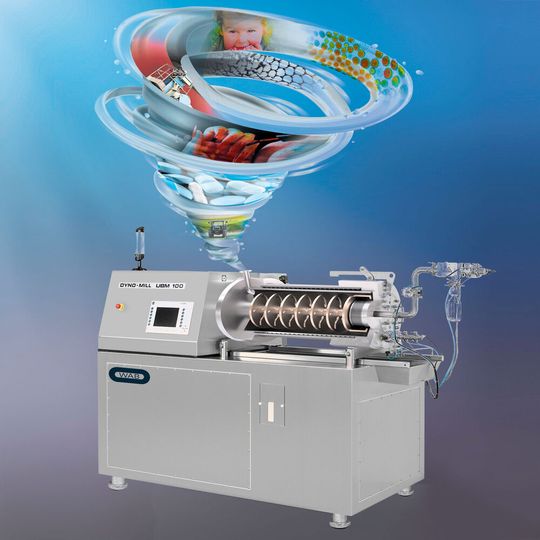
Chemical, pharmaceutical and food producers, colleges and universities all over the world use them: Wet-milling technology has been revolutionized by WAB with the development of its horizontal agitator bead mills. At this year’s Achema, the resourceful Swiss company was presenting the latest generation of its Dyno-Mill UBM (Universal Bead Mill).
There is a wide range of applications for the Dyno-Mill agitator bead mills of the WAB-Group. Their special wet grinding technology ensures brilliant colors for all types of coatings, optimally ground flavors for foodstuffs, targeted bioavailability of active medical ingredients, extraction of vaccines and much more.
What do a chicken plucking machine, a tobacco seedling setting machine, a knothole drilling machine and an agitator bead mill have in common? All these products can be found on a long list from the early 1980s of a Swiss company whose founder was tireless in thought and action. His personal secretary said of her boss: “Finding things is an art! He found gaps for innovations. He found the right people who could make things happen. He found new patents, new locations. He found his wife, he found agents for his machines and he found solutions to problems.” We are talking about Willy A. Bachofen (1912-2000), founder of the machine factory Willy A. Bachofen AG based in the city of Basel.
Even though the chicken plucking machine alone (which achieved world fame among experts) would be worthy of an article in its own right, in what follows here we devote our attention to the wet-milling technology.
Gallery
At the end of the 1960s, Willy A. Bachofen succeeded in bringing a new precept in dispersing and milling technology to the world market. The performance of wet-milling technology was significantly improved with the development of the DYNO-MILL, the first fully self-contained horizontal agitator bead mill. For the first time, it became possible to disperse and grind in a self-contained system, without the ingress of air.
In 1967, Bachofen secured the manufacturing rights — the beginning of a new era in the company’s history and the catalyst for a continuous upswing. Over the following decades, the mills were continuously developed, and today, the WAB Group offers a wide range of wet-milling solutions for applications in research, development, prototyping and production.
Green Chemistry: Agitator Bead Mill as a Reactor
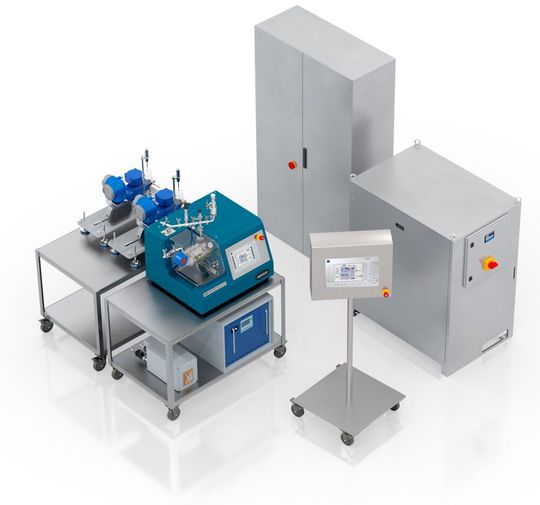
The Impa°Ct Reactor is a complete process system consisting of an inductively heated agitator bead mill, two product pumps, a mobile control panel and a control cabinet.
(Source: WAB)
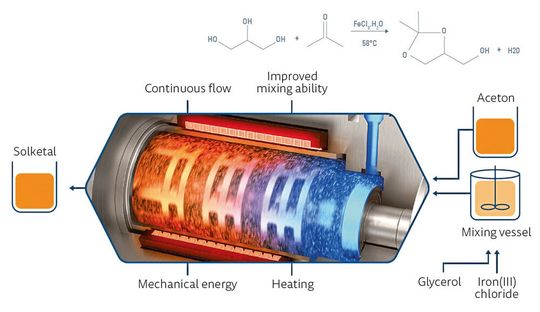
Chemical transformation triggered by mechanical force, known as “mechanochemistry”, offers many opportunities for the development and production of new molecules as well as materials, and offers several advantages over conventional production processes. WAB is also convinced that mechanochemistry is an important technology for a greener future of the chemical industry and has been investing in its introduction for several years. Although long proven in research, the implementation into industrial application has not been successful so far, as no suitable and scalable devices were previously available. The innovative WAB Impa°Ct Reactor now closes this gap: the mechanical energy is introduced by means of grinding beads. An induction heater implemented into the grinding chamber heats the reactants directly and efficiently up to 160 °C. Conventional batch processes can be replaced by a continuous process with the WAB Impa°Ct reactor. The developers promise faster, more selective and innovative reactions, a significant saving of solvents, and industrial scale-up.
Application example for the WAB Impa°Ct reactor: conversion of glycerol and acetone to isopropylidene glycerol (also called solketal), a synthetic building block in the chemical and pharmaceutical industry.
(Source: WAB)
Depending on the task and the Dyno-Mill used, different reaction times can be realized with one or more pre-mixes. This saves valuable raw materials and time, as it significantly reduces the cleaning effort between the individual tests. Important process parameters, such as product temperature, pressure and flow rate, are controlled and logged. The system enables both single-pass and circulation processes, and can be used for liquid and viscous pumpable products as well as heterogeneous catalysts. Processing volumes start with one liter of suspension and can be scaled up to the larger models of the Dyno-Mill series, combining the three WAB Dyno-Mill technologies in one reactor: the Dyno-Accelerator, the patented Dyno-Disc BC agitator discs and the Dyno-Disc KD agitator discs. Together with the grinding beads, the technology guarantees a high and uniform mechanical energy input with simultaneous good mixing and thus surface renewal of the reactants.
Agitator bead mills have long since gained a dominant position in the field of nano-scale and colloid wet grinding of, for example, lacquers, paints, pesticides, microbiological cell material and pharmaceuticals. Controlled deagglomeration, dispersion and true grinding of solid particles in a liquid medium are the principal focus of wet-milling technology. Particle sizes below 100 nanometers can thus be achieved, which other grinding techniques can often only achieve with restrictions.
Here’s how it works: The grinding suspension is placed together with the grinding beads in a horizontal (or vertical) cylindrical grinding container with an axial high-speed agitator shaft carrying several agitator discs. The suspension flows continuously through the grinding container and is ground by pressure and shear stress in a recirculating flow between the grinding beads as they are whirled around by the agitator. At the outlet of the machine, screens or separation gaps prevent the grinding beads from escaping along with the finished grinding suspension.
The grinding fineness depends on:
the type and filling level of the grinding beads,
the diameter ratio of the grinding beads to the particle size of the feed material,
the type of grinding stock to be ground,
the type of agitator elements,
the average dwell time of the suspension in the grinding chamber.
Dispersing agents prevent the fine particles from agglomerating and stabilize the grinding suspension.
The Dyno-Mill Universal Bead Mill (UBM)
The new generation of WAB agitator bead mills highlighted at this year’s Achema covers the entire range from dispersion to ultra-fine grinding of small product quantities right up to the production of large volumes. Even highly viscous products can be processed with high throughput rates. One of the strengths of the Dyno-Mill UBM is the extremely even distribution of grinding beads in the active grinding chamber. This makes it easy to determine stable and efficient process parameters for both single-pass and recirculation modes.
The innovators at WAB have developed a new generation of agitator discs — the Dyno-Disc BC (Bead Channel) — especially for the Dyno-Mill series. They have special grinding bead channels in combination with a closed outer contour. The channels ensure efficient acceleration of the grinding beads along a precisely defined path.
During operation, each of the channels create counter-rotating grinding circuits between the agitator discs. The outer contour of the new agitator discs is completely closed within the agitated bed of grinding beads. Therefore, these remain between the agitator discs and are evenly distributed in the active grinding chamber. This ensures that the bed of grinding beads is efficiently utilized. Dyno-Disc BC agitator discs are designed for high wear resistance and consistently high performance while simultaneously reducing maintenance costs.
Date: 08.12.2025
Naturally, we always handle your personal data responsibly. Any personal data we receive from you is processed in accordance with applicable data protection legislation. For detailed information please see our privacy policy.
Consent to the use of data for promotional purposes
I hereby consent to Vogel Communications Group GmbH & Co. KG, Max-Planck-Str. 7-9, 97082 Würzburg including any affiliated companies according to §§ 15 et seq. AktG (hereafter: Vogel Communications Group) using my e-mail address to send editorial newsletters. A list of all affiliated companies can be found here
Newsletter content may include all products and services of any companies mentioned above, including for example specialist journals and books, events and fairs as well as event-related products and services, print and digital media offers and services such as additional (editorial) newsletters, raffles, lead campaigns, market research both online and offline, specialist webportals and e-learning offers. In case my personal telephone number has also been collected, it may be used for offers of aforementioned products, for services of the companies mentioned above, and market research purposes.
Additionally, my consent also includes the processing of my email address and telephone number for data matching for marketing purposes with select advertising partners such as LinkedIn, Google, and Meta. For this, Vogel Communications Group may transmit said data in hashed form to the advertising partners who then use said data to determine whether I am also a member of the mentioned advertising partner portals. Vogel Communications Group uses this feature for the purposes of re-targeting (up-selling, cross-selling, and customer loyalty), generating so-called look-alike audiences for acquisition of new customers, and as basis for exclusion for on-going advertising campaigns. Further information can be found in section “data matching for marketing purposes”.
In case I access protected data on Internet portals of Vogel Communications Group including any affiliated companies according to §§ 15 et seq. AktG, I need to provide further data in order to register for the access to such content. In return for this free access to editorial content, my data may be used in accordance with this consent for the purposes stated here. This does not apply to data matching for marketing purposes.
Right of revocation
I understand that I can revoke my consent at will. My revocation does not change the lawfulness of data processing that was conducted based on my consent leading up to my revocation. One option to declare my revocation is to use the contact form found at https://contact.vogel.de. In case I no longer wish to receive certain newsletters, I have subscribed to, I can also click on the unsubscribe link included at the end of a newsletter. Further information regarding my right of revocation and the implementation of it as well as the consequences of my revocation can be found in the data protection declaration, section editorial newsletter.
The grinding or dispersing process with the Dyno-Mill can be run in different operating modes, and hence can be optimally adapted to the application and required product quality:
In the single-pass process, the grinding suspension from the supply container passes through the mill in a single closed pass.
In the simple circulation process, the grinding suspension passes through the mill several times until the required particle size is achieved.
In the circulation process with start-up pass, the grinding suspension is first pumped into the mill from a pre-mixing container and only then does the simple circulation process start. Once it has been emptied, the pre-mixing container can be prepared for the next batch.
In the circulation process with final pass, the grinding suspension is collected in a separate discharge container after the required particle size has been achieved.
In pendulum operation (“multipass process”), the circulation process randomly “swings” between two different supply containers until the desired particle size is reached.
Two mills can also be connected directly in series — without an intermediate container — in order to achieve particularly high particle finenesses. The second agitator bead mill can be equipped with smaller grinding beads.
Wide Range of Applications
The new generation of Dyno-Mill Universal Bead Mills offers the optimum wet-grinding unit for every type of wet-milling tasks — with grinding chamber volumes from 0.5 to 100 liters and particle finenesses down to below 50 nanometers. A variety of grinding bead materials (diameter 0.2 to 2.5 mm), e.g. ceramic or glass, are available. All machines are ergonomically designed and also have permanently installed stainless steel trays.
The range of applications for agitator bead mills is diverse: the special wet-milling technology ensures brilliant colors for all types of paints, optimally milled aromas for foodstuffs, targeted bioavailability of active medical substances, extraction of biological raw materials and much more. Three applications are given below as examples.
Active Pharmaceutical Ingredients
Many modern active pharmaceutical ingredients have poor solubility properties. Bioavailability can therefore become a challenge in product development. This is where the Dyno-Mill pharmaceutical wet-milling technology helps: by reducing the particle sizes during wet grinding, the available active ingredient surfaces increase exponentially and so improve the bioavailability of the active ingredient. Machines specially developed for sterile production are available for this purpose. The most important features are:
cleaning in place (CIP) and sterilization in place (SIP),
semi-automatic or fully automatic control of the CIP/SIP process,
optionally available WAB Scada system (according to 21 CFR Part 11) for control, data acquisition and data processing,
machine production in compliance with current Good Manufacturing Practice (cGMP) and EHEDG directive,
material certificates in compliance with FDA requirements.
For all Dyno-Mill Pharma installations, the FDS, DQ, FAT, SAT, IQ and OQ qualification documents required for validation, plus the certificates for process-relevant machine components (calibration and material certificates) are available.
Plant Protection Products in Suspension
Plant protection products are chemical or biological active substances that protect plants from harmful organisms or prevent them from impacting plants. Whether these are herbicides, insecticides or fungicides: modern wet milling allows simple and dust-free handling of all types of active substances. Products with the smallest concentrations of solids in suspension have the following advantages:
no clogging of the spraying apparatus,
even distribution of the active substance,
higher effectiveness and yield due to the larger area coverage,
no sedimentation during transport or storage,
easy dilution without re-agglomeration.
The Dyno-Mill agitator bead mills can easily mill large quantities of plant protection products to the desired particle size and are characterized by compact design and shorter cleaning times. The risk of cross-contamination is reduced.
Nail Polishes
Nail polishes are available in all color shades and special effects. Manufacturers are constantly developing new colors to go with the latest fashion trends. Besides the colors, the ease of application is important: The polish should spread easily during application and it should not drip. This allows for perfect drying.
The two basic components of modern nail polishes are usually a thixotropic base (gel) and a pigmented color paste. For grinding of the thixotropic base, the viscosity and gloss are of primary importance. For the separately ground color paste, the color properties (intensity and hue) and gloss are important. By combining all the properties, the two complement each other to create the finished nail polish. WAB offers the whole range of agitator bead mills for the manufacture of high-quality gels and color pastes.
WAB’s process experts will help customers to find the best solutions for their applications in one of the company’s local Process Technology Centers (PTCs). The reliable and technically competent customer service as well as the broad network of the WAB Group work together like the parts of a Swiss watch.




:quality(80)/p7i.vogel.de/wcms/77/1c/771c3d385d46ede7ab736f3f7d63cb62/0130007313v2.jpeg "The laser perforated filter elements for Eaton’s DCF series enable retention ratings that were previously unattainable with conventional manufacturing methods. Thanks to automatic self-cleaning, they also provide uninterrupted operation with long service life and minimal maintenance requirements. (Source: Eaton )")
:quality(80)/p7i.vogel.de/wcms/0b/33/0b3359449325c4e66cffdb41fce11683/0129956557v2.jpeg "Aramco Senior Vice President of Digital & Information Technology Sami A. Al Ajmi, sitting right, and President of Microsoft Arabia Turki Badhris, sitting left, at a signing ceremony attended by Aramco Executive Vice President of Technology & Innovation Ahmad O. Al Khowaiter, standing right, and Vice Chair and President of Microsoft Brad Smith, standing left. (Source: Aramco )")
:quality(80)/p7i.vogel.de/wcms/60/25/60259e0165560492b717049a5006b5d2/0129719891v2.jpeg "Adnoc's panorama digital command center. (Source: Adnoc )")
:quality(80)/p7i.vogel.de/wcms/40/8f/408f074f8094bca2cd9bb078e79eccb0/0129580192v2.jpeg "The Anymal robot undertaking gas leak detection in the field. (Source: Anybotics)")
:quality(80)/p7i.vogel.de/wcms/93/9f/939fb603e5c2c60e52e4e92dd1de44e2/0129972638v2.jpeg "Shintech Louisiana has recently announced a 3.4-billion-dollar investment to bolster its manufacturing capabilities in the state. (Source: Pixabay)")
:quality(80)/p7i.vogel.de/wcms/0d/22/0d221bfb0debc81ac74afafc9cc632c2/0129972549v2.jpeg "The overall package is worth 485 million euros, of which 10 million euros related to engineering activities already started will be recognized in the pre-FID phase, while the remaining part at Final Investment Decision. (Source: Pixabay)")
:quality(80)/p7i.vogel.de/wcms/1d/da/1ddaee208ed26c1ad241f3b8fb216afe/0129956568v2.jpeg "Inox Air Products has entered into a long-term partnership with TACC for the supply of nitrogen through a dedicated onsite nitrogen plant for their upcoming greenfield manufacturing facility in Dewas, Madhya Pradesh, India. (Source: Pixabay)")
:quality(80)/p7i.vogel.de/wcms/e9/14/e9149b52a5cf436e6fe6743e491037ac/0129926282v2.jpeg "At a glance: Plant engineering projects from across the globe. (Source: © industrieblick - stock.adobe.com)")
:quality(80)/p7i.vogel.de/wcms/6b/3f/6b3f057c83c494e4732337d870d52b21/0130006927v2.jpeg "Lonza will realize upfront cash proceeds of 2.2 billion dollars and retain a 40 % stake in the business, with additional preferential participation in its future exit. (Source: Lonza)")
:quality(80)/p7i.vogel.de/wcms/df/cd/dfcd0c2e0eb4b554f956e0161ae08519/0129794328v1.jpeg "The plasma fractionation facility at CSL Behring, viewed from the outside. (Source: CSL Behring)")
:quality(80)/p7i.vogel.de/wcms/74/af/74af2b65341eeee13a44bc85eb759596/0129839901v2.jpeg "With around 6,000 European companies operating in India and an annual trade of 180 billion euros between the EU and India at present, the trade deal intends to double EU goods exports to India by 2032. (Source: © NazeerArt - stock.adobe.com)")
:quality(80)/p7i.vogel.de/wcms/26/12/261210e5920899e5c35c4f905d3be8bd/0129399814v2.jpeg "Powders used in DPI formulations are often highly potent and administered in very low doses. (Source: Ima)")
:quality(80)/p7i.vogel.de/wcms/a6/84/a68477d4ef879cc9cedeae332ca57c49/0129893677v2.jpeg "Siemens and Caphenia sign the partnership agreement. From left to right: Nicky Ahnert, Jürgen Giegerich, Frank Knauf (all Siemens), Dr. Mark Misselhorn, Dr. Andreas Waibel (both Caphenia) (Source: Siemens)")
:quality(80)/p7i.vogel.de/wcms/42/67/42671f576c7f8a1284b54bc8f92cce02/0129864175v2.jpeg "Honeywell’s advanced technologies and standardized design will help Verso Energy reduce capital expenses, accelerate speed to market and increase global SAF capacity. (Source: Pixabay)")
:quality(80)/p7i.vogel.de/wcms/f7/70/f770417abff565b1743068fa37d21266/0129833262v2.jpeg "Under the agreement, Air Liquide will supply the necessary oxygen for Holcim’s oxyfuel-ready clinker production line, as well as provide its innovative and proprietary Cryocap Oxy technology to enable the capture of CO₂ emissions with high efficiency. (Source: Air Liquide )")
:quality(80)/p7i.vogel.de/wcms/9f/7c/9f7cd6c9dcb679827c4c2c10f116c8b9/0129832882v2.jpeg "The extended agreement helps support World Fuel's ability to secure SAF supply and comply with regulatory requirements, including the Refuel EU Aviation Regulation and the UK SAF mandate. (Source: World Fuel Services)")
:quality(80)/p7i.vogel.de/wcms/be/e1/bee13b8d51a419b9b8f0685e2b9d47bf/0128917673v1.jpeg "The Centerwave 6000 measures pipes from 32 to 1,600 mm. (Source: Maag Group)")
:quality(80)/p7i.vogel.de/wcms/51/7a/517a4e83c5827663b4839f5ddb98f434/0128872953v1.jpeg "The Tigron in SIL version can be flexibly configured for different safety requirements. (Source: Auma)")
:quality(80)/p7i.vogel.de/wcms/d5/72/d5728578b35b72f365f5086bc1d068da/0128662441v2.jpeg "Nikkiso Clean Energy & Industrial Gases Group has announced the launch of its new multistage process pump (MSPP 210), designed to enhance safety and reduce downtime on air separation equipment. (Source: Nikkiso Clean Energy & Industrial Gases Group)")
:quality(80)/p7i.vogel.de/wcms/a9/69/a96920e47e362a9cf0b9916b7ad3d30a/0128071795v2.jpeg "Nine partners from six European countries are working on the 36-month project to determine where heat pumps can achieve the greatest efficiency gains in the food and beverage sector and to develop reproducible and market-ready solutions. (Source: EU project Exquisheat)")
:quality(80)/p7i.vogel.de/wcms/c4/54/c454c7d8fd344c0ffc2ef5db00ad632f/0129728429v2.jpeg "Liqtech International recently launched its Qureflow Max produced-water treatment system. (Source: Liqtech International )")
:quality(80)/p7i.vogel.de/wcms/18/47/1847e6b1456c96f04bd511bbd21f3779/0129039479v2.jpeg "Jacobs has been selected as the progressive design-build contractor for upgrades to the San José–Santa Clara Regional Wastewater Facility in California. (Source: Jacobs)")
:quality(80)/p7i.vogel.de/wcms/3b/fd/3bfda4bbcb1a60004c330bde3b705109/0128453300v2.jpeg "In the Jiangsu province, Suez will partner with Lianyun Economic Development Zone to jointly study the investment in, build, and operate a new industrial water treatment plant. (Source: Pixabay)")
:quality(80)/p7i.vogel.de/wcms/cc/19/cc19aa5fec6f6f2b25dbd9516efed735/0128077403v2.jpeg "Distinguished guests at the ceremony included senior government officials, Japan’s Ambassador, and local business leaders. (Source: Toray)")
:quality(80)/p7i.vogel.de/wcms/6b/cc/6bcc3d26e1c7c74d90a10bc3ca296ae1/0128362351v2.jpeg "A look into Bayer's new tablet production, Solida 1, during construction: The robots and lift columns for material handling are being installed. (Source: Bayer)")
:quality(80)/p7i.vogel.de/wcms/24/c8/24c84ab6b1bcd24468a87820a07a85aa/0128194707v2.jpeg "Ajax Equipment has supplied Binding Solutions with a feed system comprising buffer hopper, screw feeder and agitated screw feeder for a pilot plant handling iron ore and additives. (Source: Ajax Equipment )")
:quality(80)/p7i.vogel.de/wcms/1d/3e/1d3e2788eb37c1e974f36337c8d33cb5/0128191010v2.jpeg "Ajax Equipment has supplied IGI Systems with a stainless-steel conical hopper with gas purge capability, as part of a prototype Sublimation System for a low-pressure chemical vapour deposition application. (Source: Ajax Equipment)")
:quality(80)/p7i.vogel.de/wcms/19/76/1976928d7d0a2ed7c1eeba7ade8552c8/0126365603v1.jpeg "Detail of Valvedesign: It has an aktiv amd passive part (Bild: Italvacuum)")
:quality(80)/p7i.vogel.de/wcms/1d/33/1d33cbe43461f24175e18aa01a426840/0129971592v2.jpeg "KBR has been awarded a major contract by Basra Oil Company to provide Integrated Field Management Services for the Majnoon Oil Field in Iraq. (Source: KBR)")
:quality(80)/p7i.vogel.de/wcms/e6/e1/e6e126a90647ced00f744126dd914531/0129956040v2.jpeg "BASF’s dispersion-production building at the Durban site, South Africa — exterior view showing the facility and surrounding site infrastructure. (Source: BASF )")
:quality(80)/p7i.vogel.de/wcms/a7/f3/a7f381d9a908136cf391070bcb069eae/0129925612v2.jpeg "Thyssenkrupp Uhde has been awarded a contract by Halifax-based Nova Sustainable Fuels to perform an integration and optimization study for NSF’s biomass-to-methanol project in Nova Scotia, Canada. (Source: Thyssenkrupp Uhde)")
:quality(80)/p7i.vogel.de/wcms/f8/29/f8298429c1638b949a6f76346f6709c7/0118701710v2.jpeg "Bosch Industrial Heat will be presenting sustainable steam and heat solutions for global industrial use at the Achema trade fair in Frankfurt, Germany. (Source: Bosch Industriekessel)")
:quality(80)/p7i.vogel.de/wcms/07/24/07242664ab2b1c7841c9d9d0a127670c/0116045959.jpeg "A look inside the GEA machine room. (Bild: Magnavale)")
:quality(80)/p7i.vogel.de/wcms/c9/79/c979a20b32395ddfa93fe7ead90578a0/0108386061.jpeg "Production residues, lime, salt and suspended solids quickly clog the pipes. (Source:©Tanakorn - stock.adobe.com)")
:quality(80)/p7i.vogel.de/wcms/9e/5c/9e5c92d942ed046a27562d6e3d730c92/0103483548.jpeg "It is almost ten metres high and extends over three floors: the world's first multiple dividing wall column is located in the new technical centre at the University of Ulm. (Bild: Eberhardt, kiz Universität Ulm)")
:quality(80)/p7i.vogel.de/wcms/2a/07/2a07c1b62903e380aa62e7a581d4a9d1/0129925640v2.jpeg "This will contribute to Aramco’s plan to increase sales gas production capacity by approximately 80 % by 2030, over 2021 production levels. (Source: Aramco )")
:quality(80)/p7i.vogel.de/wcms/16/3d/163da381529db3a47348a9440655529b/0125732969v2.jpeg "Dirk Elvermann, CFO and CDO of BASF, and Anders Opedal, President and CEO of Equinor, sign the ten-year natural gas supply agreement. (Source: Equinor and BASF)")
:quality(80)/p7i.vogel.de/wcms/e7/82/e782bbbf96e4971c22241d76e5de1720/0124855387v2.jpeg "Subsea 7 has been selected to conduct a front-end engineering study for a new subsea project in the Greater Ekofisk Area. (symbolic image) (Source: free licensed)")
:quality(80)/p7i.vogel.de/wcms/a8/4e/a84e8039a90a5cf4751d01ebcf6ba1a9/0127510172v2.jpeg "After six years, Achemasia, the international trade fair and innovation forum for sustainable chemical production, has returned with renewed vigor, bringing together global expertise, Chinese innovation, and a shared commitment to a greener industrial future—according to the organizers of the fair. (Source:PROCESS China)")
:quality(80)/p7i.vogel.de/wcms/17/c7/17c703445f134eb3d7ecc7918dda2762/0124596096v2.jpeg "Achema Middle East will launch in Saudi Arabia in 2026. (Bild: Dechema/ Hannibal)")
:quality(80)/p7i.vogel.de/wcms/2a/2c/2a2cffc07f51019065387cd63241b5ce/0119463370v1.jpeg "The Injecta 36 fills and seals RTU (Ready-to-Use) syringes at high speed. The image shows the robotic arm. (Source: IMA)")
:quality(80)/p7i.vogel.de/wcms/b1/7e/b17ea8c62ccafad1d1fb072d6199bbd6/0118578446.jpeg "“Star in the ring”: Vegapuls 6X radar level sensors are the solution of choice for Renolit for many applications on the way to the perfect plastic product. (Source: © MR Design - stock.adobe.com; Vega)")
:quality(80)/p7i.vogel.de/wcms/01/9b/019b59f3ef2e852ec5058ba18f323af2/0129651573v2.jpeg "With its strategic ‘Vision 2030’ plan announced in 2016, Saudi Arabia aims to diversify its economy by investing in sectors such as tourism, technology and industry, reduce its reliance on oil, and transform the country into a cleaner and more sustainable economy. (Source: © Peter Hermes Furian - stock.adobe.com)")
:quality(80)/p7i.vogel.de/wcms/99/d2/99d2e5e83062b4cf2aa3dc0a60d15f23/0129624804v2.jpeg "The heaviest and tallest unit – a Process Gas Cooling Module – weighed 2,464t and measured 38 meters long, 23 meters wide, and 32 meters high. (Source: Mammoet)")
:quality(80)/p7i.vogel.de/wcms/d1/a8/d1a83b822e16733380268322d033abdc/0129239584v2.jpeg "MOL Group has entered into a new strategic partnership with Libya’s National Oil Corporation. (Source: Pixabay)")
:fill(fff,0)/images.vogel.de/vogelonline/companyimg/107800/107832/65.jpg "logoDueperthal.jpg ()")
:fill(fff,0)/images.vogel.de/vogelonline/companyimg/2000/2093/65.jpg "Glatt_Logo_ND4c-RGB (5x3cm).jpg ()")
:fill(fff,0)/images.vogel.de/vogelonline/companyimg/101800/101879/65.jpg "ITV_LogoOrizzontale-per-il-web.jpg ()")
:quality(80)/p7i.vogel.de/wcms/d9/6f/d96fb947ca3076873e189bf25691da22/0106143133.jpeg "The WAB tinkerers have developed a new generation of stirring discs, the Dyno-Disc BC (Bead Channel), especially for the Dyno-Mill series.(Source: WAB)")
:quality(80)/p7i.vogel.de/wcms/e6/e1/e6e1180906c6c666e19a1e01040d6198/0109256338.jpeg "Grinding principle of the Dyno-Mill UBM(Source: WAB)")
:quality(80)/p7i.vogel.de/wcms/fe/53/fe53bb12c89f374b6b7f4b1775f33138/0105711292.jpeg "The Dyno-Mill UBM series of agitator bead mills (pictured is a UBM 5) covers the entire spectrum from dispersion to ultra-fine grinding.(Source: WAB)")
:quality(80)/p7i.vogel.de/wcms/e2/03/e2031c0d8000483c7933823df8dae7d2/0105952371.jpeg "The laboratory mills (Dyno-Mill Uni Lab in this case) are ideal for developing new formulations with small product quantities and calculating scale-up factors.(Source: WAB)")
:quality(80)/p7i.vogel.de/wcms/41/85/41850761720b85d6be9d51332da2b515/0125589239v2.jpeg "Bühler offers a solution for rice processing with its Rice Whitener. (Source: Bühler)")
:quality(80)/p7i.vogel.de/wcms/19/76/1976928d7d0a2ed7c1eeba7ade8552c8/0126365603v1.jpeg "Detail of Valvedesign: It has an aktiv amd passive part (Bild: Italvacuum)")