The global industrial wearables market is projected to grow from 1.1 billion dollars in 2019 to 8.6 billion dollars by 2024, growing at a CAGR of 50.2 %. Many firms have developed smart solutions but are there any wearables specifically for the chemical and oil & gas industries? PROCESS Worldwide finds out…
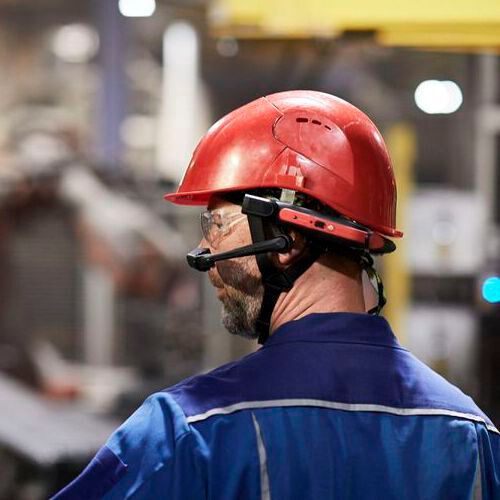
Industrial wearables come equipped with the latest technologies and software solutions through which industries are able to improve their overall productivity.
(Source: Real Wear)
The global industrial wearables market is projected to grow from 1.1 billion dollars in 2019 to 8.6 billion dollars by 2024, growing at a CAGR of 50.2 %, according to a report by research firm Markets and Markets. The core factor for this significant growth is the rise of Industry 4.0 across diverse industries. Also, this growth figure may increase further considering the current Covid-19 scenario where there is a need to maintain social distancing and also work remotely.
At present, industrial wearables come equipped with the latest technologies and software solutions through which industries are able to improve their overall productivity. Efficient and accurate, the wearable devices also ensure safety of the workers. In this background, PROCESS Worldwide offers an insight into the different kinds of industrial wearables for the chemical and oil & gas industries.
Hands-Free Head Mounted Device
Claimed to be the world’s only intrinsically safe and hands-free remote collaboration tool, HMT-1Z1 by Real Wear enables a frontline worker to get connected to a technical expert via a live stream where the expert can view the worker’s environment remotely. This means that the technician can monitor and carry out site inspection, damaged equipment inspections, emergency technical support, mentor new engineers, etc. without being physically present at the site. The fully voice controlled device is PPE compatible and can reduce downtime by up to 75 %. Equipped with a high definition camera, superior audio and noise cancellation features, the wearable can also be used even in explosive areas and highly hazardous surroundings. Leading firms such as Linde, Shell and Saudi Aramco are already using this remote collaboration tool for their operations.
Body Vest and Jacket
The Italian oil company Eni has partnered with the technological institute MIT – Design Lab to develop a body vest for the safety of industrial workers. This wearable is capable of collecting biological data from the wearer and can also monitor his health by using biosensors that measure heart rate, breathing, galvanic skin response and spatial position. The vest offers 16 points of haptic feedback and can collect information via numerous integrated sensors. All the information is then carried to a central processor placed at the back of the vest which coordinates with another wearable – the jacket. Multiple sensors integrated into the arms of the jacket measure air quality, noise levels, smoke, or any airborne chemical that could cause harm. When the sensors detect a harmful gas, an alert is sent via the vest to all operators in the area and the control room so that swift action can be undertaken and the situation can be brought under control.
Eleksen’s Self-Monitoring Analysis and Reporting Technology (Smart) is a ‘Tap & Go’ solution for industrial workers which offers various alerts for highly dangerous situations on-site including excessive noise or gas, heat stress, moving vehicle proximity, etc. The wearable is capable of sending across local SOS alerts via LED lights or a haptic alarm for noisy and busy environments. Equipped with superior sensor devices, the smart solution is easy to use and can be upgraded. The data on the device can be transferred in real-time to a dashboard and analytics module which proves beneficial for on-site industrial workers. The industrial wearable also helps in reducing risks, costs as well as enhancing overall performance of the workers. An interesting highlight of this smart solution is that it does not require any IT integration and there is no additional data privacy issues associated with it.
Smart Helmet
Daqri’s Smart Helmet was another innovation which made headlines a few years back but failed to attract customers from the industry and as a result of this the firm has reportedly ran out of business. The Industrial Internet of Things (IIOT) based wearable enabled the worker to connect with his surroundings via useful digital data in real-time. The worker also had access to ‘thermal’ vision which assisted him to see-through many facility arrangements and at the same time he could browse through multiple digitalised maps, diagrams, plans, etc. Equipped with an Intel 6th generation m7 processor, sensors, cameras, inertial measurement units, and an advanced audio system, the helmet was also supported with a display system for AR-based user interface. The innovation catered to the oil & gas, power, construction, water, transportation, shipbuilding, and aerospace industries.
Date: 08.12.2025
Naturally, we always handle your personal data responsibly. Any personal data we receive from you is processed in accordance with applicable data protection legislation. For detailed information please see our privacy policy.
Consent to the use of data for promotional purposes
I hereby consent to Vogel Communications Group GmbH & Co. KG, Max-Planck-Str. 7-9, 97082 Würzburg including any affiliated companies according to §§ 15 et seq. AktG (hereafter: Vogel Communications Group) using my e-mail address to send editorial newsletters. A list of all affiliated companies can be found here
Newsletter content may include all products and services of any companies mentioned above, including for example specialist journals and books, events and fairs as well as event-related products and services, print and digital media offers and services such as additional (editorial) newsletters, raffles, lead campaigns, market research both online and offline, specialist webportals and e-learning offers. In case my personal telephone number has also been collected, it may be used for offers of aforementioned products, for services of the companies mentioned above, and market research purposes.
Additionally, my consent also includes the processing of my email address and telephone number for data matching for marketing purposes with select advertising partners such as LinkedIn, Google, and Meta. For this, Vogel Communications Group may transmit said data in hashed form to the advertising partners who then use said data to determine whether I am also a member of the mentioned advertising partner portals. Vogel Communications Group uses this feature for the purposes of re-targeting (up-selling, cross-selling, and customer loyalty), generating so-called look-alike audiences for acquisition of new customers, and as basis for exclusion for on-going advertising campaigns. Further information can be found in section “data matching for marketing purposes”.
In case I access protected data on Internet portals of Vogel Communications Group including any affiliated companies according to §§ 15 et seq. AktG, I need to provide further data in order to register for the access to such content. In return for this free access to editorial content, my data may be used in accordance with this consent for the purposes stated here. This does not apply to data matching for marketing purposes.
Right of revocation
I understand that I can revoke my consent at will. My revocation does not change the lawfulness of data processing that was conducted based on my consent leading up to my revocation. One option to declare my revocation is to use the contact form found at https://contact.vogel.de. In case I no longer wish to receive certain newsletters, I have subscribed to, I can also click on the unsubscribe link included at the end of a newsletter. Further information regarding my right of revocation and the implementation of it as well as the consequences of my revocation can be found in the data protection declaration, section editorial newsletter.
In Conclusion…
Many chemical and oil & gas companies around the world have recently realised the many plus points of industrial wearables however, there are still many who are yet to discover its benefits. With the rapid transformation to more digital and AI based industries, change will be inevitable. Therefore, with the upcoming demand for tech-driven wearables, there is a need for the industrial wearable market to evolve and develop more advanced innovations for the chemical and oil & gas sectors. In this regard, industries can explore and form partnerships with technology focused firms or institutes to develop more customised and more efficient wearables just like in the case of Eni.
In the coming years, we hope that the industrial wearable market has more to offer to the chemical and oil & gas industry.
* The author is an editor at PROCESS Worldwide. Contact: ahlam.rais@vogel.com




:quality(80)/p7i.vogel.de/wcms/54/ae/54aece5dff672ce1651470eecd9f2589/0130138090v2.jpeg "The new Ionchromatograph “Nexera IC“ (Source: Shimadzu)")
:quality(80)/p7i.vogel.de/wcms/49/5c/495c651fabd24a437c98bde6a3d71ecc/0130060419v2.jpeg "Enfinium has successfully piloted Wasteer’s groundbreaking visual AI technology at its Ferrybridge 2 facility in West Yorkshire and Parc Adfer facility in North Wales. (Source: Chris Parkes Photographer Ltd.)")
:quality(80)/p7i.vogel.de/wcms/77/1c/771c3d385d46ede7ab736f3f7d63cb62/0130007313v2.jpeg "The laser perforated filter elements for Eaton’s DCF series enable retention ratings that were previously unattainable with conventional manufacturing methods. Thanks to automatic self-cleaning, they also provide uninterrupted operation with long service life and minimal maintenance requirements. (Source: Eaton )")
:quality(80)/p7i.vogel.de/wcms/0b/33/0b3359449325c4e66cffdb41fce11683/0129956557v2.jpeg "Aramco Senior Vice President of Digital & Information Technology Sami A. Al Ajmi, sitting right, and President of Microsoft Arabia Turki Badhris, sitting left, at a signing ceremony attended by Aramco Executive Vice President of Technology & Innovation Ahmad O. Al Khowaiter, standing right, and Vice Chair and President of Microsoft Brad Smith, standing left. (Source: Aramco )")
:quality(80)/p7i.vogel.de/wcms/64/bb/64bb4812390b6491ce0bd4fe53597086/0130333812v2.jpeg "The solar power plant produces 30 GWh per year of renewable electricity, which is self-consumed by Holcim’s industrial facilities, making it the largest floating solar power plant in Europe dedicated to self-consumption. (Source: Pixabay)")
:quality(80)/p7i.vogel.de/wcms/32/06/320643bfb6b509933012a2fd9c42504d/0130333498v2.jpeg "BASF’s X3D catalysts combine high mechanical stability with an open structure. (Source: BASF)")
:quality(80)/p7i.vogel.de/wcms/1b/ca/1bca61c846359bfd9e7998fb30b662c6/0130333482v2.jpeg "Total Energies has launched France’s first advanced plastics recycling plant, with an annual capacity of 15,000 tons, at its Grandpuits site southeast of Paris. (Source: Pixabay)")
:quality(80)/p7i.vogel.de/wcms/09/e3/09e378194b496921d2a267a6752322eb/0130333473v2.jpeg "Under the terms of the contract, KBR will provide contract management, project management and supporting technical services throughout the EPC phases of the project. (Source: KBR)")
:quality(80)/p7i.vogel.de/wcms/7a/50/7a501f6d8f87a4524dc3aaceb04eacb4/0130333829v2.jpeg "The Clear Lake facility represents Clariant's first U.S. manufacturing site dedicated to producing pharmaceutical-grade PEG excipients, marking a pivotal milestone in the company's healthcare growth strategy. (Source: Clariant)")
:quality(80)/p7i.vogel.de/wcms/26/12/261210e5920899e5c35c4f905d3be8bd/0129399814v2.jpeg "Powders used in DPI formulations are often highly potent and administered in very low doses. (Source: Ima)")
:quality(80)/p7i.vogel.de/wcms/6b/3f/6b3f057c83c494e4732337d870d52b21/0130006927v2.jpeg "Lonza will realize upfront cash proceeds of 2.2 billion dollars and retain a 40 % stake in the business, with additional preferential participation in its future exit. (Source: Lonza)")
:quality(80)/p7i.vogel.de/wcms/df/cd/dfcd0c2e0eb4b554f956e0161ae08519/0129794328v1.jpeg "The plasma fractionation facility at CSL Behring, viewed from the outside. (Source: CSL Behring)")
:quality(80)/p7i.vogel.de/wcms/df/35/df3526a6f7aba41fdd2bb2051954e0d8/0130163620v2.jpeg "The SPA, valued at more than 3 billion dollars, is one of the largest binding long-term green ammonia off-take agreements globally. (Source: Pixabay)")
:quality(80)/p7i.vogel.de/wcms/af/73/af7394d9f8900024c5ee7fca459c4eeb/0130080328v2.jpeg "Axens has signed a MOU with Airbus to strengthen their cooperation in the development and deployment of SAF, a key pillar for decarbonizing the aviation sector. (Source: Pixabay)")
:quality(80)/p7i.vogel.de/wcms/0e/19/0e19f0cf0379c3af4c2fe02629db63f1/0130079229v2.jpeg "Thyssenkrupp Uhde has been selected by CSBP to deliver its patented Envinox technology for two nitric acid plants at CSBP’s Kwinana site in Western Australia. (Source: Thyssenkrupp Uhde)")
:quality(80)/p7i.vogel.de/wcms/a6/84/a68477d4ef879cc9cedeae332ca57c49/0129893677v2.jpeg "Siemens and Caphenia sign the partnership agreement. From left to right: Nicky Ahnert, Jürgen Giegerich, Frank Knauf (all Siemens), Dr. Mark Misselhorn, Dr. Andreas Waibel (both Caphenia) (Source: Siemens)")
:quality(80)/p7i.vogel.de/wcms/1c/39/1c39433f4bb4de2e5e6c5311c3236d09/0130110254v2.jpeg "The new pumps of the Omega type series have been designed for handling water and fluids with a low solids content efficiently. (Source: KSB)")
:quality(80)/p7i.vogel.de/wcms/be/e1/bee13b8d51a419b9b8f0685e2b9d47bf/0128917673v1.jpeg "The Centerwave 6000 measures pipes from 32 to 1,600 mm. (Source: Maag Group)")
:quality(80)/p7i.vogel.de/wcms/51/7a/517a4e83c5827663b4839f5ddb98f434/0128872953v1.jpeg "The Tigron in SIL version can be flexibly configured for different safety requirements. (Source: Auma)")
:quality(80)/p7i.vogel.de/wcms/d5/72/d5728578b35b72f365f5086bc1d068da/0128662441v2.jpeg "Nikkiso Clean Energy & Industrial Gases Group has announced the launch of its new multistage process pump (MSPP 210), designed to enhance safety and reduce downtime on air separation equipment. (Source: Nikkiso Clean Energy & Industrial Gases Group)")
:quality(80)/p7i.vogel.de/wcms/60/ef/60efa975d1dd123c1afbfb6ccc060461/0130263955v2.jpeg "Aquaclean (Source: Oko-tech)")
:quality(80)/p7i.vogel.de/wcms/07/62/0762f20b1821ee2724c97989374d6397/0130257651v2.jpeg "Oleksandr Sadchykov in front of the water treatment unit (Source: Grundfos)")
:quality(80)/p7i.vogel.de/wcms/98/98/989863664c7b65e87caf74a08239d487/0130167217v2.jpeg "Keller 26KyX Level Probe (Source: © Keller Pressure)")
:quality(80)/p7i.vogel.de/wcms/64/4e/644e22b71e8d35a63f051f781eb13886/0130163451v2.jpeg "Vega will present level and pressure measurement technology for the water industry at Ifat 2026. (Source: Vega)")
:quality(80)/p7i.vogel.de/wcms/6b/cc/6bcc3d26e1c7c74d90a10bc3ca296ae1/0128362351v2.jpeg "A look into Bayer's new tablet production, Solida 1, during construction: The robots and lift columns for material handling are being installed. (Source: Bayer)")
:quality(80)/p7i.vogel.de/wcms/24/c8/24c84ab6b1bcd24468a87820a07a85aa/0128194707v2.jpeg "Ajax Equipment has supplied Binding Solutions with a feed system comprising buffer hopper, screw feeder and agitated screw feeder for a pilot plant handling iron ore and additives. (Source: Ajax Equipment )")
:quality(80)/p7i.vogel.de/wcms/1d/3e/1d3e2788eb37c1e974f36337c8d33cb5/0128191010v2.jpeg "Ajax Equipment has supplied IGI Systems with a stainless-steel conical hopper with gas purge capability, as part of a prototype Sublimation System for a low-pressure chemical vapour deposition application. (Source: Ajax Equipment)")
:quality(80)/p7i.vogel.de/wcms/19/76/1976928d7d0a2ed7c1eeba7ade8552c8/0126365603v1.jpeg "Detail of Valvedesign: It has an aktiv amd passive part (Bild: Italvacuum)")
:quality(80)/p7i.vogel.de/wcms/d0/f7/d0f7d560dfce37c8371442d5b6120e3c/0130182478v1.jpeg "The Gelsenkirchen refinery primarily manufactures fuels for vehicles and aircraft, processing roughly 12 million tonnes of crude oil per year. (Source: BP)")
:quality(80)/p7i.vogel.de/wcms/7f/96/7f9628e43c99564fa6dfd8e76149425d/0130165852v2.jpeg "Pure titanium recycling process for chlor-alkali electrolysis cells. (Source: Asahi Kasei)")
:quality(80)/p7i.vogel.de/wcms/4e/27/4e2797cb610f686f13355a5957190d92/0130164068v2.jpeg "Bilfinger experts install and inspect Electrical, Instrumentation and Control systems at customer sites. (Source: Bilfinger)")
:quality(80)/p7i.vogel.de/wcms/f8/29/f8298429c1638b949a6f76346f6709c7/0118701710v2.jpeg "Bosch Industrial Heat will be presenting sustainable steam and heat solutions for global industrial use at the Achema trade fair in Frankfurt, Germany. (Source: Bosch Industriekessel)")
:quality(80)/p7i.vogel.de/wcms/07/24/07242664ab2b1c7841c9d9d0a127670c/0116045959.jpeg "A look inside the GEA machine room. (Bild: Magnavale)")
:quality(80)/p7i.vogel.de/wcms/c9/79/c979a20b32395ddfa93fe7ead90578a0/0108386061.jpeg "Production residues, lime, salt and suspended solids quickly clog the pipes. (Source:©Tanakorn - stock.adobe.com)")
:quality(80)/p7i.vogel.de/wcms/9e/5c/9e5c92d942ed046a27562d6e3d730c92/0103483548.jpeg "It is almost ten metres high and extends over three floors: the world's first multiple dividing wall column is located in the new technical centre at the University of Ulm. (Bild: Eberhardt, kiz Universität Ulm)")
:quality(80)/p7i.vogel.de/wcms/7c/77/7c77e24fdcc9e1511e8e711eff161e28/0130175489v2.jpeg "The milestone confirms the fast pace of development of Eni’s deep water gas projects offshore East Kalimantan. (Source: Unsplash )")
:quality(80)/p7i.vogel.de/wcms/b3/2f/b32fb9f5aa54e9cb6c92e4b6c8665263/0130163018v2.jpeg "The decision to take emergency collective action was made following an extraordinary meeting of IEA Member governments, convened by the IEA Executive Director to assess market conditions amid the conflict in the Middle East and consider the options to address supply disruptions. (Source: © Sashkin - stock.adobe.com)")
:quality(80)/p7i.vogel.de/wcms/85/d2/85d2cb02c4ae45a99454b5405b0f2489/0130149909v2.jpeg "IEA Executive Director Fatih Birol issued a statement on the meeting of G7 Energy Ministers at its IEA headquarters in Paris. (Source: © Marko - stock.adobe.com)")
:quality(80)/p7i.vogel.de/wcms/a8/4e/a84e8039a90a5cf4751d01ebcf6ba1a9/0127510172v2.jpeg "After six years, Achemasia, the international trade fair and innovation forum for sustainable chemical production, has returned with renewed vigor, bringing together global expertise, Chinese innovation, and a shared commitment to a greener industrial future—according to the organizers of the fair. (Source:PROCESS China)")
:quality(80)/p7i.vogel.de/wcms/17/c7/17c703445f134eb3d7ecc7918dda2762/0124596096v2.jpeg "Achema Middle East will launch in Saudi Arabia in 2026. (Bild: Dechema/ Hannibal)")
:quality(80)/p7i.vogel.de/wcms/2a/2c/2a2cffc07f51019065387cd63241b5ce/0119463370v1.jpeg "The Injecta 36 fills and seals RTU (Ready-to-Use) syringes at high speed. The image shows the robotic arm. (Source: IMA)")
:quality(80)/p7i.vogel.de/wcms/b1/7e/b17ea8c62ccafad1d1fb072d6199bbd6/0118578446.jpeg "“Star in the ring”: Vegapuls 6X radar level sensors are the solution of choice for Renolit for many applications on the way to the perfect plastic product. (Source: © MR Design - stock.adobe.com; Vega)")
:quality(80)/p7i.vogel.de/wcms/77/9d/779db435e7f9d79bafe16101008a9cfa/0130263548v2.jpeg "The Kingdom of Saudi Arabia, the UAE and Turkey are three core countries in the region that are actively incorporating the plastics circular economy with the assistance of the chemical recycling technology. (Source: © Anastasiia - stock.adobe.com)")
:quality(80)/p7i.vogel.de/wcms/a0/a3/a0a3cec0d4f46ed33f66ac24b1e03938/0130149916v2.jpeg "Bapco Energies serves notice of Force Majeure on its Group operations. (Source: © Design_Stock - stock.adobe.com)")
:fill(fff,0)/images.vogel.de/vogelonline/companyimg/113800/113818/65.jpg "Turck_Your_Global_Automation_Partner.jpg ()")
:fill(fff,0)/p7i.vogel.de/companies/5f/98/5f98fbb2e7bf2/05-trm-filter-logo-with-slogan-en-alt.png "05_TRM_Filter_LOGO_with_slogan_EN_ALT.png (www.trm-filter.com)")
:fill(fff,0)/p7i.vogel.de/companies/68/c8/68c815bc8fe81/prominent-logo-300x300.jpeg "prominent-logo-300x300 (ProMinent GmBH)")
:quality(80)/p7i.vogel.de/wcms/1a/bc/1abc9ffb1eb0cb3a62c6d6144eff65ad/89979051.jpeg "Industrial wearables come equipped with the latest technologies and software solutions through which industries are able to improve their overall productivity.(Source: Real Wear)")
:quality(80)/p7i.vogel.de/wcms/07/4b/074b4c9274fb274bcb13cc1fd410e2c3/89979307.jpeg "The fully voice controlled HMT-1Z1 by Real Wear is PPE compatible and can reduce downtime by up to 75 %.(Source: Real Wear)")
:quality(80)/p7i.vogel.de/wcms/7e/18/7e1853165d7e32a5185abe12aa19b6ac/89979998.jpeg "Eni-MIT Project: Multiple sensors integrated into the arms of the jacket measure air quality, noise levels, smoke, or any airborne chemical that could cause physical harm.(Source: MIT)")
:quality(80)/p7i.vogel.de/wcms/0d/38/0d387c0245706f30942e1b50edb719eb/89980363.jpeg "Eleksen’s ‘Smart’ technology offers various alerts to industrial workers for highly dangerous situations on-site including excessive noise or gas, heat stress, moving vehicle proximity, etc.(Source: Eleksen)")
:quality(80)/p7i.vogel.de/wcms/bd/97/bd97a5da962cc860b64d427d2696881e/0125226771v2.jpeg "With industrial plants, there is always a risk of fire or an explosion which can damage the facility and lead to costly downtime, environmental concerns and even prove fatal for plant workers. (Source: © pornthip - stock.adobe.com)")
:quality(80)/p7i.vogel.de/wcms/1f/3f/1f3fdda55455ee59c293fa2f05b41c5f/0128230226v2.jpeg "This is just the beginning of a new 'smart tech' era for the Gulf region. (Source: © Muhammad - stock.adobe.com)")