Digitalization is one of the biggest industry trends of the 21st century. However, the transformation presents companies with major challenges. Can a professional coaching method, supported by a dedicated digital framework, help firms and employees alike achieve sustainable change for the long term?
Coaching can help to guide an organization through a difficult transition phase.
When the wind of change blows, some build walls and others, windmills. This Chinese proverb can also be used as a metaphor for the challenges of many change projects in the industry. As soon as change is imminent in an organization, there are employees who resist and others who want to channel the wind of change into positive energy.
For companies wishing to remain competitive in the future, continuous adaptation to new market situations is essential for survival. This means committing to digitize and digitalize significant operational processes in the medium or long term, given the great potential to increase efficiency and industrial plant availability. The reasons for digitalization are obvious. However, when it comes to implementation, especially when it comes to making it part of everyday working life, our experience over the years shows that a large proportion of digital transformation projects fail to achieve their goals because of missing employee support.
Digital transformation is often received as technology-driven optimization instead of a comprehensive transformation process that requires and drives significant change to the corporate culture.
Yet, a digital tool alone cannot make a difference if the employees choose to not use it — or worse, use it incorrectly, in which case it can even slow down the work process. In addition to working with the correct digital solution, the entire organization must embrace it and see it as an opportunity to grow.
Digital transformation is associated with a fundamental shift in production towards data-driven, computer-controlled manufacturing processes. When implementing these new technologies, companies generally prefer to use training courses for employee onboarding with the aim of building internal staff specialists in two to three sessions. They thus aim to build up new knowledge or urgently needed skills for a specific specialist area.
Consequently, the plan is typically to utilize these in-house specialists to familiarize a large majority of employees with the relevant tools and applications in the shortest possible time and with minimal effort. Unfortunately, this works to the detriment of the employees, who are often left alone to deal with any problems and concerns that may arise. Training courses are primarily designed to teach the basics, technical skills, and/or specialist knowledge. Operationalizing the learned skills requires an additional step, which is missed far too often.
Transformation programs, as the name indicates, require a multitude of changes without which the respective goals and benefits are put at risk. Implementation is difficult because most human beings prefer clinging to the tried and true. This is associated with fears of losing control, influence, or potentially their jobs.
Trust is the Foundation of Sucess – Also for Digitalization Projects
Coaching paves the way for necessary changes to be better accepted. The essence of coaching is to build skills and reduce potential resistance during the change process by focusing on getting the team actively involved in that process. With successful employee involvement, new processes can be established much more easily and quickly. The impression that something is being imposed on people, and that they are simply at the mercy of it, is where defensive attitudes develop.
This is what initial and early engagement helps to prevent, followed up with close monitoring and resolution of the team’s concerns and fears. This builds trust, which forms the foundation for the joint success of a change project, however large or small it may seem. Coaching experts need to take the time to get to know the employees and familiarize themselves with the respective processes and workflows. That way, they can respond appropriately to individual concerns as they come up.
In employee meetings, coaching supports the development of perspectives that ultimately reduce negative behaviors and promote acceptance and support for the change. The more advocates there are in the team, the faster everyone involved feels that they are driving in the same direction.
Date: 08.12.2025
Naturally, we always handle your personal data responsibly. Any personal data we receive from you is processed in accordance with applicable data protection legislation. For detailed information please see our privacy policy.
Consent to the use of data for promotional purposes
I hereby consent to Vogel Communications Group GmbH & Co. KG, Max-Planck-Str. 7-9, 97082 Würzburg including any affiliated companies according to §§ 15 et seq. AktG (hereafter: Vogel Communications Group) using my e-mail address to send editorial newsletters. A list of all affiliated companies can be found here
Newsletter content may include all products and services of any companies mentioned above, including for example specialist journals and books, events and fairs as well as event-related products and services, print and digital media offers and services such as additional (editorial) newsletters, raffles, lead campaigns, market research both online and offline, specialist webportals and e-learning offers. In case my personal telephone number has also been collected, it may be used for offers of aforementioned products, for services of the companies mentioned above, and market research purposes.
Additionally, my consent also includes the processing of my email address and telephone number for data matching for marketing purposes with select advertising partners such as LinkedIn, Google, and Meta. For this, Vogel Communications Group may transmit said data in hashed form to the advertising partners who then use said data to determine whether I am also a member of the mentioned advertising partner portals. Vogel Communications Group uses this feature for the purposes of re-targeting (up-selling, cross-selling, and customer loyalty), generating so-called look-alike audiences for acquisition of new customers, and as basis for exclusion for on-going advertising campaigns. Further information can be found in section “data matching for marketing purposes”.
In case I access protected data on Internet portals of Vogel Communications Group including any affiliated companies according to §§ 15 et seq. AktG, I need to provide further data in order to register for the access to such content. In return for this free access to editorial content, my data may be used in accordance with this consent for the purposes stated here. This does not apply to data matching for marketing purposes.
Right of revocation
I understand that I can revoke my consent at will. My revocation does not change the lawfulness of data processing that was conducted based on my consent leading up to my revocation. One option to declare my revocation is to use the contact form found at https://contact.vogel.de. In case I no longer wish to receive certain newsletters, I have subscribed to, I can also click on the unsubscribe link included at the end of a newsletter. Further information regarding my right of revocation and the implementation of it as well as the consequences of my revocation can be found in the data protection declaration, section editorial newsletter.
Having a common goal strengthens collaboration and team spirit among employees. This is applicable within smaller teams and for the collaboration between different departments. The moment the idea of a common goal registers, a high level of motivation can be realized from each individual to become enthusiastic about the changes and perhaps even to contribute their own ideas. This is the ideal basis for getting structural and organizational changes off the ground.
Sustainable Coaching…
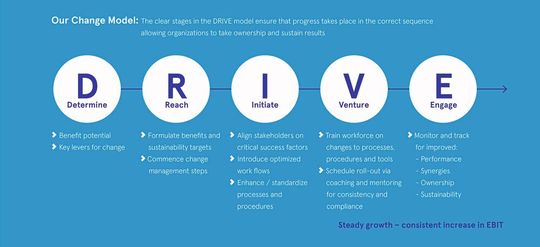
Coaching goes far beyond training: Learning new applications is only part of the change. In fact, coaching is most successful when supported with a cloud-based monitoring platform such as DRIVE+ to provide a more comprehensive, long-term, and individual focus on the challenges of a company (or a team) going through a change initiative.
But what do we mean by that? We think of coaching as on-the-job mentoring, or mentoring that helps employees see and achieve success sooner. Successful change managers immerse themselves deeply in the company and become part of it for the duration of the project, even though they start off as outsiders.
… Instead of Short-Term Training
Efficient coaches then continually track the progress of a client’s change journey to prepare their team for next steps. Software packages like DRIVE+ are developed for this specific purpose. But investments in digital tools to enable digitalization and change are just as important. This has proven especially valuable in times of global travel restrictions and/or when the right person to coach a client is located in another country. By supplementing training with a well-structured and comprehensive coaching program, digital transformations can be significantly accelerated.
Digital transformation: To create sustainable change with coaching, it is essential to bring the entire team along on the change journey, however short or long that may be.
(Source: T.A. Cook)
Failure to achieve the goals of a digital transformation, on the other hand, means that the benefits are not realized as quickly, if at all. And, given the cost of digitalization, it is imperative that management attention is brought to the attitude, magnitude, and complexity of the change early on.
The Change Towards Digitalization is a Matter of Mindset
The emotional aspect associated with such digital transformation processes must not be underestimated. It is therefore inevitable to actively involve employees in the process from the outset, making them strong advocates for change by giving them self-confidence and motivating them.
Even far-reaching changes are easier to implement when change is accepted. Compliance cannot be sustained just because it has been ordered, and target realization is much easier once the need has been understood and the journey endorsed by end-users. n
* The author is Senior Manager at T.A. Cook - Part of Accenture




:quality(80)/p7i.vogel.de/wcms/54/f4/54f4b4e2a86b203e0dfd84221602bdb5/0130367283v2.jpeg "Anybotics' Anymal robot combines depth cameras, LiDAR, thermal imaging, acoustic sensors, and gas detectors into a single inspection round. (Source: Anybotics)")
:quality(80)/p7i.vogel.de/wcms/e9/64/e964996410967c124c2cf01a8623068e/0130285341v1.jpeg "Geht unter die Oberfläche: Die Offshore-Ölförderung erfordert hochenergetische Pumpen – doch diese sind im Wesentlichen eine Black Box. Bisher zumindest. (Source: Kistler Group)")
:quality(80)/p7i.vogel.de/wcms/54/ae/54aece5dff672ce1651470eecd9f2589/0130138090v2.jpeg "The new Ionchromatograph “Nexera IC“ (Source: Shimadzu)")
:quality(80)/p7i.vogel.de/wcms/49/5c/495c651fabd24a437c98bde6a3d71ecc/0130060419v2.jpeg "Enfinium has successfully piloted Wasteer’s groundbreaking visual AI technology at its Ferrybridge 2 facility in West Yorkshire and Parc Adfer facility in North Wales. (Source: Chris Parkes Photographer Ltd.)")
:quality(80)/p7i.vogel.de/wcms/7e/1f/7e1f3996f5b0ceaa2cd63e8f42c46e8b/0130491098v2.jpeg "At a glance: Plant engineering projects from across the globe. (Source: © Andi - stock.adobe.com)")
:quality(80)/p7i.vogel.de/wcms/1e/15/1e15b0e20cf5ede83e0749260dfda733/0130465044v2.jpeg "Energy X has recently announced the successful commissioning of a first-of-its-kind, U.S.-based lithium production facility at Project Lonestar, marking a major milestone toward commercial-scale domestic lithium production. (Source: Pixabay)")
:quality(80)/p7i.vogel.de/wcms/36/36/36369e6e59d4c660893cc04a4d257cfc/0130465035v2.jpeg "Wacker has successfully completed the second expansion phase at its production site in Panagarh, India. In addition to silicone rubber, the site now also operates a production complex (left) for silicone emulsions. (Source: Wacker)")
:quality(80)/p7i.vogel.de/wcms/1f/1e/1f1eba3731af22e1d9946e2897f134da/0130464799v2.jpeg "Aerial view of the BASF production site in Zhanjiang, China. (Source: BASF )")
:quality(80)/p7i.vogel.de/wcms/3b/86/3b86c49f99e3638ed9f42c6cc7732950/0130491017v2.jpeg "Turning liquids into powders enables storage at room-temperature. (Source: Glatt)")
:quality(80)/p7i.vogel.de/wcms/84/78/8478fcee08360056b226cb8d5032d50c/0130489771v2.jpeg "Saharsh Davuluri will assume the role of Chief Executive Officer and Managing Director, effective immediately, as the company moves into its next stage of CDMO growth. (Source: Neuland Laboratories)")
:quality(80)/p7i.vogel.de/wcms/ab/c2/abc21b4affa79498712fe95c16991828/0130489183v2.jpeg "Prange Pharma recently announced the successful completion of the acquisition of the MSD Animal Health manufacturing site in Aprilia, Italy. (Source: Pixabay)")
:quality(80)/p7i.vogel.de/wcms/41/c9/41c96e0244221ad38daa73bdd8231477/0130477173v2.jpeg "The „ORBITA‑L“-system is designed for filling and capping non‑injectable liquid products. (Source: Marchesini)")
:quality(80)/p7i.vogel.de/wcms/80/ae/80ae5dcaef8b78989454ddba5eb2f6a7/0130485693v2.jpeg "The Global Impact Coalition has recently announced that Siemens has joined the coalition as a member. (Source: Siemens)")
:quality(80)/p7i.vogel.de/wcms/df/35/df3526a6f7aba41fdd2bb2051954e0d8/0130163620v2.jpeg "The SPA, valued at more than 3 billion dollars, is one of the largest binding long-term green ammonia off-take agreements globally. (Source: Pixabay)")
:quality(80)/p7i.vogel.de/wcms/af/73/af7394d9f8900024c5ee7fca459c4eeb/0130080328v2.jpeg "Axens has signed a MOU with Airbus to strengthen their cooperation in the development and deployment of SAF, a key pillar for decarbonizing the aviation sector. (Source: Pixabay)")
:quality(80)/p7i.vogel.de/wcms/0e/19/0e19f0cf0379c3af4c2fe02629db63f1/0130079229v2.jpeg "Thyssenkrupp Uhde has been selected by CSBP to deliver its patented Envinox technology for two nitric acid plants at CSBP’s Kwinana site in Western Australia. (Source: Thyssenkrupp Uhde)")
:quality(80)/p7i.vogel.de/wcms/1c/39/1c39433f4bb4de2e5e6c5311c3236d09/0130110254v2.jpeg "The new pumps of the Omega type series have been designed for handling water and fluids with a low solids content efficiently. (Source: KSB)")
:quality(80)/p7i.vogel.de/wcms/be/e1/bee13b8d51a419b9b8f0685e2b9d47bf/0128917673v1.jpeg "The Centerwave 6000 measures pipes from 32 to 1,600 mm. (Source: Maag Group)")
:quality(80)/p7i.vogel.de/wcms/51/7a/517a4e83c5827663b4839f5ddb98f434/0128872953v1.jpeg "The Tigron in SIL version can be flexibly configured for different safety requirements. (Source: Auma)")
:quality(80)/p7i.vogel.de/wcms/60/ef/60efa975d1dd123c1afbfb6ccc060461/0130263955v2.jpeg "Aquaclean (Source: Oko-tech)")
:quality(80)/p7i.vogel.de/wcms/07/62/0762f20b1821ee2724c97989374d6397/0130257651v2.jpeg "Oleksandr Sadchykov in front of the water treatment unit (Source: Grundfos)")
:quality(80)/p7i.vogel.de/wcms/98/98/989863664c7b65e87caf74a08239d487/0130167217v2.jpeg "Keller 26KyX Level Probe (Source: © Keller Pressure)")
:quality(80)/p7i.vogel.de/wcms/64/4e/644e22b71e8d35a63f051f781eb13886/0130163451v2.jpeg "Vega will present level and pressure measurement technology for the water industry at Ifat 2026. (Source: Vega)")
:quality(80)/p7i.vogel.de/wcms/79/31/7931cc94924b4c2ebc7087e9cec2f801/0130490720v2.jpeg "The new Pulsar Model R80 solids antenna delivers improved measurement capability through its high-frequency signal, narrow beam angle, and advanced configuration software. (Source: Ametek )")
:quality(80)/p7i.vogel.de/wcms/6b/cc/6bcc3d26e1c7c74d90a10bc3ca296ae1/0128362351v2.jpeg "A look into Bayer's new tablet production, Solida 1, during construction: The robots and lift columns for material handling are being installed. (Source: Bayer)")
:quality(80)/p7i.vogel.de/wcms/24/c8/24c84ab6b1bcd24468a87820a07a85aa/0128194707v2.jpeg "Ajax Equipment has supplied Binding Solutions with a feed system comprising buffer hopper, screw feeder and agitated screw feeder for a pilot plant handling iron ore and additives. (Source: Ajax Equipment )")
:quality(80)/p7i.vogel.de/wcms/1d/3e/1d3e2788eb37c1e974f36337c8d33cb5/0128191010v2.jpeg "Ajax Equipment has supplied IGI Systems with a stainless-steel conical hopper with gas purge capability, as part of a prototype Sublimation System for a low-pressure chemical vapour deposition application. (Source: Ajax Equipment)")
:quality(80)/p7i.vogel.de/wcms/0f/11/0f11c60729f25db0ca0d301d9d4ca0ee/0130485703v2.jpeg "The signatories of the Joint Biomethane Declaration, leading European industry associations, are calling to scale biomethane as an important building block of the EU’s reindustrialization, energy security, and transition to climate neutrality. (Source: Pixabay)")
:quality(80)/p7i.vogel.de/wcms/0c/a1/0ca135e0486c9af90a0552aea85de88c/0130439525v2.jpeg "Qatar Energy expects the damage to its Ras Laffan Industrial City caused by missile strikes, which occurred on Wednesday 18 March 2026, and in the early hours of Thursday 19 March 2026, to cost about 20 billion dollars a year in lost revenue. (Source: Pixabay)")
:quality(80)/p7i.vogel.de/wcms/d0/f7/d0f7d560dfce37c8371442d5b6120e3c/0130182478v1.jpeg "The Gelsenkirchen refinery primarily manufactures fuels for vehicles and aircraft, processing roughly 12 million tonnes of crude oil per year. (Source: BP)")
:quality(80)/p7i.vogel.de/wcms/f8/29/f8298429c1638b949a6f76346f6709c7/0118701710v2.jpeg "Bosch Industrial Heat will be presenting sustainable steam and heat solutions for global industrial use at the Achema trade fair in Frankfurt, Germany. (Source: Bosch Industriekessel)")
:quality(80)/p7i.vogel.de/wcms/07/24/07242664ab2b1c7841c9d9d0a127670c/0116045959.jpeg "A look inside the GEA machine room. (Bild: Magnavale)")
:quality(80)/p7i.vogel.de/wcms/c9/79/c979a20b32395ddfa93fe7ead90578a0/0108386061.jpeg "Production residues, lime, salt and suspended solids quickly clog the pipes. (Source:©Tanakorn - stock.adobe.com)")
:quality(80)/p7i.vogel.de/wcms/9e/5c/9e5c92d942ed046a27562d6e3d730c92/0103483548.jpeg "It is almost ten metres high and extends over three floors: the world's first multiple dividing wall column is located in the new technical centre at the University of Ulm. (Bild: Eberhardt, kiz Universität Ulm)")
:quality(80)/p7i.vogel.de/wcms/20/36/20366ffa57a841882fd165e4dc885c09/0130491929v2.jpeg "With the US and Israel jointly firing the first shot on Iran, the world is now witnessing major cascading effects—from soaring global oil and gas prices, to industry leaders declaring force majeure, and even predictions that the war could trigger a global economic recession! (Source: © FOYSAL - stock.adobe.com)")
:quality(80)/p7i.vogel.de/wcms/7c/77/7c77e24fdcc9e1511e8e711eff161e28/0130175489v2.jpeg "The milestone confirms the fast pace of development of Eni’s deep water gas projects offshore East Kalimantan. (Source: Unsplash )")
:quality(80)/p7i.vogel.de/wcms/b3/2f/b32fb9f5aa54e9cb6c92e4b6c8665263/0130163018v2.jpeg "The decision to take emergency collective action was made following an extraordinary meeting of IEA Member governments, convened by the IEA Executive Director to assess market conditions amid the conflict in the Middle East and consider the options to address supply disruptions. (Source: © Sashkin - stock.adobe.com)")
:quality(80)/p7i.vogel.de/wcms/a8/4e/a84e8039a90a5cf4751d01ebcf6ba1a9/0127510172v2.jpeg "After six years, Achemasia, the international trade fair and innovation forum for sustainable chemical production, has returned with renewed vigor, bringing together global expertise, Chinese innovation, and a shared commitment to a greener industrial future—according to the organizers of the fair. (Source:PROCESS China)")
:quality(80)/p7i.vogel.de/wcms/17/c7/17c703445f134eb3d7ecc7918dda2762/0124596096v2.jpeg "Achema Middle East will launch in Saudi Arabia in 2026. (Bild: Dechema/ Hannibal)")
:quality(80)/p7i.vogel.de/wcms/2a/2c/2a2cffc07f51019065387cd63241b5ce/0119463370v1.jpeg "The Injecta 36 fills and seals RTU (Ready-to-Use) syringes at high speed. The image shows the robotic arm. (Source: IMA)")
:quality(80)/p7i.vogel.de/wcms/b1/7e/b17ea8c62ccafad1d1fb072d6199bbd6/0118578446.jpeg "“Star in the ring”: Vegapuls 6X radar level sensors are the solution of choice for Renolit for many applications on the way to the perfect plastic product. (Source: © MR Design - stock.adobe.com; Vega)")
:quality(80)/p7i.vogel.de/wcms/09/e3/09e378194b496921d2a267a6752322eb/0130333473v2.jpeg "Under the terms of the contract, KBR will provide contract management, project management and supporting technical services throughout the EPC phases of the project. (Source: KBR)")
:quality(80)/p7i.vogel.de/wcms/77/9d/779db435e7f9d79bafe16101008a9cfa/0130263548v2.jpeg "The Kingdom of Saudi Arabia, the UAE and Turkey are three core countries in the region that are actively incorporating the plastics circular economy with the assistance of the chemical recycling technology. (Source: © Anastasiia - stock.adobe.com)")
:fill(fff,0)/p7i.vogel.de/companies/5e/a2/5ea2b5ca18eac/schubert-cp-gross-rgb--003-.jpg "Schubert_CP_gross_rgb (003).jpg (Gerhard Schubert GmbH)")
:fill(fff,0)/p7i.vogel.de/companies/61/f9/61f9439b7cbe4/logo-edl.png "logo-edl (EDL Anlagenbau Gesellschaft mbH)")
:fill(fff,0)/images.vogel.de/vogelonline/companyimg/64500/64561/65.jpg "Frewitt_Logo.jpg ()")

:quality(80)/images.vogel.de/vogelonline/bdb/1843400/1843408/original.jpg "Successful capex projects require a departure from old paradigms. (T.A. Cook)")
:quality(80):fill(efefef,0)/images.vogel.de/vogelonline/bdb/1241800/1241897/original.jpg "Whitepaper Cover: Rösberg Engineering")
:quality(80)/images.vogel.de/vogelonline/bdb/1017900/1017921/original.jpg "(© ronin3ds - Fotolia)")
:quality(80)/images.vogel.de/vogelonline/bdb/1946700/1946759/original.jpg "(Pixabay)")
:quality(80)/images.vogel.de/vogelonline/bdb/1946500/1946571/original.jpg "(Pixabay)")
:quality(80)/images.vogel.de/vogelonline/bdb/1946700/1946754/original.jpg "(Pixabay)")
:quality(80)/images.vogel.de/vogelonline/bdb/1946700/1946753/original.jpg "(Pixabay)")
:quality(80)/p7i.vogel.de/wcms/47/13/4713f23ed5618b42e716329a2b5ce666/0124329609v1.jpeg "In Rough Waters: The chemical industry is struggling with high raw material and energy costs and weak demand amidst the current uncertainty. (Source: © TTstudio - stock.adobe.com)")
:quality(80)/p7i.vogel.de/wcms/42/88/4288caa94fcb17380a9d1b5ac82b638a/0128488355v1.jpeg "During a tour with live demonstrations, Bausch+Ströbel showcases GMP-compliant solutions in filling technology. (Source: Bausch+Ströbel)")