When developing a nanoformulation, innovative strategies and equipment are essential to success — but typical preparation processes often require minimum quantities. Extensive screening via a method that is both fast and economical can therefore become one of the most important steps in bringing a product through the development phase.
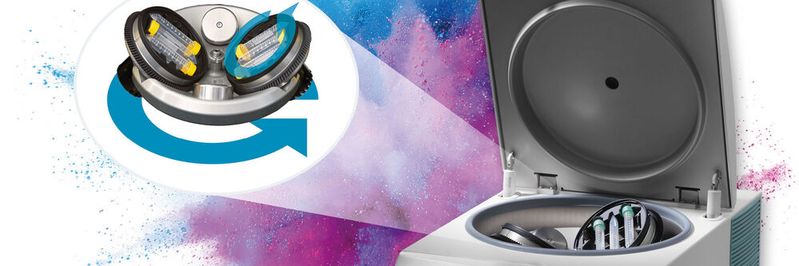
Two turntables on a central rotor ensure reliable and gentle fine grinding of very small quantities in the Deltavita.
Funfair visitors know breakdancers as amusement rides that combine the movement of several gondolas on a turnstile-shaped hub, itself mounted on a rotating turntable. The hubs rotate in the opposite direction to the platform, causing the acceleration to overlap in different directions. The fast-paced ride with its jumbled, swirling seats is a highlight for many visitors and a popular meeting place. A similar principle is now available for grinding, dispersing and mixing of smallest amounts of product — albeit without the light show and hip-hop sounds.
Especially in the field of research and development, for example for formulation development, raw material selection or process development, it is necessary to carry out extensive screening with the smallest amounts of available substance. Ideally, several samples should be able to be processed simultaneously. The new Deltavita 1 grinding system for ultra-fine grinding of very small quantities enables simultaneous grinding of up to 40 different samples with different compositions or different grinding media.
The new development by German fine grinding specialist Netzsch uses mainly cost-effective standard sample containers which can be disposed of after the test has been carried out. This helps to minimize the cleaning effort, solvent requirement and the time required, the process specialists explain. The quality control of raw materials for production is another important area of application for the Deltavita 1.
Efficiency at Smallest Volumes
The grinding system itself operates according to the principle of a dual centrifuge that is based on the advanced development of a classic centrifuge. In contrast to a conventional centrifuge rotor, the rotor is equipped with two rotary plates which can be fitted with different plastic inserts to hold sample containers. Inserts for 2-milliliter twist-top vials, 10-milliliter injection bottles, 15-milliliter and 50-milliliter Falcon tubes, 125-milliliter beakers or 30-milliliter steel vessels are currently available as standard.
The power transmission for the rotation does not use a typical V-belt mechanism, which means that it takes a few seconds longer to accelerate up to the maximum target speed of 2,500 revolutions per minute. In return, heat generation and contamination of the unit chamber, which would otherwise be caused by abrasion on the belts, have been minimized.
In addition, the Deltavita’s chamber is equipped with a powerful cooling system that allows for a cooling down to temperatures as low as –20°C, so that samples can be tested for several hours without interruption.
A novel and patented feature is the positioning of the samples slightly tilted at an angle of approximately 40°. Similar to a planetary ball mill, the rotation on the primary path is therefore superimposed by an additional rotation around the axis of the rotary plates. The combination of the sample positioning and the additional rotation causes the direction of the strong centrifugal acceleration in the sample containers to change very rapidly during the process, which in turn causes the sample material to be accelerated continuously and at high frequency in a different direction.
If the sample containers are now partially filled with grinding media, the result is a mill with a freely moving grinding media, which delivers reproducible comminution results with as little as 1 milliliter of suspension and which can thus be used for very efficient grinding processes.
The Formulation Matters
The formulation, that is the proportions of pigment, solvent and binder, but above all the dispersant, also has a decisive influence on the viscosity and stability of a preparation. In the present example, the optimal wetting and dispersant content should be determined in relation to the pigment.
For further optimization, several samples with different concentrations of the dispersant must be processed. Comparing the viscosity of the sample materials produced then makes it possible to identify the optimal ratio of dispersant to pigment, which is represented by the minimum viscosity and the corresponding formulation. For this task, the preparation of five to six samples is typically required. With the Deltavita 1, however, only a small amount of pigment is needed. Furthermore, it is possible to process all samples simultaneously.
Date: 08.12.2025
Naturally, we always handle your personal data responsibly. Any personal data we receive from you is processed in accordance with applicable data protection legislation. For detailed information please see our privacy policy.
Consent to the use of data for promotional purposes
I hereby consent to Vogel Communications Group GmbH & Co. KG, Max-Planck-Str. 7-9, 97082 Würzburg including any affiliated companies according to §§ 15 et seq. AktG (hereafter: Vogel Communications Group) using my e-mail address to send editorial newsletters. A list of all affiliated companies can be found here
Newsletter content may include all products and services of any companies mentioned above, including for example specialist journals and books, events and fairs as well as event-related products and services, print and digital media offers and services such as additional (editorial) newsletters, raffles, lead campaigns, market research both online and offline, specialist webportals and e-learning offers. In case my personal telephone number has also been collected, it may be used for offers of aforementioned products, for services of the companies mentioned above, and market research purposes.
Additionally, my consent also includes the processing of my email address and telephone number for data matching for marketing purposes with select advertising partners such as LinkedIn, Google, and Meta. For this, Vogel Communications Group may transmit said data in hashed form to the advertising partners who then use said data to determine whether I am also a member of the mentioned advertising partner portals. Vogel Communications Group uses this feature for the purposes of re-targeting (up-selling, cross-selling, and customer loyalty), generating so-called look-alike audiences for acquisition of new customers, and as basis for exclusion for on-going advertising campaigns. Further information can be found in section “data matching for marketing purposes”.
In case I access protected data on Internet portals of Vogel Communications Group including any affiliated companies according to §§ 15 et seq. AktG, I need to provide further data in order to register for the access to such content. In return for this free access to editorial content, my data may be used in accordance with this consent for the purposes stated here. This does not apply to data matching for marketing purposes.
Right of revocation
I understand that I can revoke my consent at will. My revocation does not change the lawfulness of data processing that was conducted based on my consent leading up to my revocation. One option to declare my revocation is to use the contact form found at https://contact.vogel.de. In case I no longer wish to receive certain newsletters, I have subscribed to, I can also click on the unsubscribe link included at the end of a newsletter. Further information regarding my right of revocation and the implementation of it as well as the consequences of my revocation can be found in the data protection declaration, section editorial newsletter.
The time needed is about 1.5 hours, including sample preparation, processing and all necessary analyses. Due to the use of disposable sample vessels, no cleaning is required. With the Deltavita 1 grinding system for ultrafine grinding of very small quantities, feasibility studies, product and formulation development or sample preparation for analyses or quality control are possible for a wide variety of product groups.
Ideal for Sensitive Materials
This small and handy machine is characterized by its intuitive operation. Only very small quantities of material are required for the tests to be performed. Different formulations or grinding media sizes can be tested simultaneously, so the results are available very quickly. Time-consuming cleaning, as with an agitator bead mill, is not necessary. Furthermore, the results of the Deltavita 1 can be transferred to agitator bead mills.
Due to the very efficient cooling of the device chamber and despite the high possible energy input, tests with long run times can also be carried out with no pauses, without fear of product overheating. Even temperature-sensitive pigments can be processed without any break time. n
* *The author is Manager of Technical and Scientific Communication (Mende), Sales Area Manager Italy (Marazzita) at Netzsch




:quality(80)/p7i.vogel.de/wcms/49/5c/495c651fabd24a437c98bde6a3d71ecc/0130060419v2.jpeg "Enfinium has successfully piloted Wasteer’s groundbreaking visual AI technology at its Ferrybridge 2 facility in West Yorkshire and Parc Adfer facility in North Wales. (Source: Chris Parkes Photographer Ltd.)")
:quality(80)/p7i.vogel.de/wcms/77/1c/771c3d385d46ede7ab736f3f7d63cb62/0130007313v2.jpeg "The laser perforated filter elements for Eaton’s DCF series enable retention ratings that were previously unattainable with conventional manufacturing methods. Thanks to automatic self-cleaning, they also provide uninterrupted operation with long service life and minimal maintenance requirements. (Source: Eaton )")
:quality(80)/p7i.vogel.de/wcms/0b/33/0b3359449325c4e66cffdb41fce11683/0129956557v2.jpeg "Aramco Senior Vice President of Digital & Information Technology Sami A. Al Ajmi, sitting right, and President of Microsoft Arabia Turki Badhris, sitting left, at a signing ceremony attended by Aramco Executive Vice President of Technology & Innovation Ahmad O. Al Khowaiter, standing right, and Vice Chair and President of Microsoft Brad Smith, standing left. (Source: Aramco )")
:quality(80)/p7i.vogel.de/wcms/60/25/60259e0165560492b717049a5006b5d2/0129719891v2.jpeg "Adnoc's panorama digital command center. (Source: Adnoc )")
:quality(80)/p7i.vogel.de/wcms/fd/61/fd617d02373498db1a96ba012e4cfdcd/0130026960v2.jpeg "Reliance Industries, one of India’s largest energy companies, will be investing in the new refinery at the Port of Brownsville in Texas, USA, according to Trump’s post. (Source: Unsplash )")
:quality(80)/p7i.vogel.de/wcms/93/9f/939fb603e5c2c60e52e4e92dd1de44e2/0129972638v2.jpeg "Shintech Louisiana has recently announced a 3.4-billion-dollar investment to bolster its manufacturing capabilities in the state. (Source: Pixabay)")
:quality(80)/p7i.vogel.de/wcms/0d/22/0d221bfb0debc81ac74afafc9cc632c2/0129972549v2.jpeg "The overall package is worth 485 million euros, of which 10 million euros related to engineering activities already started will be recognized in the pre-FID phase, while the remaining part at Final Investment Decision. (Source: Pixabay)")
:quality(80)/p7i.vogel.de/wcms/1d/da/1ddaee208ed26c1ad241f3b8fb216afe/0129956568v2.jpeg "Inox Air Products has entered into a long-term partnership with TACC for the supply of nitrogen through a dedicated onsite nitrogen plant for their upcoming greenfield manufacturing facility in Dewas, Madhya Pradesh, India. (Source: Pixabay)")
:quality(80)/p7i.vogel.de/wcms/6b/3f/6b3f057c83c494e4732337d870d52b21/0130006927v2.jpeg "Lonza will realize upfront cash proceeds of 2.2 billion dollars and retain a 40 % stake in the business, with additional preferential participation in its future exit. (Source: Lonza)")
:quality(80)/p7i.vogel.de/wcms/df/cd/dfcd0c2e0eb4b554f956e0161ae08519/0129794328v1.jpeg "The plasma fractionation facility at CSL Behring, viewed from the outside. (Source: CSL Behring)")
:quality(80)/p7i.vogel.de/wcms/74/af/74af2b65341eeee13a44bc85eb759596/0129839901v2.jpeg "With around 6,000 European companies operating in India and an annual trade of 180 billion euros between the EU and India at present, the trade deal intends to double EU goods exports to India by 2032. (Source: © NazeerArt - stock.adobe.com)")
:quality(80)/p7i.vogel.de/wcms/26/12/261210e5920899e5c35c4f905d3be8bd/0129399814v2.jpeg "Powders used in DPI formulations are often highly potent and administered in very low doses. (Source: Ima)")
:quality(80)/p7i.vogel.de/wcms/a6/84/a68477d4ef879cc9cedeae332ca57c49/0129893677v2.jpeg "Siemens and Caphenia sign the partnership agreement. From left to right: Nicky Ahnert, Jürgen Giegerich, Frank Knauf (all Siemens), Dr. Mark Misselhorn, Dr. Andreas Waibel (both Caphenia) (Source: Siemens)")
:quality(80)/p7i.vogel.de/wcms/42/67/42671f576c7f8a1284b54bc8f92cce02/0129864175v2.jpeg "Honeywell’s advanced technologies and standardized design will help Verso Energy reduce capital expenses, accelerate speed to market and increase global SAF capacity. (Source: Pixabay)")
:quality(80)/p7i.vogel.de/wcms/f7/70/f770417abff565b1743068fa37d21266/0129833262v2.jpeg "Under the agreement, Air Liquide will supply the necessary oxygen for Holcim’s oxyfuel-ready clinker production line, as well as provide its innovative and proprietary Cryocap Oxy technology to enable the capture of CO₂ emissions with high efficiency. (Source: Air Liquide )")
:quality(80)/p7i.vogel.de/wcms/9f/7c/9f7cd6c9dcb679827c4c2c10f116c8b9/0129832882v2.jpeg "The extended agreement helps support World Fuel's ability to secure SAF supply and comply with regulatory requirements, including the Refuel EU Aviation Regulation and the UK SAF mandate. (Source: World Fuel Services)")
:quality(80)/p7i.vogel.de/wcms/be/e1/bee13b8d51a419b9b8f0685e2b9d47bf/0128917673v1.jpeg "The Centerwave 6000 measures pipes from 32 to 1,600 mm. (Source: Maag Group)")
:quality(80)/p7i.vogel.de/wcms/51/7a/517a4e83c5827663b4839f5ddb98f434/0128872953v1.jpeg "The Tigron in SIL version can be flexibly configured for different safety requirements. (Source: Auma)")
:quality(80)/p7i.vogel.de/wcms/d5/72/d5728578b35b72f365f5086bc1d068da/0128662441v2.jpeg "Nikkiso Clean Energy & Industrial Gases Group has announced the launch of its new multistage process pump (MSPP 210), designed to enhance safety and reduce downtime on air separation equipment. (Source: Nikkiso Clean Energy & Industrial Gases Group)")
:quality(80)/p7i.vogel.de/wcms/a9/69/a96920e47e362a9cf0b9916b7ad3d30a/0128071795v2.jpeg "Nine partners from six European countries are working on the 36-month project to determine where heat pumps can achieve the greatest efficiency gains in the food and beverage sector and to develop reproducible and market-ready solutions. (Source: EU project Exquisheat)")
:quality(80)/p7i.vogel.de/wcms/c4/54/c454c7d8fd344c0ffc2ef5db00ad632f/0129728429v2.jpeg "Liqtech International recently launched its Qureflow Max produced-water treatment system. (Source: Liqtech International )")
:quality(80)/p7i.vogel.de/wcms/18/47/1847e6b1456c96f04bd511bbd21f3779/0129039479v2.jpeg "Jacobs has been selected as the progressive design-build contractor for upgrades to the San José–Santa Clara Regional Wastewater Facility in California. (Source: Jacobs)")
:quality(80)/p7i.vogel.de/wcms/3b/fd/3bfda4bbcb1a60004c330bde3b705109/0128453300v2.jpeg "In the Jiangsu province, Suez will partner with Lianyun Economic Development Zone to jointly study the investment in, build, and operate a new industrial water treatment plant. (Source: Pixabay)")
:quality(80)/p7i.vogel.de/wcms/cc/19/cc19aa5fec6f6f2b25dbd9516efed735/0128077403v2.jpeg "Distinguished guests at the ceremony included senior government officials, Japan’s Ambassador, and local business leaders. (Source: Toray)")
:quality(80)/p7i.vogel.de/wcms/6b/cc/6bcc3d26e1c7c74d90a10bc3ca296ae1/0128362351v2.jpeg "A look into Bayer's new tablet production, Solida 1, during construction: The robots and lift columns for material handling are being installed. (Source: Bayer)")
:quality(80)/p7i.vogel.de/wcms/24/c8/24c84ab6b1bcd24468a87820a07a85aa/0128194707v2.jpeg "Ajax Equipment has supplied Binding Solutions with a feed system comprising buffer hopper, screw feeder and agitated screw feeder for a pilot plant handling iron ore and additives. (Source: Ajax Equipment )")
:quality(80)/p7i.vogel.de/wcms/1d/3e/1d3e2788eb37c1e974f36337c8d33cb5/0128191010v2.jpeg "Ajax Equipment has supplied IGI Systems with a stainless-steel conical hopper with gas purge capability, as part of a prototype Sublimation System for a low-pressure chemical vapour deposition application. (Source: Ajax Equipment)")
:quality(80)/p7i.vogel.de/wcms/19/76/1976928d7d0a2ed7c1eeba7ade8552c8/0126365603v1.jpeg "Detail of Valvedesign: It has an aktiv amd passive part (Bild: Italvacuum)")
:quality(80)/p7i.vogel.de/wcms/c0/f1/c0f1dc3ee8414e8768d9c92f7884ed67/0130060528v2.jpeg "Air BP will support a wide spectrum of Airbus' operations, including its commercial aircraft, helicopters, and military aircraft divisions. (Source: Air BP)")
:quality(80)/p7i.vogel.de/wcms/ef/81/ef81cdf2881a358f8743c07eae68e428/0130060283v2.jpeg "BASF has recently announced a price increase of up to 100 dollars per metric ton for butyl acrylate and 2-ethylhexyl acrylate across Asia-Pacific. (Source: BASF)")
:quality(80)/p7i.vogel.de/wcms/51/38/51382cd4287d6372a6f9648c25de55bf/0130024254v2.jpeg "On March 4, 2026, Qatar Energy declared force majeure to its buyers due to military attacks on its operating facilities in Ras Laffan Industrial City and Mesaieed Industrial City in Qatar. (Source: © Fahad - stock.adobe.com)")
:quality(80)/p7i.vogel.de/wcms/f8/29/f8298429c1638b949a6f76346f6709c7/0118701710v2.jpeg "Bosch Industrial Heat will be presenting sustainable steam and heat solutions for global industrial use at the Achema trade fair in Frankfurt, Germany. (Source: Bosch Industriekessel)")
:quality(80)/p7i.vogel.de/wcms/07/24/07242664ab2b1c7841c9d9d0a127670c/0116045959.jpeg "A look inside the GEA machine room. (Bild: Magnavale)")
:quality(80)/p7i.vogel.de/wcms/c9/79/c979a20b32395ddfa93fe7ead90578a0/0108386061.jpeg "Production residues, lime, salt and suspended solids quickly clog the pipes. (Source:©Tanakorn - stock.adobe.com)")
:quality(80)/p7i.vogel.de/wcms/9e/5c/9e5c92d942ed046a27562d6e3d730c92/0103483548.jpeg "It is almost ten metres high and extends over three floors: the world's first multiple dividing wall column is located in the new technical centre at the University of Ulm. (Bild: Eberhardt, kiz Universität Ulm)")
:quality(80)/p7i.vogel.de/wcms/1f/60/1f608b1d7b9fe0abab30d68341eaefc7/0130031208v2.jpeg "Adnoc suspends operations at the Ruwais oil refinery following a fire triggered by a drone attack on March 10, 2026. (Source: Adnoc)")
:quality(80)/p7i.vogel.de/wcms/1d/33/1d33cbe43461f24175e18aa01a426840/0129971592v2.jpeg "KBR has been awarded a major contract by Basra Oil Company to provide Integrated Field Management Services for the Majnoon Oil Field in Iraq. (Source: KBR)")
:quality(80)/p7i.vogel.de/wcms/a8/4e/a84e8039a90a5cf4751d01ebcf6ba1a9/0127510172v2.jpeg "After six years, Achemasia, the international trade fair and innovation forum for sustainable chemical production, has returned with renewed vigor, bringing together global expertise, Chinese innovation, and a shared commitment to a greener industrial future—according to the organizers of the fair. (Source:PROCESS China)")
:quality(80)/p7i.vogel.de/wcms/17/c7/17c703445f134eb3d7ecc7918dda2762/0124596096v2.jpeg "Achema Middle East will launch in Saudi Arabia in 2026. (Bild: Dechema/ Hannibal)")
:quality(80)/p7i.vogel.de/wcms/2a/2c/2a2cffc07f51019065387cd63241b5ce/0119463370v1.jpeg "The Injecta 36 fills and seals RTU (Ready-to-Use) syringes at high speed. The image shows the robotic arm. (Source: IMA)")
:quality(80)/p7i.vogel.de/wcms/b1/7e/b17ea8c62ccafad1d1fb072d6199bbd6/0118578446.jpeg "“Star in the ring”: Vegapuls 6X radar level sensors are the solution of choice for Renolit for many applications on the way to the perfect plastic product. (Source: © MR Design - stock.adobe.com; Vega)")
:quality(80)/p7i.vogel.de/wcms/01/9b/019b59f3ef2e852ec5058ba18f323af2/0129651573v2.jpeg "With its strategic ‘Vision 2030’ plan announced in 2016, Saudi Arabia aims to diversify its economy by investing in sectors such as tourism, technology and industry, reduce its reliance on oil, and transform the country into a cleaner and more sustainable economy. (Source: © Peter Hermes Furian - stock.adobe.com)")
:fill(fff,0)/images.vogel.de/vogelonline/companyimg/107800/107832/65.jpg "logoDueperthal.jpg ()")
:fill(fff,0)/images.vogel.de/vogelonline/companyimg/109600/109698/65.png "Lutz-Jesco-Logo-2016_englisch.png ()")
:fill(fff,0)/images.vogel.de/vogelonline/companyimg/101800/101879/65.jpg "ITV_LogoOrizzontale-per-il-web.jpg ()")
:quality(80)/images.vogel.de/vogelonline/bdb/1392300/1392326/original.jpg "The combination of an Epsilon inline disperser and a Neos high-performance grinding system is the ideal universal solution for processing printing inks. (Netzsch Trockenmahltechnik )")
:quality(80)/p7i.vogel.de/wcms/cd/aa/cdaafafc73022d3bc6c8cb499f06ffc2/0105732519.jpeg "Two turntables on a central rotor ensure reliable and gentle fine grinding of very small quantities in the Deltavita.(Source Netzsch)")
:quality(80)/p7i.vogel.de/wcms/47/3b/473b735e70ed45f02daeb25217b72b49/0105770657.jpeg "With the power of two rotations: Positioning and movement sequence in the Deltavita(Source: Netzsch)")
:quality(80)/p7i.vogel.de/wcms/d3/fd/d3fdcf9310b77ffd4d718063653968d8/0105732536.jpeg "You spin me right round: Movement of the material in the sample vessels.(Source: Netzsch)")
:quality(80)/p7i.vogel.de/wcms/78/2a/782a84c93c6f32a2031746bd232d0ec3/0105750360.jpeg "Two turntables on a central rotor ensure reliable and gentle fine grinding of very small quantities in the Deltavita.(Source Netzsch)")
:quality(80)/images.vogel.de/vogelonline/bdb/1946700/1946759/original.jpg "(Pixabay)")
:quality(80)/images.vogel.de/vogelonline/bdb/1946500/1946571/original.jpg "(Pixabay)")
:quality(80)/images.vogel.de/vogelonline/bdb/1946700/1946754/original.jpg "(Pixabay)")
:quality(80)/images.vogel.de/vogelonline/bdb/1946700/1946753/original.jpg "(Pixabay)")
:quality(80):fill(efefef,0)/p7i.vogel.de/wcms/62/98/62987d1fa7df8/international-china-titelbild-wp.png "International China Titelbild WP")
:quality(80)/images.vogel.de/vogelonline/bdb/1758600/1758669/original.jpg "The N.Mac twin shaft grinder from Netzsch is available with a channel or inline housing. The versatile grinder is now available in further sizes for flow rates up to 400 m³/h. (Netzsch)")
:quality(80)/p7i.vogel.de/wcms/19/76/1976928d7d0a2ed7c1eeba7ade8552c8/0126365603v1.jpeg "Detail of Valvedesign: It has an aktiv amd passive part (Bild: Italvacuum)")
:quality(80)/p7i.vogel.de/wcms/fe/98/fe98af24913a7f122606374ff2467dc8/0125888891v2.jpeg "Modern dry-compressing vacuum pumps do not require compression oils and run with extremely low maintenance.
(Source: Leybold)")