PROCESS Worldwide brings to you the ‘Top 10 plant engineering projects of November 2024’ from all over the world. Right from BASF partnering with Exterra for commercial scale CCS project in Canada to Topsoe’s technology being selected for one of Brazil’s first SAF plants, find out all the projects making headlines here.
Grand opening of the Alpla recycling plant in Ballito, South Africa.
(Source: Alpla)
Alpla Inaugurates New Pet Recycling Plant in South Africa
Grand opening of the Alpla recycling plant in Ballito, South Africa.
(Source: Alpla)
November 04 – From 2025, Alpla will produce up to 35,000 tonnes of mechanically recycled rpet flakes and food-safe rpet pellets annually in South Africa. The international packaging and recycling specialist has just opened a state-of-the-art plant, which is located on a 90,000-square-metre site in the coastal town of Ballito, after a construction period of around 18 months. With an investment of 60 million euros, Alpla is setting the course for further growth in South Africa and providing an economic boost to the densely populated province of Kwazulu-Natal and the ilembe district.
“South Africa is a strategically important market for us and one in which we want to continue to grow. Together with our customers and partners, our aim is to provide safe, affordable and sustainable packaging solutions to our customers and to continue improving the standard of living. With our investments in Ballito and before that in Lanseria, we have laid the foundation for a successful future,” says Alpla CEO Philipp Lehner. “Alpla’s involvement does not only accelerate the industrialization of the ilembe District Municipality, but ensures investing in projects that support UN Sustainable Development Goals, attracting other companies along the value chain and creating several thousand jobs in the collection infrastructure,” says Sihle Ngcamu, CEO of Trade & Investment Kwazulu-Natal.
The Ballito recycling plant will have an initial output capacity of 35,000 tonnes of rpet flakes, of which 16,000 tonnes will be processed into rpet pellets. A state-of-the-art extrusion line has been installed for this purpose. Once all processes have been qualified and the flakes and pellets have been approved by the customer, Alpla will start production in early 2025. “Our plant will increase the supply of rpet in the national market. The country’s beverage industry will benefit in two ways: it will receive high-quality material and it will be able to meet the legal requirements,” explains Dietmar Marin, Managing Director of Alplarecycling.
BASF Partners with Exterra for Commercial Scale CCS Project in Canada
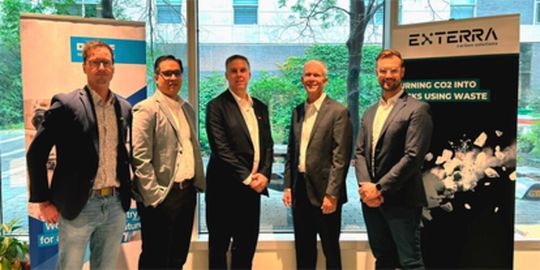
BASF and Exterra Carbon Solutions have entered into a MOU to explore opportunities to deploy a commercial scale CCS project in Quebec, Canada.
(Source: BASF)
November 06 – BASF and Exterra Carbon Solutions (Exterra) have entered into a memorandum of understanding (MOU) to explore opportunities to deploy a commercial scale carbon capture and storage (CCS) project in Quebec, Canada, using a combination of BASF’s Oase gas treatment technology and Exterra’s Reactive Oxide to Carbonate System (ROC) as part of its integrated carbon storage services. The strategic partnership is aimed at accelerating the decarbonization of Quebec’s industrial sector, specifically targeting hard-to-abate industries like the cement, steel, gas-to-power and waste-to-energy sectors, which account for nearly 20 percent of global CO2 emissions, according to the International Energy Agency. The collaboration harnesses the strengths of both companies to offer a comprehensive solution that could reduce CO2 emissions, contribute significantly to the province’s decarbonization goals and enhance environmental quality.
To pioneer the integration of carbon capture and mineralization into a single, scalable system, BASF will contribute gas treatment solutions that lay the groundwork for robust carbon capture infrastructure. With its Oase blue technology, BASF will efficiently capture CO2 emissions from industrial processes, ensuring the extracted CO2 is ready for immediate mineralization. Exterra will complement BASF’s capabilities by providing ex-situ carbon mineralization services that ensure permanent storage without risks of leakage or reversal. Exterra’s innovative ROC technology, bolstered by its low-carbon footprint of magnesium oxides, will enhance BASF’s Oase gas treatment, and, together, they will transform captured CO2 into a stable mineral form. In addition, Exterra will provide additional value to participating industries by generating high-quality carbon credits validated by third parties. Overall, the partnership will increase transparency, safety and rapid scalability.
Neste, Alterra, Technip Energies to Offer Standardized Technology Solution for Chemical Recycling
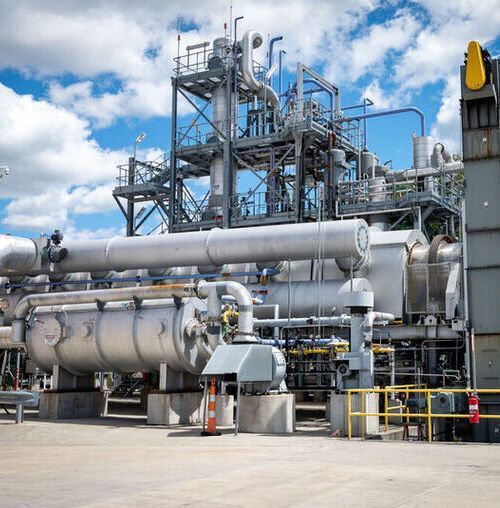
Alterra’s Akron plant in Ohio, 2024.
(Source: Alterra)
November 07 – Neste, Alterra and Technip Energies have signed a collaboration agreement to advance the circularity of plastics by providing the industry a standardized technology solution for chemical recycling, also referred to as “advanced recycling”. The partners aim to globally offer a standardized modular solution, based on Alterra’s proprietary liquefaction technology, to parties interested in building capacity for chemical recycling. This solution will come in the form of readily designed and engineered liquefaction plant modules, which will allow for lower pre-investment costs, accelerated implementation time, high predictability on project economics and reduced overall capital costs. Contributing to more effective execution of chemical recycling capacity projects, the solution helps the industry to reduce dependency on virgin fossil resources and accelerate the circularity of polymers and chemicals.
Date: 08.12.2025
Naturally, we always handle your personal data responsibly. Any personal data we receive from you is processed in accordance with applicable data protection legislation. For detailed information please see our privacy policy.
Consent to the use of data for promotional purposes
I hereby consent to Vogel Communications Group GmbH & Co. KG, Max-Planck-Str. 7-9, 97082 Würzburg including any affiliated companies according to §§ 15 et seq. AktG (hereafter: Vogel Communications Group) using my e-mail address to send editorial newsletters. A list of all affiliated companies can be found here
Newsletter content may include all products and services of any companies mentioned above, including for example specialist journals and books, events and fairs as well as event-related products and services, print and digital media offers and services such as additional (editorial) newsletters, raffles, lead campaigns, market research both online and offline, specialist webportals and e-learning offers. In case my personal telephone number has also been collected, it may be used for offers of aforementioned products, for services of the companies mentioned above, and market research purposes.
Additionally, my consent also includes the processing of my email address and telephone number for data matching for marketing purposes with select advertising partners such as LinkedIn, Google, and Meta. For this, Vogel Communications Group may transmit said data in hashed form to the advertising partners who then use said data to determine whether I am also a member of the mentioned advertising partner portals. Vogel Communications Group uses this feature for the purposes of re-targeting (up-selling, cross-selling, and customer loyalty), generating so-called look-alike audiences for acquisition of new customers, and as basis for exclusion for on-going advertising campaigns. Further information can be found in section “data matching for marketing purposes”.
In case I access protected data on Internet portals of Vogel Communications Group including any affiliated companies according to §§ 15 et seq. AktG, I need to provide further data in order to register for the access to such content. In return for this free access to editorial content, my data may be used in accordance with this consent for the purposes stated here. This does not apply to data matching for marketing purposes.
Right of revocation
I understand that I can revoke my consent at will. My revocation does not change the lawfulness of data processing that was conducted based on my consent leading up to my revocation. One option to declare my revocation is to use the contact form found at https://contact.vogel.de. In case I no longer wish to receive certain newsletters, I have subscribed to, I can also click on the unsubscribe link included at the end of a newsletter. Further information regarding my right of revocation and the implementation of it as well as the consequences of my revocation can be found in the data protection declaration, section editorial newsletter.
Alterra’s technology is a thermochemical liquefaction process, which converts hard-to-recycle plastics into a liquid hydrocarbon product. This liquid intermediate product can then be further refined into high-quality raw materials for new plastics and chemicals. As of today, Neste alone has processed more than 6,000 tons of plastic-derived feeds, including ISCC Plus certified oil from Alterra’s industrial-scale site in Akron, Ohio.
Alterra and Neste started collaborating in chemical recycling in 2021, jointly improving aspects of Alterra’s technology and creating respective value chains. Alterra and Technip Energies started their collaboration in chemical recycling in 2022. The three companies now join efforts in a unique endeavor: Alterra and Neste will license the liquefaction technology and Technip Energies will design, engineer and deliver the standardized liquefaction plant solution to interested parties globally.
Evonik Breaks Ground for Specialty Amines Plant Expansion in China
Evonik's cooperation with the Nanjing government continues to flourish, as demonstrated by the successful groundbreaking ceremony attended by local government officials.
(Source: Evonik)
November 12 – Evonik has officially broken ground on its plant expansion for specialty amines in Nanjing, during a ceremony attended by Nanjing government delegates on November 8. This milestone underscores Evonik's commitment to the development of the polyurethane and epoxy curing agent markets. The expansion at the existing production site strengthens Evonik's presence in China, a vital region for the company’s global operations.
The expansion represents a strategic investment in the double-digit million-euro range, allowing Evonik to enhance its amine portfolio by accessing cost-effective raw materials. By increasing production in China, Evonik strengthens its competitiveness and improves market efficiency, optimizing its production network. This expansion supports future market growth and aligns with Evonik’s global amine strategy to further differentiate its product offerings.
"The groundbreaking of our new specialty amines plant is testament to Evonik's strategic focus on expanding our capabilities in Asia and our confidence in its potential. China’s role as a competitive production hub is pivotal for both our regional and global business strategies," said, Dr. Claudine Mollenkopf, Head of Evonik’s Specialty Additives division. "This investment not only strengthens our position in the polyurethane and epoxy markets, but also highlights our commitment to sustainable growth and innovation."
The Nanjing plant runs on green electricity and specializes in producing amine-based additives crucial for industries such as construction, automotive, and furnishings. These additives play a significant role as catalysts during polyurethane foam formation. Innovative catalysts also reduce odor and VOC emissions. In November 2023, Evonik signed a Letter of Intent with the Nanjing authorities to expand the plant with construction to be completed in 2026.
St1 Refinery to Produce SAF with Honeywell Technology
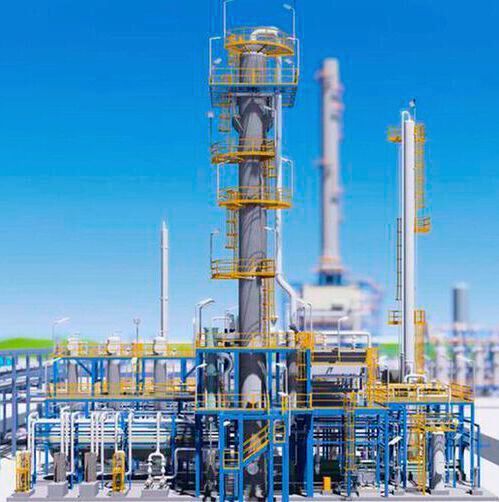
Honeywell has announced that the St1 Refinery has started using Honeywell’s Ecofining technology to produce sustainable aviation fuel.
(Source: Honeywell)
November 12 – Honeywell has recently announced that the St1 Refinery has started using Honeywell’s Ecofining technology to produce sustainable aviation fuel (SAF). The biorefinery in Gothenburg, Sweden will provide SAF to regional airlines, including Braathens Regional Airlines. The production of SAF with Ecofining technology also supports Honeywell’s alignment of its portfolio to three powerful megatrends, including the energy transition and future of aviation.
The Gothenburg plant will produce 200,000 tons of renewable fuels annually and can utilize flexible feedstocks, including used cooking oil, animal fats, and tall oil fatty acids from paper and pulp mills. In addition to SAF, the biorefinery will produce biodiesel, bio-naphtha, and bio liquid petroleum gas. St1 reported the fuels produced at the biorefinery will reduce road and air traffic emissions by about 500,000 tons of CO₂ annually compared to fossil fuels.
The SAF produced at St1’s facility will support the European Union’s Refuel EU initiative, which requires aviation fuel to contain a blend of at least 2 % SAF beginning in 2025. The required percentage gradually increases over time, eventually increasing to 70 % by 2050, contributing to the European Green Deal's goal of climate neutrality that follows the same timeline.
Topsoe Technology Selected for One of Brazil’s First SAF Plants
The production addresses the rapidly growing demand for SAF.
(Source: Topsoe)
November 14 – Topsoe has signed an agreement with Refinaria de Petróleo Riograndense (Riograndense), to provide its Hydroflex and H2bridge technologies for sustainable aviation fuel (SAF) and renewable diesel production at Riograndense’s Rio Grande renewable fuels plant in Brazil. The production addresses the rapidly growing demand for SAF. As cited by the International Energy Agency’s Net Zero Scenario, over 10 % of fuel consumption in aviation needs to be SAF by 2030 to stay on course for net zero CO2 emissions by 2050. In 2023, the International Air Transport Association estimated global SAF production to make up only around 0.2 % of total jet fuel demand.
Elena Scaltritti, Chief Commercial Officer at Topsoe, said: “With Brazil setting ambitious airline emissions reduction targets in October this year, Riograndense is one of the country’s early movers to ensure SAF supply is available for airline operators on-time. We look forward to partnering with Riograndense to grow the supply of renewable fuels in Brazil.”
With Hydroflex, customers can convert various fats, oils and greases into drop-in renewable jet and diesel that meet all globally accepted specifications for these fuels. Topsoe’s Hydroflex can be deployed in both grassroots units and revamps for co-processing or fully renewable applications.
The H2bridge technology replaces external fossil feedstocks for production of hydrogen by processing the waste propane and off gases from the Hydroflex process and converting it into green hydrogen that is then consumed in the same process (i.e. Hydroflex). This patented process integration provides the customers with improved carbon intensity score.
Ohmium, Spirare Energy, Jncasr to Develop India’s First CO2 to Green Methanol Plant
Ohmium has partnered with the Jawaharlal Nehru Centre for Advanced Scientific Research, Breathe Applied Sciences, and Spirare Energy, to announce India’s first CO2-to-Green Methanol plant.
(Source: Pixabay)
November 19 – Ohmium International (Ohmium), a leading green hydrogen company that designs, manufactures, and deploys advanced Proton Exchange Membrane (PEM) electrolyzers, is pleased to partner with the Jawaharlal Nehru Centre for Advanced Scientific Research (Jncasr), Breathe Applied Sciences, and Spirare Energy, to announce India’s first CO2-to-Green Methanol plant.
The project will combine green hydrogen generated by Ohmium PEM electrolyzers with CO2 captured from the Singareni Thermal Power Plant to produce green methanol. The process to synthesize green methanol from CO2 emissions was developed by researchers at Breathe Applied Sciences and the Jawaharlal Nehru Centre for Advanced Scientific Research in India. Spirare Energy partnered with Ohmium to procure the PEM electrolyzer solution, an important component of the overall project.
“Converting CO2 from coal based thermal power to green methanol can significantly advance decarbonization and sustainability,” said Jncasr Professor Sebastian Peter, Breathe Applied Sciences co-founder and project leader of the CO2-to-Green Methanol plant from Jncasr. “We are excited to see our research applied in this pioneering project and looking forward to seeing it scale.”
Methanol is commonly used as a fuel or as a raw material in various industrial processes. Reducing or eliminating the carbon content of methanol production helps decrease greenhouse gas emissions and reduces reliance on fossil fuels. Technologies for converting CO2 to green methanol can also help decarbonize various sectors including the coal based thermal power sector.
November 19 – Clariant has recently announced the successful installation of its Envicat N2O-S catalyst at the nitric acid plant of Hengli Petrochemical. Envicat N2O-S was installed as part of Clariant’s global Climate Campaign, which offered a free load of the N2O removal catalyst to nitric acid producers with no abatement technology. One of the winners of the campaign is Hengli which operates a 300,000-metric ton per annum nitric acid plant in Dalian, China. With the successful installation of the catalyst in June 2024, the plant is projected to reduce its N2O emissions by 690,000 tons of CO2eq annually.
Xaver Karsunke, Vice President of Specialty Catalysts at Clariant, commented, "We are honored to support Hengli Petrochemical in their drive toward cleaner chemical production. Our catalysts not only help industry leaders like Hengli to significantly reduce harmful greenhouse gas emissions, but also to do so in the most efficient and economical manner possible. Partnerships like this are crucial for accelerating China’s energy transition and meeting the country’s ambitious decarbonization goals.”
Arcelormittal Poland Collaborates with Linde Gaz Polska to Develop New Hydrogen Plant
Linde Gaz Polska has entered into an agreement with Arcelormittal Poland to develop a hydrogen production plant on the site of its Krakow branch in Poland.
(Source: Pixabay)
November 25 – Since 2018, Arcelormittal Poland has not used coal as a fuel in its Kraków branch, and since July this year it has not produced coke here. – Our installations: the hot rolling mill and the cold rolling mill, as well as the galvanizing and sheet metal painting lines, currently operate exclusively on the basis of natural gas – explains Łukasz Skorupa, COO Flat Products and Quality and director of the Krakow branch. "We are currently completing a project to build hydrogen furnaces, which allowed us to eliminate ammonia in the annealing plant. Its cost is PLN 52 million (12.58 million dollars). The project with Linde, on the other hand, is to ensure a reliable supply of hydrogen for our galvanizing plants. We are increasingly focusing on hydrogen," he adds.
The plant will be built near the galvanizing plant, producing hydrogen from natural gas. The investment has already begun, and design work is currently underway. In addition to hydrogen fuel for galvanizing plants, the Krakow branch of Arcelormittal Poland will also gain another environmental effect – it will completely eliminate ammonia from the process, which will increase the level of process safety of the plants.
"Since 2004, we have already invested nearly PLN 2.5 billion in Kraków's rolling mills and galvanizing plants. We are constantly improving the quality of our products, expanding their product range, and at the same time gradually reducing our environmental impact," says Wojciech Koszuta, CEO of Arcelormittal Poland. “Hence the elimination of ammonia and the transition to hydrogen. The decarbonization of our company is not only about activities in the area of steel production, but also in the processing part," he concludes.
"As an expert with over a century of experience in the field of hydrogen production, distribution and storage, we were able to offer Arcelormittal the best solutions available in the hydrogen sector, ensuring the highest level of operational plant safety and production process reliability," says Oleksandra Tuzhylina, CEO of Linde Gaz Polska.
Ineos, GNFC to Develop New World Scale Acetic Acid Plant
Ineos Acetyls and Gujarat Narmada Valley Fertilizers & Chemicals have recently signed a MOU to explore the feasibility to build a new world scale, 600kt acetic acid plant at GNFC's site in Bharuch, Gujarat, India.
(Source: Pixabay)
November 26 – Ineos Acetyls and Gujarat Narmada Valley Fertilizers & Chemicals (GNFC) have recently signed an MOU to explore the feasibility to build a new world scale, 600kt acetic acid plant at GNFC's site in Bharuch, Gujarat, India.
Ineos Acetyls are a leading producer of acetic acid globally and GNFC is the only current producer of acetic acid in India. The two companies have held a technology partnership for close to 30 years but will now establish a new joint venture which will manage bringing this project to market, currently forecast in 2028.
David Brooks, CEO Ineos Acetyls commented, "We are delighted to make this announcement today, working with our partner GNFC on this new project. India is recognized as being a key growth market for our products over the coming years and this investment will increase much needed locally produced acetic acid, reducing the country’s reliance on imports.”
Pankaj Joshi, MD GNFC commented that India imports ~85 % of its annual requirements of acetic acid. The proposed JV is expected to achieve the objective of ‘Make in India’. Domestication of acetic acid will serve existing demand and provide the required boost to other evolving downstream demands saving precious foreign exchange outgo.




:quality(80)/p7i.vogel.de/wcms/54/f4/54f4b4e2a86b203e0dfd84221602bdb5/0130367283v2.jpeg "Anybotics' Anymal robot combines depth cameras, LiDAR, thermal imaging, acoustic sensors, and gas detectors into a single inspection round. (Source: Anybotics)")
:quality(80)/p7i.vogel.de/wcms/e9/64/e964996410967c124c2cf01a8623068e/0130285341v1.jpeg "Geht unter die Oberfläche: Die Offshore-Ölförderung erfordert hochenergetische Pumpen – doch diese sind im Wesentlichen eine Black Box. Bisher zumindest. (Source: Kistler Group)")
:quality(80)/p7i.vogel.de/wcms/54/ae/54aece5dff672ce1651470eecd9f2589/0130138090v2.jpeg "The new Ionchromatograph “Nexera IC“ (Source: Shimadzu)")
:quality(80)/p7i.vogel.de/wcms/49/5c/495c651fabd24a437c98bde6a3d71ecc/0130060419v2.jpeg "Enfinium has successfully piloted Wasteer’s groundbreaking visual AI technology at its Ferrybridge 2 facility in West Yorkshire and Parc Adfer facility in North Wales. (Source: Chris Parkes Photographer Ltd.)")
:quality(80)/p7i.vogel.de/wcms/1e/15/1e15b0e20cf5ede83e0749260dfda733/0130465044v2.jpeg "Energy X has recently announced the successful commissioning of a first-of-its-kind, U.S.-based lithium production facility at Project Lonestar, marking a major milestone toward commercial-scale domestic lithium production. (Source: Pixabay)")
:quality(80)/p7i.vogel.de/wcms/36/36/36369e6e59d4c660893cc04a4d257cfc/0130465035v2.jpeg "Wacker has successfully completed the second expansion phase at its production site in Panagarh, India. In addition to silicone rubber, the site now also operates a production complex (left) for silicone emulsions. (Source: Wacker)")
:quality(80)/p7i.vogel.de/wcms/1f/1e/1f1eba3731af22e1d9946e2897f134da/0130464799v2.jpeg "Aerial view of the BASF production site in Zhanjiang, China. (Source: BASF )")
:quality(80)/p7i.vogel.de/wcms/64/bb/64bb4812390b6491ce0bd4fe53597086/0130333812v2.jpeg "The solar power plant produces 30 GWh per year of renewable electricity, which is self-consumed by Holcim’s industrial facilities, making it the largest floating solar power plant in Europe dedicated to self-consumption. (Source: Pixabay)")
:quality(80)/p7i.vogel.de/wcms/41/c9/41c96e0244221ad38daa73bdd8231477/0130477173v2.jpeg "The „ORBITA‑L“-system is designed for filling and capping non‑injectable liquid products. (Source: Marchesini)")
:quality(80)/p7i.vogel.de/wcms/7a/50/7a501f6d8f87a4524dc3aaceb04eacb4/0130333829v2.jpeg "The Clear Lake facility represents Clariant's first U.S. manufacturing site dedicated to producing pharmaceutical-grade PEG excipients, marking a pivotal milestone in the company's healthcare growth strategy. (Source: Clariant)")
:quality(80)/p7i.vogel.de/wcms/26/12/261210e5920899e5c35c4f905d3be8bd/0129399814v2.jpeg "Powders used in DPI formulations are often highly potent and administered in very low doses. (Source: Ima)")
:quality(80)/p7i.vogel.de/wcms/6b/3f/6b3f057c83c494e4732337d870d52b21/0130006927v2.jpeg "Lonza will realize upfront cash proceeds of 2.2 billion dollars and retain a 40 % stake in the business, with additional preferential participation in its future exit. (Source: Lonza)")
:quality(80)/p7i.vogel.de/wcms/df/35/df3526a6f7aba41fdd2bb2051954e0d8/0130163620v2.jpeg "The SPA, valued at more than 3 billion dollars, is one of the largest binding long-term green ammonia off-take agreements globally. (Source: Pixabay)")
:quality(80)/p7i.vogel.de/wcms/af/73/af7394d9f8900024c5ee7fca459c4eeb/0130080328v2.jpeg "Axens has signed a MOU with Airbus to strengthen their cooperation in the development and deployment of SAF, a key pillar for decarbonizing the aviation sector. (Source: Pixabay)")
:quality(80)/p7i.vogel.de/wcms/0e/19/0e19f0cf0379c3af4c2fe02629db63f1/0130079229v2.jpeg "Thyssenkrupp Uhde has been selected by CSBP to deliver its patented Envinox technology for two nitric acid plants at CSBP’s Kwinana site in Western Australia. (Source: Thyssenkrupp Uhde)")
:quality(80)/p7i.vogel.de/wcms/a6/84/a68477d4ef879cc9cedeae332ca57c49/0129893677v2.jpeg "Siemens and Caphenia sign the partnership agreement. From left to right: Nicky Ahnert, Jürgen Giegerich, Frank Knauf (all Siemens), Dr. Mark Misselhorn, Dr. Andreas Waibel (both Caphenia) (Source: Siemens)")
:quality(80)/p7i.vogel.de/wcms/1c/39/1c39433f4bb4de2e5e6c5311c3236d09/0130110254v2.jpeg "The new pumps of the Omega type series have been designed for handling water and fluids with a low solids content efficiently. (Source: KSB)")
:quality(80)/p7i.vogel.de/wcms/be/e1/bee13b8d51a419b9b8f0685e2b9d47bf/0128917673v1.jpeg "The Centerwave 6000 measures pipes from 32 to 1,600 mm. (Source: Maag Group)")
:quality(80)/p7i.vogel.de/wcms/51/7a/517a4e83c5827663b4839f5ddb98f434/0128872953v1.jpeg "The Tigron in SIL version can be flexibly configured for different safety requirements. (Source: Auma)")
:quality(80)/p7i.vogel.de/wcms/60/ef/60efa975d1dd123c1afbfb6ccc060461/0130263955v2.jpeg "Aquaclean (Source: Oko-tech)")
:quality(80)/p7i.vogel.de/wcms/07/62/0762f20b1821ee2724c97989374d6397/0130257651v2.jpeg "Oleksandr Sadchykov in front of the water treatment unit (Source: Grundfos)")
:quality(80)/p7i.vogel.de/wcms/98/98/989863664c7b65e87caf74a08239d487/0130167217v2.jpeg "Keller 26KyX Level Probe (Source: © Keller Pressure)")
:quality(80)/p7i.vogel.de/wcms/64/4e/644e22b71e8d35a63f051f781eb13886/0130163451v2.jpeg "Vega will present level and pressure measurement technology for the water industry at Ifat 2026. (Source: Vega)")
:quality(80)/p7i.vogel.de/wcms/6b/cc/6bcc3d26e1c7c74d90a10bc3ca296ae1/0128362351v2.jpeg "A look into Bayer's new tablet production, Solida 1, during construction: The robots and lift columns for material handling are being installed. (Source: Bayer)")
:quality(80)/p7i.vogel.de/wcms/24/c8/24c84ab6b1bcd24468a87820a07a85aa/0128194707v2.jpeg "Ajax Equipment has supplied Binding Solutions with a feed system comprising buffer hopper, screw feeder and agitated screw feeder for a pilot plant handling iron ore and additives. (Source: Ajax Equipment )")
:quality(80)/p7i.vogel.de/wcms/1d/3e/1d3e2788eb37c1e974f36337c8d33cb5/0128191010v2.jpeg "Ajax Equipment has supplied IGI Systems with a stainless-steel conical hopper with gas purge capability, as part of a prototype Sublimation System for a low-pressure chemical vapour deposition application. (Source: Ajax Equipment)")
:quality(80)/p7i.vogel.de/wcms/19/76/1976928d7d0a2ed7c1eeba7ade8552c8/0126365603v1.jpeg "Detail of Valvedesign: It has an aktiv amd passive part (Bild: Italvacuum)")
:quality(80)/p7i.vogel.de/wcms/0c/a1/0ca135e0486c9af90a0552aea85de88c/0130439525v2.jpeg "Qatar Energy expects the damage to its Ras Laffan Industrial City caused by missile strikes, which occurred on Wednesday 18 March 2026, and in the early hours of Thursday 19 March 2026, to cost about 20 billion dollars a year in lost revenue. (Source: Pixabay)")
:quality(80)/p7i.vogel.de/wcms/d0/f7/d0f7d560dfce37c8371442d5b6120e3c/0130182478v1.jpeg "The Gelsenkirchen refinery primarily manufactures fuels for vehicles and aircraft, processing roughly 12 million tonnes of crude oil per year. (Source: BP)")
:quality(80)/p7i.vogel.de/wcms/7f/96/7f9628e43c99564fa6dfd8e76149425d/0130165852v2.jpeg "Pure titanium recycling process for chlor-alkali electrolysis cells. (Source: Asahi Kasei)")
:quality(80)/p7i.vogel.de/wcms/f8/29/f8298429c1638b949a6f76346f6709c7/0118701710v2.jpeg "Bosch Industrial Heat will be presenting sustainable steam and heat solutions for global industrial use at the Achema trade fair in Frankfurt, Germany. (Source: Bosch Industriekessel)")
:quality(80)/p7i.vogel.de/wcms/07/24/07242664ab2b1c7841c9d9d0a127670c/0116045959.jpeg "A look inside the GEA machine room. (Bild: Magnavale)")
:quality(80)/p7i.vogel.de/wcms/c9/79/c979a20b32395ddfa93fe7ead90578a0/0108386061.jpeg "Production residues, lime, salt and suspended solids quickly clog the pipes. (Source:©Tanakorn - stock.adobe.com)")
:quality(80)/p7i.vogel.de/wcms/9e/5c/9e5c92d942ed046a27562d6e3d730c92/0103483548.jpeg "It is almost ten metres high and extends over three floors: the world's first multiple dividing wall column is located in the new technical centre at the University of Ulm. (Bild: Eberhardt, kiz Universität Ulm)")
:quality(80)/p7i.vogel.de/wcms/7c/77/7c77e24fdcc9e1511e8e711eff161e28/0130175489v2.jpeg "The milestone confirms the fast pace of development of Eni’s deep water gas projects offshore East Kalimantan. (Source: Unsplash )")
:quality(80)/p7i.vogel.de/wcms/b3/2f/b32fb9f5aa54e9cb6c92e4b6c8665263/0130163018v2.jpeg "The decision to take emergency collective action was made following an extraordinary meeting of IEA Member governments, convened by the IEA Executive Director to assess market conditions amid the conflict in the Middle East and consider the options to address supply disruptions. (Source: © Sashkin - stock.adobe.com)")
:quality(80)/p7i.vogel.de/wcms/85/d2/85d2cb02c4ae45a99454b5405b0f2489/0130149909v2.jpeg "IEA Executive Director Fatih Birol issued a statement on the meeting of G7 Energy Ministers at its IEA headquarters in Paris. (Source: © Marko - stock.adobe.com)")
:quality(80)/p7i.vogel.de/wcms/a8/4e/a84e8039a90a5cf4751d01ebcf6ba1a9/0127510172v2.jpeg "After six years, Achemasia, the international trade fair and innovation forum for sustainable chemical production, has returned with renewed vigor, bringing together global expertise, Chinese innovation, and a shared commitment to a greener industrial future—according to the organizers of the fair. (Source:PROCESS China)")
:quality(80)/p7i.vogel.de/wcms/17/c7/17c703445f134eb3d7ecc7918dda2762/0124596096v2.jpeg "Achema Middle East will launch in Saudi Arabia in 2026. (Bild: Dechema/ Hannibal)")
:quality(80)/p7i.vogel.de/wcms/2a/2c/2a2cffc07f51019065387cd63241b5ce/0119463370v1.jpeg "The Injecta 36 fills and seals RTU (Ready-to-Use) syringes at high speed. The image shows the robotic arm. (Source: IMA)")
:quality(80)/p7i.vogel.de/wcms/b1/7e/b17ea8c62ccafad1d1fb072d6199bbd6/0118578446.jpeg "“Star in the ring”: Vegapuls 6X radar level sensors are the solution of choice for Renolit for many applications on the way to the perfect plastic product. (Source: © MR Design - stock.adobe.com; Vega)")
:quality(80)/p7i.vogel.de/wcms/09/e3/09e378194b496921d2a267a6752322eb/0130333473v2.jpeg "Under the terms of the contract, KBR will provide contract management, project management and supporting technical services throughout the EPC phases of the project. (Source: KBR)")
:quality(80)/p7i.vogel.de/wcms/77/9d/779db435e7f9d79bafe16101008a9cfa/0130263548v2.jpeg "The Kingdom of Saudi Arabia, the UAE and Turkey are three core countries in the region that are actively incorporating the plastics circular economy with the assistance of the chemical recycling technology. (Source: © Anastasiia - stock.adobe.com)")
:fill(fff,0)/images.vogel.de/vogelonline/companyimg/2000/2093/65.jpg "Glatt_Logo_ND4c-RGB (5x3cm).jpg ()")
:fill(fff,0)/p7i.vogel.de/companies/61/f9/61f9439b7cbe4/logo-edl.png "logo-edl (EDL Anlagenbau Gesellschaft mbH)")
:fill(fff,0)/p7i.vogel.de/companies/66/9f/669f700d3b118/cac-2023-poslogo-idea-ahead.png "cac-2023-poslogo-idea-ahead (CAC ENGINEERING GMBH)")






:quality(80)/p7i.vogel.de/wcms/9f/bc/9fbcff62c6ca8d6b26e74aa896df834b/0124467383v2.jpeg "At a glance: Plant engineering projects from across the globe. (Source: Pixabay)")
:quality(80)/p7i.vogel.de/wcms/d5/0a/d50a48ba8079516a21b5ed40f882f7de/0124001601v2.jpeg "At a glance: Plant engineering projects from across the globe. (Source: Sasint - stock.adobe.com)")