PROCESS Worldwide brings to you the ‘Top 10 plant engineering projects of February 2025’ from all over the world. Right from Repsol investing 800+ million euros for a renewable methanol project in Europe to Thyssenkrupp Uhde’s CCU technology being selected for ammonia, urea plants in Egypt, find out all the projects making headlines here.
At a glance: Plant engineering projects from across the globe.
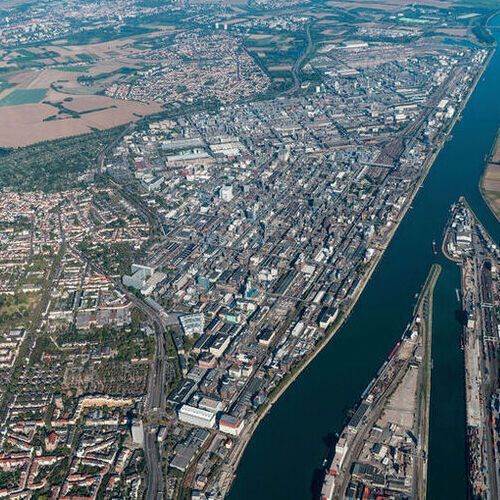
(Source: Pixabay)
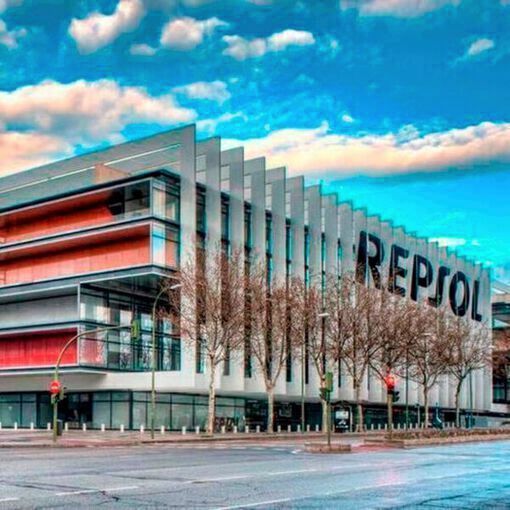
Repsol to Invest 800+ Million Euros for Renewable Methanol Project
Repsol's Board of Directors recently gave the green light to invest in the Ecoplant project.
(Source: Repsol)
Feb 03 – Repsol's Board of Directors recently gave the green light to invest in the Ecoplant, a pioneering project in Europe to transform urban waste into renewable fuels and circular products, adding a solution for reducing CO2 emissions in the transport sector, while at the same time promoting the circular economy.
Located in Tarragona, this facility —expected to receive an investment of over 800 million euros— will become the first plant in Europe to produce renewable and circular methanol from waste through gasification, the world’s most advanced waste valorization process. This cutting-edge technology, developed by Enerkem - a technology company in which Repsol is a partner - gives a second life to waste that would otherwise end up in landfills or be incinerated.
The new plant will have the capacity to process up to 400,000 tons of municipal solid waste per year and turn them into 240,000 tons of renewable fuels and circular products. The renewable methanol originates from organic waste, while the circular products come from non-organic waste, such as non-recyclable plastics.
The start-up of the plant, scheduled for 2029, will result in the creation of 340 direct, indirect, and induced jobs, as well as some 2,800 jobs during the construction phase. The Ecoplant will be integrated into Repsol's industrial complex in Tarragona to take advantage of existing infrastructures and accelerate the transformation of the center into a multi-energy hub that will continue to manufacture essential products for society, such as renewable fuels and circular materials. This investment is a clear commitment by Repsol to maintain industrial employment in Spain and to continue generating wealth in the surrounding area.
Moeve to Establish 30 New Biomethane Plants in Spain
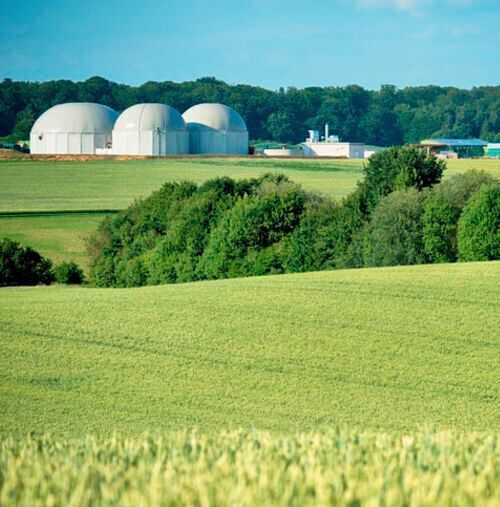
The energy company aims to produce biomethane from agricultural and livestock waste and manage a project portfolio of 4 TWh by 2030.
(Source: Moeve)
Feb 04 – Moeve has recently announced an ambitious 600-million-euro investment plan for the construction, together with its partners, of up to 30 new biomethane plants by 2030, which the company projects throughout Spain, with Andalusia, Catalonia, and Galicia being among the regions with the greatest potential for its deployment. This investment is part of Moeve's plans to promote the circular economy and lead the energy transition, in the framework of its transformation strategy Positive Motion.
The energy company aims to produce biomethane from agricultural and livestock waste and manage a project portfolio of 4 TWh by 2030. The use of this renewable gas, instead of fossil fuels, will allow Moeve to reduce CO2 emissions from its energy parks, chemical plants, its strategic industrial clients and partners, as well as providing a complementary vector for green hydrogen production and promoting sustainable mobility. The total production, equivalent to enough energy for 568,000 households, will result in the reuse of 10 million tons of waste per year and will prevent the emission of 728,000 tons of CO2 per year, similar to planting 48.5 million trees.
For the development of these plants, Moeve has partnerships with companies such as Kira Ventures and Prezero and has just signed an agreement with Inproener to develop five biomethane plants in Spain, which are expected to be operational between 2028 and 2029. Each facility will produce around 50 GWh per year, adding up to 250 GWh of biomethane annually. This partnership includes a collaboration with Envitec Biogas, which will contribute its experience in the construction of more than 650 biogas plants internationally.
Air Liquide to Develop New ASU in Japan
Air Liquide will build, own and operate, through a significant investment, a large-scale Air Separation Unit in Naoshima Island, Japan.
(Source: Air Liquide)
Feb 05 – Air Liquide will build, own and operate, through a significant investment, a large-scale Air Separation Unit (ASU) in Naoshima Island, Japan. This plant is designed to meet the rising demand for copper, a crucial element for the energy transition, and support the production ramp-up of Mitsubishi Materials, Japan’s leading copper company. In addition to providing large volumes of oxygen with a capacity of up to 1,400 tons per day as well as nitrogen, Air Liquide’s new ASU will also produce argon and neon, helping to ensure a stable supply of those rare gases essential to Japan's key industries such as semiconductor manufacturing, transportation equipment manufacturing and construction work.
Date: 08.12.2025
Naturally, we always handle your personal data responsibly. Any personal data we receive from you is processed in accordance with applicable data protection legislation. For detailed information please see our privacy policy.
Consent to the use of data for promotional purposes
I hereby consent to Vogel Communications Group GmbH & Co. KG, Max-Planck-Str. 7-9, 97082 Würzburg including any affiliated companies according to §§ 15 et seq. AktG (hereafter: Vogel Communications Group) using my e-mail address to send editorial newsletters. A list of all affiliated companies can be found here
Newsletter content may include all products and services of any companies mentioned above, including for example specialist journals and books, events and fairs as well as event-related products and services, print and digital media offers and services such as additional (editorial) newsletters, raffles, lead campaigns, market research both online and offline, specialist webportals and e-learning offers. In case my personal telephone number has also been collected, it may be used for offers of aforementioned products, for services of the companies mentioned above, and market research purposes.
Additionally, my consent also includes the processing of my email address and telephone number for data matching for marketing purposes with select advertising partners such as LinkedIn, Google, and Meta. For this, Vogel Communications Group may transmit said data in hashed form to the advertising partners who then use said data to determine whether I am also a member of the mentioned advertising partner portals. Vogel Communications Group uses this feature for the purposes of re-targeting (up-selling, cross-selling, and customer loyalty), generating so-called look-alike audiences for acquisition of new customers, and as basis for exclusion for on-going advertising campaigns. Further information can be found in section “data matching for marketing purposes”.
In case I access protected data on Internet portals of Vogel Communications Group including any affiliated companies according to §§ 15 et seq. AktG, I need to provide further data in order to register for the access to such content. In return for this free access to editorial content, my data may be used in accordance with this consent for the purposes stated here. This does not apply to data matching for marketing purposes.
Right of revocation
I understand that I can revoke my consent at will. My revocation does not change the lawfulness of data processing that was conducted based on my consent leading up to my revocation. One option to declare my revocation is to use the contact form found at https://contact.vogel.de. In case I no longer wish to receive certain newsletters, I have subscribed to, I can also click on the unsubscribe link included at the end of a newsletter. Further information regarding my right of revocation and the implementation of it as well as the consequences of my revocation can be found in the data protection declaration, section editorial newsletter.
Further strengthening its long-term partnership, Air Liquide will support Mitsubishi Materials with their plan to increase copper production to address the growing demand for the use of electric vehicles, next-generation communication technology and renewable energy.
Air Liquide will build, own and operate this ASU at the Naoshima smelter and refinery. Set to commence operations in 2027, it will rank among Air Liquide’s largest and state of the art oxygen production plants in Japan. The facility will also produce argon and neon, enhancing the capacity of these rare gases, crucial for semiconductor manufacturing and welding applications, to customers in those industries.
Blue Biofuels Acquires Land to Develop Biofuels Production Facility in USA
Blue Biofuels has announced the signing of an agreement to acquire 35.5 acres of land in Frostproof, Florida, marking a significant milestone in the company’s commercialization efforts.
(Source: Pixabay)
Feb 12 – Blue Biofuels has recently announced the signing of an agreement to acquire 35.5 acres of land in Frostproof, Florida, marking a significant milestone in the company’s commercialization efforts. The site will house a cutting-edge production facility designed to produce an initial 3 million gallons of biofuel annually. The infrastructure and available land can support future expansion to 100 million gallons per year of cellulosic ethanol and 100 million gallons per year of Sustainable Aviation Fuel (SAF).
The property, located in Polk County, one of the fastest-growing counties in Florida, is in the heart of Central Florida’s agricultural region, offering access to an abundant supply of biomass feedstock. It is also strategically located in the proximity of The Port of Tampa, which will facilitate efficient logistics by rail and road for biofuel transportation. Blue Biofuels is working closely with Global Management Partners (GMP) to develop the design and engineering plans for the first phase of the facility. This collaboration ensures a strong foundation for the company’s state-of-the-art biofuel production plant.
Construction of the facility, capable of converting 3 million gallons of ethanol to SAF annually is expected to begin in 2025. Subsequent expansions will enable Blue Biofuels to meet the growing demand for renewable fuels on a larger scale.
Ta’ziz to Develop UAE’s First Methanol Plant
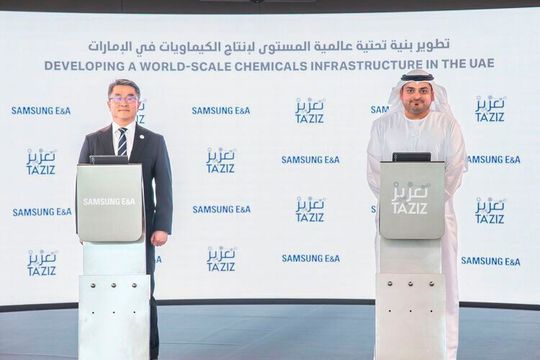
Ta’ziz has announced an EPC contract award of 1.7 billion dollars to Samsung E&A for the construction of one of the world’s largest methanol plants in Al Ruwais Industrial City, Al Dhafra region, Abu Dhabi.
(Source: Adnoc)
Feb 14 – Ta’ziz has recently announced an engineering, procurement and construction (EPC) contract award of 1.7 billion dollars (AED6.2 billion) to Samsung E&A for the construction of one of the world’s largest methanol plants in Al Ruwais Industrial City, Al Dhafra region, Abu Dhabi.
The project is a key milestone in Ta’ziz’s mission to advance the UAE’s economic diversification by unlocking new domestic chemical value chains. The 1.8 million tons per annum (mtpa) plant will be the first methanol production facility in the UAE. Upon completion in 2028, it will be powered by clean energy from the grid, making it one of the world’s most energy-efficient methanol plants.
In its initial phase, Ta'ziz will produce 4.7 mtpa of chemicals by 2028, including methanol, low-carbon ammonia, polyvinyl chloride (PVC), ethylene dichloride, vinyl chloride monomer, and caustic soda. Several of these chemicals will be produced for the first time in the UAE, reinforcing Ta’ziz’s strategic goal to expand the local chemicals value chain and advance economic diversification through industrialization.
BASF to Develop New Alcoholates Plant in Germany
BASF is investing a mid-double-digit million-euro amount in a new alcoholates plant at its site in Ludwigshafen, Germany.
(Source: BASF)
Feb 20 – BASF is investing a mid-double-digit million-euro amount in a new alcoholates plant at its site in Ludwigshafen, Germany. The plant will produce sodium methylate and potassium methylate, two important chemicals used for the production of biodiesel and for pharmaceutical and agricultural applications. Utilizing state-of-the-art technology, the new plant will replace the existing production facility in Ludwigshafen and is expected to start up in the second half of 2027.
“Various industries in Europe and around the globe rely on the high-quality alcoholates we produce in Ludwigshafen,” said Dr. Ramkumar Dhruva, President of the Monomers division at BASF. “We are investing in an efficient, Verbund-integrated and future-oriented production process because it is our priority to remain a reliable supplier of alcoholates to our customers in the future.”
BASF is a leading supplier of alcoholates for various applications. The new plant in Ludwigshafen complements BASF’s recently completed expansion of its sodium methylate production in Guaratinguetá, Brazil.
Wood Secures Feed Contract for Green Hydrogen Facility in the Netherlands
Wood has been awarded the front-end engineering design scope for the Zeevonk hydrogen facility, in Rotterdam, Netherlands.
(Source: Pixabay)
Feb 20 – Wood has been awarded the front-end engineering design (Feed) scope for the Zeevonk hydrogen facility, in Rotterdam, Netherlands. The hydrogen plant will be powered by offshore wind and floating offshore solar from the Zeevonk offshore developments.
The Zeevonk project is a joint venture between Vattenfall and Copenhagen Infrastructure Partners (CIP), the world’s largest dedicated fund manager within greenfield renewable energy investments, through its Energy Transition Fund (CI ETF I). This ambitious initiative will advance Vattenfall’s net-zero emissions goals and play a significant role in advancing Europe towards its target of meeting net-zero emissions by 2050.
The facility will be designed to reach significant peak consumption and, once complete, the produced hydrogen will be transported via pipeline to the nearby hydrogen grid, Hydrogen Network Rotterdam. This network is the first phase of the new Dutch hydrogen infrastructure centered in the Port of Rotterdam, one of Europe’s most significant energy ports.
OMV Petrom Begins Developing SAF, Renewable Diesel Production Unit
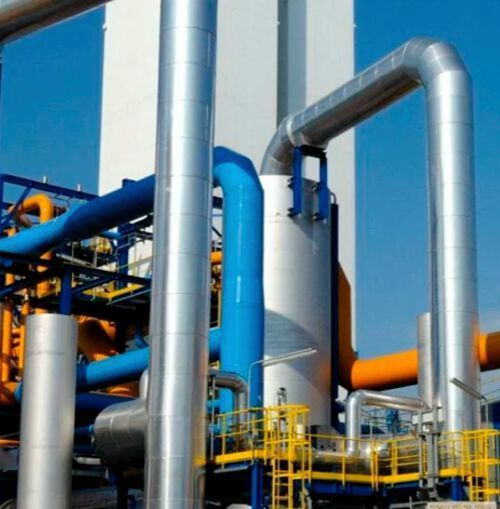
This new facility will position OMV Petrom as the first major producer of sustainable fuels in the Southeast Europe, with an annual capacity of 250,000 tons.
(Source: Pixabay)
Feb 24 – OMV Petrom has recently announced the start of construction for a sustainable aviation fuel (SAF) and renewable diesel (HVO) production unit at the Petrobrazi refinery in Brazi, Romania. This new facility will position OMV Petrom as the first major producer of sustainable fuels in the Southeast Europe, with an annual capacity of 250,000 tons.
Christina Verchere, CEO of OMV Petrom: "Investing in sustainable fuel production is part of our Strategy 2030 and reflects OMV Petrom's commitment to energy transition and reducing carbon emissions. Sustainable fuels are essential to decarbonize transportation, especially in sectors where electrification is difficult to implement, such as aviation. Between 2022 and 2030, we are allocating 35 % of our investment budget towards projects that support the energy transition, in Romania and the region."
The new unit will enable OMV Petrom to integrate the production of SAF and HVO with the existing infrastructure for fuel production, storage, and distribution, thus meeting the region's sustainable mobility needs.
The project entails a total investment of 750 million euros, of which 560 million euros are allocated for the construction of the SAF/HVO unit, and 190 million euros for two green hydrogen production facilities.
Thyssenkrupp Uhde’s CCU Technology Selected for Ammonia, Urea Plants in Egypt
Thyssenkrupp Uhde has been selected by Mopco to supply advanced technology for three existing ammonia and urea plants in Damietta, Egypt.
(Source: Thyssenkrupp Uhde)
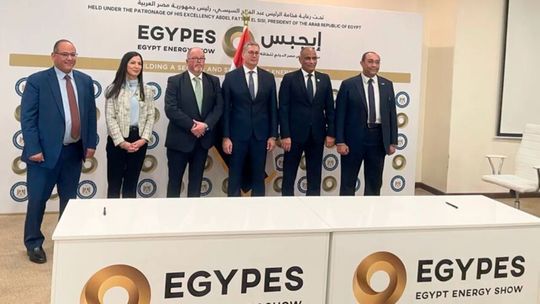
Feb 24 – Thyssenkrupp Uhde has been selected by Mopco – Misr Fertilizers Production Company (Egypt) – to supply advanced technology for three existing ammonia and urea plants in Damietta, Egypt, to enhance the sustainability of their production. Using an innovative carbon capture and usage (CCU) solution from Thyssenkrupp Uhde, the aim is to remove up to 145,000 t/year of CO2 from the flue gas of the existing ammonia production and use them in the urea production.
At the same time, three state-of-the-art uhde ammonia converter cartridges will be installed in the existing converters to increase ammonia production capacity while lowering natural gas consumption in the synthesis loop by around 10 %. To bring down CO2 emissions even further, additional green hydrogen feedstock will be sourced from new water electrolysis units powered by renewable energy. Mopco plans to produce up to 150,000 tons per year of green ammonia.
The ammonia and urea plants (three plants each) were originally built by Thyssenkrupp Uhde between 2006 and 2015, each plant having a capacity of approximately 1,200 metric tons per day (mtpd) of ammonia and 2,000 mtpd of urea respectively. Now, to increase ammonia production capacity, three new uhde ammonia converter cartridges will be inserted. The new cartridges, based on the latest design principles like removable beds with axial-radial flow design, will boost production by 150 mtpd per plant in order to allow Mopco to produce ammonia.
This is achieved through a significant increase of effective catalyst volumes and utilizing Johnson Matthey’s high-performance catalyst Katalco 74-1 as part of the solution.
BASF India Breaks Ground for New Microcellular Polyurethane Plant
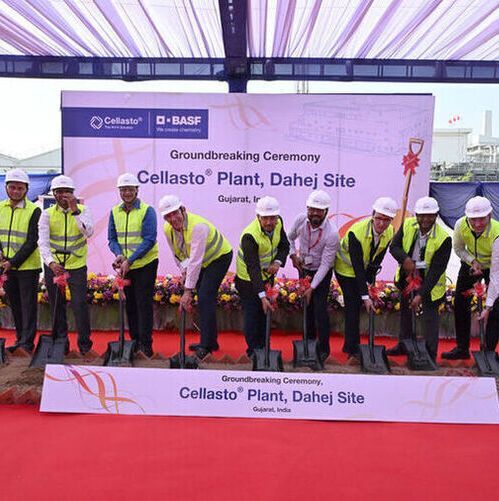
The groundbreaking ceremony marks the beginning of the establishment of a new mold line, aimed at offering customized products that support the growth plans of various Original Equipment Manufacturers.
(Source: BASF)
Feb 25 – BASF India has broken ground on a new plant to increase the production capacity of its Cellasto microcellular polyurethane (MCU) in Dahej, India. Under BASF's new "Winning Ways" strategy, the plant will be constructed with state-of-the-art technologies and automation systems to ensure that BASF’s high standards of safety and quality are upheld. The plant, expected to be operational in the second half of 2026, features a new mold line in its first stage and empowers Cellasto to meet the high demands of the rapidly growing local market.
Committed to "Producing in India for India", Cellasto established its first plant in Dahej in 2014, providing superior solutions that deliver noise, vibration, and harshness (NVH) reduction to the automotive industry. Cellasto’s latest significant investment demonstrates its readiness to support the growth plans of various Original Equipment Manufacturers and its confidence in the Indian market.
"The new facility is part of our efforts to innovate the production process. The plant will flexibly expand production further if demand increases. We emphasize our long-term commitment to better serve our Indian customers. I am confident that this strategic move will position us for sustained success in India," said Bjoern Kophstahl, Vice President, Global Business Management for Cellasto.




:quality(80)/p7i.vogel.de/wcms/f3/4a/f34abcf99d71d8bff5a4e98b60889c8e/0129239597v2.jpeg "Dow has recently announced a comprehensive plan to simplify how it operates and streamline its end-to-end processes. (Source: Dow )")
:quality(80)/p7i.vogel.de/wcms/5c/27/5c27bddaef122b61c636e31d82a33bd9/0129017834v2.jpeg "Merck has recently announced the launch of the Chemisphere app. (Source: Merck )")
:quality(80)/p7i.vogel.de/wcms/f7/f0/f7f0fdf4a4e1d872d078d63abfa4a7fd/0127844838v2.jpeg "Plantperfect Monitor provides centralized monitoring for Profibus and Profinet networks (Source: Softing Industrial)")
:quality(80)/p7i.vogel.de/wcms/1e/50/1e5099910c2370ad08d578161f3fe3c2/0128939735v1.jpeg "Conducted in a live production environment, the results indicate the potential to increase efficiency by up to 20 %, enhancement of reliability by reducing downtime by 20 %, and improve production performance while lowering operating costs by up to 15 %. (Source: Borouge)")
:quality(80)/p7i.vogel.de/wcms/5b/e1/5be15b3ec731f81589ae9b16a43ac54c/0129243604v2.jpeg "At a glance: Plant engineering projects from across the globe. (Source: Pixabay)")
:quality(80)/p7i.vogel.de/wcms/40/6d/406de78846e840f6c7cf7849cbf0ab08/0129163370v2.jpeg "Solvay inaugurated its new bio-circular silica facility at its plant in Livorno, Italy, marking a major milestone in Europe’s industrial transformation toward sustainability. (Source: Solvay )")
:quality(80)/p7i.vogel.de/wcms/e7/40/e74003abab999d9c5ff06672ed899136/0128971984v2.jpeg "Veolia has recently unveiled a flagship district heating project in Poznań: a multi-energy cogeneration plant that supplies heat to 60 % of Poznań's 560,000 residents. (Source: Veolia)")
:quality(80)/p7i.vogel.de/wcms/0b/c2/0bc2d35b3728c6155bcdc18aa0b4f43e/0128940631v2.jpeg "L&T Onshore has achieved a major milestone by achieving the Feed-in of the world’s first LC-Max Residue Upgradation Facility at HPCL's Visakh Refinery in Andhra Pradesh, India. (Source: Pixabay)")
:quality(80)/p7i.vogel.de/wcms/2c/87/2c879e9ba1bd966c7003802f0b8e1149/0128880738v2.jpeg "Exterior view of the building that will host BFF’s open-access pilot facility. (Source: Nizo/BFF)")
:quality(80)/p7i.vogel.de/wcms/f2/d4/f2d42a2b7ad97329aeafb49c514f63f3/0128879848v2.jpeg "The new system integrates cutting-edge robotics, non-destructive weight checks, and a state-of-the-art lyophilizer, enabling Sharp Sterile to efficiently produce batches of up to 100,000 units. (Source: Ima Life)")
:quality(80)/p7i.vogel.de/wcms/94/f2/94f2a278fd90b0da7400966874f44950/0128605000v2.jpeg "With the acquisition of Italian specialist Intimac, Foeth will now cover the entire pharmaceutical value chain. Further growth is envisaged either organically or through acquisitions. (Source: Foeth )")
:quality(80)/p7i.vogel.de/wcms/1f/52/1f528d0628ffe679a69a2e9f65c0e157/0128668896v2.jpeg "BW Packaging has recently announced the launch of its Hayssen X850, a multi-jaw flow wrapper uniquely designed for cheese and other products that require high seal integrity at high speeds. (Source: BW Packaging )")
:quality(80)/p7i.vogel.de/wcms/03/11/031137c1a0c2b4407960a762fd0fd915/0129189201v2.jpeg "Lanzatech has been awarded a contract by Spray Engineering Devices to build a next generation ethanol facility using sugarcane. (Source: Pixabay)")
:quality(80)/p7i.vogel.de/wcms/47/4f/474fac12fca989a8d8db63de335dd78d/0129188583v2.jpeg "Under the new contract, Air Products will supply about 36.5 million pounds of liquid hydrogen to NASA for the Kennedy Space Center and Cape Canaveral Space Force Station in Florida; NASA’s Marshall Space Flight Center in Huntsville, Alabama; and NASA’s Stennis Space Center in Bay St. Louis, Mississippi. (Source: Air Products)")
:quality(80)/p7i.vogel.de/wcms/cd/1f/cd1f2c8c755b62b5693a7a25ceb830e8/0129165850v2.jpeg "Mizushima industrial complex in Okayama Prefecture: Here, AMEC’s ethylene cracker will be gradually phased out by 2030. (Source: Asahi Kasei)")
:quality(80)/p7i.vogel.de/wcms/11/d1/11d1742b523f3c25e3daf075e1966b03/0129132942v2.jpeg "From left: Yassir Ghiyati, CCO, Topsoe; Mohammed Benchekchou, VP and Managing Director, Europe, Middle East, Africa and Central Asia, Topsoe; Alfons Juan, Vice President of Strategic Supply & Contracting, Acwa; and Thomas Altmann, Executive Vice President, Innovation & New Technology, Acwa. (Source: Topsoe)")
:quality(80)/p7i.vogel.de/wcms/be/e1/bee13b8d51a419b9b8f0685e2b9d47bf/0128917673v1.jpeg "The Centerwave 6000 measures pipes from 32 to 1,600 mm. (Source: Maag Group)")
:quality(80)/p7i.vogel.de/wcms/51/7a/517a4e83c5827663b4839f5ddb98f434/0128872953v1.jpeg "The Tigron in SIL version can be flexibly configured for different safety requirements. (Source: Auma)")
:quality(80)/p7i.vogel.de/wcms/d5/72/d5728578b35b72f365f5086bc1d068da/0128662441v2.jpeg "Nikkiso Clean Energy & Industrial Gases Group has announced the launch of its new multistage process pump (MSPP 210), designed to enhance safety and reduce downtime on air separation equipment. (Source: Nikkiso Clean Energy & Industrial Gases Group)")
:quality(80)/p7i.vogel.de/wcms/a9/69/a96920e47e362a9cf0b9916b7ad3d30a/0128071795v2.jpeg "Nine partners from six European countries are working on the 36-month project to determine where heat pumps can achieve the greatest efficiency gains in the food and beverage sector and to develop reproducible and market-ready solutions. (Source: EU project Exquisheat)")
:quality(80)/p7i.vogel.de/wcms/18/47/1847e6b1456c96f04bd511bbd21f3779/0129039479v2.jpeg "Jacobs has been selected as the progressive design-build contractor for upgrades to the San José–Santa Clara Regional Wastewater Facility in California. (Source: Jacobs)")
:quality(80)/p7i.vogel.de/wcms/3b/fd/3bfda4bbcb1a60004c330bde3b705109/0128453300v2.jpeg "In the Jiangsu province, Suez will partner with Lianyun Economic Development Zone to jointly study the investment in, build, and operate a new industrial water treatment plant. (Source: Pixabay)")
:quality(80)/p7i.vogel.de/wcms/cc/19/cc19aa5fec6f6f2b25dbd9516efed735/0128077403v2.jpeg "Distinguished guests at the ceremony included senior government officials, Japan’s Ambassador, and local business leaders. (Source: Toray)")
:quality(80)/p7i.vogel.de/wcms/de/66/de66dd32e1af2fa37ff20bded4417afc/0127787418v2.jpeg "The 300,000 tons-per-day seawater desalination plant is the first BIM-designed project of its kind in China, providing an annual 90 million tons of freshwater resources for Penglai. (Source: Beijing Shougang International Engineering Technology Co., Wanhua Chemical (Penglai) Co.)")
:quality(80)/p7i.vogel.de/wcms/6b/cc/6bcc3d26e1c7c74d90a10bc3ca296ae1/0128362351v2.jpeg "A look into Bayer's new tablet production, Solida 1, during construction: The robots and lift columns for material handling are being installed. (Source: Bayer)")
:quality(80)/p7i.vogel.de/wcms/24/c8/24c84ab6b1bcd24468a87820a07a85aa/0128194707v2.jpeg "Ajax Equipment has supplied Binding Solutions with a feed system comprising buffer hopper, screw feeder and agitated screw feeder for a pilot plant handling iron ore and additives. (Source: Ajax Equipment )")
:quality(80)/p7i.vogel.de/wcms/1d/3e/1d3e2788eb37c1e974f36337c8d33cb5/0128191010v2.jpeg "Ajax Equipment has supplied IGI Systems with a stainless-steel conical hopper with gas purge capability, as part of a prototype Sublimation System for a low-pressure chemical vapour deposition application. (Source: Ajax Equipment)")
:quality(80)/p7i.vogel.de/wcms/19/76/1976928d7d0a2ed7c1eeba7ade8552c8/0126365603v1.jpeg "Detail of Valvedesign: It has an aktiv amd passive part (Bild: Italvacuum)")
:quality(80)/p7i.vogel.de/wcms/d1/a8/d1a83b822e16733380268322d033abdc/0129239584v2.jpeg "MOL Group has entered into a new strategic partnership with Libya’s National Oil Corporation. (Source: Pixabay)")
:quality(80)/p7i.vogel.de/wcms/02/02/020250273eb250f46d355a16c1baeb74/0129163933v2.jpeg "Under the agreement, Adnoc and Taqa will jointly develop the central utilities project, including the electricity grid connection, steam production, process cooling, and a range of water and wastewater utilities required to enable Ta’ziz’s chemicals and transition-fuels projects. (Source: Adnoc)")
:quality(80)/p7i.vogel.de/wcms/71/3b/713bcd0d20244ceda895e06bd851d5a9/0129162836v3.jpeg "Dr. Dirk Elvermann, Member of the Board of Executive Directors, Chief Financial Officer and Chief Digital Officer of BASF (left), with the Commerce and Industry Minister of India, Piyush Goyal, at a meeting in New Delhi. (Source: BASF)")
:quality(80)/p7i.vogel.de/wcms/41/22/412299226dfb0b70c11970e2f3f339e3/0129131672v2.jpeg "The report underlines the human and economic impact of the ongoing wave of closures. (Source: Pixabay)")
:quality(80)/p7i.vogel.de/wcms/f8/29/f8298429c1638b949a6f76346f6709c7/0118701710v2.jpeg "Bosch Industrial Heat will be presenting sustainable steam and heat solutions for global industrial use at the Achema trade fair in Frankfurt, Germany. (Source: Bosch Industriekessel)")
:quality(80)/p7i.vogel.de/wcms/07/24/07242664ab2b1c7841c9d9d0a127670c/0116045959.jpeg "A look inside the GEA machine room. (Bild: Magnavale)")
:quality(80)/p7i.vogel.de/wcms/c9/79/c979a20b32395ddfa93fe7ead90578a0/0108386061.jpeg "Production residues, lime, salt and suspended solids quickly clog the pipes. (Source:©Tanakorn - stock.adobe.com)")
:quality(80)/p7i.vogel.de/wcms/9e/5c/9e5c92d942ed046a27562d6e3d730c92/0103483548.jpeg "It is almost ten metres high and extends over three floors: the world's first multiple dividing wall column is located in the new technical centre at the University of Ulm. (Bild: Eberhardt, kiz Universität Ulm)")
:quality(80)/p7i.vogel.de/wcms/16/3d/163da381529db3a47348a9440655529b/0125732969v2.jpeg "Dirk Elvermann, CFO and CDO of BASF, and Anders Opedal, President and CEO of Equinor, sign the ten-year natural gas supply agreement. (Source: Equinor and BASF)")
:quality(80)/p7i.vogel.de/wcms/e7/82/e782bbbf96e4971c22241d76e5de1720/0124855387v2.jpeg "Subsea 7 has been selected to conduct a front-end engineering study for a new subsea project in the Greater Ekofisk Area. (symbolic image) (Source: free licensed)")
:quality(80)/p7i.vogel.de/wcms/f9/40/f940b2630f4805f08212fd851af46d6d/0124788233v2.jpeg "The agreement was signed by Mr. A.K. Tyagi, CMD, Nuberg & Mr. Peter Sonntag, VP — Business Development - International, EDL. (Source: Nuberg)")
:quality(80)/p7i.vogel.de/wcms/3a/6d/3a6d046cf1db266c3009cecb2af8e2b7/0124656182v2.jpeg "These extensions will see Wood continue to support operations for an extensive offshore portfolio. (Source: Wood)")
:quality(80)/p7i.vogel.de/wcms/a8/4e/a84e8039a90a5cf4751d01ebcf6ba1a9/0127510172v2.jpeg "After six years, Achemasia, the international trade fair and innovation forum for sustainable chemical production, has returned with renewed vigor, bringing together global expertise, Chinese innovation, and a shared commitment to a greener industrial future—according to the organizers of the fair. (Source:PROCESS China)")
:quality(80)/p7i.vogel.de/wcms/17/c7/17c703445f134eb3d7ecc7918dda2762/0124596096v2.jpeg "Achema Middle East will launch in Saudi Arabia in 2026. (Bild: Dechema/ Hannibal)")
:quality(80)/p7i.vogel.de/wcms/2a/2c/2a2cffc07f51019065387cd63241b5ce/0119463370v1.jpeg "The Injecta 36 fills and seals RTU (Ready-to-Use) syringes at high speed. The image shows the robotic arm. (Source: IMA)")
:quality(80)/p7i.vogel.de/wcms/b1/7e/b17ea8c62ccafad1d1fb072d6199bbd6/0118578446.jpeg "“Star in the ring”: Vegapuls 6X radar level sensors are the solution of choice for Renolit for many applications on the way to the perfect plastic product. (Source: © MR Design - stock.adobe.com; Vega)")
:quality(80)/p7i.vogel.de/wcms/bb/54/bb54162539c6fc9ac135719af078ea06/0129188218v2.jpeg "Serving as a regional hub for the Middle East, the new site is scheduled to be operational in Q2 2026. (Source: Akzonobel Aerospace Coatings )")
:quality(80)/p7i.vogel.de/wcms/3f/69/3f69ed74aeaa46ac08dcd9fbe1f2d497/0129141343v2.jpeg "With significant investments into clean, sustainable and smart technologies, the Middle East is all set to transform like never before. (Source: © IBEX.Media - stock.adobe.com)")
:fill(fff,0)/images.vogel.de/vogelonline/companyimg/2000/2093/65.jpg "Glatt_Logo_ND4c-RGB (5x3cm).jpg ()")
:fill(fff,0)/p7i.vogel.de/companies/61/f9/61f9439b7cbe4/logo-edl.png "logo-edl (EDL Anlagenbau Gesellschaft mbH)")
:fill(fff,0)/p7i.vogel.de/companies/66/9f/669f700d3b118/cac-2023-poslogo-idea-ahead.png "cac-2023-poslogo-idea-ahead (CAC ENGINEERING GMBH)")




:quality(80)/p7i.vogel.de/wcms/a7/35/a735ddc71ae28669592c0f9357fec937/0123191516v2.jpeg "This new facility will position OMV Petrom as the first major producer of sustainable fuels in the Southeast Europe, with an annual capacity of 250,000 tons. (Source: Pixabay)")
:quality(80)/p7i.vogel.de/wcms/1d/5f/1d5fbdcf56d59b2aabf018d70b454334/0122842840v2.jpeg "The energy company aims to produce biomethane from agricultural and livestock waste and manage a project portfolio of 4 TWh by 2030. (Source: Moeve)")