One of the greatest challenges in industry is the radical transformation towards a circular economy that relies on electricity and is at least partially self-sufficient. Examples of potential optimizations range from production, through logistics, to office buildings. WAGO, an international company headquartered in Minden, has pursued this path over the last several years for itself and with its clients. However, what was a natural, evolutionary process has been intensely accelerated by the current crises.
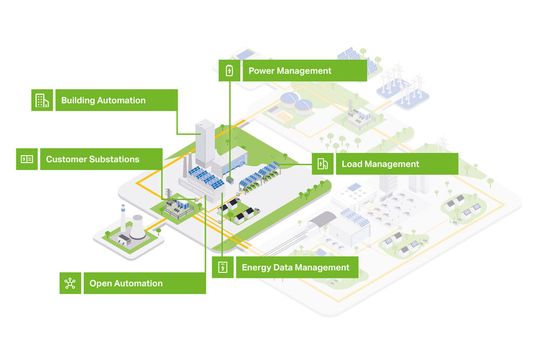
All participants in an industrial infrastructure are integrated and controlled in a so-called microgrid.
(Source: WAGO)
There’s not much time left. The new EU Rule, “Corporate Sustainability Reporting Directive” from the European Commission, which goes into effect in 2025, legally mandates that companies identify and eliminate negative impacts, including environmental effects, caused by their activities. For companies located in the EU, the topic of sustainability has thus become even more important than previously.
The WAGO systems orchestrate generation, consumption and distribution in the plants — based on the microgrid idea.
(Source: WAGO)
In practice, sustainable corporate behavior is very complex, and every single area of a company is affected. It can be just as important to make small adjustments as it is to engage in larger projects. At WAGO, the specific issues addressed range from environmental protection, such as the efficient use of resources, through the reparability and durability of products, to new construction and renovations of existing buildings. These are on an equal footing with sustainability issues, such as employees’ rights, both in-house and at suppliers, and also social and compliance issues.
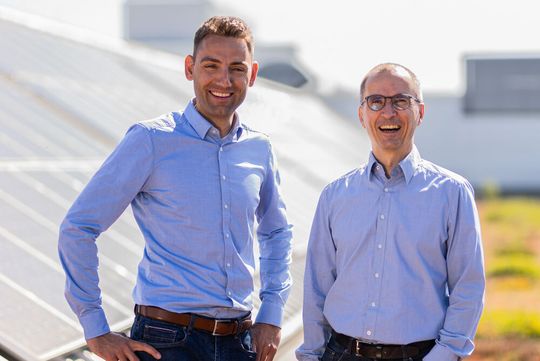
Are responsible for energy topics at WAGO: Lukas Dökel (left) and Achim Zerbst.
(Source: WAGO)
Family companies have traditionally taken a longer-term view, beyond the limits of their quarterly financial statements, and often think sustainably. This is also the case at WAGO in Minden. Supported by the shareholder family, the manufacturer of electrical interconnection and automation technology has been on the path to implementing sustainability principles for many years. This is amply demonstrated by the company’s participation in corresponding initiatives and commitment to securely anchor the concept of sustainability within the corporate strategy.
With regard to resource efficiency and quality improvement, success can also mean energy savings. This extends from product development up to the manufacturing process and logistics. To increase this potential, data must be collected, evaluated and provided in clearly organized dashboards with meaningful key figures. WAGO supports the process industry in collecting detailed energy data from production facilities and office buildings – unlike in the past, which was limited to building or floor-level data, this data collection will be targeted at the level of individual machines and energy consumers. Relevant parameters are thus precisely mapped and included in decision-making processes. In addition, energy consumption data is automatically analyzed to quickly detect anomalies. Within the context of customer projects, production processes can be examined using machine learning methods, which will allow clients to exploit potentials for improvements, waste prevention and energy savings.
At WAGO, those aspects of sustainability that have to do with electrical energy play a special role. This focus has to do with the product portfolio of the family-owned company: WAGO combines the hardware and software they produce with engineering expertise to provide automation to process and manufacturing industries around the world.
Whenever WAGO customers need intelligent automation to produce more efficiently and inexpensively, this fits perfectly with the corporate vision — to be the backbone of a sustainable and intelligently networked world.
Family-owned companies traditionally look far beyond the edges of their quarterly reports and often think sustainably - and WAGO is no exception.
Achim Zerbst, Facility Manager and Chief Energy Manager at WAGO
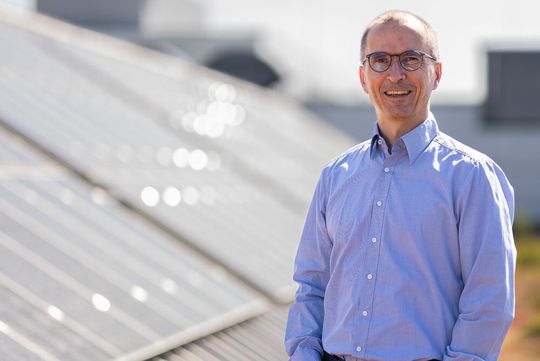
At WAGO, the Energy Management Officer Achim Zerbst takes care of all building and conversion activities that require a planning basis.
(Source: WAGO)
Due to this mix of corporate goals, qualified employees and intelligent products, WAGO can exploit a broad portfolio of knowledge and solutions for its in-house sustainability goals.
“We have been driving energy efficiency forward in production, logistics and the office sector for years – and doing it during ongoing operations,” says Achim Zerbst. As an energy management officer, he is responsible for all construction and conversion activities at WAGO that require a planning basis. With regard to the WAGO portfolio, his function is similar to that of a trained supply technician at an outside company, thus his work is that of an in-house client and driver for environmental protection and sustainability.
For us, energy efficiency is a natural part of our corporate culture, which leads to a list of measures that can be continued indefinitely. We are also directly investing in the local expansion of photovoltaics and wind energy, i.e., truly renewable solutions.
Achim Zerbst, Facility Manager and Chief Energy Manager at WAGO
“One long-term goal at WAGO is greenhouse gas neutrality. Large steps are necessary in relation to this,” states Zerbst. Flexible work schedules, remote work and providing flexibility in office spaces to allow for optimal use of buildings – these are just as important to attitudes and corporate culture as the search for compromise in setting lower temperatures in work spaces. And they are also successful. During the gas shortages of last winter, these measures led to reductions in gas consumption in buildings, including some savings as high as 70 percent.
Potential Savings in Production and Office Buildings
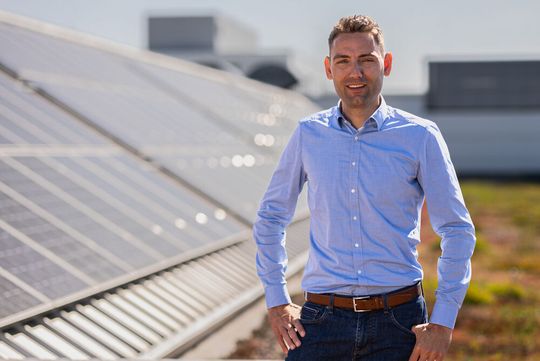
Lukas Dökel, Head of Industry and Key-Account-Management Digital Plant at WAGO
(Source: WAGO)
Efforts are not limited to reducing gas consumption:hydraulic machines used in injection molding are gradually being replaced by electrical ones. Dashboards with key production figures help to increase efficiency in production. Zerbst and his colleagues actively use WAGO’s own product portfolio to achieve their goals.
In the near future, no company will be able to avoid the topic of electrification in its production operations and office buildings. We support users during the conversion of their energy sources, regardless of whether it relates to production, buildings, logistics or e-mobility.
Lukas Dökel, Head of Industry & Key Account Management Digital Plant
For example, the WAGO Automation Solution is used to control lighting in the office spaces and production areas based on the needs and presence of the users, the blinds and shutters are opened and closed depending on the time of day and light incidence, and the air conditioning in work spaces is set at the lower range of the comfort zone.
The optimized interactions between sensors and actuators via centralized or decentralized controllers can save up to 50 percent in operating costs for room lighting, and just over 30 percent for room air conditioning. Measures, which have already been proven at WAGO, can also be applied to other industrial sectors. The extensive portfolio of interface solutions available for bus systems and subsystems in room automation allows for a wide variety of applications.
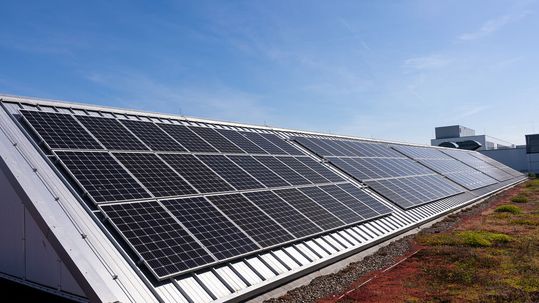
If the proportion of electrical energy in consumption increases as desired, the supply question becomes obvious: Where does the electricity come from? The answer can be found on the roofs of a large number of WAGO locations: WAGO invests in its own photovoltaic systems wherever that is possible, that is, locations where other environmental projects, like green roofs, are not already established or planned. “We already have a 200 kW system on the roof at our headquarters in Minden. In Päpinghausen, near Minden, we have just under 700 kW. At our location in India, we operate a PV system that generates more than one megawatt of power. We have other projects in the pipeline, both in Germany and abroad, that will allow us to assume responsibility for generating our own renewable electricity,” explains Zerbst.
WAGO has been investing in renewable energy generation for many years – the PV system installed on the roof of the Minden headquarters supplies 200 kW.
(Source: WAGO)
Energy Distribution Requires New Regulations
In association with this initiative, WAGO exemplifies the new challenges of a society based on renewable energy. From the rooftops, it is clear that the classic path of power distribution — from the power plant through the energy supplier to the grid connection point — is changing. Lukas Dökel knows how to maintain stability in the grid, despite the volatility caused by decentralized generation of electricity.
As Head of Industry and Key Account Management for Digital Plant at WAGO, he is close to both in-house and external clients. “Renewable energy generation on the hall roof, privately-owned combined heat and power plants and the ever-increasing number of charging stations — the infrastructures have already changed and must be managed differently than before,” says Dökel, adding, “We’re finding the right answers here.”
WAGO has a clear stance on climate compensation measures: we consciously place compensation behind all other measures, and will only provide compensation at those points where alternative solutions can’t be sensibly implemented.
Achim Zerbst, Facility Manager and Chief Energy Manager at WAGO
“In our production, we ensure the intelligent and flexible distribution of energy flows, which work resiliently. Our systems orchestrate the generation, consumption and distribution in the systems — inspired by the microgrid idea,” explains Dökel.
Therefore, he and his colleagues fall back on corresponding solutions to link and control all of the participants in an industrial infrastructure into a so-called microgrid.
The entire system should have appropriate intelligent “contacts”, both in the network and at the individual units. These are also sometimes challenging projects because, depending on conditions at their location, they have to exchange data seamlessly and with low latency over longer distances — as in an efficient microgrid.
“Despite the fact that e-mobility is a positive development, this trend presents challenges at the logistics level.” Dökel addresses another aspect, and WAGO provides yet another example: e-vehicles that require charging are becoming increasingly common, both in the parking lots for employees and those for visitors. The company vehicles are now fully electric. At each location, a growing fleet of e-vehicles — that will require charging in the company parking lot at the beginning of a shift — represents a hurdle for capacity.
To meet these challenges, WAGO provides intelligent charging management to ensure that no vehicle battery is left uncharged and that production continues to run seamlessly through its own peak loads. The key phrase is energy flexibility. Whether at its own locations and those of its clients, WAGO directs the energy supply and consumption flows, balances them out, and determines both how much of its own renewable energy is currently available and the direction of the price for renewable energy on the market.
At the same time, focus remains on how to distribute or reduce the peak load generated by plant operations. WAGO controllers make it easy for users to analyze load distributions during production and to harmonize them with a view toward demand pricing. Due to the ease of integrating WAGO’s load management individual desires and calculations can be taken into account.
Achim Zerbst sees three main product areas as essential for meeting his responsibilities in the future. “If I had to commit to a few selections from the entire spectrum of possibilities, I would choose load management for the charging infrastructure, energy data management for energy and infrastructure monitoring, and lighting management as an optimization potential for lighting control.
There are, of course, many other solutions that also greatly contribute to increased sustainability.” This also includes, for example, the connection of customer transfer stations to the medium-voltage network. This will become even more important in the future, as companies will function both as energy suppliers, and also as load providers for grid stabilization.
This requires communication both within the company and also with the utilities. Lukas Dökel sees challenges in the high levels of complexity found in both data and dependency analysis. “WAGO and our clients are already using analytics solutions to successfully reduce this complexity to recommendations for action.”
Thus, it is the consistent implementation of many smaller and larger measures that aggregates to increased sustainability of complex industrial operations and contributes to the protection of the environment and climate. Companies that approach the topic in this way need not dread environmental social governance reporting, a supply chain law or increasing CO2 prices. Together with partners such as WAGO, every company can play a key role in building a sustainable economy and society.
Feel free to contact us: teamdigitalplant@wago.com
(ID:49672522)
Date: 08.12.2025
Naturally, we always handle your personal data responsibly. Any personal data we receive from you is processed in accordance with applicable data protection legislation. For detailed information please see our privacy policy.
Consent to the use of data for promotional purposes
I hereby consent to Vogel Communications Group GmbH & Co. KG, Max-Planck-Str. 7-9, 97082 Würzburg including any affiliated companies according to §§ 15 et seq. AktG (hereafter: Vogel Communications Group) using my e-mail address to send editorial newsletters. A list of all affiliated companies can be found here
Newsletter content may include all products and services of any companies mentioned above, including for example specialist journals and books, events and fairs as well as event-related products and services, print and digital media offers and services such as additional (editorial) newsletters, raffles, lead campaigns, market research both online and offline, specialist webportals and e-learning offers. In case my personal telephone number has also been collected, it may be used for offers of aforementioned products, for services of the companies mentioned above, and market research purposes.
Additionally, my consent also includes the processing of my email address and telephone number for data matching for marketing purposes with select advertising partners such as LinkedIn, Google, and Meta. For this, Vogel Communications Group may transmit said data in hashed form to the advertising partners who then use said data to determine whether I am also a member of the mentioned advertising partner portals. Vogel Communications Group uses this feature for the purposes of re-targeting (up-selling, cross-selling, and customer loyalty), generating so-called look-alike audiences for acquisition of new customers, and as basis for exclusion for on-going advertising campaigns. Further information can be found in section “data matching for marketing purposes”.
In case I access protected data on Internet portals of Vogel Communications Group including any affiliated companies according to §§ 15 et seq. AktG, I need to provide further data in order to register for the access to such content. In return for this free access to editorial content, my data may be used in accordance with this consent for the purposes stated here. This does not apply to data matching for marketing purposes.
Right of revocation
I understand that I can revoke my consent at will. My revocation does not change the lawfulness of data processing that was conducted based on my consent leading up to my revocation. One option to declare my revocation is to use the contact form found at https://contact.vogel.de. In case I no longer wish to receive certain newsletters, I have subscribed to, I can also click on the unsubscribe link included at the end of a newsletter. Further information regarding my right of revocation and the implementation of it as well as the consequences of my revocation can be found in the data protection declaration, section editorial newsletter.




:quality(80)/p7i.vogel.de/wcms/54/f4/54f4b4e2a86b203e0dfd84221602bdb5/0130367283v2.jpeg "Anybotics' Anymal robot combines depth cameras, LiDAR, thermal imaging, acoustic sensors, and gas detectors into a single inspection round. (Source: Anybotics)")
:quality(80)/p7i.vogel.de/wcms/e9/64/e964996410967c124c2cf01a8623068e/0130285341v1.jpeg "Geht unter die Oberfläche: Die Offshore-Ölförderung erfordert hochenergetische Pumpen – doch diese sind im Wesentlichen eine Black Box. Bisher zumindest. (Source: Kistler Group)")
:quality(80)/p7i.vogel.de/wcms/54/ae/54aece5dff672ce1651470eecd9f2589/0130138090v2.jpeg "The new Ionchromatograph “Nexera IC“ (Source: Shimadzu)")
:quality(80)/p7i.vogel.de/wcms/49/5c/495c651fabd24a437c98bde6a3d71ecc/0130060419v2.jpeg "Enfinium has successfully piloted Wasteer’s groundbreaking visual AI technology at its Ferrybridge 2 facility in West Yorkshire and Parc Adfer facility in North Wales. (Source: Chris Parkes Photographer Ltd.)")
:quality(80)/p7i.vogel.de/wcms/1e/15/1e15b0e20cf5ede83e0749260dfda733/0130465044v2.jpeg "Energy X has recently announced the successful commissioning of a first-of-its-kind, U.S.-based lithium production facility at Project Lonestar, marking a major milestone toward commercial-scale domestic lithium production. (Source: Pixabay)")
:quality(80)/p7i.vogel.de/wcms/36/36/36369e6e59d4c660893cc04a4d257cfc/0130465035v2.jpeg "Wacker has successfully completed the second expansion phase at its production site in Panagarh, India. In addition to silicone rubber, the site now also operates a production complex (left) for silicone emulsions. (Source: Wacker)")
:quality(80)/p7i.vogel.de/wcms/1f/1e/1f1eba3731af22e1d9946e2897f134da/0130464799v2.jpeg "Aerial view of the BASF production site in Zhanjiang, China. (Source: BASF )")
:quality(80)/p7i.vogel.de/wcms/64/bb/64bb4812390b6491ce0bd4fe53597086/0130333812v2.jpeg "The solar power plant produces 30 GWh per year of renewable electricity, which is self-consumed by Holcim’s industrial facilities, making it the largest floating solar power plant in Europe dedicated to self-consumption. (Source: Pixabay)")
:quality(80)/p7i.vogel.de/wcms/41/c9/41c96e0244221ad38daa73bdd8231477/0130477173v2.jpeg "The „ORBITA‑L“-system is designed for filling and capping non‑injectable liquid products. (Source: Marchesini)")
:quality(80)/p7i.vogel.de/wcms/7a/50/7a501f6d8f87a4524dc3aaceb04eacb4/0130333829v2.jpeg "The Clear Lake facility represents Clariant's first U.S. manufacturing site dedicated to producing pharmaceutical-grade PEG excipients, marking a pivotal milestone in the company's healthcare growth strategy. (Source: Clariant)")
:quality(80)/p7i.vogel.de/wcms/26/12/261210e5920899e5c35c4f905d3be8bd/0129399814v2.jpeg "Powders used in DPI formulations are often highly potent and administered in very low doses. (Source: Ima)")
:quality(80)/p7i.vogel.de/wcms/6b/3f/6b3f057c83c494e4732337d870d52b21/0130006927v2.jpeg "Lonza will realize upfront cash proceeds of 2.2 billion dollars and retain a 40 % stake in the business, with additional preferential participation in its future exit. (Source: Lonza)")
:quality(80)/p7i.vogel.de/wcms/df/35/df3526a6f7aba41fdd2bb2051954e0d8/0130163620v2.jpeg "The SPA, valued at more than 3 billion dollars, is one of the largest binding long-term green ammonia off-take agreements globally. (Source: Pixabay)")
:quality(80)/p7i.vogel.de/wcms/af/73/af7394d9f8900024c5ee7fca459c4eeb/0130080328v2.jpeg "Axens has signed a MOU with Airbus to strengthen their cooperation in the development and deployment of SAF, a key pillar for decarbonizing the aviation sector. (Source: Pixabay)")
:quality(80)/p7i.vogel.de/wcms/0e/19/0e19f0cf0379c3af4c2fe02629db63f1/0130079229v2.jpeg "Thyssenkrupp Uhde has been selected by CSBP to deliver its patented Envinox technology for two nitric acid plants at CSBP’s Kwinana site in Western Australia. (Source: Thyssenkrupp Uhde)")
:quality(80)/p7i.vogel.de/wcms/a6/84/a68477d4ef879cc9cedeae332ca57c49/0129893677v2.jpeg "Siemens and Caphenia sign the partnership agreement. From left to right: Nicky Ahnert, Jürgen Giegerich, Frank Knauf (all Siemens), Dr. Mark Misselhorn, Dr. Andreas Waibel (both Caphenia) (Source: Siemens)")
:quality(80)/p7i.vogel.de/wcms/1c/39/1c39433f4bb4de2e5e6c5311c3236d09/0130110254v2.jpeg "The new pumps of the Omega type series have been designed for handling water and fluids with a low solids content efficiently. (Source: KSB)")
:quality(80)/p7i.vogel.de/wcms/be/e1/bee13b8d51a419b9b8f0685e2b9d47bf/0128917673v1.jpeg "The Centerwave 6000 measures pipes from 32 to 1,600 mm. (Source: Maag Group)")
:quality(80)/p7i.vogel.de/wcms/51/7a/517a4e83c5827663b4839f5ddb98f434/0128872953v1.jpeg "The Tigron in SIL version can be flexibly configured for different safety requirements. (Source: Auma)")
:quality(80)/p7i.vogel.de/wcms/60/ef/60efa975d1dd123c1afbfb6ccc060461/0130263955v2.jpeg "Aquaclean (Source: Oko-tech)")
:quality(80)/p7i.vogel.de/wcms/07/62/0762f20b1821ee2724c97989374d6397/0130257651v2.jpeg "Oleksandr Sadchykov in front of the water treatment unit (Source: Grundfos)")
:quality(80)/p7i.vogel.de/wcms/98/98/989863664c7b65e87caf74a08239d487/0130167217v2.jpeg "Keller 26KyX Level Probe (Source: © Keller Pressure)")
:quality(80)/p7i.vogel.de/wcms/64/4e/644e22b71e8d35a63f051f781eb13886/0130163451v2.jpeg "Vega will present level and pressure measurement technology for the water industry at Ifat 2026. (Source: Vega)")
:quality(80)/p7i.vogel.de/wcms/6b/cc/6bcc3d26e1c7c74d90a10bc3ca296ae1/0128362351v2.jpeg "A look into Bayer's new tablet production, Solida 1, during construction: The robots and lift columns for material handling are being installed. (Source: Bayer)")
:quality(80)/p7i.vogel.de/wcms/24/c8/24c84ab6b1bcd24468a87820a07a85aa/0128194707v2.jpeg "Ajax Equipment has supplied Binding Solutions with a feed system comprising buffer hopper, screw feeder and agitated screw feeder for a pilot plant handling iron ore and additives. (Source: Ajax Equipment )")
:quality(80)/p7i.vogel.de/wcms/1d/3e/1d3e2788eb37c1e974f36337c8d33cb5/0128191010v2.jpeg "Ajax Equipment has supplied IGI Systems with a stainless-steel conical hopper with gas purge capability, as part of a prototype Sublimation System for a low-pressure chemical vapour deposition application. (Source: Ajax Equipment)")
:quality(80)/p7i.vogel.de/wcms/19/76/1976928d7d0a2ed7c1eeba7ade8552c8/0126365603v1.jpeg "Detail of Valvedesign: It has an aktiv amd passive part (Bild: Italvacuum)")
:quality(80)/p7i.vogel.de/wcms/0c/a1/0ca135e0486c9af90a0552aea85de88c/0130439525v2.jpeg "Qatar Energy expects the damage to its Ras Laffan Industrial City caused by missile strikes, which occurred on Wednesday 18 March 2026, and in the early hours of Thursday 19 March 2026, to cost about 20 billion dollars a year in lost revenue. (Source: Pixabay)")
:quality(80)/p7i.vogel.de/wcms/d0/f7/d0f7d560dfce37c8371442d5b6120e3c/0130182478v1.jpeg "The Gelsenkirchen refinery primarily manufactures fuels for vehicles and aircraft, processing roughly 12 million tonnes of crude oil per year. (Source: BP)")
:quality(80)/p7i.vogel.de/wcms/7f/96/7f9628e43c99564fa6dfd8e76149425d/0130165852v2.jpeg "Pure titanium recycling process for chlor-alkali electrolysis cells. (Source: Asahi Kasei)")
:quality(80)/p7i.vogel.de/wcms/f8/29/f8298429c1638b949a6f76346f6709c7/0118701710v2.jpeg "Bosch Industrial Heat will be presenting sustainable steam and heat solutions for global industrial use at the Achema trade fair in Frankfurt, Germany. (Source: Bosch Industriekessel)")
:quality(80)/p7i.vogel.de/wcms/07/24/07242664ab2b1c7841c9d9d0a127670c/0116045959.jpeg "A look inside the GEA machine room. (Bild: Magnavale)")
:quality(80)/p7i.vogel.de/wcms/c9/79/c979a20b32395ddfa93fe7ead90578a0/0108386061.jpeg "Production residues, lime, salt and suspended solids quickly clog the pipes. (Source:©Tanakorn - stock.adobe.com)")
:quality(80)/p7i.vogel.de/wcms/9e/5c/9e5c92d942ed046a27562d6e3d730c92/0103483548.jpeg "It is almost ten metres high and extends over three floors: the world's first multiple dividing wall column is located in the new technical centre at the University of Ulm. (Bild: Eberhardt, kiz Universität Ulm)")
:quality(80)/p7i.vogel.de/wcms/7c/77/7c77e24fdcc9e1511e8e711eff161e28/0130175489v2.jpeg "The milestone confirms the fast pace of development of Eni’s deep water gas projects offshore East Kalimantan. (Source: Unsplash )")
:quality(80)/p7i.vogel.de/wcms/b3/2f/b32fb9f5aa54e9cb6c92e4b6c8665263/0130163018v2.jpeg "The decision to take emergency collective action was made following an extraordinary meeting of IEA Member governments, convened by the IEA Executive Director to assess market conditions amid the conflict in the Middle East and consider the options to address supply disruptions. (Source: © Sashkin - stock.adobe.com)")
:quality(80)/p7i.vogel.de/wcms/85/d2/85d2cb02c4ae45a99454b5405b0f2489/0130149909v2.jpeg "IEA Executive Director Fatih Birol issued a statement on the meeting of G7 Energy Ministers at its IEA headquarters in Paris. (Source: © Marko - stock.adobe.com)")
:quality(80)/p7i.vogel.de/wcms/a8/4e/a84e8039a90a5cf4751d01ebcf6ba1a9/0127510172v2.jpeg "After six years, Achemasia, the international trade fair and innovation forum for sustainable chemical production, has returned with renewed vigor, bringing together global expertise, Chinese innovation, and a shared commitment to a greener industrial future—according to the organizers of the fair. (Source:PROCESS China)")
:quality(80)/p7i.vogel.de/wcms/17/c7/17c703445f134eb3d7ecc7918dda2762/0124596096v2.jpeg "Achema Middle East will launch in Saudi Arabia in 2026. (Bild: Dechema/ Hannibal)")
:quality(80)/p7i.vogel.de/wcms/2a/2c/2a2cffc07f51019065387cd63241b5ce/0119463370v1.jpeg "The Injecta 36 fills and seals RTU (Ready-to-Use) syringes at high speed. The image shows the robotic arm. (Source: IMA)")
:quality(80)/p7i.vogel.de/wcms/b1/7e/b17ea8c62ccafad1d1fb072d6199bbd6/0118578446.jpeg "“Star in the ring”: Vegapuls 6X radar level sensors are the solution of choice for Renolit for many applications on the way to the perfect plastic product. (Source: © MR Design - stock.adobe.com; Vega)")
:quality(80)/p7i.vogel.de/wcms/09/e3/09e378194b496921d2a267a6752322eb/0130333473v2.jpeg "Under the terms of the contract, KBR will provide contract management, project management and supporting technical services throughout the EPC phases of the project. (Source: KBR)")
:quality(80)/p7i.vogel.de/wcms/77/9d/779db435e7f9d79bafe16101008a9cfa/0130263548v2.jpeg "The Kingdom of Saudi Arabia, the UAE and Turkey are three core countries in the region that are actively incorporating the plastics circular economy with the assistance of the chemical recycling technology. (Source: © Anastasiia - stock.adobe.com)")

:quality(80)/p7i.vogel.de/wcms/6b/cc/6bcc3d26e1c7c74d90a10bc3ca296ae1/0128362351v2.jpeg "A look into Bayer's new tablet production, Solida 1, during construction: The robots and lift columns for material handling are being installed. (Source: Bayer)")
:quality(80)/p7i.vogel.de/wcms/11/10/11101ac5360146f5f222aa3dd14788fe/0127051066v2.jpeg "The Thermopress double belt system offers a wide range of options, including the integration of scattering systems (blue and white box on the left-hand side). (Source: IPCO)")