Whether for the sealing of dams or as a decorative upholstery material for furniture: Plastic films as well as other plastic products from Renolit stand for maximum functionality. To ensure that this remains true in the future, the company continuously optimises its production processes. And it does this by utilising Vega sensors for level, flow and pressure.
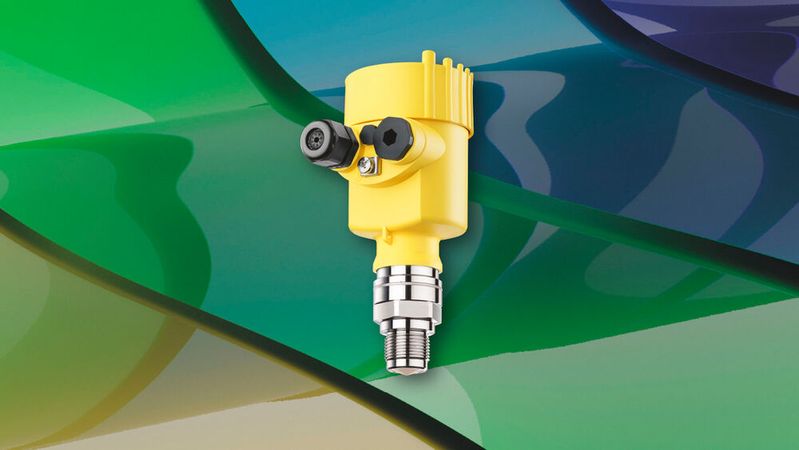
“Star in the ring”: Vegapuls 6X radar level sensors are the solution of choice for Renolit for many applications on the way to the perfect plastic product.
Some companies have efficiency as part of their DNA, and that’s the case at Renolit. The manufacturer of plastic films and other plastic products is making enormous efforts to improve the efficiency and effectiveness of its production systems. This enables it to create products that are guaranteed to last longer, use fewer resources and support a closed-loop economy.
It’s worth noting that the foundation for these futuristic-sounding goals was laid back in 1946, when resources were scarcer than ever. The first person to set standards here was Jakob Müller. When he founded Renolit post-war in the town of Worms, Germany, which was plagued by shortages of all kinds, the previously successful leather goods manufacturer was forced to look for alternative materials to replace leather. His contemporaries attested to his “foresight and profound knowledge” because he not only found a practical substitute in PVC, but also used the material to penetrate other new markets. That was the birth of the first floor coverings and films “made by Renolit”.
A lot has happened since then, but the search for efficiency runs like a common thread through the company’s history. Not because the raw materials are scarce, but because there is no alternative to sustainability. The Operational Excellence (OpEx) department, which is committed to the process of continuous improvement, is a key area of the company in charting the path towards this goal. At the Worms site, Andreas Böhm is responsible for recording process and energy data, among other things. He works to maximize plant availability and sees his work as a logical consequence of the same spirit of efficiency that drove founder Jakob Müller. “If we scrutinise our processes thoroughly and go into great detail, we always come across worthwhile savings ideas,” he says.
Custom-Made Plastics
Manufactured for special applications in many cases, plastic film is a product of almost unimaginable variety. Its properties can be configured exactly according to customer requirements through the use of additives and development under carefully controlled synthesis conditions. “In this sense, we’re a manufacturer of the much-vaunted ‘batch size 1’,” explains Böhm, highlighting the flexibility of Renolit’s production processes. Renolit products are almost never purchased “off the shelf” because they are always manufactured according to what best meets the customer’s needs. Some of the end products feature pleasantly tactile embossing, some are especially hygienic, and some are so finely homogeneous that no moss can stick to them, even when used outdoors for a long time.
Because production requires highly precise dosing of the base materials, such as polymers, additives or colourants, under constant process and environmental conditions, Vega radar sensors are utilised: for example, on IBC containers, that hold the raw materials to be processed. Thanks to radar technology, precise level monitoring of such containers is made from the outside, without the plastic tank body being opened or modified.
Experienced in measurement and control technology, Andreas Böhm was actively involved in his employer’s selection of a partner for industrial measurement technology. “When I started working here in Worms 16 years ago, I already knew Vega from my previous job,” he recalls. “In my very first week here, I won a bet because I managed to get a process measurement that was always inaccurate to work reliably with a Vega radar sensor.”
In Böhm’s opinion, radar level sensors are the solution of choice for many applications in this industry, as they help to deliver a perfect finished plastic product. Böhm is delighted that the Vegapuls 6X is a universal sensor that can monitor a wide variety of measuring points. In the preparation area, on the second floor of the production building, it is precisely this sensor model that immediately catches the eye, as it monitors the filling of paste. Andreas Böhm points to the mobile, 1000-litre plastic containers, which are almost one quarter full of amber-coloured liquid. Vegapuls 6X sensors are mounted near the inlet. As the containers are filled with the paste-like mass, the radar sensor transmits and receives back microwave pulses to measure the distance to the level by their transit times. By comparing the distance measurement with the calibration values, the exact level is determined. This ensures that the correct amounts are measured and filled into the vessels all times.
Procurement Has Become Much Easier
“It’s a big advantage for us,” says Böhm, “that the sensor measures both liquids in the small IBCs and bulk solids in tall bulk containers outdoors with millimeter precision.” He’s referring to 12 slender outdoor silos, each with a capacity of 200 cubic meters, which are located directly in front of the doors of Plant A. “We use the same sensors on these silos as we do on the small process tanks in the production lines,” he notes. These metal cylinders, which can be up to 23 meters high, store powdered bulk solid materials that are fed into the production process to produce plastic film using calendering machines. “Since we started using the Vegapuls 6X universally for our inventory monitoring, procurement has become much easier for us,” says Böhm, summarising the improved processes. Although the configuration and the materials in the silos vary depending on the specific product requirements, it is always important that the materials used are optimally stocked so that production runs efficiently and without interruption.
Since we started using the Vegapuls 6X universally for our inventory monitoring, procurement has become much easier for us.
Andreas Böhm, Operational Excellence department, Renolit
Saving Energy With Flow Measurement
But it’s not just the optimal stocking of raw materials that offers a savings potential that’s noticeable on the bottom line. “Energy metering is becoming increasingly important to us,” says Andreas Böhm, describing one of the goals of the OpEx department. He’s referring to the more than 300 meters in the PVC film production area that record all the electrical energy currently being consumed. The savings potential here is enormous: “The plastics industry is energy-intensive and we have every intention of achieving CO2-neutral production by 2045.” With its “One Renolit 2025” strategy, the company is part of the Circular Plastics Alliance (CPA) and has committed itself to the closed-loop economy.
To save energy, they use three differential pressure transmitter Vegadif 85 pressure sensors to measure the differential pressure in the temperature control units of the calender rollers. The flow of the heating water is closely monitored to ensure the required product quality. “We use water at a maximum temperature of 200 °C to keep the process at the right temperature,” explains Böhm. This means that the process runs under optimal conditions — and the measurement also results in significant energy savings: “The precise flow measurement with Vegadif 85 guarantees that our thermal energy consumption is precisely adapted to demand.”
Sensor Replacement During the Ongoing Process
In his daily work, Andreas Böhm is also highly satisfied with the “gate valve solution” that he found together with the Vega field representative. Since the measuring instruments are each mounted with a gate valve, they can be serviced or replaced at any time without having to interrupt the process.
The special double-chamber electronics of the differential pressure measuring system offers further savings potential. With one Vegadif 85 sensor, the static pressure and the differential pressure process values can be measured simultaneously. This is a real user benefit as monitoring the static pressure is also important for optimal process flow in the calender. Thanks to the this dual output feature of Vegadif, an additional sensor is not required.
The Improvement Detectives
“This part of the plant consumes a huge amount of energy” says Andreas Böhm, “so the better we measure and regulate here, the greater our savings.” Just the addition of new software modules alone, which optimize the standby mode of all electrical devices, has reduced energy loss by 60 %. To reduce consumption even further, he leaves no stone unturned when it comes to optimizing the remaining ‘energy guzzlers’ such as cooling and heating processes. He’s convinced that “you can only achieve quality by implementing quality”. That’s why he plans to continue relying on high-quality measurement technology in the future. A technology that delivers exact, reliable measured values that show where and when the production took place, and at what temperatures and speeds, is what ultimately makes end products traceable.
“Considering all this, we can say that well-monitored processes are, above all, one thing,” says Böhm emphatically: “Customer friendly”. Traceability and reproducibility are key factors for users of Renolit products. And the fact that the manufacturing processes are also low-emission and often even plastic-neutral is, of course, a highly welcome side benefit.
Meet the Vega experts at Achema 2024 in Frankfurt a. Main (10.-14.6.): Hall 11.1, Booth C63.
Naturally, we always handle your personal data responsibly. Any personal data we receive from you is processed in accordance with applicable data protection legislation. For detailed information please see our privacy policy.
Consent to the use of data for promotional purposes
I hereby consent to Vogel Communications Group GmbH & Co. KG, Max-Planck-Str. 7-9, 97082 Würzburg including any affiliated companies according to §§ 15 et seq. AktG (hereafter: Vogel Communications Group) using my e-mail address to send editorial newsletters. A list of all affiliated companies can be found here
Newsletter content may include all products and services of any companies mentioned above, including for example specialist journals and books, events and fairs as well as event-related products and services, print and digital media offers and services such as additional (editorial) newsletters, raffles, lead campaigns, market research both online and offline, specialist webportals and e-learning offers. In case my personal telephone number has also been collected, it may be used for offers of aforementioned products, for services of the companies mentioned above, and market research purposes.
Additionally, my consent also includes the processing of my email address and telephone number for data matching for marketing purposes with select advertising partners such as LinkedIn, Google, and Meta. For this, Vogel Communications Group may transmit said data in hashed form to the advertising partners who then use said data to determine whether I am also a member of the mentioned advertising partner portals. Vogel Communications Group uses this feature for the purposes of re-targeting (up-selling, cross-selling, and customer loyalty), generating so-called look-alike audiences for acquisition of new customers, and as basis for exclusion for on-going advertising campaigns. Further information can be found in section “data matching for marketing purposes”.
In case I access protected data on Internet portals of Vogel Communications Group including any affiliated companies according to §§ 15 et seq. AktG, I need to provide further data in order to register for the access to such content. In return for this free access to editorial content, my data may be used in accordance with this consent for the purposes stated here. This does not apply to data matching for marketing purposes.
Right of revocation
I understand that I can revoke my consent at will. My revocation does not change the lawfulness of data processing that was conducted based on my consent leading up to my revocation. One option to declare my revocation is to use the contact form found at https://contact.vogel.de. In case I no longer wish to receive certain newsletters, I have subscribed to, I can also click on the unsubscribe link included at the end of a newsletter. Further information regarding my right of revocation and the implementation of it as well as the consequences of my revocation can be found in the data protection declaration, section editorial newsletter.




:quality(80)/p7i.vogel.de/wcms/e9/64/e964996410967c124c2cf01a8623068e/0130285341v1.jpeg "Geht unter die Oberfläche: Die Offshore-Ölförderung erfordert hochenergetische Pumpen – doch diese sind im Wesentlichen eine Black Box. Bisher zumindest. (Source: Kistler Group)")
:quality(80)/p7i.vogel.de/wcms/54/ae/54aece5dff672ce1651470eecd9f2589/0130138090v2.jpeg "The new Ionchromatograph “Nexera IC“ (Source: Shimadzu)")
:quality(80)/p7i.vogel.de/wcms/49/5c/495c651fabd24a437c98bde6a3d71ecc/0130060419v2.jpeg "Enfinium has successfully piloted Wasteer’s groundbreaking visual AI technology at its Ferrybridge 2 facility in West Yorkshire and Parc Adfer facility in North Wales. (Source: Chris Parkes Photographer Ltd.)")
:quality(80)/p7i.vogel.de/wcms/77/1c/771c3d385d46ede7ab736f3f7d63cb62/0130007313v2.jpeg "The laser perforated filter elements for Eaton’s DCF series enable retention ratings that were previously unattainable with conventional manufacturing methods. Thanks to automatic self-cleaning, they also provide uninterrupted operation with long service life and minimal maintenance requirements. (Source: Eaton )")
:quality(80)/p7i.vogel.de/wcms/64/bb/64bb4812390b6491ce0bd4fe53597086/0130333812v2.jpeg "The solar power plant produces 30 GWh per year of renewable electricity, which is self-consumed by Holcim’s industrial facilities, making it the largest floating solar power plant in Europe dedicated to self-consumption. (Source: Pixabay)")
:quality(80)/p7i.vogel.de/wcms/32/06/320643bfb6b509933012a2fd9c42504d/0130333498v2.jpeg "BASF’s X3D catalysts combine high mechanical stability with an open structure. (Source: BASF)")
:quality(80)/p7i.vogel.de/wcms/1b/ca/1bca61c846359bfd9e7998fb30b662c6/0130333482v2.jpeg "Total Energies has launched France’s first advanced plastics recycling plant, with an annual capacity of 15,000 tons, at its Grandpuits site southeast of Paris. (Source: Pixabay)")
:quality(80)/p7i.vogel.de/wcms/09/e3/09e378194b496921d2a267a6752322eb/0130333473v2.jpeg "Under the terms of the contract, KBR will provide contract management, project management and supporting technical services throughout the EPC phases of the project. (Source: KBR)")
:quality(80)/p7i.vogel.de/wcms/7a/50/7a501f6d8f87a4524dc3aaceb04eacb4/0130333829v2.jpeg "The Clear Lake facility represents Clariant's first U.S. manufacturing site dedicated to producing pharmaceutical-grade PEG excipients, marking a pivotal milestone in the company's healthcare growth strategy. (Source: Clariant)")
:quality(80)/p7i.vogel.de/wcms/26/12/261210e5920899e5c35c4f905d3be8bd/0129399814v2.jpeg "Powders used in DPI formulations are often highly potent and administered in very low doses. (Source: Ima)")
:quality(80)/p7i.vogel.de/wcms/6b/3f/6b3f057c83c494e4732337d870d52b21/0130006927v2.jpeg "Lonza will realize upfront cash proceeds of 2.2 billion dollars and retain a 40 % stake in the business, with additional preferential participation in its future exit. (Source: Lonza)")
:quality(80)/p7i.vogel.de/wcms/df/cd/dfcd0c2e0eb4b554f956e0161ae08519/0129794328v1.jpeg "The plasma fractionation facility at CSL Behring, viewed from the outside. (Source: CSL Behring)")
:quality(80)/p7i.vogel.de/wcms/df/35/df3526a6f7aba41fdd2bb2051954e0d8/0130163620v2.jpeg "The SPA, valued at more than 3 billion dollars, is one of the largest binding long-term green ammonia off-take agreements globally. (Source: Pixabay)")
:quality(80)/p7i.vogel.de/wcms/af/73/af7394d9f8900024c5ee7fca459c4eeb/0130080328v2.jpeg "Axens has signed a MOU with Airbus to strengthen their cooperation in the development and deployment of SAF, a key pillar for decarbonizing the aviation sector. (Source: Pixabay)")
:quality(80)/p7i.vogel.de/wcms/0e/19/0e19f0cf0379c3af4c2fe02629db63f1/0130079229v2.jpeg "Thyssenkrupp Uhde has been selected by CSBP to deliver its patented Envinox technology for two nitric acid plants at CSBP’s Kwinana site in Western Australia. (Source: Thyssenkrupp Uhde)")
:quality(80)/p7i.vogel.de/wcms/a6/84/a68477d4ef879cc9cedeae332ca57c49/0129893677v2.jpeg "Siemens and Caphenia sign the partnership agreement. From left to right: Nicky Ahnert, Jürgen Giegerich, Frank Knauf (all Siemens), Dr. Mark Misselhorn, Dr. Andreas Waibel (both Caphenia) (Source: Siemens)")
:quality(80)/p7i.vogel.de/wcms/1c/39/1c39433f4bb4de2e5e6c5311c3236d09/0130110254v2.jpeg "The new pumps of the Omega type series have been designed for handling water and fluids with a low solids content efficiently. (Source: KSB)")
:quality(80)/p7i.vogel.de/wcms/be/e1/bee13b8d51a419b9b8f0685e2b9d47bf/0128917673v1.jpeg "The Centerwave 6000 measures pipes from 32 to 1,600 mm. (Source: Maag Group)")
:quality(80)/p7i.vogel.de/wcms/51/7a/517a4e83c5827663b4839f5ddb98f434/0128872953v1.jpeg "The Tigron in SIL version can be flexibly configured for different safety requirements. (Source: Auma)")
:quality(80)/p7i.vogel.de/wcms/60/ef/60efa975d1dd123c1afbfb6ccc060461/0130263955v2.jpeg "Aquaclean (Source: Oko-tech)")
:quality(80)/p7i.vogel.de/wcms/07/62/0762f20b1821ee2724c97989374d6397/0130257651v2.jpeg "Oleksandr Sadchykov in front of the water treatment unit (Source: Grundfos)")
:quality(80)/p7i.vogel.de/wcms/98/98/989863664c7b65e87caf74a08239d487/0130167217v2.jpeg "Keller 26KyX Level Probe (Source: © Keller Pressure)")
:quality(80)/p7i.vogel.de/wcms/64/4e/644e22b71e8d35a63f051f781eb13886/0130163451v2.jpeg "Vega will present level and pressure measurement technology for the water industry at Ifat 2026. (Source: Vega)")
:quality(80)/p7i.vogel.de/wcms/6b/cc/6bcc3d26e1c7c74d90a10bc3ca296ae1/0128362351v2.jpeg "A look into Bayer's new tablet production, Solida 1, during construction: The robots and lift columns for material handling are being installed. (Source: Bayer)")
:quality(80)/p7i.vogel.de/wcms/24/c8/24c84ab6b1bcd24468a87820a07a85aa/0128194707v2.jpeg "Ajax Equipment has supplied Binding Solutions with a feed system comprising buffer hopper, screw feeder and agitated screw feeder for a pilot plant handling iron ore and additives. (Source: Ajax Equipment )")
:quality(80)/p7i.vogel.de/wcms/1d/3e/1d3e2788eb37c1e974f36337c8d33cb5/0128191010v2.jpeg "Ajax Equipment has supplied IGI Systems with a stainless-steel conical hopper with gas purge capability, as part of a prototype Sublimation System for a low-pressure chemical vapour deposition application. (Source: Ajax Equipment)")
:quality(80)/p7i.vogel.de/wcms/19/76/1976928d7d0a2ed7c1eeba7ade8552c8/0126365603v1.jpeg "Detail of Valvedesign: It has an aktiv amd passive part (Bild: Italvacuum)")
:quality(80)/p7i.vogel.de/wcms/d0/f7/d0f7d560dfce37c8371442d5b6120e3c/0130182478v1.jpeg "The Gelsenkirchen refinery primarily manufactures fuels for vehicles and aircraft, processing roughly 12 million tonnes of crude oil per year. (Source: BP)")
:quality(80)/p7i.vogel.de/wcms/7f/96/7f9628e43c99564fa6dfd8e76149425d/0130165852v2.jpeg "Pure titanium recycling process for chlor-alkali electrolysis cells. (Source: Asahi Kasei)")
:quality(80)/p7i.vogel.de/wcms/4e/27/4e2797cb610f686f13355a5957190d92/0130164068v2.jpeg "Bilfinger experts install and inspect Electrical, Instrumentation and Control systems at customer sites. (Source: Bilfinger)")
:quality(80)/p7i.vogel.de/wcms/f8/29/f8298429c1638b949a6f76346f6709c7/0118701710v2.jpeg "Bosch Industrial Heat will be presenting sustainable steam and heat solutions for global industrial use at the Achema trade fair in Frankfurt, Germany. (Source: Bosch Industriekessel)")
:quality(80)/p7i.vogel.de/wcms/07/24/07242664ab2b1c7841c9d9d0a127670c/0116045959.jpeg "A look inside the GEA machine room. (Bild: Magnavale)")
:quality(80)/p7i.vogel.de/wcms/c9/79/c979a20b32395ddfa93fe7ead90578a0/0108386061.jpeg "Production residues, lime, salt and suspended solids quickly clog the pipes. (Source:©Tanakorn - stock.adobe.com)")
:quality(80)/p7i.vogel.de/wcms/9e/5c/9e5c92d942ed046a27562d6e3d730c92/0103483548.jpeg "It is almost ten metres high and extends over three floors: the world's first multiple dividing wall column is located in the new technical centre at the University of Ulm. (Bild: Eberhardt, kiz Universität Ulm)")
:quality(80)/p7i.vogel.de/wcms/7c/77/7c77e24fdcc9e1511e8e711eff161e28/0130175489v2.jpeg "The milestone confirms the fast pace of development of Eni’s deep water gas projects offshore East Kalimantan. (Source: Unsplash )")
:quality(80)/p7i.vogel.de/wcms/b3/2f/b32fb9f5aa54e9cb6c92e4b6c8665263/0130163018v2.jpeg "The decision to take emergency collective action was made following an extraordinary meeting of IEA Member governments, convened by the IEA Executive Director to assess market conditions amid the conflict in the Middle East and consider the options to address supply disruptions. (Source: © Sashkin - stock.adobe.com)")
:quality(80)/p7i.vogel.de/wcms/85/d2/85d2cb02c4ae45a99454b5405b0f2489/0130149909v2.jpeg "IEA Executive Director Fatih Birol issued a statement on the meeting of G7 Energy Ministers at its IEA headquarters in Paris. (Source: © Marko - stock.adobe.com)")
:quality(80)/p7i.vogel.de/wcms/a8/4e/a84e8039a90a5cf4751d01ebcf6ba1a9/0127510172v2.jpeg "After six years, Achemasia, the international trade fair and innovation forum for sustainable chemical production, has returned with renewed vigor, bringing together global expertise, Chinese innovation, and a shared commitment to a greener industrial future—according to the organizers of the fair. (Source:PROCESS China)")
:quality(80)/p7i.vogel.de/wcms/17/c7/17c703445f134eb3d7ecc7918dda2762/0124596096v2.jpeg "Achema Middle East will launch in Saudi Arabia in 2026. (Bild: Dechema/ Hannibal)")
:quality(80)/p7i.vogel.de/wcms/2a/2c/2a2cffc07f51019065387cd63241b5ce/0119463370v1.jpeg "The Injecta 36 fills and seals RTU (Ready-to-Use) syringes at high speed. The image shows the robotic arm. (Source: IMA)")
:quality(80)/p7i.vogel.de/wcms/b1/7e/b17ea8c62ccafad1d1fb072d6199bbd6/0118578446.jpeg "“Star in the ring”: Vegapuls 6X radar level sensors are the solution of choice for Renolit for many applications on the way to the perfect plastic product. (Source: © MR Design - stock.adobe.com; Vega)")
:quality(80)/p7i.vogel.de/wcms/77/9d/779db435e7f9d79bafe16101008a9cfa/0130263548v2.jpeg "The Kingdom of Saudi Arabia, the UAE and Turkey are three core countries in the region that are actively incorporating the plastics circular economy with the assistance of the chemical recycling technology. (Source: © Anastasiia - stock.adobe.com)")
:quality(80)/p7i.vogel.de/wcms/a0/a3/a0a3cec0d4f46ed33f66ac24b1e03938/0130149916v2.jpeg "Bapco Energies serves notice of Force Majeure on its Group operations. (Source: © Design_Stock - stock.adobe.com)")
:fill(fff,0)/p7i.vogel.de/companies/68/24/68245db33945f/l-vega-rgb.png "l-vega-rgb (VEGA)")
:quality(80)/p7i.vogel.de/wcms/94/70/94707a59f505134f398bc36335de3147/0118281518.jpeg "One for all: At the extensive premises of Renolit in Worms, these outdoor silos stand strikingly tall, each with a capacity of 200 cubic metres. The product levels inside are monitored by the very same Vegapuls 6X radar sensors that are used on the small process tanks in the production lines.(Source: Vega)")
:quality(80)/p7i.vogel.de/wcms/26/10/26107048fed2c10b25f4249a732fc611/0118281528.jpeg "Because the production of plastic films requires consistent process conditions, Vegavib 63 level switches are installed on the bulk solids containers to signal the minimum and maximum levels. Thanks to the compact rod probe of the sensor, the measurement remains reliable even with low bulk densities and changing media.(Source: Vega)")
:quality(80)/p7i.vogel.de/wcms/7a/83/7a83d8df62434aaae73c619e3b5ed4a2/0118281520.jpeg "Double security: On this process vessel, a Vegaflex 81 guided radar sensor and a Vegaswing 63 vibrating level switch ensure precise interface measurement and reliable overfill protection at the same time.(Source: Vega)")
:quality(80)/p7i.vogel.de/wcms/03/9c/039c7bb9f79f07d5fd7558b9b1f41132/0118281519.jpeg "During calendering, the plastic is fed through a system of multiple rollers and can thus be transformed into a film and shaped in a wide variety of ways: from embossing to optimising the physical properties of the material by stretching.(Source: Vega)")
:quality(80)/p7i.vogel.de/wcms/64/8f/648fb91091c29afe44c32aaa18d2174e/0125819903v2.jpeg "Compact, attractively priced and technologically superior, the sensors are setting a clear trend in process automation. (Source: Vega )")
:quality(80)/p7i.vogel.de/wcms/b0/91/b091a2adbf615d2dc8fba812c3130693/0125912213v2.jpeg "The Ondosense apex Level Line radar sensor enables high-precision and fast level measurements in harsh industrial environments. (Source: © Ondosense)")