Natural gas pipelines, hydrogen, drinking water or CO2 capture — you can’t do it without pumps, valves and compressors. At the same time, fluid systems have a reputation for being energy- and maintenance-intensive cost traps. With fluid technology becoming networked and the threat of a PFAS ban looming, the industry is looking for new approaches.
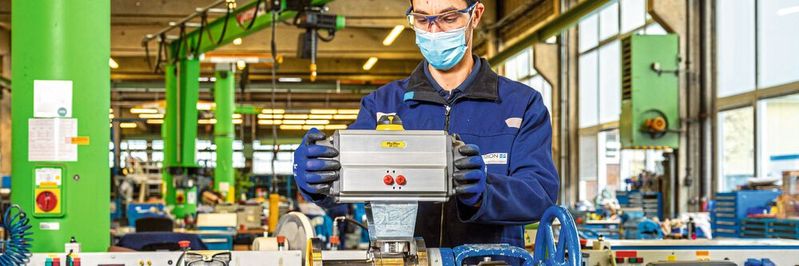
Almost as sought after as pumps and fittings: fluidics specialists and maintenance experts. Here is a Tectrion specialist working on a Pfeiffer fitting.
Pumps — and, of course, compressors — are energy-hungry units: it is estimated that around a quarter of all the electricity consumed by industry is used to pump fluids. In terms of global electricity production, this represents ten percent of the world’s total — meaning that one in ten power stations is in operation just to provide the energy needed to move liquids from point A to point B.
This is not always efficient: in particular, improperly dimensioned, worn or poorly controlled pumps, as well as inefficient compressors and compressed air leaks, are known to be huge energy wasters. In addition, pumps are often oversized due to ignorance or uncertainty. As a result, the units operate outside their optimum efficiency, have to be throttled, and wear out more quickly. However, the consistent use of modern speed control systems could help to save 7.5 terawatt hours of energy and four million tonnes of CO2 emissions each year in Germany alone. Thanks to the lower energy consumption of controlled drives, improved impeller geometries or smaller clearances, the extra cost of new equipment is quickly amortised.
Another factor to consider is the enormous burden of high energy prices, particularly for companies with a high degree of upstream integration: Production processes such as the casting of machine parts or the testing of large pumps are expensive, with energy requirements in the megawatt range and huge costs for electricity and gas, experts warn — and they point out that, unlike consumers, industrial companies do not benefit from fixed price guarantees. Energy and cost optimisation will therefore not only be part of the product development specifications for pump manufacturers in 2023, but also at the heart of their own manufacturing processes.
The prevailing influence of energy efficiency is also reflected in the fact that the industry associations such as Germany’s Engineering Federation (VDMA) see the greatest potential for digital tools in this area. After all, a lot is happening in terms of Fluidics 4.0: The asset administration shell could finally bring the concept of the digital twin to life. Pumps, compressors, vacuum pumps and even connected fittings can now be specified in such a way that this information can be read and used by everyone involved in the process. OPC UA Companion Specifications are also available to ensure interoperability between components from different manufacturers.
Digital solutions also score when it comes to leak detection: Acoustic cameras combine ultrasonic sensors with optical imaging to detect leaks in pipelines or compressed air systems. Manufacturers such as FLIR are taking this a step further by integrating gas analysis into so-called gas cameras. These cameras not only detect leaks, but also identify the corresponding gas. Today, such units are small enough to be available as handheld devices, but they can also be permanently installed at critical points within an industrial production process.
In addition to efficient drives and precise controls, more and more suppliers are using methods such as software-based anomaly detection, in which an algorithm examines current operating conditions. Based on these values, the software can make predictions about future malfunctions or anomalies and suggest appropriate measures. According to the VDMA, predictive maintenance could prevent around 70 percent of unplanned shutdowns.
Most common digital technologies currently used by the oil & gas industry worldwide as of 2020
There are growing calls for the integration of condition monitoring, even for relatively simple components such as valves and even seals. This is not easy when the necessary sensor technology also has to work in a hazardous area, for example. Even mechanical seals are making the leap into the digital world with products such as EagleBurgmann’s wireless Smart Seal sensors.
Operators are increasingly unwilling to take risks, especially when dealing with explosive or hazardous substances. Sealless magnetically coupled pumps are therefore in great demand, especially because manufacturers such as Richter Chemie-Technik supply them with wetted parts or linings made of PFA or PTFE. However, because the magnetic force can only transmit a certain amount of torque, a full-length shaft is sometimes essential — this can be made even tighter, for example with leak-free mechanical seals from EagleBurgmann. The nitrogen-flushed sealing solutions are used in compressor stations for natural gas pipelines, where they prevent the escape of the greenhouse gas methane.
Date: 08.12.2025
Naturally, we always handle your personal data responsibly. Any personal data we receive from you is processed in accordance with applicable data protection legislation. For detailed information please see our privacy policy.
Consent to the use of data for promotional purposes
I hereby consent to Vogel Communications Group GmbH & Co. KG, Max-Planck-Str. 7-9, 97082 Würzburg including any affiliated companies according to §§ 15 et seq. AktG (hereafter: Vogel Communications Group) using my e-mail address to send editorial newsletters. A list of all affiliated companies can be found here
Newsletter content may include all products and services of any companies mentioned above, including for example specialist journals and books, events and fairs as well as event-related products and services, print and digital media offers and services such as additional (editorial) newsletters, raffles, lead campaigns, market research both online and offline, specialist webportals and e-learning offers. In case my personal telephone number has also been collected, it may be used for offers of aforementioned products, for services of the companies mentioned above, and market research purposes.
Additionally, my consent also includes the processing of my email address and telephone number for data matching for marketing purposes with select advertising partners such as LinkedIn, Google, and Meta. For this, Vogel Communications Group may transmit said data in hashed form to the advertising partners who then use said data to determine whether I am also a member of the mentioned advertising partner portals. Vogel Communications Group uses this feature for the purposes of re-targeting (up-selling, cross-selling, and customer loyalty), generating so-called look-alike audiences for acquisition of new customers, and as basis for exclusion for on-going advertising campaigns. Further information can be found in section “data matching for marketing purposes”.
In case I access protected data on Internet portals of Vogel Communications Group including any affiliated companies according to §§ 15 et seq. AktG, I need to provide further data in order to register for the access to such content. In return for this free access to editorial content, my data may be used in accordance with this consent for the purposes stated here. This does not apply to data matching for marketing purposes.
Right of revocation
I understand that I can revoke my consent at will. My revocation does not change the lawfulness of data processing that was conducted based on my consent leading up to my revocation. One option to declare my revocation is to use the contact form found at https://contact.vogel.de. In case I no longer wish to receive certain newsletters, I have subscribed to, I can also click on the unsubscribe link included at the end of a newsletter. Further information regarding my right of revocation and the implementation of it as well as the consequences of my revocation can be found in the data protection declaration, section editorial newsletter.
New Media for the Energy Transition
Of course, pumps and fluid fittings will also be needed in the energy and raw materials value chains of the future: hydrogen, for example, as the smallest molecule in the periodic table, places special demands on pumps and compressors. The gas is highly volatile and can penetrate the crystal lattice of metallic materials, leading to hydrogen embrittlement. It is therefore important to take a close look at the components used — from the pump to the fittings. After all, requirements such as specific materials and surface qualities are often not specified. For this reason, pump manufacturers such as KSB are currently drawing on their expertise from “classic” hydrogen projects in the chemical industry, even though not every detail has yet been clarified. For example, developers complain that there are still unresolved questions about hydraulic balancing or the operation of pumps in different hydrogen processes.
Spending on digital transformation technologies and services worldwide from 2017 to 2026
This also applies to the size of future hydrogen projects. While typical modular container plants currently produce around 10 m3 per hour, large world-scale plants can produce 800 m3 and more — as can the operating pressure, which can range from 6 bar to up to 40 bar. Depending on the size, sealless standardised chemical pumps, diaphragm valves and butterfly valves made of corrosion-resistant materials or with appropriate coatings are used. Also on the pumping experts’ agenda are processes for CO2 capture and utilisation or storage (CCS or CCSU). For these processes, pumps must cover a wide range of applications, be ready for use in a short time and be able to withstand very high pressures and temperatures, the manufacturers explain. Then there are the challenges of CO2 as a medium, such as its volatility — carbon dioxide exists as a gas phase at ambient pressure — which requires a suitable seal.
Exploiting Energy and Efficiency Potentials
However, these challenges can be overcome: This is demonstrated by the column internals for amine scrubbing that fluidics specialists such as Sulzer are supplying for large-scale demonstration projects for CO2 capture, as well as the high-pressure pumps and valves — such as double-eccentric butterfly valves, cage-guided single-seat control valves and diaphragm valves — that KSB, among others, offers for handling liquid CO2. Lewa, for example, uses diaphragm pumps for the injection of carbon dioxide or hydrogen sulfide, as the toxic H2S in particular is difficult to pump due to its high vapor pressure and poor lubricating properties.
Then there is LNG: in the short term, liquefied natural gas is expected to satisfy Europe’s hunger for energy and compensate for the loss of supplies from Russia. In 2022, 27 billion dollars worldwide — ten times as much as in 2020 — were invested in gas projects and terminals. This includes the corresponding fluidics, especially since the extreme conditions of this cryogenic medium require high-performance technology: The components must be able to withstand temperatures well below –160 °C and safely contain the explosive vapor produced during evaporation. Single or multi-stage centrifugal pumps are used for this purpose, but the extreme conditions make seal-less designs such as canned motor pumps more suitable.
Furthermore, explosion protection and Atex certification place high demands on the components used. LNG regasification in particular requires suitable safety valves due to the extreme pressures involved. For fluctuating flow rates, side channel pumps designed for low-viscosity media, such as those from Sero Pump Systems with their wide speed ranges, are best suited, experts agree. With the right components — and as production becomes more connected and digitally supported — operation and maintenance can be streamlined and run with less manpower, say fluid experts.
After all, the process industry is now also concerned about whether there will be enough skilled workers in the future and whether companies will be able to pay them. Particularly in the labour-intensive service sector, but also in manufacturing and increasingly in development, more and more companies are complaining about the difficulty of filling positions. Although the number of employees in the mechanical engineering sector recently rose slightly by 1.7 percent, to a total of 1.02 million, the German Engineering Federation (VDMA) estimates that there are still 1,400 vacancies at its member companies.
The End of the Seal as We Know it?
In fact, no one doubts that pumps, valves, actuators and compressed air components will continue to be needed in the future. Industrial pumps alone have a global turnover of around 70 billion dollars a year. But whether they will be as reliable and safe in the future as they are today is by no means a foregone conclusion, at least in Europe: the EU’s planned ban on so-called persistent chemicals or PFAS (perfluorinated and polyfluorinated substances) covers much more than just outdoor clothing, cosmetics, Teflon pans and pesticides.
The ECHA’s proposed ban covers all substances containing at least one CF2 or CF3 group. FKM and other fluorinated elastomeric plastics such as PTFE, FFKM, FEPM, PFA and FEP are also PFASs by definition, so using them would therefore be forbidden in the EU from 2026 onwards.
Gaskets in your sights? FKM and other fluorinated elastomer plastics (such as PTFE, FFKM, FEPM, PFA and FEP) are also PFAS under the ECHA definition and thus potentially banned in the EU from 2026.
As a result, some of the most important materials for seals could disappear from the market for good. If this proposed law goes ahead as planned, the consequences would be dramatic: there are currently no alternative materials available that could replace PFAS seals. The impact on industry and society would be significant: it is estimated that around 80 % of industrial production would be affected. Not only that, but water and energy supplies, as well as the health sector, would also suffer massive problems. As a result, insiders expect the law to be watered down, if it passes at all. However, it is virtually impossible that ECHA will back down completely. Regardless of how the PFAS issue develops, the fluid handling industry cannot ignore it.
The only option for manufacturers is to take the bull by the horns: suppliers want to become less dependent on the chemical industry by offering a diversified range of products. But this will also require innovation and ideas that go beyond fluidics, which is already highly developed. This includes digital services as well as customised solutions to meet market and regulatory requirements close to the customer




:quality(80)/p7i.vogel.de/wcms/54/f4/54f4b4e2a86b203e0dfd84221602bdb5/0130367283v2.jpeg "Anybotics' Anymal robot combines depth cameras, LiDAR, thermal imaging, acoustic sensors, and gas detectors into a single inspection round. (Source: Anybotics)")
:quality(80)/p7i.vogel.de/wcms/e9/64/e964996410967c124c2cf01a8623068e/0130285341v1.jpeg "Geht unter die Oberfläche: Die Offshore-Ölförderung erfordert hochenergetische Pumpen – doch diese sind im Wesentlichen eine Black Box. Bisher zumindest. (Source: Kistler Group)")
:quality(80)/p7i.vogel.de/wcms/54/ae/54aece5dff672ce1651470eecd9f2589/0130138090v2.jpeg "The new Ionchromatograph “Nexera IC“ (Source: Shimadzu)")
:quality(80)/p7i.vogel.de/wcms/49/5c/495c651fabd24a437c98bde6a3d71ecc/0130060419v2.jpeg "Enfinium has successfully piloted Wasteer’s groundbreaking visual AI technology at its Ferrybridge 2 facility in West Yorkshire and Parc Adfer facility in North Wales. (Source: Chris Parkes Photographer Ltd.)")
:quality(80)/p7i.vogel.de/wcms/64/bb/64bb4812390b6491ce0bd4fe53597086/0130333812v2.jpeg "The solar power plant produces 30 GWh per year of renewable electricity, which is self-consumed by Holcim’s industrial facilities, making it the largest floating solar power plant in Europe dedicated to self-consumption. (Source: Pixabay)")
:quality(80)/p7i.vogel.de/wcms/32/06/320643bfb6b509933012a2fd9c42504d/0130333498v2.jpeg "BASF’s X3D catalysts combine high mechanical stability with an open structure. (Source: BASF)")
:quality(80)/p7i.vogel.de/wcms/1b/ca/1bca61c846359bfd9e7998fb30b662c6/0130333482v2.jpeg "Total Energies has launched France’s first advanced plastics recycling plant, with an annual capacity of 15,000 tons, at its Grandpuits site southeast of Paris. (Source: Pixabay)")
:quality(80)/p7i.vogel.de/wcms/09/e3/09e378194b496921d2a267a6752322eb/0130333473v2.jpeg "Under the terms of the contract, KBR will provide contract management, project management and supporting technical services throughout the EPC phases of the project. (Source: KBR)")
:quality(80)/p7i.vogel.de/wcms/7a/50/7a501f6d8f87a4524dc3aaceb04eacb4/0130333829v2.jpeg "The Clear Lake facility represents Clariant's first U.S. manufacturing site dedicated to producing pharmaceutical-grade PEG excipients, marking a pivotal milestone in the company's healthcare growth strategy. (Source: Clariant)")
:quality(80)/p7i.vogel.de/wcms/26/12/261210e5920899e5c35c4f905d3be8bd/0129399814v2.jpeg "Powders used in DPI formulations are often highly potent and administered in very low doses. (Source: Ima)")
:quality(80)/p7i.vogel.de/wcms/6b/3f/6b3f057c83c494e4732337d870d52b21/0130006927v2.jpeg "Lonza will realize upfront cash proceeds of 2.2 billion dollars and retain a 40 % stake in the business, with additional preferential participation in its future exit. (Source: Lonza)")
:quality(80)/p7i.vogel.de/wcms/df/cd/dfcd0c2e0eb4b554f956e0161ae08519/0129794328v1.jpeg "The plasma fractionation facility at CSL Behring, viewed from the outside. (Source: CSL Behring)")
:quality(80)/p7i.vogel.de/wcms/df/35/df3526a6f7aba41fdd2bb2051954e0d8/0130163620v2.jpeg "The SPA, valued at more than 3 billion dollars, is one of the largest binding long-term green ammonia off-take agreements globally. (Source: Pixabay)")
:quality(80)/p7i.vogel.de/wcms/af/73/af7394d9f8900024c5ee7fca459c4eeb/0130080328v2.jpeg "Axens has signed a MOU with Airbus to strengthen their cooperation in the development and deployment of SAF, a key pillar for decarbonizing the aviation sector. (Source: Pixabay)")
:quality(80)/p7i.vogel.de/wcms/0e/19/0e19f0cf0379c3af4c2fe02629db63f1/0130079229v2.jpeg "Thyssenkrupp Uhde has been selected by CSBP to deliver its patented Envinox technology for two nitric acid plants at CSBP’s Kwinana site in Western Australia. (Source: Thyssenkrupp Uhde)")
:quality(80)/p7i.vogel.de/wcms/a6/84/a68477d4ef879cc9cedeae332ca57c49/0129893677v2.jpeg "Siemens and Caphenia sign the partnership agreement. From left to right: Nicky Ahnert, Jürgen Giegerich, Frank Knauf (all Siemens), Dr. Mark Misselhorn, Dr. Andreas Waibel (both Caphenia) (Source: Siemens)")
:quality(80)/p7i.vogel.de/wcms/1c/39/1c39433f4bb4de2e5e6c5311c3236d09/0130110254v2.jpeg "The new pumps of the Omega type series have been designed for handling water and fluids with a low solids content efficiently. (Source: KSB)")
:quality(80)/p7i.vogel.de/wcms/be/e1/bee13b8d51a419b9b8f0685e2b9d47bf/0128917673v1.jpeg "The Centerwave 6000 measures pipes from 32 to 1,600 mm. (Source: Maag Group)")
:quality(80)/p7i.vogel.de/wcms/51/7a/517a4e83c5827663b4839f5ddb98f434/0128872953v1.jpeg "The Tigron in SIL version can be flexibly configured for different safety requirements. (Source: Auma)")
:quality(80)/p7i.vogel.de/wcms/60/ef/60efa975d1dd123c1afbfb6ccc060461/0130263955v2.jpeg "Aquaclean (Source: Oko-tech)")
:quality(80)/p7i.vogel.de/wcms/07/62/0762f20b1821ee2724c97989374d6397/0130257651v2.jpeg "Oleksandr Sadchykov in front of the water treatment unit (Source: Grundfos)")
:quality(80)/p7i.vogel.de/wcms/98/98/989863664c7b65e87caf74a08239d487/0130167217v2.jpeg "Keller 26KyX Level Probe (Source: © Keller Pressure)")
:quality(80)/p7i.vogel.de/wcms/64/4e/644e22b71e8d35a63f051f781eb13886/0130163451v2.jpeg "Vega will present level and pressure measurement technology for the water industry at Ifat 2026. (Source: Vega)")
:quality(80)/p7i.vogel.de/wcms/6b/cc/6bcc3d26e1c7c74d90a10bc3ca296ae1/0128362351v2.jpeg "A look into Bayer's new tablet production, Solida 1, during construction: The robots and lift columns for material handling are being installed. (Source: Bayer)")
:quality(80)/p7i.vogel.de/wcms/24/c8/24c84ab6b1bcd24468a87820a07a85aa/0128194707v2.jpeg "Ajax Equipment has supplied Binding Solutions with a feed system comprising buffer hopper, screw feeder and agitated screw feeder for a pilot plant handling iron ore and additives. (Source: Ajax Equipment )")
:quality(80)/p7i.vogel.de/wcms/1d/3e/1d3e2788eb37c1e974f36337c8d33cb5/0128191010v2.jpeg "Ajax Equipment has supplied IGI Systems with a stainless-steel conical hopper with gas purge capability, as part of a prototype Sublimation System for a low-pressure chemical vapour deposition application. (Source: Ajax Equipment)")
:quality(80)/p7i.vogel.de/wcms/19/76/1976928d7d0a2ed7c1eeba7ade8552c8/0126365603v1.jpeg "Detail of Valvedesign: It has an aktiv amd passive part (Bild: Italvacuum)")
:quality(80)/p7i.vogel.de/wcms/0c/a1/0ca135e0486c9af90a0552aea85de88c/0130439525v2.jpeg "Qatar Energy expects the damage to its Ras Laffan Industrial City caused by missile strikes, which occurred on Wednesday 18 March 2026, and in the early hours of Thursday 19 March 2026, to cost about 20 billion dollars a year in lost revenue. (Source: Pixabay)")
:quality(80)/p7i.vogel.de/wcms/d0/f7/d0f7d560dfce37c8371442d5b6120e3c/0130182478v1.jpeg "The Gelsenkirchen refinery primarily manufactures fuels for vehicles and aircraft, processing roughly 12 million tonnes of crude oil per year. (Source: BP)")
:quality(80)/p7i.vogel.de/wcms/7f/96/7f9628e43c99564fa6dfd8e76149425d/0130165852v2.jpeg "Pure titanium recycling process for chlor-alkali electrolysis cells. (Source: Asahi Kasei)")
:quality(80)/p7i.vogel.de/wcms/f8/29/f8298429c1638b949a6f76346f6709c7/0118701710v2.jpeg "Bosch Industrial Heat will be presenting sustainable steam and heat solutions for global industrial use at the Achema trade fair in Frankfurt, Germany. (Source: Bosch Industriekessel)")
:quality(80)/p7i.vogel.de/wcms/07/24/07242664ab2b1c7841c9d9d0a127670c/0116045959.jpeg "A look inside the GEA machine room. (Bild: Magnavale)")
:quality(80)/p7i.vogel.de/wcms/c9/79/c979a20b32395ddfa93fe7ead90578a0/0108386061.jpeg "Production residues, lime, salt and suspended solids quickly clog the pipes. (Source:©Tanakorn - stock.adobe.com)")
:quality(80)/p7i.vogel.de/wcms/9e/5c/9e5c92d942ed046a27562d6e3d730c92/0103483548.jpeg "It is almost ten metres high and extends over three floors: the world's first multiple dividing wall column is located in the new technical centre at the University of Ulm. (Bild: Eberhardt, kiz Universität Ulm)")
:quality(80)/p7i.vogel.de/wcms/7c/77/7c77e24fdcc9e1511e8e711eff161e28/0130175489v2.jpeg "The milestone confirms the fast pace of development of Eni’s deep water gas projects offshore East Kalimantan. (Source: Unsplash )")
:quality(80)/p7i.vogel.de/wcms/b3/2f/b32fb9f5aa54e9cb6c92e4b6c8665263/0130163018v2.jpeg "The decision to take emergency collective action was made following an extraordinary meeting of IEA Member governments, convened by the IEA Executive Director to assess market conditions amid the conflict in the Middle East and consider the options to address supply disruptions. (Source: © Sashkin - stock.adobe.com)")
:quality(80)/p7i.vogel.de/wcms/85/d2/85d2cb02c4ae45a99454b5405b0f2489/0130149909v2.jpeg "IEA Executive Director Fatih Birol issued a statement on the meeting of G7 Energy Ministers at its IEA headquarters in Paris. (Source: © Marko - stock.adobe.com)")
:quality(80)/p7i.vogel.de/wcms/a8/4e/a84e8039a90a5cf4751d01ebcf6ba1a9/0127510172v2.jpeg "After six years, Achemasia, the international trade fair and innovation forum for sustainable chemical production, has returned with renewed vigor, bringing together global expertise, Chinese innovation, and a shared commitment to a greener industrial future—according to the organizers of the fair. (Source:PROCESS China)")
:quality(80)/p7i.vogel.de/wcms/17/c7/17c703445f134eb3d7ecc7918dda2762/0124596096v2.jpeg "Achema Middle East will launch in Saudi Arabia in 2026. (Bild: Dechema/ Hannibal)")
:quality(80)/p7i.vogel.de/wcms/2a/2c/2a2cffc07f51019065387cd63241b5ce/0119463370v1.jpeg "The Injecta 36 fills and seals RTU (Ready-to-Use) syringes at high speed. The image shows the robotic arm. (Source: IMA)")
:quality(80)/p7i.vogel.de/wcms/b1/7e/b17ea8c62ccafad1d1fb072d6199bbd6/0118578446.jpeg "“Star in the ring”: Vegapuls 6X radar level sensors are the solution of choice for Renolit for many applications on the way to the perfect plastic product. (Source: © MR Design - stock.adobe.com; Vega)")
:quality(80)/p7i.vogel.de/wcms/77/9d/779db435e7f9d79bafe16101008a9cfa/0130263548v2.jpeg "The Kingdom of Saudi Arabia, the UAE and Turkey are three core countries in the region that are actively incorporating the plastics circular economy with the assistance of the chemical recycling technology. (Source: © Anastasiia - stock.adobe.com)")
:fill(fff,0)/images.vogel.de/vogelonline/companyimg/109600/109698/65.png "Lutz-Jesco-Logo-2016_englisch.png ()")
:fill(fff,0)/p7i.vogel.de/companies/65/ce/65ce1e4b1aa5f/eagle-logo.jpeg "eagle-logo (EagleBurgmann)")
:fill(fff,0)/p7i.vogel.de/companies/67/f7/67f7b358f1b9f/ap-logo-cmyk-72dpi-jpg.jpeg "ap-logo-cmyk-72dpi-jpg (www.angst-pfister.com)")
:quality(80)/p7i.vogel.de/wcms/ea/a6/eaa68bb5202e3f4d6e18002d0722c5cf/0112426982.jpeg "Fluidics goes digital: EagleBurgmann brings seals into the Industry 4.0 era with networked components.(Source: EagleBurgmann)")
:quality(80)/p7i.vogel.de/wcms/b8/42/b842f679efded56acbf5d124201f9c0d/0111808482.jpeg "Standardized chemical pumps like this Mega CPK are also used in hydrogen projects.(Source: KSB)")
:quality(80)/p7i.vogel.de/wcms/b2/32/b23291d66ad25914cb91db40ba4c5f67/0112426986.jpeg "Tight and networked: Smart sealing solution from EagleBurgmann.(Source: EagleBurgmann)")
:quality(80)/p7i.vogel.de/wcms/6d/f2/6df29807180a6470b5ffabd304bae638/0104745254.jpeg "Safely sealed: diaphragm valves from the Sisto-16s series are used in alkaline electrolysis.(Source: KSB)")
:quality(80)/p7i.vogel.de/wcms/ea/e0/eae0cbb4dadc45459b3d45b3a65f585e/0110486024.jpeg "More efficiency with greater safety? Sounds like a contradiction, but it’s not. (Source: © Yellow Boat – stock.adobe.com)")
:quality(80)/p7i.vogel.de/wcms/51/4a/514a95267aa71edc8e5edb73216e0daf/0113592373.jpeg "Most common digital technologies currently used by the oil & gas industry worldwide as of 2020. (Source: Shinonome Studio - stock.adobe.com)")
:quality(80)/p7i.vogel.de/wcms/36/86/368623003a43533d510ed8df063f2437/0113644228.jpeg "Most common digital technologies currently used by the oil & gas industry worldwide as of 2020. (Source: Shinonome Studio - stock.adobe.com)")
:quality(80)/p7i.vogel.de/wcms/09/25/092505fc043ce7be2e7bd12ae22ed8ab/0113586746.jpeg "Remote monitoring (93 %). Source: EY, Statista 2023(Source: Quality Stock Arts - stock.adobe.com)")
:quality(80)/p7i.vogel.de/wcms/db/d3/dbd345bd48373d9ac6423c15cc0b06fa/0113586735.jpeg "Mobile platform/apps (92 %). Source: EY, Statista 2023(Source: Elnur - stock.adobe.com)")
:quality(80)/p7i.vogel.de/wcms/3f/f9/3ff9e73bd264ddb774df6edcf7baa8e1/0115304244.jpeg "Spending on digital transformation technologies and services worldwide from 2017 to 2026. (Source: peshkova - stock.adobe.com)")
:quality(80)/p7i.vogel.de/wcms/bd/0d/bd0d6e6136985ec23e1dd5406ff0356c/0115305858.jpeg "Spending on digital transformation technologies and services worldwide from 2017 to 2026. (Source: peshkova - stock.adobe.com)")
:quality(80)/p7i.vogel.de/wcms/9c/f3/9cf37eaf95e1dd95d4f56670b9071e9b/0115304516.jpeg "In 2017, the global spending on digital transformation technologies and services was 0.96 trillion dollars. Source: IDC; Statista(Source: WrightStudio - stock.adobe.com)")
:quality(80)/p7i.vogel.de/wcms/df/98/df98e402da538f11cb092357c4570ed2/0115304519.jpeg "In 2018, the global spending on digital transformation technologies and services was 1 trillion dollars. Source: IDC; Statista (Source: greenbutterfly - stock.adobe.com)")
:quality(80)/p7i.vogel.de/wcms/f8/1d/f81d0e2b7ffd63e82eb8bfebefae39e0/0106118259.jpeg "Be smart: Strict efficiency standards and growing technological advancements are expected to usher in the age of digital pumps. (Source: © Evija; © josephsjacobs - stock.adobe.com)")
:quality(80)/p7i.vogel.de/wcms/83/cc/83cc4a0bbc4a973e742536edafe3ec8b/0125230620v2.jpeg "Valves play an important role in industrial plants and the chemical sector is no exception to this. (Source: © Sebelas Studio - stock.adobe.com)")
:quality(80)/p7i.vogel.de/wcms/fe/98/fe98af24913a7f122606374ff2467dc8/0125888891v2.jpeg "Modern dry-compressing vacuum pumps do not require compression oils and run with extremely low maintenance.
(Source: Leybold)")