With Ethernet-APL, digital process control is finally becoming the new standard in the process industry. The field switches from Pepperl+Fuchs have already proven their durability in a fourth scaling test.
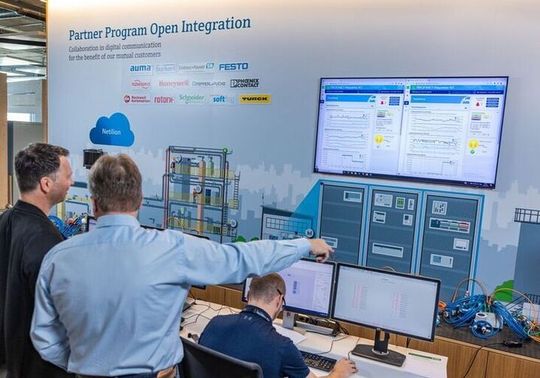
In full swing: Technical experts from end users and manufacturers test scenarios with almost 240 field devices on a redundant control system with very positive results.
(Source: Pepperl+Fuchs)
According to the company, this test was primarily focused on the reliability of Ethernet-APL in extreme situations. However, it was also about the smooth interaction of infrastructure components from different manufacturers. A realistic scenario was played out, which probably corresponds most closely to the reality encountered in process control today. All sensors and other infrastructure components involved in this test have proven their performance capability even under extremely demanding conditions, adds the firm.
The requirements for the scaling test were defined by the chemical company BASF and correspond to a typical application profile for the industry. A total of almost 240 measuring devices were included in the test environment. The flow, pressure, temperature and level sensors, as well as the positioners, came from leading manufacturers such as Endress+Hauser and Samson, explains the company.
Reliability taken to the limit
All field devices were operated via an Emerson Delta V DCS process control system with Profinet system redundancy (S2) and an AMS Device Manager system. Several Ethernet APL field switches from Pepperl+Fuchs ensured signal distribution within a ring-shaped topology and the integration of the parallel Ethernet structure, opines the firm.
A test configuration of this size goes far beyond the usual test setups. The aim here is to explore the limits and prove that Ethernet-APL can also cope with the conditions of an extensive control system in which more than ten thousand signals have to be processed. The aim is to prove that the network and the Delta V control system used here are capable of handling the considerably higher data volume that a maximum number of field devices entail, mentions the company.
Switches in an absolute stress test
The Pepperl+Fuchs switches performed their task with flying colors. Reliability and performance knew no limitations during the entire process. Important performance characteristics such as redundancy switching times and the general network load under the test conditions were met or even exceeded at all times, claims the firm. Cyclical communication - i.e. the transfer of measured and set values between the controller and the field devices - remained stable even in these simulated stress situations.
The test routines also included the overloading of the Ethernet network combined with storm attacks on the switches and field devices, introduced by a separate computer into the network. In practice, an automation system must be able to withstand such situations, even if they occur only in an extremely critical operating state of the system.
This showed the general advantage of the way in which an Ethernet-APL switch communicates with the connected field devices. There are absolutely robust point-to-point connections that remain free from all external influences in every situation. The switch contains special communication filters that provide special protection for the field devices.
Redundancy switching in the Ethernet ring is a standard feature of an Ethernet-APL configuration. This enables network architects to set up a highly available infrastructure with manageable effort, which maintains uninterrupted operation even in the event of unforeseen disruptions, shares the company.
Together towards a new standard
Ethernet-APL is not a proprietary solution. It was not developed by a single supplier. Rather, Ethernet-APL is the result of many years of result-focused collaboration between end users such as BASF and various leading manufacturers from the process sector. Pepperl+Fuchs was also significantly involved in the development and standardization of this technology.
This provides the best conditions for an open system. The market appreciates this and sees it as a strong signal on the way to digitalizing process instrumentation. It is therefore safe to assume that Ethernet-APL offers precisely the advantages that the process industry has been waiting for a long time, opines the firm.
What's more, Ethernet-APL is not only based on existing standards and infrastructures, thereby protecting existing investments. The new network solution also takes much of the complexity out of the automation system. And it does so over the entire life cycle, from conception and implementation through all the way to ongoing operation, explains the company.
Date: 08.12.2025
Naturally, we always handle your personal data responsibly. Any personal data we receive from you is processed in accordance with applicable data protection legislation. For detailed information please see our privacy policy.
Consent to the use of data for promotional purposes
I hereby consent to Vogel Communications Group GmbH & Co. KG, Max-Planck-Str. 7-9, 97082 Würzburg including any affiliated companies according to §§ 15 et seq. AktG (hereafter: Vogel Communications Group) using my e-mail address to send editorial newsletters. A list of all affiliated companies can be found here
Newsletter content may include all products and services of any companies mentioned above, including for example specialist journals and books, events and fairs as well as event-related products and services, print and digital media offers and services such as additional (editorial) newsletters, raffles, lead campaigns, market research both online and offline, specialist webportals and e-learning offers. In case my personal telephone number has also been collected, it may be used for offers of aforementioned products, for services of the companies mentioned above, and market research purposes.
Additionally, my consent also includes the processing of my email address and telephone number for data matching for marketing purposes with select advertising partners such as LinkedIn, Google, and Meta. For this, Vogel Communications Group may transmit said data in hashed form to the advertising partners who then use said data to determine whether I am also a member of the mentioned advertising partner portals. Vogel Communications Group uses this feature for the purposes of re-targeting (up-selling, cross-selling, and customer loyalty), generating so-called look-alike audiences for acquisition of new customers, and as basis for exclusion for on-going advertising campaigns. Further information can be found in section “data matching for marketing purposes”.
In case I access protected data on Internet portals of Vogel Communications Group including any affiliated companies according to §§ 15 et seq. AktG, I need to provide further data in order to register for the access to such content. In return for this free access to editorial content, my data may be used in accordance with this consent for the purposes stated here. This does not apply to data matching for marketing purposes.
Right of revocation
I understand that I can revoke my consent at will. My revocation does not change the lawfulness of data processing that was conducted based on my consent leading up to my revocation. One option to declare my revocation is to use the contact form found at https://contact.vogel.de. In case I no longer wish to receive certain newsletters, I have subscribed to, I can also click on the unsubscribe link included at the end of a newsletter. Further information regarding my right of revocation and the implementation of it as well as the consequences of my revocation can be found in the data protection declaration, section editorial newsletter.
For example, the user has access to communication and diagnostic information via an easy-to-use web interface on the Ethernet-APL field switch. This enables even less specialized employees to set up and commission a communication system without in-depth knowledge or special tools. The device data can also be integrated into the asset management system. This seamlessly accessible information and its integration into higher-level systems is part of a concept of general simplification and is to a certain extent one of the genes of Ethernet-APL.
Interaction without compromise
BASF explains that with the help of digital field devices, they were able to optimize various topics relating to engineering, commissioning and lifecycle in BASF plants and reduce Capex and Opex costs.
For Endress+Hauser, the scaling test is one of four similarly designed tests that have proven beyond doubt that Ethernet-APL is ready for widespread use in the process industry.
Ethernet-APL offers decisive prerequisites for making a process plant more transparent down to the individual field device than was possible with previous analog technologies. This digital technology makes a decisive contribution to realizing more efficient and cost-effective industrial automation systems. It is the technological door opener for a wealth of new applications that were simply not possible before, shares the company.
Ethernet-APL already is the core of a broad ecosystem that more and more manufacturers of infrastructure components are joining. The first successful implementations are creating trust and show that Ethernet-based communication in process automation is on the rise.
Ethernet-APL has what it takes to become a standard, especially in the process sector with its often highly critical applications.
Pepperl+Fuchs encourages planners and end users to familiarize themselves with Ethernet-APL and the integration technologies with the help of a test setup or a small installation and to exploit the advantages, concludes the firm.




:quality(80)/p7i.vogel.de/wcms/84/a5/84a5012a0d1f286ae6fc43be3750184c/0131703087v2.jpeg "The Taurob heavy-duty robot is now conducting on-site autonomous inspections as the first set of ‘eyes’ on the ground, enabling Adnoc’s engineers to identify potential gas leaks, unusual hotspots and other hazards to enhance safety. (Source: Adnoc)")
:quality(80)/p7i.vogel.de/wcms/f1/41/f141fc30eddadc5a340d28fd8980aa27/0131438828v2.jpeg "Aramco Executive Vice President of Technology and Innovation, Ahmad O. Al Khowaiter and Pasqal CEO, Wasiq Bokhari, at the launch of Saudi Arabia’s first Quantum Computer and the Middle East’s first commercial Quantum Computing as a Service platform. (Source: Aramco )")
:quality(80)/p7i.vogel.de/wcms/22/a4/22a4a5a34b3157c9ef8b6fdc5a2b11ec/0131429879v2.jpeg "Emerson Synchros enables continuous asset monitoring with wireless technology, providing actionable insights to reduce downtime and optimize operations. (Source: Emerson)")
:quality(80)/p7i.vogel.de/wcms/27/57/2757786ef0ad2d230e7776df6079b28b/0131301702v2.jpeg "Emerson has recently introduced the Aspentech AVA AI platform. (Source: Emerson )")
:quality(80)/p7i.vogel.de/wcms/88/64/8864732d605466526032316858c1e254/0131888956v2.jpeg "Project engineering and permitting activities will now transition to Hanko in Finland. (Source: Unsplash)")
:quality(80)/p7i.vogel.de/wcms/89/47/8947595eafaa6ad27c8552a5f9ad48e1/0129967379v1.jpeg "Biogas and biomethane currently provide approximately 5.5 GW of stable electrical capacity and could be expanded to up to 20 GW without requiring additional land – an enormous potential. (Source: license free via Pixabay)")
:quality(80)/p7i.vogel.de/wcms/7f/f8/7ff8d99b8b71cf29eab9851fa870df34/0131844385v2.jpeg "Kent has been awarded a contract by Cabinda Gulf Oil Company for Construction Management Services in Angola. (Source: Unsplash)")
:quality(80)/p7i.vogel.de/wcms/1f/a2/1fa27adf6455df1bf8019bc78c826fc4/0131842167v2.jpeg "Posco Holdings signed a cooperation agreement with Anson Resources on June 10 at the Posco Center in Seoul for the construction and operation of a direct lithium extraction demonstration plant in the Green River area of Utah, U.S. (Source: Posco Holdings)")
:quality(80)/p7i.vogel.de/wcms/dd/be/ddbe621ac35ec49d9aee43615173f703/0131898392v2.jpeg "The acquisition is consistent with GSK’s strategy of acquiring assets that have validated targets and meaningfully address efficacy and/or tolerability limitations of existing standard-of-care therapies. (Source: Pixabay)")
:quality(80)/p7i.vogel.de/wcms/0a/02/0a02d3fe4cbae5c1da97b4bbf77286bc/0131844077v2.jpeg "The facility adds 100 m³ of reactor capacity and strengthens Siegfried’s position as one of the leading global CDMOs for small molecule drug substances. (Source: Siegfried)")
:quality(80)/p7i.vogel.de/wcms/30/9c/309c19fe8590076dd4d7acd0e79fe962/0131651735v2.jpeg "ADCs combine the high specificity of monoclonal antibodies with the efficacy of cytotoxic agents in order to selectively attack tumor cells while largely sparing healthy tissue. (Bild: Asahi Kasei)")
:quality(80)/p7i.vogel.de/wcms/71/16/71167a6d12f3f694a9cf744a6f12e77b/0131584322v2.jpeg "With its two sites in South Carolina (USA) and Shanghai (China), Ambiopharm adds differentiated peptide manufacturing capabilities to Cordenpharma’s existing Peptides Platform and expertise. (Source: Ambiopharm)")
:quality(80)/p7i.vogel.de/wcms/a6/6d/a66d23f394d0ee8f348ba421b201a9ee/0131898113v2.jpeg "Under the agreement, Nextchem will provide the license for its proprietary NX Circular technology for the biomass-to-syngas section of the plant. (Source: Pixabay)")
:quality(80)/p7i.vogel.de/wcms/81/87/8187198dcf8207931a744e2471783f3e/0131897128v2.jpeg "Phelan Green Hydrogen has announced that it has licensed technologies from Johnson Matthey Catalyst Technologies for its planned electro-sustainable aviation fuel facility in the Western Cape, South Africa. (Source: Pixabay)")
:quality(80)/p7i.vogel.de/wcms/99/19/9919d260a3b4149babcf849fec0eb2c1/0131889842v2.jpeg "Honeywell has announced that its modular Ecofining process technology, specialized pumps, compressors, and integrated control and safety systems will help drive SAF and renewable diesel production for Acelen Renewables' greenfield site in Bahia, Brazil. (Source: Unsplash)")
:quality(80)/p7i.vogel.de/wcms/f9/ae/f9ae01edfc6e630bd6e961360f3f0274/0131844231v2.jpeg "Axens has announced its collaboration with Dragonfly for the licensing of Axens’ leading Vegan Hefa technology for the development of several SAF production facilities in Africa and the Caribbean. (Source: Pixabay)")
:quality(80)/p7i.vogel.de/wcms/e9/64/e964996410967c124c2cf01a8623068e/0130285341v1.jpeg "Geht unter die Oberfläche: Die Offshore-Ölförderung erfordert hochenergetische Pumpen – doch diese sind im Wesentlichen eine Black Box. Bisher zumindest. (Source: Kistler Group)")
:quality(80)/p7i.vogel.de/wcms/1c/39/1c39433f4bb4de2e5e6c5311c3236d09/0130110254v2.jpeg "The new pumps of the Omega type series have been designed for handling water and fluids with a low solids content efficiently. (Source: KSB)")
:quality(80)/p7i.vogel.de/wcms/be/e1/bee13b8d51a419b9b8f0685e2b9d47bf/0128917673v1.jpeg "The Centerwave 6000 measures pipes from 32 to 1,600 mm. (Source: Maag Group)")
:quality(80)/p7i.vogel.de/wcms/6d/f4/6df401340dd39e80535bfdef67909958/0131840391v2.jpeg "Dupont has recently announced that a MBR system has been selected as part of the next phase of upgrades at the Riverstone Water Resource Recovery Facility in Sydney, Australia. (Source: Dupont)")
:quality(80)/p7i.vogel.de/wcms/f8/48/f848b446deb0595d2494aed2154ed010/0131700971v2.jpeg "Under the agreement, Xylem will deliver a full end-to-end solution that includes engineering, system design, and long-term operation. (Source: Pixabay)")
:quality(80)/p7i.vogel.de/wcms/a8/92/a892445199f1f77c914c4de44d10fa5d/0131584311v2.jpeg "The transaction is expected to close on 1 July 2026, pending regulatory approvals and satisfaction of customary closing conditions. (Source: Pixabay)")
:quality(80)/p7i.vogel.de/wcms/2c/42/2c42affbdc6932f5a2fa8393b4fb3824/0131478702v2.jpeg "This is the first commercial partnership to apply generative AI end-to-end to the design of new materials for PFAS remediation. (Source: Kemira)")
:quality(80)/p7i.vogel.de/wcms/79/31/7931cc94924b4c2ebc7087e9cec2f801/0130490720v2.jpeg "The new Pulsar Model R80 solids antenna delivers improved measurement capability through its high-frequency signal, narrow beam angle, and advanced configuration software. (Source: Ametek )")
:quality(80)/p7i.vogel.de/wcms/6b/cc/6bcc3d26e1c7c74d90a10bc3ca296ae1/0128362351v2.jpeg "A look into Bayer's new tablet production, Solida 1, during construction: The robots and lift columns for material handling are being installed. (Source: Bayer)")
:quality(80)/p7i.vogel.de/wcms/24/c8/24c84ab6b1bcd24468a87820a07a85aa/0128194707v2.jpeg "Ajax Equipment has supplied Binding Solutions with a feed system comprising buffer hopper, screw feeder and agitated screw feeder for a pilot plant handling iron ore and additives. (Source: Ajax Equipment )")
:quality(80)/p7i.vogel.de/wcms/1d/3e/1d3e2788eb37c1e974f36337c8d33cb5/0128191010v2.jpeg "Ajax Equipment has supplied IGI Systems with a stainless-steel conical hopper with gas purge capability, as part of a prototype Sublimation System for a low-pressure chemical vapour deposition application. (Source: Ajax Equipment)")
:quality(80)/p7i.vogel.de/wcms/33/bd/33bd7c4a49ef953a4714ae0465d4603f/0131887372v2.jpeg "Evonik’s Innovation Factory has opened an Anion Exchange Membrane application technology center to test its high-performance Duraion membranes in real-world operating conditions. (Source: Evonik )")
:quality(80)/p7i.vogel.de/wcms/59/74/597467e719db0f4e9cfb14e79e5837a6/0131843161v2.jpeg "Schneider Electric and Torngat Metals have recently announced the signature of a non-binding MOU to explore a strategic industrial partnership to support the development of a resilient and responsible rare earth value chain. (Source: Schneider Electric )")
:quality(80)/p7i.vogel.de/wcms/93/fb/93fbd04ddbbd49ee57989b5e13471f01/0131801665v2.jpeg "The transaction is expected to close toward the end of 2026, subject to customary regulatory approvals. (Source: Repsol)")
:quality(80)/p7i.vogel.de/wcms/76/c6/76c645aa3962749f9a3f18289d0e5a63/0131703875v2.jpeg "Covestro opens its new TPU Application Development Center in Guangzhou, China. From left: Edward Zhou (Managing Director of Guangzhou Site), Christian Haessler (Head of Innovation TPU), Holly Lei (President of Covestro China), Andrea Maier-Richter (Global Head of TPU), Kevin Ho (Head of TPU Sales and Market Development APAC) and Frank Yang (Head of TPU Innovation APAC). (Source: Covestro )")
:quality(80)/p7i.vogel.de/wcms/f8/29/f8298429c1638b949a6f76346f6709c7/0118701710v2.jpeg "Bosch Industrial Heat will be presenting sustainable steam and heat solutions for global industrial use at the Achema trade fair in Frankfurt, Germany. (Source: Bosch Industriekessel)")
:quality(80)/p7i.vogel.de/wcms/07/24/07242664ab2b1c7841c9d9d0a127670c/0116045959.jpeg "A look inside the GEA machine room. (Bild: Magnavale)")
:quality(80)/p7i.vogel.de/wcms/c9/79/c979a20b32395ddfa93fe7ead90578a0/0108386061.jpeg "Production residues, lime, salt and suspended solids quickly clog the pipes. (Source:©Tanakorn - stock.adobe.com)")
:quality(80)/p7i.vogel.de/wcms/9e/5c/9e5c92d942ed046a27562d6e3d730c92/0103483548.jpeg "It is almost ten metres high and extends over three floors: the world's first multiple dividing wall column is located in the new technical centre at the University of Ulm. (Bild: Eberhardt, kiz Universität Ulm)")
:quality(80)/p7i.vogel.de/wcms/57/da/57da73af9c35d633196afd46348182b2/0130820106v2.jpeg "Today, the world is witnessing a deepening energy crisis. The Iran–US war has exposed the vulnerability of the global oil, gas, and petrochemicals industry. Its impact is not confined to one region—it has triggered a domino effect across continents. (Source: © Rayhan - stock.adobe.com)")
:quality(80)/p7i.vogel.de/wcms/20/36/20366ffa57a841882fd165e4dc885c09/0130491929v2.jpeg "With the US and Israel jointly firing the first shot on Iran, the world is now witnessing major cascading effects—from soaring global oil and gas prices, to industry leaders declaring force majeure, and even predictions that the war could trigger a global economic recession! (Source: © FOYSAL - stock.adobe.com)")
:quality(80)/p7i.vogel.de/wcms/d0/f7/d0f7d560dfce37c8371442d5b6120e3c/0130182478v1.jpeg "The Gelsenkirchen refinery primarily manufactures fuels for vehicles and aircraft, processing roughly 12 million tonnes of crude oil per year. (Source: BP)")
:quality(80)/p7i.vogel.de/wcms/7c/77/7c77e24fdcc9e1511e8e711eff161e28/0130175489v2.jpeg "The milestone confirms the fast pace of development of Eni’s deep water gas projects offshore East Kalimantan. (Source: Unsplash )")
:quality(80)/p7i.vogel.de/wcms/a8/4e/a84e8039a90a5cf4751d01ebcf6ba1a9/0127510172v2.jpeg "After six years, Achemasia, the international trade fair and innovation forum for sustainable chemical production, has returned with renewed vigor, bringing together global expertise, Chinese innovation, and a shared commitment to a greener industrial future—according to the organizers of the fair. (Source:PROCESS China)")
:quality(80)/p7i.vogel.de/wcms/17/c7/17c703445f134eb3d7ecc7918dda2762/0124596096v2.jpeg "Achema Middle East will launch in Saudi Arabia in 2026. (Bild: Dechema/ Hannibal)")
:quality(80)/p7i.vogel.de/wcms/2a/2c/2a2cffc07f51019065387cd63241b5ce/0119463370v1.jpeg "The Injecta 36 fills and seals RTU (Ready-to-Use) syringes at high speed. The image shows the robotic arm. (Source: IMA)")
:quality(80)/p7i.vogel.de/wcms/b1/7e/b17ea8c62ccafad1d1fb072d6199bbd6/0118578446.jpeg "“Star in the ring”: Vegapuls 6X radar level sensors are the solution of choice for Renolit for many applications on the way to the perfect plastic product. (Source: © MR Design - stock.adobe.com; Vega)")
:quality(80)/p7i.vogel.de/wcms/44/a5/44a5d4f0a4c4b001846500c9e853d821/0131634217v2.jpeg "Emerson has recently announced that it will co-develop next-generation corrosion management solutions for the Saudi Arabian Oil Company (Aramco). (Source: Emerson )")
:quality(80)/p7i.vogel.de/wcms/d0/87/d087e325d2fc41b031fd812c7515d5f3/0131574190v2.jpeg "Petronas and Aramco will remain focused on delivering operational excellence and sustained value for stakeholders and the communities they serve. (Source: Aramco )")
:quality(80)/p7i.vogel.de/wcms/59/6c/596cdde662a90ad3295fb67ad7f74737/0131244347v2.jpeg "The deployment of AI-driven Aspen Hybrid Models helps Aramco achieve yield and quality prediction accuracy of up to 98.5 % in key refinery units. (Source: Aramco )")
:quality(80)/p7i.vogel.de/wcms/6a/7e/6a7e738aac81597b04bae84add8a9077/0131141034v2.jpeg "Construction of the Ta’ziz methanol plant is progressing with completion targeted for 2028. (Source: Adnoc )")
:fill(fff,0)/images.vogel.de/vogelonline/companyimg/113800/113818/65.jpg "Turck_Your_Global_Automation_Partner.jpg ()")
:fill(fff,0)/images.vogel.de/vogelonline/companyimg/2000/2093/65.jpg "Glatt_Logo_ND4c-RGB (5x3cm).jpg ()")
:fill(fff,0)/p7i.vogel.de/companies/68/c8/68c815bc8fe81/prominent-logo-300x300.jpeg "prominent-logo-300x300 (ProMinent GmBH)")
:quality(80)/p7i.vogel.de/wcms/ef/6c/ef6cb8c5748557d0d1ebdf4ad86822ab/0126630797v2.jpeg "With hydrogen, the buses in Bremerhaven achieve a longer range compared to batteries. (Source: Phoenix Contact)")
:quality(80)/p7i.vogel.de/wcms/25/18/251839e664bf3defe469f9e1cd9c1215/0125828142v3.jpeg "Igel Topologie. (Source: Pepperl+Fuchs )")