The new term prescriptive maintenance (RxM) is a mashup of prescriptive analytics and predictive maintenance. Both have been around for a long time. So is RxM new, or is it just a clever name? And whichever the case, how is it done? And what’s the difference between prescriptive and descriptive analytics, and anomaly detection?
Prescriptive maintenance is about scheduling and carrying out predictive maintenance based on predictive analytics providing recommended actions.
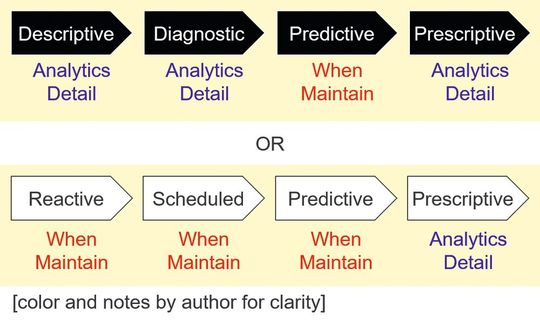
Prescriptive Maintenance = Prescriptive Analytics + Predictive Maintenance. There are various illustrations of prescriptive maintenance in relation to descriptive, diagnostics, predictive, reactive, condition-based, and scheduled.
Two common examples illustrating prescriptive maintenance.
(Source: Jonas Berge)
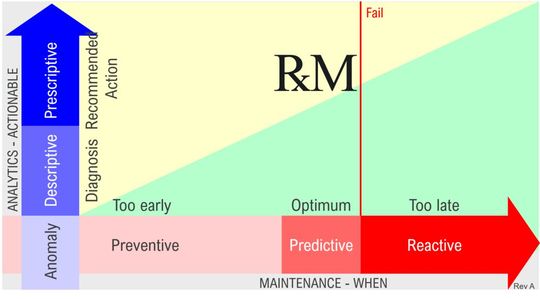
These illustrations are confusing because they mix the level of ‘analytics detail’ (anomaly detection, descriptive or prescriptive) with the ‘time of maintenance’ (too early, too late, or just in time) on a single axis. These are really two separate dimensions:
• time when maintenance is performed
• the level of actionable analytics
For instance, predictive maintenance is possible based on descriptive or prescriptive analytics, or even simple anomaly detection. Conversely, prescriptive does not necessarily mean it is predictive. The problem may already have occurred, but the analytics software recommends corrective action.
A better way to illustrate ‘when maintenance’ is performed, and the ‘level of actionable’ the analytics is, involves two dimensions.
When 'maintenance' is performed and how 'actionable' the diagnostics is, are two separate dimensions.
(Source: Jonas Berge)
Prescriptive maintenance really means ‘predictive maintenance based on prescriptive analytics’ or ‘predictive maintenance based on recommended action’.
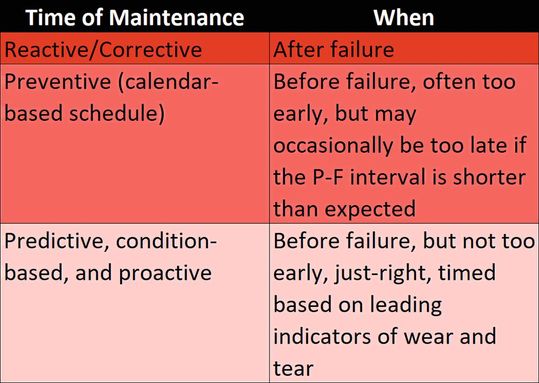
The first dimension is the ‘time when maintenance’ is performed as we have traditionally ordered maintenance schemes: reactive, corrective, preventive, predictive, condition-based and proactive.
Schemes refer to 'when maintenance' is performed.
(Source: Jonas Berge)
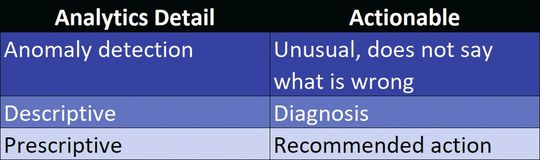
The second dimension is understanding ‘how actionable’ the analytics are; anomaly detection, descriptive and prescriptive.
Refers to 'how actionable' the diagnostics is.
(Source: Jonas Berge)
Analytics Detail
Prescriptive analytics is the foundation for prescriptive maintenance. Descriptive and prescriptive analytics have been around for a long time. Initially all analytics were already descriptive and prescriptive but it was simply called diagnostics. This is different from ‘anomaly detection’.
Anomaly Detection
Anomaly detection means that analytics detects something that is not normal but can’t tell what it is, and therefore there is no associated description or recommended action. Only when machine learning (ML) gained interest a few years ago did the term ‘anomaly’ enter our vocabulary.
Very often the training dataset used for machine learning does not contain multiple examples of each condition it is expected to predict, such as various equipment failure modes. Or it doesn’t contain variables with a strong correlation to find a pattern.
The ML training dataset might include many years of data collected in a historian, but since the equipment is reliable, there may not be five or more examples of each failure mode for the equipment, or whatever number of exposures the algorithm requires to find a strong pattern. Or the data in the historian may only be process data which does not contain useful early symptoms of equipment failure, because the piece of equipment had not been fitted with sensors for vibration, acoustic noise or other issues.
That is, the years of data for a piece of equipment in the process historian is almost exclusively for normal operation so the ML algorithm can in this case only be trained for what ‘normal’ operations look like, and thus can only tell that anything outside of this normal operating window is ‘abnormal’ or an ‘anomaly’.
So, anomaly detection doesn’t indicate what the problem is or what to do about it, but knowing something is abnormal could still be useful to initiate a detailed investigation by an expert with other tools to determine what is going on and decide what to do about it.
On the other hand, the production process is more dynamic, changing all the time with process upsets or smaller variability caused by variations in feedstock, catalyst, weather or other factors. That is, historian data probably contains many samples of process upsets that can be used to train ML to predict a process upset and differentiate between them, such as a change in Reid vapor pressure (RVP).
Descriptive Analytics
Descriptive analytics means the ability to distinguish between multiple conditions it is expected to detect or predict such as to diagnose to distinguish various failure modes of a piece of equipment telling one failure mode from the other to more specifically pinpoint the problem to make maintenance more effective. That is, descriptive analytics is more advanced than mere anomaly detection. Descriptive analytics is the most common level of analytics detail in the process industries. The most interesting fact is that instrumentation diagnostics, control valve diagnostics, and vibration monitoring was never about ‘anomaly’ but has all along been very specific; descriptive. So descriptive analytics is not new. Only the term is new. Traditionally it was simply referred to as diagnostics.
Date: 08.12.2025
Naturally, we always handle your personal data responsibly. Any personal data we receive from you is processed in accordance with applicable data protection legislation. For detailed information please see our privacy policy.
Consent to the use of data for promotional purposes
I hereby consent to Vogel Communications Group GmbH & Co. KG, Max-Planck-Str. 7-9, 97082 Würzburg including any affiliated companies according to §§ 15 et seq. AktG (hereafter: Vogel Communications Group) using my e-mail address to send editorial newsletters. A list of all affiliated companies can be found here
Newsletter content may include all products and services of any companies mentioned above, including for example specialist journals and books, events and fairs as well as event-related products and services, print and digital media offers and services such as additional (editorial) newsletters, raffles, lead campaigns, market research both online and offline, specialist webportals and e-learning offers. In case my personal telephone number has also been collected, it may be used for offers of aforementioned products, for services of the companies mentioned above, and market research purposes.
Additionally, my consent also includes the processing of my email address and telephone number for data matching for marketing purposes with select advertising partners such as LinkedIn, Google, and Meta. For this, Vogel Communications Group may transmit said data in hashed form to the advertising partners who then use said data to determine whether I am also a member of the mentioned advertising partner portals. Vogel Communications Group uses this feature for the purposes of re-targeting (up-selling, cross-selling, and customer loyalty), generating so-called look-alike audiences for acquisition of new customers, and as basis for exclusion for on-going advertising campaigns. Further information can be found in section “data matching for marketing purposes”.
In case I access protected data on Internet portals of Vogel Communications Group including any affiliated companies according to §§ 15 et seq. AktG, I need to provide further data in order to register for the access to such content. In return for this free access to editorial content, my data may be used in accordance with this consent for the purposes stated here. This does not apply to data matching for marketing purposes.
Right of revocation
I understand that I can revoke my consent at will. My revocation does not change the lawfulness of data processing that was conducted based on my consent leading up to my revocation. One option to declare my revocation is to use the contact form found at https://contact.vogel.de. In case I no longer wish to receive certain newsletters, I have subscribed to, I can also click on the unsubscribe link included at the end of a newsletter. Further information regarding my right of revocation and the implementation of it as well as the consequences of my revocation can be found in the data protection declaration, section editorial newsletter.
Descriptive analytics requires more data, more variables, to reliably distinguish one failure mode from another. For example, both bearing wear and cavitation on a pump cause vibration, so vibration sensor data alone may not be sufficient to distinguish bearing wear from cavitation. Additional sensor data may be required. This is the reason why plants are now having their I&C engineers deploy additional sensors; advanced equipment sensors, to complement the already existing process sensors.
Various types of analytics algorithms can be used to achieve descriptive analytics. Well understood equipment like pumps, compressors, and valves use rule-based AI built from Failure Mode and Effect Analysis (FMEA) data.
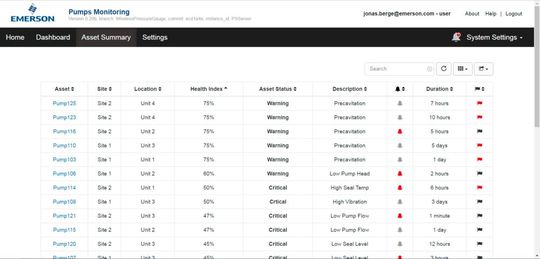
With process equipment fully instrumented with the right sensors to pick up the early symptoms, rule-based analytics is a very effective solution to many plant problems. Readymade engineered analytics apps are available from automation vendors.
A summary page: Pump analytics alarm.
(Source: Emerson)
Prescriptive Analytics
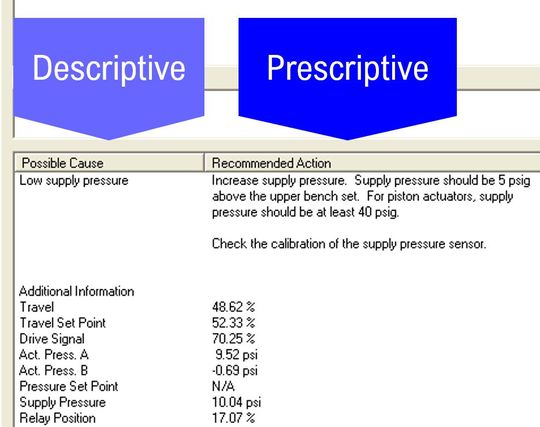
Prescriptive analytics means prescribing recommended actions for each of the many conditions it is expected to detect or predict such as suggestions for correcting or avoiding various failure modes of a piece of equipment to make maintenance more effective. That is, prescriptive analytics builds on descriptive analytics, after the descriptive analytics has diagnosed the condition of the equipment, corresponding recommended actions such as correcting alignment or adding lubrication is provided. Instrumentation and valve management software have had recommended actions for years, so prescriptive analytics is not new. Only the term is new. Traditionally it has simply been referred to as recommended action.
Descriptive and prescriptive valve diagnostics.
(Source: Jonas Berge)
Prescription
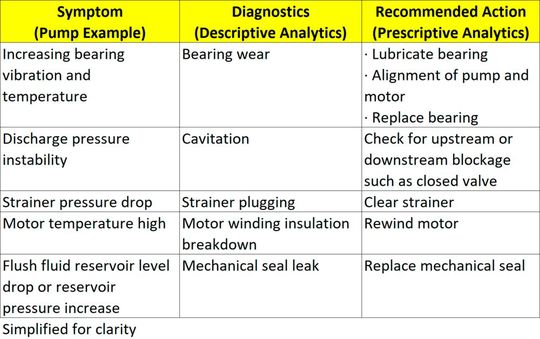
The recommended action (prescription) can be provided by the analytics software, which is easiest. Alternatively, if the analytics app provides the description (diagnosis), the app presenting the diagnostics to the user can display associated recommended action (prescription) text together with the description. This could involve alarm management software or mobile notification software. The recommended actions are entered into the software. More than one recommended action is provided.
Prescriptive analytics is descriptive analytics with recommended action.
(Source: Jonas Berge)
Scale Out
Prescriptive maintenance is about scheduling and carrying out predictive maintenance based on predictive analytics providing recommended actions. Some plants already have prescriptive analytics for some instrumentation and control valves and are using this information in scheduling and execution of maintenance for these asset classes. Plants now apply the same concept to larger pieces of equipment like pumps and heat exchangers. When the plant I&C engineers instrument these assets and deploy purpose-built predictive analytics for these equipment types, the plant can scale out prescriptive maintenance practices across multiple asset classes in the plant.
* The author is a Senior Director, Applied Technology at Emerson Automation Solutions. Contact: jonas.berge@emerson.com




:quality(80)/p7i.vogel.de/wcms/60/25/60259e0165560492b717049a5006b5d2/0129719891v2.jpeg "Adnoc's panorama digital command center. (Source: Adnoc )")
:quality(80)/p7i.vogel.de/wcms/40/8f/408f074f8094bca2cd9bb078e79eccb0/0129580192v2.jpeg "The Anymal robot undertaking gas leak detection in the field. (Source: Anybotics)")
:quality(80)/p7i.vogel.de/wcms/f3/4a/f34abcf99d71d8bff5a4e98b60889c8e/0129239597v2.jpeg "Dow has recently announced a comprehensive plan to simplify how it operates and streamline its end-to-end processes. (Source: Dow )")
:quality(80)/p7i.vogel.de/wcms/5c/27/5c27bddaef122b61c636e31d82a33bd9/0129017834v2.jpeg "Merck has recently announced the launch of the Chemisphere app. (Source: Merck )")
:quality(80)/p7i.vogel.de/wcms/3f/e3/3fe39c03ebb8bb0d4b4f46099ebd99e4/0129746348v2.jpeg "AGC Vinythai has commenced commercial operations following the planned capacity expansion at its chlor-alkali plant in Map Ta Phut, Thailand. (Source: Pixabay)")
:quality(80)/p7i.vogel.de/wcms/cc/2a/cc2adab5b0d9dfe126364d289a5f16f1/0129688606v2.jpeg "A groundbreaking ceremony was held at the site on February 18, 2026. (Source: Zeon Corporation )")
:quality(80)/p7i.vogel.de/wcms/0a/1c/0a1c5f661e1df4b35d4cd8e4901e4035/0129624833v2.jpeg "The new plant would add significant capacity to reactivate activated carbon for the region’s drinking water and wastewater market. (Source: Kemira )")
:quality(80)/p7i.vogel.de/wcms/9f/7f/9f7f9d5256b75ba8141a63bbf981b793/0129506442v2.jpeg "Ground floor-side view of the Haleu cascade centrifuges. (Source: Fluor Corporation)")
:quality(80)/p7i.vogel.de/wcms/df/cd/dfcd0c2e0eb4b554f956e0161ae08519/0129794328v1.jpeg "The plasma fractionation facility at CSL Behring, viewed from the outside. (Source: CSL Behring)")
:quality(80)/p7i.vogel.de/wcms/74/af/74af2b65341eeee13a44bc85eb759596/0129839901v2.jpeg "With around 6,000 European companies operating in India and an annual trade of 180 billion euros between the EU and India at present, the trade deal intends to double EU goods exports to India by 2032. (Source: © NazeerArt - stock.adobe.com)")
:quality(80)/p7i.vogel.de/wcms/26/12/261210e5920899e5c35c4f905d3be8bd/0129399814v2.jpeg "Powders used in DPI formulations are often highly potent and administered in very low doses. (Source: Ima)")
:quality(80)/p7i.vogel.de/wcms/d7/9e/d79e4ba6b9e0923d1513b843962712d9/0129591121v2.jpeg "The acquisition adds Avadel’s FDA-approved product, Lumryz, to Alkermes’ commercial portfolio, and provides Alkermes with a commercial organization experienced in this disease state. (Source: Pixabay)")
:quality(80)/p7i.vogel.de/wcms/42/67/42671f576c7f8a1284b54bc8f92cce02/0129864175v2.jpeg "Honeywell’s advanced technologies and standardized design will help Verso Energy reduce capital expenses, accelerate speed to market and increase global SAF capacity. (Source: Pixabay)")
:quality(80)/p7i.vogel.de/wcms/f7/70/f770417abff565b1743068fa37d21266/0129833262v2.jpeg "Under the agreement, Air Liquide will supply the necessary oxygen for Holcim’s oxyfuel-ready clinker production line, as well as provide its innovative and proprietary Cryocap Oxy technology to enable the capture of CO₂ emissions with high efficiency. (Source: Air Liquide )")
:quality(80)/p7i.vogel.de/wcms/9f/7c/9f7cd6c9dcb679827c4c2c10f116c8b9/0129832882v2.jpeg "The extended agreement helps support World Fuel's ability to secure SAF supply and comply with regulatory requirements, including the Refuel EU Aviation Regulation and the UK SAF mandate. (Source: World Fuel Services)")
:quality(80)/p7i.vogel.de/wcms/91/d3/91d363e4abe71708f00b7205b2d32eff/0129746143v2.jpeg "HIF Global and German e-fuel One have signed a Heads of Agreement for the long‑term offtake of e‑methanol. (Source: Pixabay)")
:quality(80)/p7i.vogel.de/wcms/be/e1/bee13b8d51a419b9b8f0685e2b9d47bf/0128917673v1.jpeg "The Centerwave 6000 measures pipes from 32 to 1,600 mm. (Source: Maag Group)")
:quality(80)/p7i.vogel.de/wcms/51/7a/517a4e83c5827663b4839f5ddb98f434/0128872953v1.jpeg "The Tigron in SIL version can be flexibly configured for different safety requirements. (Source: Auma)")
:quality(80)/p7i.vogel.de/wcms/d5/72/d5728578b35b72f365f5086bc1d068da/0128662441v2.jpeg "Nikkiso Clean Energy & Industrial Gases Group has announced the launch of its new multistage process pump (MSPP 210), designed to enhance safety and reduce downtime on air separation equipment. (Source: Nikkiso Clean Energy & Industrial Gases Group)")
:quality(80)/p7i.vogel.de/wcms/a9/69/a96920e47e362a9cf0b9916b7ad3d30a/0128071795v2.jpeg "Nine partners from six European countries are working on the 36-month project to determine where heat pumps can achieve the greatest efficiency gains in the food and beverage sector and to develop reproducible and market-ready solutions. (Source: EU project Exquisheat)")
:quality(80)/p7i.vogel.de/wcms/c4/54/c454c7d8fd344c0ffc2ef5db00ad632f/0129728429v2.jpeg "Liqtech International recently launched its Qureflow Max produced-water treatment system. (Source: Liqtech International )")
:quality(80)/p7i.vogel.de/wcms/18/47/1847e6b1456c96f04bd511bbd21f3779/0129039479v2.jpeg "Jacobs has been selected as the progressive design-build contractor for upgrades to the San José–Santa Clara Regional Wastewater Facility in California. (Source: Jacobs)")
:quality(80)/p7i.vogel.de/wcms/3b/fd/3bfda4bbcb1a60004c330bde3b705109/0128453300v2.jpeg "In the Jiangsu province, Suez will partner with Lianyun Economic Development Zone to jointly study the investment in, build, and operate a new industrial water treatment plant. (Source: Pixabay)")
:quality(80)/p7i.vogel.de/wcms/cc/19/cc19aa5fec6f6f2b25dbd9516efed735/0128077403v2.jpeg "Distinguished guests at the ceremony included senior government officials, Japan’s Ambassador, and local business leaders. (Source: Toray)")
:quality(80)/p7i.vogel.de/wcms/6b/cc/6bcc3d26e1c7c74d90a10bc3ca296ae1/0128362351v2.jpeg "A look into Bayer's new tablet production, Solida 1, during construction: The robots and lift columns for material handling are being installed. (Source: Bayer)")
:quality(80)/p7i.vogel.de/wcms/24/c8/24c84ab6b1bcd24468a87820a07a85aa/0128194707v2.jpeg "Ajax Equipment has supplied Binding Solutions with a feed system comprising buffer hopper, screw feeder and agitated screw feeder for a pilot plant handling iron ore and additives. (Source: Ajax Equipment )")
:quality(80)/p7i.vogel.de/wcms/1d/3e/1d3e2788eb37c1e974f36337c8d33cb5/0128191010v2.jpeg "Ajax Equipment has supplied IGI Systems with a stainless-steel conical hopper with gas purge capability, as part of a prototype Sublimation System for a low-pressure chemical vapour deposition application. (Source: Ajax Equipment)")
:quality(80)/p7i.vogel.de/wcms/19/76/1976928d7d0a2ed7c1eeba7ade8552c8/0126365603v1.jpeg "Detail of Valvedesign: It has an aktiv amd passive part (Bild: Italvacuum)")
:quality(80)/p7i.vogel.de/wcms/2b/ec/2bec59da942498af975ef5a8835f9452/0129863223v2.jpeg "Combining global standards with deep regional expertise and strong Guyanese leadership, the joint venture will play a central role in advancing the country’s energy sector. (Source: John Wood )")
:quality(80)/p7i.vogel.de/wcms/e5/ad/e5ad680643cf15b1d1282231c3dc0989/0129832856v2.jpeg "This adjustment is a direct response to challenging market conditions, which are characterized by worldwide oversupply and the sustained high energy and carbon costs in Europe. (Source: Solvay )")
:quality(80)/p7i.vogel.de/wcms/e7/cc/e7cc48a384ef2e790f79f1de7f54597b/0129729765v2.jpeg "Packed recycled pellets. (Source: Borealis )")
:quality(80)/p7i.vogel.de/wcms/f8/29/f8298429c1638b949a6f76346f6709c7/0118701710v2.jpeg "Bosch Industrial Heat will be presenting sustainable steam and heat solutions for global industrial use at the Achema trade fair in Frankfurt, Germany. (Source: Bosch Industriekessel)")
:quality(80)/p7i.vogel.de/wcms/07/24/07242664ab2b1c7841c9d9d0a127670c/0116045959.jpeg "A look inside the GEA machine room. (Bild: Magnavale)")
:quality(80)/p7i.vogel.de/wcms/c9/79/c979a20b32395ddfa93fe7ead90578a0/0108386061.jpeg "Production residues, lime, salt and suspended solids quickly clog the pipes. (Source:©Tanakorn - stock.adobe.com)")
:quality(80)/p7i.vogel.de/wcms/9e/5c/9e5c92d942ed046a27562d6e3d730c92/0103483548.jpeg "It is almost ten metres high and extends over three floors: the world's first multiple dividing wall column is located in the new technical centre at the University of Ulm. (Bild: Eberhardt, kiz Universität Ulm)")
:quality(80)/p7i.vogel.de/wcms/16/3d/163da381529db3a47348a9440655529b/0125732969v2.jpeg "Dirk Elvermann, CFO and CDO of BASF, and Anders Opedal, President and CEO of Equinor, sign the ten-year natural gas supply agreement. (Source: Equinor and BASF)")
:quality(80)/p7i.vogel.de/wcms/e7/82/e782bbbf96e4971c22241d76e5de1720/0124855387v2.jpeg "Subsea 7 has been selected to conduct a front-end engineering study for a new subsea project in the Greater Ekofisk Area. (symbolic image) (Source: free licensed)")
:quality(80)/p7i.vogel.de/wcms/f9/40/f940b2630f4805f08212fd851af46d6d/0124788233v2.jpeg "The agreement was signed by Mr. A.K. Tyagi, CMD, Nuberg & Mr. Peter Sonntag, VP — Business Development - International, EDL. (Source: Nuberg)")
:quality(80)/p7i.vogel.de/wcms/3a/6d/3a6d046cf1db266c3009cecb2af8e2b7/0124656182v2.jpeg "These extensions will see Wood continue to support operations for an extensive offshore portfolio. (Source: Wood)")
:quality(80)/p7i.vogel.de/wcms/a8/4e/a84e8039a90a5cf4751d01ebcf6ba1a9/0127510172v2.jpeg "After six years, Achemasia, the international trade fair and innovation forum for sustainable chemical production, has returned with renewed vigor, bringing together global expertise, Chinese innovation, and a shared commitment to a greener industrial future—according to the organizers of the fair. (Source:PROCESS China)")
:quality(80)/p7i.vogel.de/wcms/17/c7/17c703445f134eb3d7ecc7918dda2762/0124596096v2.jpeg "Achema Middle East will launch in Saudi Arabia in 2026. (Bild: Dechema/ Hannibal)")
:quality(80)/p7i.vogel.de/wcms/2a/2c/2a2cffc07f51019065387cd63241b5ce/0119463370v1.jpeg "The Injecta 36 fills and seals RTU (Ready-to-Use) syringes at high speed. The image shows the robotic arm. (Source: IMA)")
:quality(80)/p7i.vogel.de/wcms/b1/7e/b17ea8c62ccafad1d1fb072d6199bbd6/0118578446.jpeg "“Star in the ring”: Vegapuls 6X radar level sensors are the solution of choice for Renolit for many applications on the way to the perfect plastic product. (Source: © MR Design - stock.adobe.com; Vega)")
:quality(80)/p7i.vogel.de/wcms/01/9b/019b59f3ef2e852ec5058ba18f323af2/0129651573v2.jpeg "With its strategic ‘Vision 2030’ plan announced in 2016, Saudi Arabia aims to diversify its economy by investing in sectors such as tourism, technology and industry, reduce its reliance on oil, and transform the country into a cleaner and more sustainable economy. (Source: © Peter Hermes Furian - stock.adobe.com)")
:quality(80)/p7i.vogel.de/wcms/99/d2/99d2e5e83062b4cf2aa3dc0a60d15f23/0129624804v2.jpeg "The heaviest and tallest unit – a Process Gas Cooling Module – weighed 2,464t and measured 38 meters long, 23 meters wide, and 32 meters high. (Source: Mammoet)")
:quality(80)/p7i.vogel.de/wcms/d1/a8/d1a83b822e16733380268322d033abdc/0129239584v2.jpeg "MOL Group has entered into a new strategic partnership with Libya’s National Oil Corporation. (Source: Pixabay)")
:fill(fff,0)/images.vogel.de/vogelonline/companyimg/107800/107832/65.jpg "logoDueperthal.jpg ()")
:fill(fff,0)/images.vogel.de/vogelonline/companyimg/113800/113818/65.jpg "Turck_Your_Global_Automation_Partner.jpg ()")
:fill(fff,0)/p7i.vogel.de/companies/65/ce/65ce1e4b1aa5f/eagle-logo.jpeg "eagle-logo (EagleBurgmann)")

:quality(80)/p7i.vogel.de/wcms/5d/e0/5de07e8d29342cab46968d97ba7c6faf/0125589871v2.jpeg "Alfa Laval has recently launched Clariot, a next-generation AI-based condition monitoring solution designed specifically for hygienic process plants, providing more accurate analysis and support. (Source: Alfa Laval)")
:quality(80)/p7i.vogel.de/wcms/60/25/60259e0165560492b717049a5006b5d2/0129719891v2.jpeg "Adnoc's panorama digital command center. (Source: Adnoc )")