The mixing of a viscoplastic fluid with an anchor impeller is studied visually. Three different types of experiments, documented through videos and still images, demonstrate the existence of an unyielded region, rotating like a rigid body. These results are in good agreement with previous workers’ numerical predictions, and dramatically show the influence of yield stress on mixing effectiveness, even with a well-designed agitation system. The unyielded region is the equivalent, for a close-clearance impeller, of the stagnant region outside the well-known ‘cavern’ forming around a small-diameter impeller. Furthermore, for such systems the presence of motion is not by itself a criterion by which quality of mixing can be assessed.
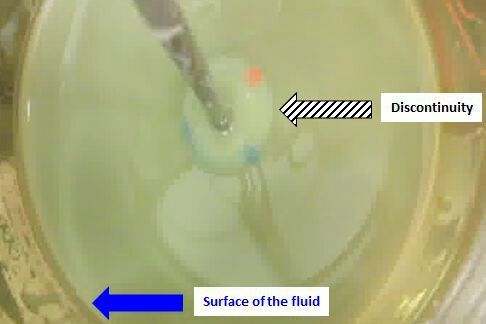
Figure 1: Visual appearance of the discontinuity and central region.
(Source: Syngenta)
Transport phenomena are of great industrial importance. Processing of fluids often requires mixing to homogenize them but also to provide adequate heat and mass transfer [1-4]. Careful equipment design is thus required, leading to a great variety of commercially available impeller systems, and accompanying science. Process development cannot be performed directly at industrial scale for cost and convenience reasons. Scale-up rules are thus necessary to transpose small-scale results, using theoretical understanding and empirical findings, to full commercial scale by setting parameters such as the agitation rate and rate of addition to maintain representativeness across different sizes.
The basic physical property governing flow is rheology. Appreciating the importance and practical consequences thereof is therefore critical to chemical engineers. Newtonian fluids exhibit the simplest possible rheology: constant viscosity at all shear rates. Amongst more complex rheologies, viscoplastic fluids are particularly common. Such fluids exhibit no motion until the stress upon them is larger than a critical value, the so-called yield stress. Once flowing, they also appear to become thinner at larger shear rates. These two defining characteristics are expressed mathematically together by expressions such as the Herschel-Bulkley equation (see Fig.6, Picture Gallery).
Yield stress fluids are common in everyday life: for instance, desserts (e.g., chocolate mousse) are often found to exhibit a yield stress; as a possible sign of cosmic equilibrium, so does tooth paste. In the fine chemicals industry, a class of fluids often exhibiting a yield stress are slurries, such as those encountered in crystallizations. Despite such examples, viscoplasticity is not well understood/appreciated. Indeed, the fundamental existence of yield stress has been vigorously debated [6-7].
Viscoplastic fluids present some special challenges to ensure that they remain in motion: stagnant zones must be ‘eradicated’ to ensure homogeneity. Early mixing studies showed that small diameter impellers only moved fluid in a limited zone close to them, termed a ‘cavern’. Outside this zone, the fluid was insufficiently stressed and remained motionless; [10] and [11] provide both theoretical and empirical equations for cavern behavior. To mix viscoplastic fluids, close-clearance impellers are often used.
Later work has focused on Computational Fluid Dynamics (CFD), with limited experimental work and interpretation thereof. The experimental work available largely concerns itself with mixing times or power measurements rather than the more difficult to characterize flow fields, except for [8] where visualization of central caverns is performed for multiple scales and fluids to propose a new dimensionless correlation for the cavern diameter. [2] calculated flow patterns, which were interpreted to show the existence of a central ‘unyielded zone’, which would rotate like a rigid body. Most recent CFD work has focused on characterizing the mixing efficiency of different impellers: helical screw, ribbon, anchors and coaxial impeller systems [12-17].
Parameter sensitivity studies have also been carried out [18] [19]. [20] recognized limits of existing literature, and emphasized the importance and interpretation of the unyielded zone. In the context of these studies, coaxial mixers are believed to offer the best combination of flexibility and efficiency for mixing viscoplastic fluids [17, 21-22]. By contrast to the case of central caverns, simple equations are not available to calculate the extent of unyielded zone for close-clearance impellers, nor the dependence thereof on scale and operating parameters.
The essential novelty of the present work is visually confirming, and documenting, the formation of unyielded zones for close-clearance impellers agitating viscoplastic fluids. These experiments can easily be adapted to a teaching demonstration to impart to fluid mechanics students a visceral, naked-eye appreciation for the importance of non-Newtonian behavior and its consequences. The authors found such a visual demonstration equally helpful to embed the concept of scale-up [23].
Materials and Methods
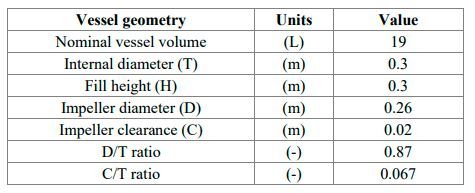
The agitation was carried out in an un-baffled single-jacketed torispherical based glass vessel of 19 L nominal volume. The vessel was fitted with an anchor impeller of D/T = 0.87, rotated by an overhead electrical motor with a digital speed controller. The exact dimensions of the vessel and impeller are detailed in Table 1, and illustrated in Figure 2 (see Gallery).
Table 1: System dimensions and geometry
(Source: Syngenta)
A model fluid displaying a mild yield stress (<10 Pa) and shear thinning behavior was desired, so as to mimic a manufacturing fluid for a scale-down study. A non-hazardous suspension in deionized water was thus formulated, containing 50 g/l Bentopharm (clay, Wilfrid Smith) and 3.6 g/l Rhodopol 23 (Xanthan gum, Solvay). All the ingredients were added simultaneously to a large vessel (50 L) and mixed with a high-shear Silverson mixer (approximately 60 min at 600 rpm) until no traces of powder were visible anymore.
Date: 08.12.2025
Naturally, we always handle your personal data responsibly. Any personal data we receive from you is processed in accordance with applicable data protection legislation. For detailed information please see our privacy policy.
Consent to the use of data for promotional purposes
I hereby consent to Vogel Communications Group GmbH & Co. KG, Max-Planck-Str. 7-9, 97082 Würzburg including any affiliated companies according to §§ 15 et seq. AktG (hereafter: Vogel Communications Group) using my e-mail address to send editorial newsletters. A list of all affiliated companies can be found here
Newsletter content may include all products and services of any companies mentioned above, including for example specialist journals and books, events and fairs as well as event-related products and services, print and digital media offers and services such as additional (editorial) newsletters, raffles, lead campaigns, market research both online and offline, specialist webportals and e-learning offers. In case my personal telephone number has also been collected, it may be used for offers of aforementioned products, for services of the companies mentioned above, and market research purposes.
Additionally, my consent also includes the processing of my email address and telephone number for data matching for marketing purposes with select advertising partners such as LinkedIn, Google, and Meta. For this, Vogel Communications Group may transmit said data in hashed form to the advertising partners who then use said data to determine whether I am also a member of the mentioned advertising partner portals. Vogel Communications Group uses this feature for the purposes of re-targeting (up-selling, cross-selling, and customer loyalty), generating so-called look-alike audiences for acquisition of new customers, and as basis for exclusion for on-going advertising campaigns. Further information can be found in section “data matching for marketing purposes”.
In case I access protected data on Internet portals of Vogel Communications Group including any affiliated companies according to §§ 15 et seq. AktG, I need to provide further data in order to register for the access to such content. In return for this free access to editorial content, my data may be used in accordance with this consent for the purposes stated here. This does not apply to data matching for marketing purposes.
Right of revocation
I understand that I can revoke my consent at will. My revocation does not change the lawfulness of data processing that was conducted based on my consent leading up to my revocation. One option to declare my revocation is to use the contact form found at https://contact.vogel.de. In case I no longer wish to receive certain newsletters, I have subscribed to, I can also click on the unsubscribe link included at the end of a newsletter. Further information regarding my right of revocation and the implementation of it as well as the consequences of my revocation can be found in the data protection declaration, section editorial newsletter.
The rheology of the fluid could be described well by the Herschel-Bulkley model, see Figure 7.
Figure 7: Herschel-Bulkley model
(Source: Syngenta)
In other words, it exhibits shear-thinning behavior. The yield stress of 7.6 Pa is relatively low compared to values for ketchup (~15 MPa) and mayonnaise (~90 MPa). The suspension is opaque and light grey in color.
Experimental procedure
Agitation
The experimental procedure was kept very simple by intent, to enable a visceral appreciation of the phenomena. First the material was agitated at the desired agitation rate (48 rpm or 90 rpm) for approximately 60 minutes to allow the material to form its intermolecular structure. Three different motion experiments were then performed relying on different physical phenomena: bulk motion, solids motion, addition of a second liquid. In all cases, a digital camera was used to record the motion of the main fluid and of the added materials. Measurements of relative distances were performed on still images along their left-right axis.
Floating solid addition
Two colored, transparent plastic A4 folders were cut into square pieces with an edge of roughly 1 cm. These squares were then dropped onto the surface of the agitated fluid, 5 cm (red square; r/T of 1/6, where r denotes the radial coordinate) or 10 cm (blue square; r/T of 1/3) from the center of the vessel.
Dye addition
Drops of colored blue food dye (Sainsbury’s, London, UK) were added to the surface of the agitated fluid via a pipette at different vessel locations (approximately: 1/4, 1/2 and 2/3 radii from the center of the vessel).
Results and Discussion
Videos of the experiments can be viewed in the text below. They demonstrate most clearly the results and behavior of the fluid and system. The results are also presented as sequences of still images below. Table 2 lists the observations recorded, and their interpretation is described in the sections below.
Table 2: Observations presented here.
(Source: Syngenta)
Qualitative motion
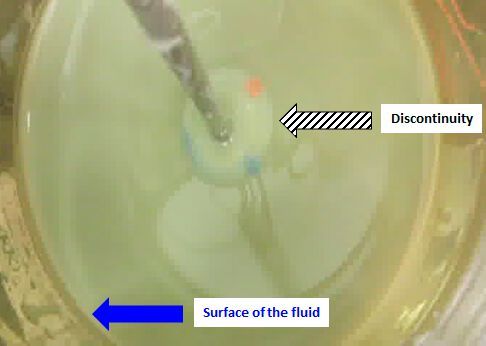
Prior to any addition, the fluid visually shows on the surface a marked central discontinuity, indicated with a striped arrow in Figure 1, and visible in all videos. The central region width is approximately one-fifth to one-quarter tank diameter. Based on visual observations, it was hypothesized that the discontinuity separated flowing bulk material from unyielded material near the center of the vessel where the material is rotating like a rigid body.
By virtue of these distinct behaviors, the discontinuity appears to acts like a barrier to flow. The CFD predictions and discussion of this behavior by [20] were only found after completion of the experimental work. While [20] predicts multiple unyielded zones, the resolution of the present work only allows the validation of the existence of an unyielded zone, not of its fine structure. Two more formal experiments were performed to test this hypothesis using different physical phenomena. First, however, we consider the quantitative results with respect to motion alone.
Figure 1: Visual appearance of the discontinuity and central region.
(Source: Syngenta)
Quantitative analysis
Measurements on the images show asymmetric behavior in the vessel, with the discontinuity extending further from the center towards the right side (of the images) than on the left. This asymmetry cannot be ascribed to the baffling, which is symmetric. Possible explanations include: imperfect alignment of the impeller; a slightly bent shaft; or asymmetry of the impeller upon fabrication. Some vibration of the shaft can be observed in the video recordings.
To minimize the impact of such imperfections on the experimental results, the full width w of the central zone was therefore measured, so as to avoid introducing directional bias. The fraction of the surface rotating like a rigid body was then calculated as (w/T)2, and is shown in Table 3.
Table 3: Fraction of surface rotating as a rigid body.
(Source: Syngenta)
Since both fluid and equipment used here are different from those of [20], direct comparisons are not possible. Nonetheless, the fraction of the rigid zone decreases with faster stirring, as qualitatively expected. The fact that it decreases only by 23 % for an 88 % increase in agitation rate suggests that it could be quite difficult to totally eradicate the unyielded zone in the case of incorrect mixing system design and/or incorrect formulations (with too high a yield stress).
This far from linear behavior was unexpected, highlighting the lack of information in the literature about unyielded central zones, and how their extent depends on composition and operating conditions. Indeed, not even general recommendations of mixing parameters to eradicate or reduce the central cavern were found.
Floating solids addition
Figure 3 (see Gallery) shows the trajectories of the two colored squares. The first two frames show the addition of each plastic piece. Thereafter, each frame is spaced by 20 seconds. Both colored squares slowly spiral towards the center of the vessel, until they reach the discontinuity surrounding the central zone, in the fifth (red, inner square) and eighth (blue, outer square) frame. Upon reaching this discontinuity the squares continue to rotate tangentially, but do not move further in the radial direction. This behavior is consistent with the central zone rotating like a rigid body.
Video 1 also shows this motion, in a more inherently dynamic fashion.
Dye addition
Figures 4 and 5 (see Gallery) show the movement of dye droplets over different timescales, 1.9 and 13.2 s respectively. Figure 4 presents the initial phase with each frame separated by 100 ms. The drops, progressively elongated by shear forces, move towards the center of the vessel until they reach the discontinuity. Figure 5, with each frame separated by 1.2 s, demonstrates that at the discontinuity the drops form a (partial) annular shape and over time slowly diffuse into the center. This behavior is also consistent with the central zone rotating like a rigid body.
Video 2 also shows this motion dynamically, with the addition occurring at timepoint 01:02.
Interpretation
The experiments described here, considered together, visually show in short succession that: (i) for a yield stress fluid stirred with a close-clearance impeller, a discontinuity can appear, at least on the surface; (ii) both solids and liquids behave differently when they reach this zone: outside it they move towards the center, but the bulk radial motion stops when reaching the discontinuity. Together these findings imply that the bulk motion of the surface inside the discontinuity is similar to that of a rigid body – in excellent qualitative agreement with the explicit predictions and interpretation of ‘unyielded zones’ ‘certainly very bad for mixing’ in [20], following on earlier work such as [2]. The importance of considering yield stress in the agitation of viscoplastic fluids, even for close-clearance impellers, is thus visually demonstrated since the unyielded state is detrimental to good mixing.
The behavior described here is encountered in industrial practice. For concentrated slurries in crystallizers, close-clearance impellers, especially anchors, are often observed to lead to poor movement close to the centre. In such cases, the walls can be exempt from fouling while the central shafts simultaneously build up heavy solid deposits at the centre. Consider a plant with a multi-m3 vessel, mixing with an anchor. At the relatively slow rotation rates typically practiced for anchors, the tip speed may be relatively high, but the tangential speed at the shaft surface will be very low.
The size of the central unyielded zone does not scale linearly with agitation rate, suggesting scale-up challenges: specifically, the need to operate an anchor excessively fast to eradicate the unyielded zone completely – if even possible. Estimating the corresponding tip speed or power-per-unit-volume value is thus of great practical relevance. Especially so, if the required mixing conditions are found to exceed the ratings of the motor, gear box, or shaft materials. While the experimental setup is no longer available to the authors of this study, such a follow-up study is a natural extension of the work reported here.
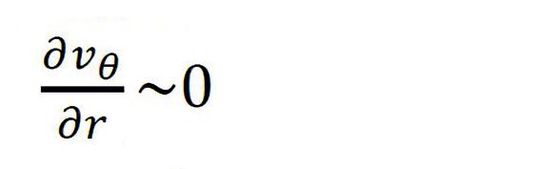
For CFD studies, this means that the absence of motion is not the only condition corresponding to an unyielded (and hence very poorly mixed) state. Velocity magnitudes are not a an exclusive criterion. A second possible condition for a cylindrical tank is the absence of gradient in the angular coordinate, i.e (Fig.8).
Figure 8
(Source: Syngenta)
This criterion could prove quite informative in CFD studies comparing the effectiveness of different types of impellers agitating viscoplastic fluids.
Conclusions
Visual and video observations of an opaque suspension of a viscoplastic fluid confirm the existence of an unyielded zone in the center of a tank when using a close-clearance impeller. Such regions are detrimental to homogeneity and must be avoided, e.g., by (much) faster agitation or the use of a different geometry. The work reported here can be used to demonstrate the importance of understanding non-Newtonian rheology, as well as the practical implications thereof: namely, significant fouling issues at industrial scale. The materials are safe and the discontinuity is clearly visible. The quantitative dependence of the size of the unyielded zone on various parameters, such as agitation rate, can be characterized by image analysis. This dependence, especially upon scale-up, will be important to characterize for many industrial applications. Indeed, there is a significant gap in mixing knowledge with respect to yield stress fluids with close clearance impellers.
In addition to the well-known cavern phenomenon observed for small-diameter impellers, the results shown here for close-clearance impellers support the notion that yield strength is a realistic and useful engineering description of the physical world, in good accordance with [6]. Further work in the area should include systematic explorations of the effect of various parameters on the extent of the unyielded zone. The use of transparent fluids, such as those in [8], is highly recommended, as this would allow the quantification of not just the radius but also volume of the unyielded zone.
The authors would like to thank Rob Lind (Syngenta) for help with video and image processing, and Professor Christos Markides (Imperial College) for commenting on an early draft of the manuscript.
References
[1] E. L. Paul, V. Atiemo-Obeng and S. Kresta, Handbook of Industrial Mixing (Wiley, Hoboken, N.J., 2003).
[2] F. Bertrand, P. Tanguy and E. Brito-De La Fuente, “A New Perspective for the Mixing of Yield Stress Fluids with Anchor Impellers,” J. Chem. Eng. Japan 29, 51-58 (1996).
[3] K. J. Carpenter and J. H. Atherton, Process Development: Physicochemical Concepts (Oxford University Press, Oxford, 1999).
[4] L. Pakzad, F. Ein-Mozaffari, S. Upreti and A. Lohi, “Experimental and Numerical Studies on Mixing of Yield-Pseudoplastic Fluids with a Coaxial Mixer,” Chem. Eng. Comm. 200, 1553-1577 (2013.)
[5] W. Herschel and R. Bulkley, “Konsistenzmessungen von Gummi-Benzollösungen,” Kolloid Zeitschrift 39, 291-300 (1926).
[6] J. M. Piau, “Carbopol gels: Elastoviscoplastic and slippery glasses made of individual swollen sponges Meso- and macroscopic properties, constitutive equations and scaling laws,” J. Non-Newtonian Fluid Mech. 144, 1-29 (2007).
[7] see Reference [7] in picture gallery
[8] A. W. Russell, L. Kahouadji, K. Mirpuri, A. Quarmby, P. M. Piccione, O. K. Matar, P. F. Luckham and C. N. Markides, “Mixing Viscoplastic Fluids in Stirred Vessels Over Multiple Scales,” Chem. Eng. Sci. 208, 115-129 (2019).
[9] K. Wichterle and O. Wein, “Threshold of mixing of non-Newtonian liquids,” Int. Chem. Eng. 21, 116-120 (1981).
[10] T. Elson, D. Cheesman and A. Nienow, “X-Ray Studies of Cavern Sizes and Mixing Performance with Fluids Possessing a Yield Stress,” Chem. Eng. Sci. 41, 2555-2562 (1986).
[11] J. Solomon, T. Elson, A. Nienow and G. Pace, “Cavern sizes in agitated fluids with a yield stress,” Chem. Eng. Commun. 11, 143-164 (1981).
[12] S. Shekhar and S. Jayanti, “Mixing of power‐law fluids using anchors: Metzner‐Otto concept revisited,” AIChE J. 49, 30-40 (2003).
[13] J. Aubin, I. Naude, J. Bertrand and C. Xuereb, “Blending of Newtonian and Shear-Thinning Fluids in a Tank Stirred with a Helical Screw Agitator,” Trans. IChemE 78, 1105-1114 (2000).
[14] I. Ihejirika and F. Ein-Mozaffari, “Using CFD and ultrasonic velocimetry to study the mixing of pseudoplastic fluids with a helical ribbon impeller.,” Chem. Eng. Technol. 30, 606-614 (2007).
[15] P. Prajapati and F. Ein-Mozaffari, “CFD Investigation of the Mixing of Yield‐Pseudoplastic Fluids with Anchor Impellers,” Chem. Eng. Tech. 32, 1211-1218 (2009).
[16] L. Pakzad, F. Ein-Mozaffari, S. Upreti and A. Lohi, “A novel and energy-efficient coaxial mixer for agitation of non-Newtonian fluids possessing yield stress,” Chem. Eng. Sci. 101, 642-654 (2013).
[17] L. Pakzad, F. Ein-Mozaffari, S. Upreti and A. Lohi, “Agitation of Herschel–Bulkley fluids with the Scaba–anchor coaxial mixers,” Chem. Eng. Res. Des. 91, 761-777 (2013).
[18] D. Patel, F. Ein-Mozaffari and M. Mehrvar, “Effect of rheological parameters on non-ideal flows in the continuous-flow mixing of biopolymer solutions,” Chem. Eng. Res. Des. 100, 126–134 (2015).
[19] A. Kazemzadeh, F. Ein-Mozaffari, A. Lohi and L. Pakzad, “Effect of the rheological properties on the mixing of Herschel-Bulkley fluids with coaxial mixers: Applications of tomography, CFD, and response surface methodology,” Can. J. Chem. Eng. 94, 2394–2406 (2016).
[20] F. Savreux, P. Jay and A. Magnin, “Viscoplastic fluid mixing in a rotating tank,” Chemical Engineering Science 62, 2290-2301 (2007).
[21] C. Rivera, S. Foucault, M. Heniche, T. Espinosa-Solares and P. Tanguy, “Mixing analysis in a coaxial mixer.,” Chem. Eng. Sci. 61, 2895-2907 (2006).
[22] P. Tanguy, F. Thibault, E. Brito-De La Fuente, T. Espinosa-Solares and A. Tecante, “Mixing performance induced by coaxial flat blade-helical ribbon impellers rotating at different speeds.,” Chem. Eng. Sci. 52, 1733-1741 (1997).
[23] P. M. Piccione, A. A. Rasheed, A. Quarmby and D. Dionisi, “Direct Visualization of Scale-Up Effects on the Mass Transfer Coefficient through the “Blue Bottle” Reaction,” J. Chem. Edu. 94, 726-729 (2017).
* P. M. Piccione and A. Quarmby used to work at Syngenta at the time of this work: Process Studies Group, Syngenta, Bracknell, UK.




:quality(80)/p7i.vogel.de/wcms/49/5c/495c651fabd24a437c98bde6a3d71ecc/0130060419v2.jpeg "Enfinium has successfully piloted Wasteer’s groundbreaking visual AI technology at its Ferrybridge 2 facility in West Yorkshire and Parc Adfer facility in North Wales. (Source: Chris Parkes Photographer Ltd.)")
:quality(80)/p7i.vogel.de/wcms/77/1c/771c3d385d46ede7ab736f3f7d63cb62/0130007313v2.jpeg "The laser perforated filter elements for Eaton’s DCF series enable retention ratings that were previously unattainable with conventional manufacturing methods. Thanks to automatic self-cleaning, they also provide uninterrupted operation with long service life and minimal maintenance requirements. (Source: Eaton )")
:quality(80)/p7i.vogel.de/wcms/0b/33/0b3359449325c4e66cffdb41fce11683/0129956557v2.jpeg "Aramco Senior Vice President of Digital & Information Technology Sami A. Al Ajmi, sitting right, and President of Microsoft Arabia Turki Badhris, sitting left, at a signing ceremony attended by Aramco Executive Vice President of Technology & Innovation Ahmad O. Al Khowaiter, standing right, and Vice Chair and President of Microsoft Brad Smith, standing left. (Source: Aramco )")
:quality(80)/p7i.vogel.de/wcms/60/25/60259e0165560492b717049a5006b5d2/0129719891v2.jpeg "Adnoc's panorama digital command center. (Source: Adnoc )")
:quality(80)/p7i.vogel.de/wcms/0e/19/0e19f0cf0379c3af4c2fe02629db63f1/0130079229v2.jpeg "Thyssenkrupp Uhde has been selected by CSBP to deliver its patented Envinox technology for two nitric acid plants at CSBP’s Kwinana site in Western Australia. (Source: Thyssenkrupp Uhde)")
:quality(80)/p7i.vogel.de/wcms/fd/61/fd617d02373498db1a96ba012e4cfdcd/0130026960v2.jpeg "Reliance Industries, one of India’s largest energy companies, will be investing in the new refinery at the Port of Brownsville in Texas, USA, according to Trump’s post. (Source: Unsplash )")
:quality(80)/p7i.vogel.de/wcms/93/9f/939fb603e5c2c60e52e4e92dd1de44e2/0129972638v2.jpeg "Shintech Louisiana has recently announced a 3.4-billion-dollar investment to bolster its manufacturing capabilities in the state. (Source: Pixabay)")
:quality(80)/p7i.vogel.de/wcms/0d/22/0d221bfb0debc81ac74afafc9cc632c2/0129972549v2.jpeg "The overall package is worth 485 million euros, of which 10 million euros related to engineering activities already started will be recognized in the pre-FID phase, while the remaining part at Final Investment Decision. (Source: Pixabay)")
:quality(80)/p7i.vogel.de/wcms/6b/3f/6b3f057c83c494e4732337d870d52b21/0130006927v2.jpeg "Lonza will realize upfront cash proceeds of 2.2 billion dollars and retain a 40 % stake in the business, with additional preferential participation in its future exit. (Source: Lonza)")
:quality(80)/p7i.vogel.de/wcms/df/cd/dfcd0c2e0eb4b554f956e0161ae08519/0129794328v1.jpeg "The plasma fractionation facility at CSL Behring, viewed from the outside. (Source: CSL Behring)")
:quality(80)/p7i.vogel.de/wcms/74/af/74af2b65341eeee13a44bc85eb759596/0129839901v2.jpeg "With around 6,000 European companies operating in India and an annual trade of 180 billion euros between the EU and India at present, the trade deal intends to double EU goods exports to India by 2032. (Source: © NazeerArt - stock.adobe.com)")
:quality(80)/p7i.vogel.de/wcms/26/12/261210e5920899e5c35c4f905d3be8bd/0129399814v2.jpeg "Powders used in DPI formulations are often highly potent and administered in very low doses. (Source: Ima)")
:quality(80)/p7i.vogel.de/wcms/af/73/af7394d9f8900024c5ee7fca459c4eeb/0130080328v2.jpeg "Axens has signed a MOU with Airbus to strengthen their cooperation in the development and deployment of SAF, a key pillar for decarbonizing the aviation sector. (Source: Pixabay)")
:quality(80)/p7i.vogel.de/wcms/a6/84/a68477d4ef879cc9cedeae332ca57c49/0129893677v2.jpeg "Siemens and Caphenia sign the partnership agreement. From left to right: Nicky Ahnert, Jürgen Giegerich, Frank Knauf (all Siemens), Dr. Mark Misselhorn, Dr. Andreas Waibel (both Caphenia) (Source: Siemens)")
:quality(80)/p7i.vogel.de/wcms/42/67/42671f576c7f8a1284b54bc8f92cce02/0129864175v2.jpeg "Honeywell’s advanced technologies and standardized design will help Verso Energy reduce capital expenses, accelerate speed to market and increase global SAF capacity. (Source: Pixabay)")
:quality(80)/p7i.vogel.de/wcms/be/e1/bee13b8d51a419b9b8f0685e2b9d47bf/0128917673v1.jpeg "The Centerwave 6000 measures pipes from 32 to 1,600 mm. (Source: Maag Group)")
:quality(80)/p7i.vogel.de/wcms/51/7a/517a4e83c5827663b4839f5ddb98f434/0128872953v1.jpeg "The Tigron in SIL version can be flexibly configured for different safety requirements. (Source: Auma)")
:quality(80)/p7i.vogel.de/wcms/d5/72/d5728578b35b72f365f5086bc1d068da/0128662441v2.jpeg "Nikkiso Clean Energy & Industrial Gases Group has announced the launch of its new multistage process pump (MSPP 210), designed to enhance safety and reduce downtime on air separation equipment. (Source: Nikkiso Clean Energy & Industrial Gases Group)")
:quality(80)/p7i.vogel.de/wcms/a9/69/a96920e47e362a9cf0b9916b7ad3d30a/0128071795v2.jpeg "Nine partners from six European countries are working on the 36-month project to determine where heat pumps can achieve the greatest efficiency gains in the food and beverage sector and to develop reproducible and market-ready solutions. (Source: EU project Exquisheat)")
:quality(80)/p7i.vogel.de/wcms/c2/08/c2089104ef8928a971945a0197f3b372/0130079797v2.jpeg "Valued at nearly 100 million dollars, the investment will add approximately 27 million pounds of annual drinking water carbon reactivation capacity, with operations expected to begin in 2028. (Source: Pixabay)")
:quality(80)/p7i.vogel.de/wcms/c4/54/c454c7d8fd344c0ffc2ef5db00ad632f/0129728429v2.jpeg "Liqtech International recently launched its Qureflow Max produced-water treatment system. (Source: Liqtech International )")
:quality(80)/p7i.vogel.de/wcms/18/47/1847e6b1456c96f04bd511bbd21f3779/0129039479v2.jpeg "Jacobs has been selected as the progressive design-build contractor for upgrades to the San José–Santa Clara Regional Wastewater Facility in California. (Source: Jacobs)")
:quality(80)/p7i.vogel.de/wcms/3b/fd/3bfda4bbcb1a60004c330bde3b705109/0128453300v2.jpeg "In the Jiangsu province, Suez will partner with Lianyun Economic Development Zone to jointly study the investment in, build, and operate a new industrial water treatment plant. (Source: Pixabay)")
:quality(80)/p7i.vogel.de/wcms/6b/cc/6bcc3d26e1c7c74d90a10bc3ca296ae1/0128362351v2.jpeg "A look into Bayer's new tablet production, Solida 1, during construction: The robots and lift columns for material handling are being installed. (Source: Bayer)")
:quality(80)/p7i.vogel.de/wcms/24/c8/24c84ab6b1bcd24468a87820a07a85aa/0128194707v2.jpeg "Ajax Equipment has supplied Binding Solutions with a feed system comprising buffer hopper, screw feeder and agitated screw feeder for a pilot plant handling iron ore and additives. (Source: Ajax Equipment )")
:quality(80)/p7i.vogel.de/wcms/1d/3e/1d3e2788eb37c1e974f36337c8d33cb5/0128191010v2.jpeg "Ajax Equipment has supplied IGI Systems with a stainless-steel conical hopper with gas purge capability, as part of a prototype Sublimation System for a low-pressure chemical vapour deposition application. (Source: Ajax Equipment)")
:quality(80)/p7i.vogel.de/wcms/19/76/1976928d7d0a2ed7c1eeba7ade8552c8/0126365603v1.jpeg "Detail of Valvedesign: It has an aktiv amd passive part (Bild: Italvacuum)")
:quality(80)/p7i.vogel.de/wcms/76/87/7687c53b1f8451b5d78ccb2254e5bcd9/0130080619v2.jpeg "The transaction marks a transformational milestone for Sidara and significantly advances its long-term strategic ambition to expand and elevate its energy offering to clients worldwide. (Source: Pixabay)")
:quality(80)/p7i.vogel.de/wcms/c0/f1/c0f1dc3ee8414e8768d9c92f7884ed67/0130060528v2.jpeg "Air BP will support a wide spectrum of Airbus' operations, including its commercial aircraft, helicopters, and military aircraft divisions. (Source: Air BP)")
:quality(80)/p7i.vogel.de/wcms/ef/81/ef81cdf2881a358f8743c07eae68e428/0130060283v2.jpeg "BASF has recently announced a price increase of up to 100 dollars per metric ton for butyl acrylate and 2-ethylhexyl acrylate across Asia-Pacific. (Source: BASF)")
:quality(80)/p7i.vogel.de/wcms/51/38/51382cd4287d6372a6f9648c25de55bf/0130024254v2.jpeg "On March 4, 2026, Qatar Energy declared force majeure to its buyers due to military attacks on its operating facilities in Ras Laffan Industrial City and Mesaieed Industrial City in Qatar. (Source: © Fahad - stock.adobe.com)")
:quality(80)/p7i.vogel.de/wcms/f8/29/f8298429c1638b949a6f76346f6709c7/0118701710v2.jpeg "Bosch Industrial Heat will be presenting sustainable steam and heat solutions for global industrial use at the Achema trade fair in Frankfurt, Germany. (Source: Bosch Industriekessel)")
:quality(80)/p7i.vogel.de/wcms/07/24/07242664ab2b1c7841c9d9d0a127670c/0116045959.jpeg "A look inside the GEA machine room. (Bild: Magnavale)")
:quality(80)/p7i.vogel.de/wcms/c9/79/c979a20b32395ddfa93fe7ead90578a0/0108386061.jpeg "Production residues, lime, salt and suspended solids quickly clog the pipes. (Source:©Tanakorn - stock.adobe.com)")
:quality(80)/p7i.vogel.de/wcms/9e/5c/9e5c92d942ed046a27562d6e3d730c92/0103483548.jpeg "It is almost ten metres high and extends over three floors: the world's first multiple dividing wall column is located in the new technical centre at the University of Ulm. (Bild: Eberhardt, kiz Universität Ulm)")
:quality(80)/p7i.vogel.de/wcms/1f/60/1f608b1d7b9fe0abab30d68341eaefc7/0130031208v2.jpeg "Adnoc suspends operations at the Ruwais oil refinery following a fire triggered by a drone attack on March 10, 2026. (Source: Adnoc)")
:quality(80)/p7i.vogel.de/wcms/1d/33/1d33cbe43461f24175e18aa01a426840/0129971592v2.jpeg "KBR has been awarded a major contract by Basra Oil Company to provide Integrated Field Management Services for the Majnoon Oil Field in Iraq. (Source: KBR)")
:quality(80)/p7i.vogel.de/wcms/a8/4e/a84e8039a90a5cf4751d01ebcf6ba1a9/0127510172v2.jpeg "After six years, Achemasia, the international trade fair and innovation forum for sustainable chemical production, has returned with renewed vigor, bringing together global expertise, Chinese innovation, and a shared commitment to a greener industrial future—according to the organizers of the fair. (Source:PROCESS China)")
:quality(80)/p7i.vogel.de/wcms/17/c7/17c703445f134eb3d7ecc7918dda2762/0124596096v2.jpeg "Achema Middle East will launch in Saudi Arabia in 2026. (Bild: Dechema/ Hannibal)")
:quality(80)/p7i.vogel.de/wcms/2a/2c/2a2cffc07f51019065387cd63241b5ce/0119463370v1.jpeg "The Injecta 36 fills and seals RTU (Ready-to-Use) syringes at high speed. The image shows the robotic arm. (Source: IMA)")
:quality(80)/p7i.vogel.de/wcms/b1/7e/b17ea8c62ccafad1d1fb072d6199bbd6/0118578446.jpeg "“Star in the ring”: Vegapuls 6X radar level sensors are the solution of choice for Renolit for many applications on the way to the perfect plastic product. (Source: © MR Design - stock.adobe.com; Vega)")
:fill(fff,0)/images.vogel.de/vogelonline/companyimg/2000/2093/65.jpg "Glatt_Logo_ND4c-RGB (5x3cm).jpg ()")
:quality(80)/p7i.vogel.de/wcms/08/ba/08ba3d9a1f923223cd39a949b03580b4/0100312072.jpeg "Figure 2: Geometry of the vessel and impeller system(Source: Syngenta)")
:quality(80)/p7i.vogel.de/wcms/84/a4/84a4816044e4c9fd33db7c8989ff42cf/0101727405.jpeg "Figure 6: Herschel-Bulkley equation(Source: Syngenta)")
:quality(80)/p7i.vogel.de/wcms/c9/88/c988936d2f2593c9d6a0438befbe5236/0100816534.jpeg "Figure 3: Behavior of floating solids over 215 sec.(Source: Syngenta)")
:quality(80)/p7i.vogel.de/wcms/d4/83/d483d1bf5e30221def6661bbf2f67514/0100816537.jpeg "Figure 4: Movement of droplet over the first 1.9 s after dye addition.(Source: Syngenta)")



:quality(80)/p7i.vogel.de/wcms/41/85/41850761720b85d6be9d51332da2b515/0125589239v2.jpeg "Bühler offers a solution for rice processing with its Rice Whitener. (Source: Bühler)")
:quality(80)/p7i.vogel.de/wcms/83/cc/83cc4a0bbc4a973e742536edafe3ec8b/0125230620v2.jpeg "Valves play an important role in industrial plants and the chemical sector is no exception to this. (Source: © Sebelas Studio - stock.adobe.com)")