Hydrocarbon producers face mounting pressure to become climate resilient, reduce carbon emissions, and focus on revenue streams from renewables. To alleviate this pressure, power generation organizations need to embrace renewable alternatives, and while some companies have become early adopters, many operators are looking at substantial changes to their business models to accommodate the transition.
One of the main challenges the industry encounters that prevents oil and gas producers from achieving a fully digital solution is the ability to pull together information from many different data silos.
(Source: Getty Gallery - stock.adobe.com)
There are numerous trends affecting hydrocarbon producers who are still carrying out upstream operations while transitioning into renewable alternatives, and their concerns focus on the type of digital technology solutions that can help them achieve their goals. Specifically, they want to ensure that the skills and knowledge gap is kept to a minimum, overcome challenges managing and optimizing current operations while reducing the environmental impact, and solve the data problem of how to manage and extract value from the vast amount of generated data and to prevent it being inaccessible to everyone.
The Current Situation
One of the main trends concerning the increase in demand for oil and gas is that despite the push toward renewables, demand for reliable and, more importantly, affordable energy will not go away until renewable sources outsource traditional oil and gas, as reliance on it could extend to the next 30 to 50 years. The war in Ukraine has made our reliance on energy sources even more apparent, fueling the need for cheaper alternatives. While capital investments in low- and zero-carbon energy projects have grown quickly, they are still lower than the collective investments in the fossil fuel-based infrastructure. That is because hydrocarbon producers are falling into three different camps:
Carry on as normal. These companies keep producing while demand and prices are still high. It means that they are still at the mercy of downturns and recessions in the coming years, but strong returns will see them through the next 30 years and more. They are smart to capitalize now while the window remains open.
Wholesale swing. The wholesale swing strategy replaces oil and gas production entirely and switches solely to renewable energy resources for a greener approach. The approach appeals to operators who are flexible and smart enough to embrace alternative energy sources before their main and often bigger rivals.
The best of both. A hybrid strategy implies carrying on as normal but cutting back on core activities to reduce carbon emissions and investigating and investing in renewable alternatives, such as carbon capture, energy storage, electrification, hydrogen projects, solar, and offshore wind. These renewables will eventually replace core oil and gas activities overtime, as it is widely anticipated that growing renewable capacity will displace fossil fuels in the world’s energy mix. The transition will be achieved by exploring and acquiring strategic opportunities that are already close to them, such as assets in the North Sea, and by taking digital advancements further in design and operation, such as digital twins and analytics.
Transferable Technology
One way to accelerate the process of transitioning to renewables is through reusing technology and skills from one industry to another. It could be personnel, technology, solutions, or partners applying the same principles of one project to another. One example is the offshore Block Island Wind Farm, one of the first commercial wind farms in the U.S., which began commercial operation in December 2016.
Offshore structures face many more challenges, compared to onshore ones, as they face wind, waves, and currents. Structurally, the turbine foundations require more engineering analysis. For the Block Island project, the structural design was carried out by Keystone Engineering, which had built oil and gas platforms to withstand the force of Hurricane Katrina without being damaged.
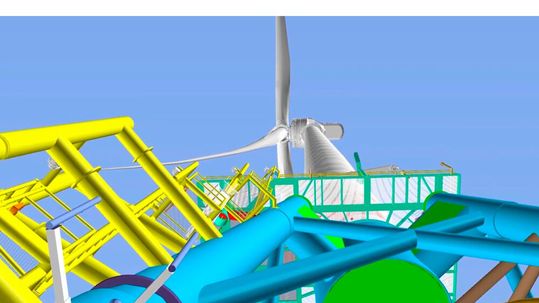
Keystone Engineering leveraged their knowledge in offshore platforms into offshore wind platforms.
(Source: Keystone Engineering)
This knowledge and experience they had in the fabrication, construction, and installation of offshore structures gave the firm a key advantage in the design of the Block Island Wind Farm foundation structure by providing a focus on constructability, fabrication efficiency, and reduced installation time. The additional benefits of partnering with Bentley was twofold—both companies had a long history of working together in the offshore oil and gas industry, as well as expertise in structural analysis for wind turbines. Without this, it would have taken the project much longer to complete without the necessary guarantees of success and resilience.
The companies that will gradually make the transition and those that will continue oil and gas production for the next several decades will face even more intense scrutiny from an environmental standpoint and must show that they are making giant strides toward net-zero emissions. There are still many ways of achieving that goal.
Going Digital
One of the main challenges the industry encounters that prevents oil and gas producers from achieving a fully digital solution is the ability to pull together information from many different data silos. It could be engineering data stored in engineering modeling systems, control systems, maintenance and operational data, data historians, and other sources. Siloed data causes bottlenecks as maintenance and operations fail to find the information that they need to fix problems quickly. It takes too long to make accurate decisions when teams spend most of their time trying to find the right information and confirm if it is up to date and reliable. They lack the visibility and access to the right information.
Date: 08.12.2025
Naturally, we always handle your personal data responsibly. Any personal data we receive from you is processed in accordance with applicable data protection legislation. For detailed information please see our privacy policy.
Consent to the use of data for promotional purposes
I hereby consent to Vogel Communications Group GmbH & Co. KG, Max-Planck-Str. 7-9, 97082 Würzburg including any affiliated companies according to §§ 15 et seq. AktG (hereafter: Vogel Communications Group) using my e-mail address to send editorial newsletters. A list of all affiliated companies can be found here
Newsletter content may include all products and services of any companies mentioned above, including for example specialist journals and books, events and fairs as well as event-related products and services, print and digital media offers and services such as additional (editorial) newsletters, raffles, lead campaigns, market research both online and offline, specialist webportals and e-learning offers. In case my personal telephone number has also been collected, it may be used for offers of aforementioned products, for services of the companies mentioned above, and market research purposes.
Additionally, my consent also includes the processing of my email address and telephone number for data matching for marketing purposes with select advertising partners such as LinkedIn, Google, and Meta. For this, Vogel Communications Group may transmit said data in hashed form to the advertising partners who then use said data to determine whether I am also a member of the mentioned advertising partner portals. Vogel Communications Group uses this feature for the purposes of re-targeting (up-selling, cross-selling, and customer loyalty), generating so-called look-alike audiences for acquisition of new customers, and as basis for exclusion for on-going advertising campaigns. Further information can be found in section “data matching for marketing purposes”.
In case I access protected data on Internet portals of Vogel Communications Group including any affiliated companies according to §§ 15 et seq. AktG, I need to provide further data in order to register for the access to such content. In return for this free access to editorial content, my data may be used in accordance with this consent for the purposes stated here. This does not apply to data matching for marketing purposes.
Right of revocation
I understand that I can revoke my consent at will. My revocation does not change the lawfulness of data processing that was conducted based on my consent leading up to my revocation. One option to declare my revocation is to use the contact form found at https://contact.vogel.de. In case I no longer wish to receive certain newsletters, I have subscribed to, I can also click on the unsubscribe link included at the end of a newsletter. Further information regarding my right of revocation and the implementation of it as well as the consequences of my revocation can be found in the data protection declaration, section editorial newsletter.
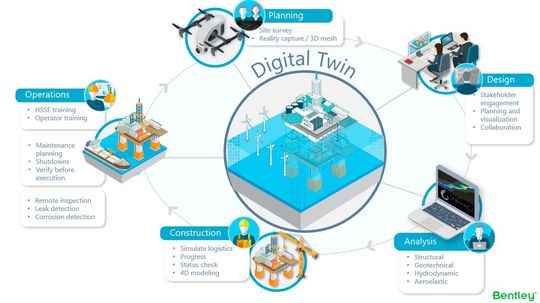
Going digital means always having access to reliable and up-to-date information from multiple sources across the lifecycle.
(Source: Bentley Systems)
In addition to pulling together siloed data, there is the question of how the oil and gas industry can calculate the return on investment (ROI) from digital and business transformation solutions, where data attributes and data integration are primary and fundamental deliverables. There is no single answer, as ROI can be calculated in many ways. Recent improvements delivered by a more collaborative supply chain, working with common data and information, has further improved execution performance. Critically, these improvements have facilitated better decision-making, resulting in fundamentally better solutions.
Better solutions are essential if the industry is to meet the immense challenge of “net-zero;” however, these improvements are harder to quantify. What we are seeing is companies demonstrating efficiency improvements through time to find accurate information, trust that information, and avoid offshore visits. Again, these improvements are easy to quantify, but given the focus on safety, they are critical for reducing workforces and developing the flexibility to deploy the best skill sets. Digitization is simply essential to ongoing operations, and imperative for companies to remain competitive and safe.
Incorporating analytics and machine learning techniques to reliability solutions—such as the Assetwise services that Bentley provides—enables the connectivity, interoperability, visibility, and insights that were previously hidden within these data silos. These solutions provide a more holistic view of performance and reliability across operations around the clock, as constant monitoring and reporting can show early indicators of future events or problems. These reliability and analytical solutions can provide a variety of use case to help reduce emissions and achieve the net zero goal.
How to Start a Journey to Net Zero
The rising environmental, social, and governance (ESG) imperative will, to a large extent, define overall producer strategies, as ESG excellence could be viewed as a competitive advantage. Oil and gas companies are increasingly looking to digital solutions like digital twins, data platforms, and other technologies to move beyond monitoring to emission controls, proving that they are taking a step in the right direction. One of the first things that operators can do now, if they haven’t already started, to reduce their carbon footprint is to optimize their operations. While optimizing operations is nothing new, the effect on the environment is evident. If everything is running smoothly and as intended, then energy expenditure is minimized.
The first step is to prevent failures that cause equipment to run outside of optimal efficiency, or even cause shutdowns. For instance, pumps not running at their best efficiency not only use more energy, but are also less reliable, both of which lead to a higher level of emissions. Having a robust asset performance management strategy in place is a must. An example of how to establish an asset performance management strategy comes from OQ Upstream, an integrated energy company that operates and manages dozens of plants, thousands of assets, and over 4,500 kilometers of pipeline across Oman.
In their 2022 Going Digital Awards in Infrastructure submission, which is a finalist in the Process and Power Generation category, OQ digitized their asset performance management activities. As a result, they could recognize the impact on the reliability growth and the reduction of failures and unplanned downtime, resulting in a growth of asset reliability while significantly reducing functional failures, unplanned work orders, and maintenance costs.
Other ways of optimizing operations are monitoring and managing your assets more effectively. In a recent Mc Kinsey report, they state that, on average, a 10 % increase in production efficiency delivers a 4 % reduction in emission intensity. The process industry generates a tremendous amount of data, so being able to access, monitor, analyze, and report on this data is crucial for achieving optimal asset performance and emission reporting and control. By having this data at your fingertips, you can ensure that you are operating within governmental and industry guidelines in terms of production, chemical use, flaring, minimized oil in water, and many other factors.
An example of optimizing existing assets more effectively is Cairn Vedanta in India. Using Assetwise 4D Analytics from Bentley, they captured all well integrity and flow assurance data from over 800 onshore and offshore wells. They aggregated data from multiple systems into one solution, and by using analytics, they created a near real-time picture of asset health and performance. They could then identify which wells were performing against cost after stimulation. Having the data helped them to decide whether they should continue, retire, or make changes to the well, resulting in improvements to both emissions reduction and costs. It enabled them to move to a proactive approach toward integrity management to eliminate possible failures or rectify them as soon as possible, creating a more sustainable operation.
The Role of the Digital Twin
These optimization techniques, which are often offered as stand-alone solutions, can now be offered within digital twins. A digital twin is a virtual representation of real-world entities and processes, combining engineering and design data/models, with operational and IT information. Digital twin systems transform businesses by accelerating understanding, supporting optimal decision-making, and enabling effective action.
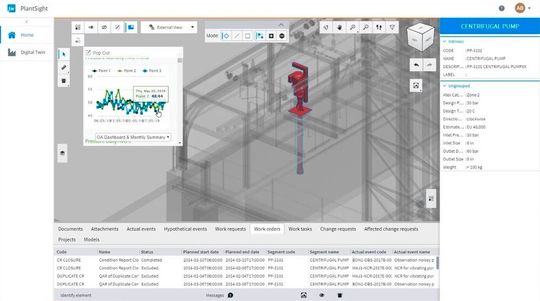
Plantsight combines operational and asset data on top of engineering data for a more holistic view of performance.
(Source: Bentley Systems)
As oil and gas operations become more digitized to improve operational performance, as well as remain competitive and more sustainable, the role of digital twin technology becomes even more important. Gartner says that by 2024, at least 90 % of greenfield investments will already have comprehensive digital twin models, on-site data integration, and dynamic software configuration capabilities. As the need for renewable transition escalates, the need for complex oil and gas digital twins may slip down the list of importance. Nevertheless, the benefits a digital twin brings to any digital operation are attractive, including:
Enabling automated, remotely operated, minimally manned, highly efficient, and more sustainable assets.
Providing an accurate and reliable source of information across the whole lifecycle of the asset.
Accessibility across multiple teams, from engineering design and handover through to operations and maintenance.
Providing facilities for training and familiarization of operations prior to on-site visits.
Multidiscipline integration of third-party models, data, and information into one application.
Improving overall decision-making with the addition of simulation and predictive capabilities.
To date, the focus has been on how to build digital twins, and the foundations are there in applications, such as Plantsight and Assetwise from Bentley. However, what is becoming increasingly important is how organizations keep those digital twins—the complete set of information about their assets, not just models and engineering—up to date and accurate. How do those organizations connect to their supply chains, maintain an open choice, and collaborate effectively on a global scale? Adopting these practices will define the next five years in the oil and gas and energy industries. New organizations entering the market will be the catalyst for this change. The other axis of change will be connectivity between the digital twin and operational and transactional systems. New approaches to federation and integration are essential, and the packaged integration tools that are available are leading the way in delivering these integrations in the industry.
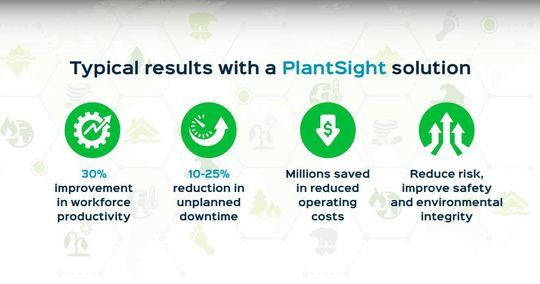
The typical benefits of a Plantsight digital twin.
(Source: Bentley Systems)
Overall, digital twins can improve asset operators’ situational awareness and optimize asset performance by modeling dynamic behavior. As a focal point system for asset operations, digital twins have the significant potential to improve oil and gas companies’ asset and business performance. The oil and gas industry is already a leading adopter of digital twins, as evidenced by the inclusion of the 2022 Going Digital Awards finalist Shell and their Deepwater Project Delivery Digital Platform. This project uses a digital twin created with Plantsight to aggregate data from various sources and provide a comprehensive picture of the project, leading to clarity and alignment among the diverse teams working on the project.
Conclusion
As the climate debate has escalated over the last few years, oil and gas companies are now working hard to update their strategies and shift capital as part of the energy transition. Technology, such as digital twins, will play a large strategic role as they provide the visualization, context, and the right information at the right time. By providing an accurate overview of energy assets, digital twins enable efficiency, emission reduction, and an acceleration of the energy transition. It may entail acquisitions of renewable companies or longer-term investments in their own technology.
Lastly, oil and gas companies need to partner with vendors that have the expertise, domain knowledge, and technology. Bentley applications, for example, have been used for a long time in renewable energy projects from design to operations in solar, offshore and onshore wind, hydroelectric, and other sources to make the energy transition smoother. While digital twins are only one of the options available to reach the goal of a net-zero emissions future, they remain a key focus of the digitization process and of the oil and gas industry.
* Richard Irwin, solution marketing manager, Bentley Systems




:quality(80)/p7i.vogel.de/wcms/54/f4/54f4b4e2a86b203e0dfd84221602bdb5/0130367283v2.jpeg "Anybotics' Anymal robot combines depth cameras, LiDAR, thermal imaging, acoustic sensors, and gas detectors into a single inspection round. (Source: Anybotics)")
:quality(80)/p7i.vogel.de/wcms/e9/64/e964996410967c124c2cf01a8623068e/0130285341v1.jpeg "Geht unter die Oberfläche: Die Offshore-Ölförderung erfordert hochenergetische Pumpen – doch diese sind im Wesentlichen eine Black Box. Bisher zumindest. (Source: Kistler Group)")
:quality(80)/p7i.vogel.de/wcms/54/ae/54aece5dff672ce1651470eecd9f2589/0130138090v2.jpeg "The new Ionchromatograph “Nexera IC“ (Source: Shimadzu)")
:quality(80)/p7i.vogel.de/wcms/49/5c/495c651fabd24a437c98bde6a3d71ecc/0130060419v2.jpeg "Enfinium has successfully piloted Wasteer’s groundbreaking visual AI technology at its Ferrybridge 2 facility in West Yorkshire and Parc Adfer facility in North Wales. (Source: Chris Parkes Photographer Ltd.)")
:quality(80)/p7i.vogel.de/wcms/1e/15/1e15b0e20cf5ede83e0749260dfda733/0130465044v2.jpeg "Energy X has recently announced the successful commissioning of a first-of-its-kind, U.S.-based lithium production facility at Project Lonestar, marking a major milestone toward commercial-scale domestic lithium production. (Source: Pixabay)")
:quality(80)/p7i.vogel.de/wcms/36/36/36369e6e59d4c660893cc04a4d257cfc/0130465035v2.jpeg "Wacker has successfully completed the second expansion phase at its production site in Panagarh, India. In addition to silicone rubber, the site now also operates a production complex (left) for silicone emulsions. (Source: Wacker)")
:quality(80)/p7i.vogel.de/wcms/1f/1e/1f1eba3731af22e1d9946e2897f134da/0130464799v2.jpeg "Aerial view of the BASF production site in Zhanjiang, China. (Source: BASF )")
:quality(80)/p7i.vogel.de/wcms/64/bb/64bb4812390b6491ce0bd4fe53597086/0130333812v2.jpeg "The solar power plant produces 30 GWh per year of renewable electricity, which is self-consumed by Holcim’s industrial facilities, making it the largest floating solar power plant in Europe dedicated to self-consumption. (Source: Pixabay)")
:quality(80)/p7i.vogel.de/wcms/41/c9/41c96e0244221ad38daa73bdd8231477/0130477173v2.jpeg "The „ORBITA‑L“-system is designed for filling and capping non‑injectable liquid products. (Source: Marchesini)")
:quality(80)/p7i.vogel.de/wcms/7a/50/7a501f6d8f87a4524dc3aaceb04eacb4/0130333829v2.jpeg "The Clear Lake facility represents Clariant's first U.S. manufacturing site dedicated to producing pharmaceutical-grade PEG excipients, marking a pivotal milestone in the company's healthcare growth strategy. (Source: Clariant)")
:quality(80)/p7i.vogel.de/wcms/26/12/261210e5920899e5c35c4f905d3be8bd/0129399814v2.jpeg "Powders used in DPI formulations are often highly potent and administered in very low doses. (Source: Ima)")
:quality(80)/p7i.vogel.de/wcms/6b/3f/6b3f057c83c494e4732337d870d52b21/0130006927v2.jpeg "Lonza will realize upfront cash proceeds of 2.2 billion dollars and retain a 40 % stake in the business, with additional preferential participation in its future exit. (Source: Lonza)")
:quality(80)/p7i.vogel.de/wcms/df/35/df3526a6f7aba41fdd2bb2051954e0d8/0130163620v2.jpeg "The SPA, valued at more than 3 billion dollars, is one of the largest binding long-term green ammonia off-take agreements globally. (Source: Pixabay)")
:quality(80)/p7i.vogel.de/wcms/af/73/af7394d9f8900024c5ee7fca459c4eeb/0130080328v2.jpeg "Axens has signed a MOU with Airbus to strengthen their cooperation in the development and deployment of SAF, a key pillar for decarbonizing the aviation sector. (Source: Pixabay)")
:quality(80)/p7i.vogel.de/wcms/0e/19/0e19f0cf0379c3af4c2fe02629db63f1/0130079229v2.jpeg "Thyssenkrupp Uhde has been selected by CSBP to deliver its patented Envinox technology for two nitric acid plants at CSBP’s Kwinana site in Western Australia. (Source: Thyssenkrupp Uhde)")
:quality(80)/p7i.vogel.de/wcms/a6/84/a68477d4ef879cc9cedeae332ca57c49/0129893677v2.jpeg "Siemens and Caphenia sign the partnership agreement. From left to right: Nicky Ahnert, Jürgen Giegerich, Frank Knauf (all Siemens), Dr. Mark Misselhorn, Dr. Andreas Waibel (both Caphenia) (Source: Siemens)")
:quality(80)/p7i.vogel.de/wcms/1c/39/1c39433f4bb4de2e5e6c5311c3236d09/0130110254v2.jpeg "The new pumps of the Omega type series have been designed for handling water and fluids with a low solids content efficiently. (Source: KSB)")
:quality(80)/p7i.vogel.de/wcms/be/e1/bee13b8d51a419b9b8f0685e2b9d47bf/0128917673v1.jpeg "The Centerwave 6000 measures pipes from 32 to 1,600 mm. (Source: Maag Group)")
:quality(80)/p7i.vogel.de/wcms/51/7a/517a4e83c5827663b4839f5ddb98f434/0128872953v1.jpeg "The Tigron in SIL version can be flexibly configured for different safety requirements. (Source: Auma)")
:quality(80)/p7i.vogel.de/wcms/60/ef/60efa975d1dd123c1afbfb6ccc060461/0130263955v2.jpeg "Aquaclean (Source: Oko-tech)")
:quality(80)/p7i.vogel.de/wcms/07/62/0762f20b1821ee2724c97989374d6397/0130257651v2.jpeg "Oleksandr Sadchykov in front of the water treatment unit (Source: Grundfos)")
:quality(80)/p7i.vogel.de/wcms/98/98/989863664c7b65e87caf74a08239d487/0130167217v2.jpeg "Keller 26KyX Level Probe (Source: © Keller Pressure)")
:quality(80)/p7i.vogel.de/wcms/64/4e/644e22b71e8d35a63f051f781eb13886/0130163451v2.jpeg "Vega will present level and pressure measurement technology for the water industry at Ifat 2026. (Source: Vega)")
:quality(80)/p7i.vogel.de/wcms/6b/cc/6bcc3d26e1c7c74d90a10bc3ca296ae1/0128362351v2.jpeg "A look into Bayer's new tablet production, Solida 1, during construction: The robots and lift columns for material handling are being installed. (Source: Bayer)")
:quality(80)/p7i.vogel.de/wcms/24/c8/24c84ab6b1bcd24468a87820a07a85aa/0128194707v2.jpeg "Ajax Equipment has supplied Binding Solutions with a feed system comprising buffer hopper, screw feeder and agitated screw feeder for a pilot plant handling iron ore and additives. (Source: Ajax Equipment )")
:quality(80)/p7i.vogel.de/wcms/1d/3e/1d3e2788eb37c1e974f36337c8d33cb5/0128191010v2.jpeg "Ajax Equipment has supplied IGI Systems with a stainless-steel conical hopper with gas purge capability, as part of a prototype Sublimation System for a low-pressure chemical vapour deposition application. (Source: Ajax Equipment)")
:quality(80)/p7i.vogel.de/wcms/19/76/1976928d7d0a2ed7c1eeba7ade8552c8/0126365603v1.jpeg "Detail of Valvedesign: It has an aktiv amd passive part (Bild: Italvacuum)")
:quality(80)/p7i.vogel.de/wcms/0c/a1/0ca135e0486c9af90a0552aea85de88c/0130439525v2.jpeg "Qatar Energy expects the damage to its Ras Laffan Industrial City caused by missile strikes, which occurred on Wednesday 18 March 2026, and in the early hours of Thursday 19 March 2026, to cost about 20 billion dollars a year in lost revenue. (Source: Pixabay)")
:quality(80)/p7i.vogel.de/wcms/d0/f7/d0f7d560dfce37c8371442d5b6120e3c/0130182478v1.jpeg "The Gelsenkirchen refinery primarily manufactures fuels for vehicles and aircraft, processing roughly 12 million tonnes of crude oil per year. (Source: BP)")
:quality(80)/p7i.vogel.de/wcms/7f/96/7f9628e43c99564fa6dfd8e76149425d/0130165852v2.jpeg "Pure titanium recycling process for chlor-alkali electrolysis cells. (Source: Asahi Kasei)")
:quality(80)/p7i.vogel.de/wcms/f8/29/f8298429c1638b949a6f76346f6709c7/0118701710v2.jpeg "Bosch Industrial Heat will be presenting sustainable steam and heat solutions for global industrial use at the Achema trade fair in Frankfurt, Germany. (Source: Bosch Industriekessel)")
:quality(80)/p7i.vogel.de/wcms/07/24/07242664ab2b1c7841c9d9d0a127670c/0116045959.jpeg "A look inside the GEA machine room. (Bild: Magnavale)")
:quality(80)/p7i.vogel.de/wcms/c9/79/c979a20b32395ddfa93fe7ead90578a0/0108386061.jpeg "Production residues, lime, salt and suspended solids quickly clog the pipes. (Source:©Tanakorn - stock.adobe.com)")
:quality(80)/p7i.vogel.de/wcms/9e/5c/9e5c92d942ed046a27562d6e3d730c92/0103483548.jpeg "It is almost ten metres high and extends over three floors: the world's first multiple dividing wall column is located in the new technical centre at the University of Ulm. (Bild: Eberhardt, kiz Universität Ulm)")
:quality(80)/p7i.vogel.de/wcms/7c/77/7c77e24fdcc9e1511e8e711eff161e28/0130175489v2.jpeg "The milestone confirms the fast pace of development of Eni’s deep water gas projects offshore East Kalimantan. (Source: Unsplash )")
:quality(80)/p7i.vogel.de/wcms/b3/2f/b32fb9f5aa54e9cb6c92e4b6c8665263/0130163018v2.jpeg "The decision to take emergency collective action was made following an extraordinary meeting of IEA Member governments, convened by the IEA Executive Director to assess market conditions amid the conflict in the Middle East and consider the options to address supply disruptions. (Source: © Sashkin - stock.adobe.com)")
:quality(80)/p7i.vogel.de/wcms/85/d2/85d2cb02c4ae45a99454b5405b0f2489/0130149909v2.jpeg "IEA Executive Director Fatih Birol issued a statement on the meeting of G7 Energy Ministers at its IEA headquarters in Paris. (Source: © Marko - stock.adobe.com)")
:quality(80)/p7i.vogel.de/wcms/a8/4e/a84e8039a90a5cf4751d01ebcf6ba1a9/0127510172v2.jpeg "After six years, Achemasia, the international trade fair and innovation forum for sustainable chemical production, has returned with renewed vigor, bringing together global expertise, Chinese innovation, and a shared commitment to a greener industrial future—according to the organizers of the fair. (Source:PROCESS China)")
:quality(80)/p7i.vogel.de/wcms/17/c7/17c703445f134eb3d7ecc7918dda2762/0124596096v2.jpeg "Achema Middle East will launch in Saudi Arabia in 2026. (Bild: Dechema/ Hannibal)")
:quality(80)/p7i.vogel.de/wcms/2a/2c/2a2cffc07f51019065387cd63241b5ce/0119463370v1.jpeg "The Injecta 36 fills and seals RTU (Ready-to-Use) syringes at high speed. The image shows the robotic arm. (Source: IMA)")
:quality(80)/p7i.vogel.de/wcms/b1/7e/b17ea8c62ccafad1d1fb072d6199bbd6/0118578446.jpeg "“Star in the ring”: Vegapuls 6X radar level sensors are the solution of choice for Renolit for many applications on the way to the perfect plastic product. (Source: © MR Design - stock.adobe.com; Vega)")
:quality(80)/p7i.vogel.de/wcms/09/e3/09e378194b496921d2a267a6752322eb/0130333473v2.jpeg "Under the terms of the contract, KBR will provide contract management, project management and supporting technical services throughout the EPC phases of the project. (Source: KBR)")
:quality(80)/p7i.vogel.de/wcms/77/9d/779db435e7f9d79bafe16101008a9cfa/0130263548v2.jpeg "The Kingdom of Saudi Arabia, the UAE and Turkey are three core countries in the region that are actively incorporating the plastics circular economy with the assistance of the chemical recycling technology. (Source: © Anastasiia - stock.adobe.com)")
:fill(fff,0)/images.vogel.de/vogelonline/companyimg/113800/113818/65.jpg "Turck_Your_Global_Automation_Partner.jpg ()")
:fill(fff,0)/p7i.vogel.de/companies/61/f9/61f9439b7cbe4/logo-edl.png "logo-edl (EDL Anlagenbau Gesellschaft mbH)")
:fill(fff,0)/p7i.vogel.de/companies/5f/98/5f98fbb2e7bf2/05-trm-filter-logo-with-slogan-en-alt.png "05_TRM_Filter_LOGO_with_slogan_EN_ALT.png (www.trm-filter.com)")

:quality(80)/p7i.vogel.de/wcms/01/15/0115415d906c21a45a3843617426db74/0125679758v3.jpeg "With the power to replicate the physical assets of a system or production process into a virtual system, the digital twin enables industry players to make informed decisions about the lifecycle of plants, optimization of processes as well as enhancing production based on real-time data. (Source: © EmmaStock - stock.adobe.com)")
:quality(80)/p7i.vogel.de/wcms/0f/f9/0ff9a64d717c25f0c77923d95f561713/0126455560v2.jpeg "With the help of various new technologies such as Artificial Intelligence, Digital Twin, Augmented Reality and Robotics being incorporated across industrial plants, plant personnel can optimize their processes, enhance production based on real-time data, reduce downtime, slash costs and even carry out autonomous plant inspections. (Source: © KM - stock.adobe.com)")