The U.S. Food and Drug Administration (FDA) has issued November 27th, 2023 as the deadline for the pharmaceutical industry to comply with the Drug Supply Chain Security Act (DSCSA). This regulation has opened a series of opportunities for track and trace solution providers in the U.S. market. Read on to find out more about the impact of the Act on the industry along with the latest solutions in this segment.
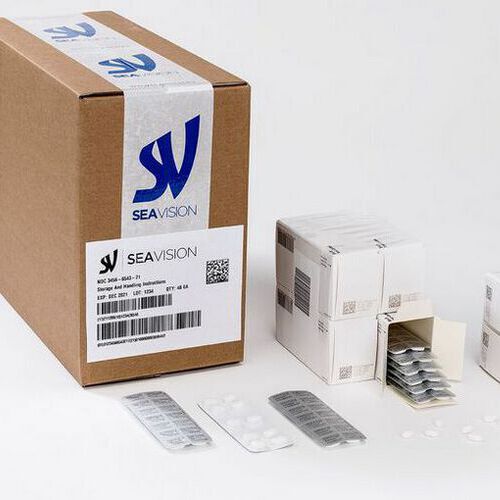
Pharma packaging: An example of the logistic units under the new Drug Supply Chain Security Act.
(Source: Sea Vision)
Under the leadership of Former U.S. President Barack Obama, the U.S. Drug Quality and Security Act (DQSA) became a law in 2013. Comprising of two parts – Title I: The Compounding Quality Act which focuses on compounded drugs and Title II: the Drug Supply Chain Security Act (DSCSA), the DQSA was passed in the background of accidental distribution of contaminated steroid injections which claimed the lives of 64 people and left 793 patients down with infection.
What is the Drug Supply Chain Security Act?
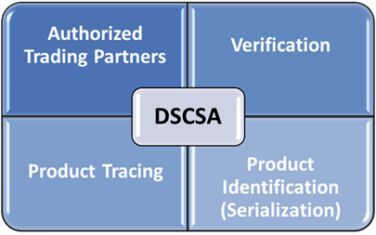
Recently, the DQSA’s Drug Supply Chain Security Act (DSCSA) has been in the news but what is the core focus of the act? According to the website of the U.S. Food and Drug Administration (FDA), Title II of the Drug Quality and Security Act, the Drug Supply Chain Security Act (DSCSA), outlines steps to achieve interoperable, electronic tracing of products at the package level to identify and trace certain prescription drugs as they are distributed in the United States.
Key pillars of the Drug Supply Chain Security Act.
(Source: rfxcel, Antares Vision)
It further adds that this will enhance FDA’s ability to help protect consumers from exposure to drugs that may be counterfeit, stolen, contaminated, or otherwise harmful. These requirements will also improve detection and removal of potentially dangerous drugs from the drug supply chain to protect U.S. consumers, shares the site.
Watershed moment for the pharma industry
This is a vital move for the pharmaceutical industry and one that cannot be ignored by the different stakeholders in the sector. “This is a watershed change for the industry because it establishes a new ‘hyper level’ of tracking that was not possible before,” mentions Herb Wong, Senior Vice President, Product and Strategy at rfxcel, a leader in digital supply chain traceability solutions acquired by the Antares Vision Group, a global provider of intelligent track and trace, inspection, and smart data management solutions for the life sciences and food and beverage sectors. He explains that generally, the first phase of the DSCSA focused on lot-level traceability and complying with requirements for exchanging information. The second phase creates full interoperable electronic unit-level traceability — or full serialization of the U.S. pharma supply chain.
Herb Wong, Senior Vice President, Product and Strategy at rfxcel.
(Source: Antares Vision Group)
This means that the industry will now have to adopt enhanced track and trace solutions in their operations and they must do it in the coming months if they haven’t already done so as the FDA has now set a deadline of November 27th, 2023 to comply with the Drug Supply Chain Security Act (DSCSA).
Federico Finotti, Sales Director from Sea Vision USA, a firm specializing in vision systems, track and trace, and 4.0 solutions for the pharmaceutical industry shares, “US pharma companies have to meet the DSCSA deadline of 2023 for the local market, and at the same time they have to keep an eye on the markets abroad where they export their goods to, and comply with all their track and trace regulations. Production lines have to be ready for the complete aggregation process to be compliant with DSCSA for the local market on both existing and new packaging lines.”
Federico Finotti, Sales Director, Sea Vision USA
(Source: Sea Vision USA)
“In this regulatory landscape, solution providers can help pharma companies realize a bigger vision of ‘value beyond compliance’. For example, serialized data allows for laser-focused recalls, improved tracking, and earlier detection of diversion or fraud in the supply chain,” opines Wong.
Golden opportunity for track and trace solution providers
Now, this a golden opportunity for track and trace solution providers to significantly increase their customer base in the US and they know it well. “The DSCSA creates a window of opportunity for the track and trace providers who have a strong presence in the US market, shares Finotti. “Those companies will get a chance to propose reliable and tested solutions on a market as big as the United States, with plenty of pharmaceutical packaging lines.”
He mentions that track and trace solution providers will make sure the companies have all necessary tools to comply with this regulation. Most of them have been familiar with similar regulations for years, ever since they were introduced in China and the European Union.
Date: 08.12.2025
Naturally, we always handle your personal data responsibly. Any personal data we receive from you is processed in accordance with applicable data protection legislation. For detailed information please see our privacy policy.
Consent to the use of data for promotional purposes
I hereby consent to Vogel Communications Group GmbH & Co. KG, Max-Planck-Str. 7-9, 97082 Würzburg including any affiliated companies according to §§ 15 et seq. AktG (hereafter: Vogel Communications Group) using my e-mail address to send editorial newsletters. A list of all affiliated companies can be found here
Newsletter content may include all products and services of any companies mentioned above, including for example specialist journals and books, events and fairs as well as event-related products and services, print and digital media offers and services such as additional (editorial) newsletters, raffles, lead campaigns, market research both online and offline, specialist webportals and e-learning offers. In case my personal telephone number has also been collected, it may be used for offers of aforementioned products, for services of the companies mentioned above, and market research purposes.
Additionally, my consent also includes the processing of my email address and telephone number for data matching for marketing purposes with select advertising partners such as LinkedIn, Google, and Meta. For this, Vogel Communications Group may transmit said data in hashed form to the advertising partners who then use said data to determine whether I am also a member of the mentioned advertising partner portals. Vogel Communications Group uses this feature for the purposes of re-targeting (up-selling, cross-selling, and customer loyalty), generating so-called look-alike audiences for acquisition of new customers, and as basis for exclusion for on-going advertising campaigns. Further information can be found in section “data matching for marketing purposes”.
In case I access protected data on Internet portals of Vogel Communications Group including any affiliated companies according to §§ 15 et seq. AktG, I need to provide further data in order to register for the access to such content. In return for this free access to editorial content, my data may be used in accordance with this consent for the purposes stated here. This does not apply to data matching for marketing purposes.
Right of revocation
I understand that I can revoke my consent at will. My revocation does not change the lawfulness of data processing that was conducted based on my consent leading up to my revocation. One option to declare my revocation is to use the contact form found at https://contact.vogel.de. In case I no longer wish to receive certain newsletters, I have subscribed to, I can also click on the unsubscribe link included at the end of a newsletter. Further information regarding my right of revocation and the implementation of it as well as the consequences of my revocation can be found in the data protection declaration, section editorial newsletter.
With the deadline fast approaching, track and trace solution providers in the U.S. market will definitely see a spike in their sales.
Ongoing discussions with U.S. pharma companies
The competition is real and solution providers are leaving no stone unturned to impress and win the confidence of their target audience. “We are in continuous discussions with US companies,” says Wong. “As the track and trace market matures, we are seeing a consolidation of solution providers. Companies that have failed to innovate or deliver on their promise of compliance are being replaced. A sizable amount of our talks is with pharma companies that want to switch from their current providers.”
Agreeing with this, Finotti opines, “This is a moment for the pharmaceutical companies to reconsider the level of support received in the past years by their current track and trace vendors, and to evaluate potential new vendors bearing in mind their technical solutions and the level of assistance offered.”
Latest solutions in the market
Sea Vision’s latest solutions are based on the concept of improving process automation via continuous digitalization of the process. The company aims to provide an easy tool for the creation of the Electronic Batch Record combining different technologies such as digital connection to all the components of the line (machines, PLCs, checkweighers, printers) and the artificial intelligence to support the software in special critical phases.
For instance, one of its latest solutions performs production line clearance with the help of cameras distributed in different positions inside the machines and throughout the whole line in order to provide a digital proof (images) of the correct conclusion of the clearing procedure. This solution aims at improving the packaging processes with the help of continuous digitalization that allows to get feedbacks and statistics for the runtime and post-production evaluation of the efficiency and safety of the packaging line.
Rfxcel offers a digital fingerprint to be associated with its customers’ products. Like a human fingerprint, each digital fingerprint is unique. The technology endows every product with unique characteristics directly on the packaging. This is the scannable digital fingerprint, which is invisible to the naked eye and cannot be counterfeited. The solution is non-invasive and requires no additional printing or changes to the packaging. There are benefits for consumers and companies alike.
For example, patients can use a mobile app to scan products that have digital fingerprints to confirm that they are authentic. Pharma companies can use digital fingerprints for product investigations and different types of tracking.
Track and trace providers are constantly trying to upgrade their solutions with the latest features to stay ahead of their counterparts and this ensures that the pharma industry secures the best technology from time to time. Overall, a win-win situation for everyone.




:quality(80)/p7i.vogel.de/wcms/54/f4/54f4b4e2a86b203e0dfd84221602bdb5/0130367283v2.jpeg "Anybotics' Anymal robot combines depth cameras, LiDAR, thermal imaging, acoustic sensors, and gas detectors into a single inspection round. (Source: Anybotics)")
:quality(80)/p7i.vogel.de/wcms/e9/64/e964996410967c124c2cf01a8623068e/0130285341v1.jpeg "Geht unter die Oberfläche: Die Offshore-Ölförderung erfordert hochenergetische Pumpen – doch diese sind im Wesentlichen eine Black Box. Bisher zumindest. (Source: Kistler Group)")
:quality(80)/p7i.vogel.de/wcms/54/ae/54aece5dff672ce1651470eecd9f2589/0130138090v2.jpeg "The new Ionchromatograph “Nexera IC“ (Source: Shimadzu)")
:quality(80)/p7i.vogel.de/wcms/49/5c/495c651fabd24a437c98bde6a3d71ecc/0130060419v2.jpeg "Enfinium has successfully piloted Wasteer’s groundbreaking visual AI technology at its Ferrybridge 2 facility in West Yorkshire and Parc Adfer facility in North Wales. (Source: Chris Parkes Photographer Ltd.)")
:quality(80)/p7i.vogel.de/wcms/7e/1f/7e1f3996f5b0ceaa2cd63e8f42c46e8b/0130491098v2.jpeg "At a glance: Plant engineering projects from across the globe. (Source: © Andi - stock.adobe.com)")
:quality(80)/p7i.vogel.de/wcms/1e/15/1e15b0e20cf5ede83e0749260dfda733/0130465044v2.jpeg "Energy X has recently announced the successful commissioning of a first-of-its-kind, U.S.-based lithium production facility at Project Lonestar, marking a major milestone toward commercial-scale domestic lithium production. (Source: Pixabay)")
:quality(80)/p7i.vogel.de/wcms/36/36/36369e6e59d4c660893cc04a4d257cfc/0130465035v2.jpeg "Wacker has successfully completed the second expansion phase at its production site in Panagarh, India. In addition to silicone rubber, the site now also operates a production complex (left) for silicone emulsions. (Source: Wacker)")
:quality(80)/p7i.vogel.de/wcms/1f/1e/1f1eba3731af22e1d9946e2897f134da/0130464799v2.jpeg "Aerial view of the BASF production site in Zhanjiang, China. (Source: BASF )")
:quality(80)/p7i.vogel.de/wcms/3b/86/3b86c49f99e3638ed9f42c6cc7732950/0130491017v2.jpeg "Turning liquids into powders enables storage at room-temperature. (Source: Glatt)")
:quality(80)/p7i.vogel.de/wcms/84/78/8478fcee08360056b226cb8d5032d50c/0130489771v2.jpeg "Saharsh Davuluri will assume the role of Chief Executive Officer and Managing Director, effective immediately, as the company moves into its next stage of CDMO growth. (Source: Neuland Laboratories)")
:quality(80)/p7i.vogel.de/wcms/ab/c2/abc21b4affa79498712fe95c16991828/0130489183v2.jpeg "Prange Pharma recently announced the successful completion of the acquisition of the MSD Animal Health manufacturing site in Aprilia, Italy. (Source: Pixabay)")
:quality(80)/p7i.vogel.de/wcms/41/c9/41c96e0244221ad38daa73bdd8231477/0130477173v2.jpeg "The „ORBITA‑L“-system is designed for filling and capping non‑injectable liquid products. (Source: Marchesini)")
:quality(80)/p7i.vogel.de/wcms/4c/05/4c05e753794ab348734a3b8f64091196/0130549487v2.jpeg "The new unit will replace the existing Battery #3A at the Pohang site. (Source: Thyssenkrupp Uhde)")
:quality(80)/p7i.vogel.de/wcms/ce/a0/cea0130be5857132356c9915ff9b35b7/0130548375v2.jpeg "Phelan efuels will deploy Honeywell UOP’s Fischer Tropsch Unicracking process technology, which uses FT liquids and waxes made from CO2 to create eSAF that complies with aviation industry standards. (Source: Pixabay)")
:quality(80)/p7i.vogel.de/wcms/80/ae/80ae5dcaef8b78989454ddba5eb2f6a7/0130485693v2.jpeg "The Global Impact Coalition has recently announced that Siemens has joined the coalition as a member. (Source: Siemens)")
:quality(80)/p7i.vogel.de/wcms/df/35/df3526a6f7aba41fdd2bb2051954e0d8/0130163620v2.jpeg "The SPA, valued at more than 3 billion dollars, is one of the largest binding long-term green ammonia off-take agreements globally. (Source: Pixabay)")
:quality(80)/p7i.vogel.de/wcms/1c/39/1c39433f4bb4de2e5e6c5311c3236d09/0130110254v2.jpeg "The new pumps of the Omega type series have been designed for handling water and fluids with a low solids content efficiently. (Source: KSB)")
:quality(80)/p7i.vogel.de/wcms/be/e1/bee13b8d51a419b9b8f0685e2b9d47bf/0128917673v1.jpeg "The Centerwave 6000 measures pipes from 32 to 1,600 mm. (Source: Maag Group)")
:quality(80)/p7i.vogel.de/wcms/51/7a/517a4e83c5827663b4839f5ddb98f434/0128872953v1.jpeg "The Tigron in SIL version can be flexibly configured for different safety requirements. (Source: Auma)")
:quality(80)/p7i.vogel.de/wcms/60/ef/60efa975d1dd123c1afbfb6ccc060461/0130263955v2.jpeg "Aquaclean (Source: Oko-tech)")
:quality(80)/p7i.vogel.de/wcms/07/62/0762f20b1821ee2724c97989374d6397/0130257651v2.jpeg "Oleksandr Sadchykov in front of the water treatment unit (Source: Grundfos)")
:quality(80)/p7i.vogel.de/wcms/98/98/989863664c7b65e87caf74a08239d487/0130167217v2.jpeg "Keller 26KyX Level Probe (Source: © Keller Pressure)")
:quality(80)/p7i.vogel.de/wcms/64/4e/644e22b71e8d35a63f051f781eb13886/0130163451v2.jpeg "Vega will present level and pressure measurement technology for the water industry at Ifat 2026. (Source: Vega)")
:quality(80)/p7i.vogel.de/wcms/79/31/7931cc94924b4c2ebc7087e9cec2f801/0130490720v2.jpeg "The new Pulsar Model R80 solids antenna delivers improved measurement capability through its high-frequency signal, narrow beam angle, and advanced configuration software. (Source: Ametek )")
:quality(80)/p7i.vogel.de/wcms/6b/cc/6bcc3d26e1c7c74d90a10bc3ca296ae1/0128362351v2.jpeg "A look into Bayer's new tablet production, Solida 1, during construction: The robots and lift columns for material handling are being installed. (Source: Bayer)")
:quality(80)/p7i.vogel.de/wcms/24/c8/24c84ab6b1bcd24468a87820a07a85aa/0128194707v2.jpeg "Ajax Equipment has supplied Binding Solutions with a feed system comprising buffer hopper, screw feeder and agitated screw feeder for a pilot plant handling iron ore and additives. (Source: Ajax Equipment )")
:quality(80)/p7i.vogel.de/wcms/1d/3e/1d3e2788eb37c1e974f36337c8d33cb5/0128191010v2.jpeg "Ajax Equipment has supplied IGI Systems with a stainless-steel conical hopper with gas purge capability, as part of a prototype Sublimation System for a low-pressure chemical vapour deposition application. (Source: Ajax Equipment)")
:quality(80)/p7i.vogel.de/wcms/8e/f9/8ef9bb7b46f133439b299c2ea2f4bac4/0130548981v2.jpeg "The Rockville site comprises two cGMP manufacturing plants with a combined 60,000-liter drug substance capacity, supporting both clinical and commercial biologics production across multiple manufacturing scales. (Source: Samsung Biologics)")
:quality(80)/p7i.vogel.de/wcms/0f/11/0f11c60729f25db0ca0d301d9d4ca0ee/0130485703v2.jpeg "The signatories of the Joint Biomethane Declaration, leading European industry associations, are calling to scale biomethane as an important building block of the EU’s reindustrialization, energy security, and transition to climate neutrality. (Source: Pixabay)")
:quality(80)/p7i.vogel.de/wcms/0c/a1/0ca135e0486c9af90a0552aea85de88c/0130439525v2.jpeg "Qatar Energy expects the damage to its Ras Laffan Industrial City caused by missile strikes, which occurred on Wednesday 18 March 2026, and in the early hours of Thursday 19 March 2026, to cost about 20 billion dollars a year in lost revenue. (Source: Pixabay)")
:quality(80)/p7i.vogel.de/wcms/f8/29/f8298429c1638b949a6f76346f6709c7/0118701710v2.jpeg "Bosch Industrial Heat will be presenting sustainable steam and heat solutions for global industrial use at the Achema trade fair in Frankfurt, Germany. (Source: Bosch Industriekessel)")
:quality(80)/p7i.vogel.de/wcms/07/24/07242664ab2b1c7841c9d9d0a127670c/0116045959.jpeg "A look inside the GEA machine room. (Bild: Magnavale)")
:quality(80)/p7i.vogel.de/wcms/c9/79/c979a20b32395ddfa93fe7ead90578a0/0108386061.jpeg "Production residues, lime, salt and suspended solids quickly clog the pipes. (Source:©Tanakorn - stock.adobe.com)")
:quality(80)/p7i.vogel.de/wcms/9e/5c/9e5c92d942ed046a27562d6e3d730c92/0103483548.jpeg "It is almost ten metres high and extends over three floors: the world's first multiple dividing wall column is located in the new technical centre at the University of Ulm. (Bild: Eberhardt, kiz Universität Ulm)")
:quality(80)/p7i.vogel.de/wcms/20/36/20366ffa57a841882fd165e4dc885c09/0130491929v2.jpeg "With the US and Israel jointly firing the first shot on Iran, the world is now witnessing major cascading effects—from soaring global oil and gas prices, to industry leaders declaring force majeure, and even predictions that the war could trigger a global economic recession! (Source: © FOYSAL - stock.adobe.com)")
:quality(80)/p7i.vogel.de/wcms/d0/f7/d0f7d560dfce37c8371442d5b6120e3c/0130182478v1.jpeg "The Gelsenkirchen refinery primarily manufactures fuels for vehicles and aircraft, processing roughly 12 million tonnes of crude oil per year. (Source: BP)")
:quality(80)/p7i.vogel.de/wcms/7c/77/7c77e24fdcc9e1511e8e711eff161e28/0130175489v2.jpeg "The milestone confirms the fast pace of development of Eni’s deep water gas projects offshore East Kalimantan. (Source: Unsplash )")
:quality(80)/p7i.vogel.de/wcms/b3/2f/b32fb9f5aa54e9cb6c92e4b6c8665263/0130163018v2.jpeg "The decision to take emergency collective action was made following an extraordinary meeting of IEA Member governments, convened by the IEA Executive Director to assess market conditions amid the conflict in the Middle East and consider the options to address supply disruptions. (Source: © Sashkin - stock.adobe.com)")
:quality(80)/p7i.vogel.de/wcms/a8/4e/a84e8039a90a5cf4751d01ebcf6ba1a9/0127510172v2.jpeg "After six years, Achemasia, the international trade fair and innovation forum for sustainable chemical production, has returned with renewed vigor, bringing together global expertise, Chinese innovation, and a shared commitment to a greener industrial future—according to the organizers of the fair. (Source:PROCESS China)")
:quality(80)/p7i.vogel.de/wcms/17/c7/17c703445f134eb3d7ecc7918dda2762/0124596096v2.jpeg "Achema Middle East will launch in Saudi Arabia in 2026. (Bild: Dechema/ Hannibal)")
:quality(80)/p7i.vogel.de/wcms/2a/2c/2a2cffc07f51019065387cd63241b5ce/0119463370v1.jpeg "The Injecta 36 fills and seals RTU (Ready-to-Use) syringes at high speed. The image shows the robotic arm. (Source: IMA)")
:quality(80)/p7i.vogel.de/wcms/b1/7e/b17ea8c62ccafad1d1fb072d6199bbd6/0118578446.jpeg "“Star in the ring”: Vegapuls 6X radar level sensors are the solution of choice for Renolit for many applications on the way to the perfect plastic product. (Source: © MR Design - stock.adobe.com; Vega)")
:quality(80)/p7i.vogel.de/wcms/09/e3/09e378194b496921d2a267a6752322eb/0130333473v2.jpeg "Under the terms of the contract, KBR will provide contract management, project management and supporting technical services throughout the EPC phases of the project. (Source: KBR)")
:quality(80)/p7i.vogel.de/wcms/77/9d/779db435e7f9d79bafe16101008a9cfa/0130263548v2.jpeg "The Kingdom of Saudi Arabia, the UAE and Turkey are three core countries in the region that are actively incorporating the plastics circular economy with the assistance of the chemical recycling technology. (Source: © Anastasiia - stock.adobe.com)")
:fill(fff,0)/images.vogel.de/vogelonline/companyimg/113800/113818/65.jpg "Turck_Your_Global_Automation_Partner.jpg ()")
:fill(fff,0)/images.vogel.de/vogelonline/companyimg/101800/101879/65.jpg "ITV_LogoOrizzontale-per-il-web.jpg ()")
:fill(fff,0)/p7i.vogel.de/companies/5f/98/5f98fbb2e7bf2/05-trm-filter-logo-with-slogan-en-alt.png "05_TRM_Filter_LOGO_with_slogan_EN_ALT.png (www.trm-filter.com)")


:quality(80)/p7i.vogel.de/wcms/3d/43/3d437a40d6f10dcfd3017ba721feb16a/0127144444v2.jpeg "Some of the biggest names in the pharma industry are actively using AI for drug discovery, precision medicine, and clinical trials. (Source: © CrazyJuke - stock.adobe.com)")
:quality(80)/p7i.vogel.de/wcms/aa/7b/aa7b96ed0efc0ddfb4fa89987e63a34e/0127504202v2.jpeg "0127504202v2 (Source: Sea Vision)")