The separation of liquid phases is the supreme discipline for centrifuges. Continuous processes and modular concepts bring more efficiency to extraction and separation and also give digitalization a boost.
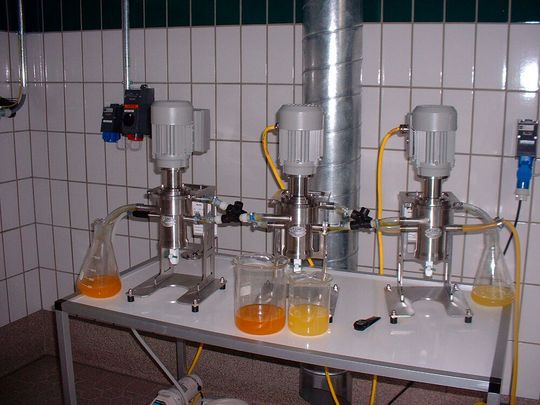
Figure 4. Laboratory scale (pilot installation) three stage counter current extraction.
(Source: CINC)
Modern concepts in the chemical-, pharmaceutical-, biotechnology- and metal industry require continuous flow and modularized production in order to stay economical. The industries have to work their way up towards applying new technologies, in order to maintain their position in the market.
The process industries future becoming increasingly insecure and uncertain in terms of markets and customers [1]. The production industry have to cope with increasing market volatilities, rising environmental requirements, fluctuating energy costs and higher quality demands from customers [2].
Continuous modularized concepts [11; 12] overcome the disadvantages of batch concepts, reduce the development time, have a smaller ecological footprint, with higher yields, max. quality control, less equipment, less product in the process, easy automated process control, coupled with less human interaction. This allows for smarter and digitized process control [3].
Laboratory scale centrifugal extractors are used to optimize existing continuous processes or to pilot new processes. Centrifugal extractors are the alternative to optimize traditional liquid — liquid extraction and separation processes.
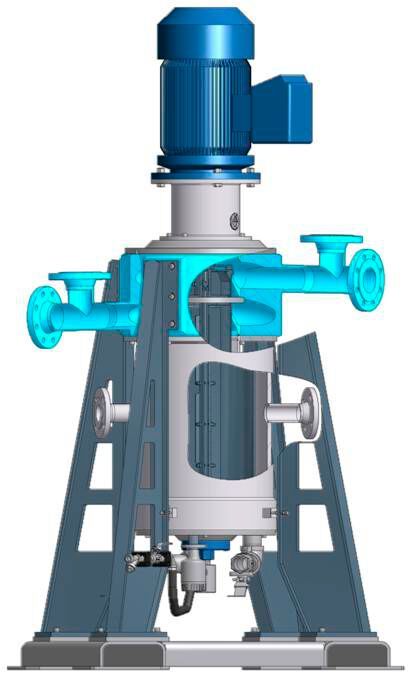
Figure 1: Cutaway view complete CINC centrifugal extractor.
(Source: CINC)
General Centrifuge
Liquid – liquid extraction and liquid - liquid separation processes have been one of the niches in the process arena carved by liquid-liquid centrifuges, especially whenever emulsions or liquids close in density have been involved or contact times have to be minimized. Difficulties that often arise in separation of immiscible liquids include: poor or slow phase separation, emulsion or rag layer formation, and poor process control in batch systems.
Centrifuges accelerate separation processes by enhancing the specific gravity differences. Liquid-liquid dispersions requiring hours to separate at 1G will proceed much faster at 1000 G, with greatly improved efficiency and outflow quality. The efficiency of the physical separation of two phases can be several percent higher by using centrifuges versus decanting from tanks.
CINC Centrifuges as Extractors and Washers
Liquid-liquid centrifuges are valuable separation devices because of their small size and the rapid, yet efficient operation. However, they become even more valuable when employed as liquid-liquid contactors. The ability of a centrifuge to thoroughly mix two phases in the annular zone prior to separation in the rotor broadens its scope. Good mixing is very important to ensure optimal mass transfer and to minimize solvent or water usage. [4]. Chemical processes requiring extraction and washing (or neutralization) as well as separation can be performed in one step utilizing liquid-liquid centrifugal contactors. Better process control, low retained fluid volume during processing, and reduced plant space usage are realized when using these devices in place of traditional tanks, mixer settlers, and extraction columns.
Annular Centrifugal Contactors (ACC)
History: Annular centrifugal contactor design and development has been pursued by various Department of Energy labs for more than 40 years. It has been employed in solvent extraction processes for metals valuable to the nuclear industry [5]. Commercialization of this technology began in 1990 when a patent was granted for continuous separation of hydrocarbons from water [6].
In the past years the centrifuge design has been further improved and scaled up to flow rates of several hundred gallons per minute. CINC Deutschland improved the technology by developing a direct feed bottom plate (separation processes) for the process scale units [7] and a mixing time extension time option for mass transfer reduced systems [8].
Commercial Annular Centrifugal Contactor (ACC)
Principle of Operation: The annular centrifugal contactor operates as both separator and contactor which makes it a valuable tool in numerous types of processes. Its unique design provides mixing and separation in a single, compact unit. As shown in Fig. 1, this centrifuge is an upright, axially symmetric device that mainly consists of two co-axial cylinders: the outer stationary one that forms the housing and the inner rotor. The electrical motor on top is directly connected to the rotor shaft.
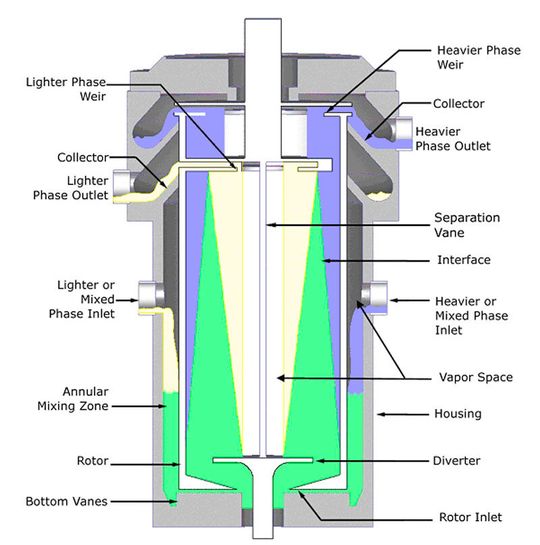
Figure 2. Cutaway view rotor and housing.
(Source: CINC)
Cutaway view
Two immiscible liquids of different densities are fed to the separate inlets and are rapidly mixed in the annular space between the spinning rotor and stationary housing. Please note that the areas above the liquid levels are vapour space. The mixed phases are directed towards the centre of the rotor bottom by radial vanes in the housing base. As the liquids enter the central opening of the rotor, they are accelerated towards the wall. This self-pumping rotor is divided into four vertical chambers which are dynamically balanced by the pumped liquids.
Date: 08.12.2025
Naturally, we always handle your personal data responsibly. Any personal data we receive from you is processed in accordance with applicable data protection legislation. For detailed information please see our privacy policy.
Consent to the use of data for promotional purposes
I hereby consent to Vogel Communications Group GmbH & Co. KG, Max-Planck-Str. 7-9, 97082 Würzburg including any affiliated companies according to §§ 15 et seq. AktG (hereafter: Vogel Communications Group) using my e-mail address to send editorial newsletters. A list of all affiliated companies can be found here
Newsletter content may include all products and services of any companies mentioned above, including for example specialist journals and books, events and fairs as well as event-related products and services, print and digital media offers and services such as additional (editorial) newsletters, raffles, lead campaigns, market research both online and offline, specialist webportals and e-learning offers. In case my personal telephone number has also been collected, it may be used for offers of aforementioned products, for services of the companies mentioned above, and market research purposes.
Additionally, my consent also includes the processing of my email address and telephone number for data matching for marketing purposes with select advertising partners such as LinkedIn, Google, and Meta. For this, Vogel Communications Group may transmit said data in hashed form to the advertising partners who then use said data to determine whether I am also a member of the mentioned advertising partner portals. Vogel Communications Group uses this feature for the purposes of re-targeting (up-selling, cross-selling, and customer loyalty), generating so-called look-alike audiences for acquisition of new customers, and as basis for exclusion for on-going advertising campaigns. Further information can be found in section “data matching for marketing purposes”.
In case I access protected data on Internet portals of Vogel Communications Group including any affiliated companies according to §§ 15 et seq. AktG, I need to provide further data in order to register for the access to such content. In return for this free access to editorial content, my data may be used in accordance with this consent for the purposes stated here. This does not apply to data matching for marketing purposes.
Right of revocation
I understand that I can revoke my consent at will. My revocation does not change the lawfulness of data processing that was conducted based on my consent leading up to my revocation. One option to declare my revocation is to use the contact form found at https://contact.vogel.de. In case I no longer wish to receive certain newsletters, I have subscribed to, I can also click on the unsubscribe link included at the end of a newsletter. Further information regarding my right of revocation and the implementation of it as well as the consequences of my revocation can be found in the data protection declaration, section editorial newsletter.
The mixed phases are rapidly accelerated to rotor speed once trapped in a quadrant, and separation begins as the liquids are displaced upward by continued pumping. The separating zone extends from the diverter disk to the lighter phase weir, which provides a transit time for the liquid-liquid interface to form and sharpen [9]. The interface should be positioned half way between the lighter phase weir and the heavier phase underflow at the top of the separating zone. This is done by selecting the proper heavy phase weir ring (calculation program) and then adjusting the rotor speed to fine tune.
Processing Principles
The annular centrifugal contactors are low rpm, moderate gravity enhancing (100-2000 g) machines, and can therefore be powered by a direct drive, variable speed motor. The effectiveness of a centrifugal separation can be easily described as proportional to the product of the force exerted in multiples of gravity (g) and the residence time in seconds or g -seconds. Achieving a particular g -seconds value in a liquid-liquid centrifuge can be obtained in two ways: increasing the multiples of gravity or increasing the residence time. Creating higher g force values for a specific rotor diameter is a function of rpm only. To cover small (0,1 l/min) to large (757 l/min) flow rates, different size models have been developed.
Multi Stage Process (counter- & cross current)
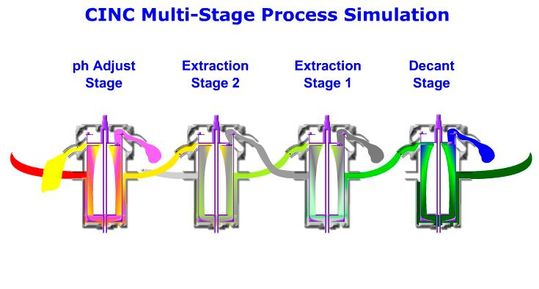
An example of a multistage process is given in Figure 3. In this case, four inter-connected stages provide a continuous separation followed by a counter current extraction followed by a neutralization step. No intermediate pumps or tanks are required for the continuous phase as it traverses the complete separation. Counter current flow in the extraction is employed to gain maximum efficiency while minimizing reagent usage. Counter current flow in both the extraction and strip stages is employed to gain maximum efficiency while minimizing reagent usage. The number of extraction units depends on the selectivity of the solvent. [10]
Figure 3. Multi Stage counter current and cross current extraction.
(Source: CINC)
Piloting: Effective piloting can be insured with the V02 / CS 50 lab scale continuous centrifugal extractor. CINC provides rental equipment to pilot new applications or to optimize existing processes at the customers’ facility. The units can be adjusted to all density differences, can operate between 1800 – 6000 RPM. Different flow rates of the light and the heavy phase can be adjusted by the speed of the peristaltic pumps. Very often the complete pilot studies take only a few days. The gained physical and chemical characteristics of the relevant liquids will be used to precisely scale up to process size. CINC offers centrifugal extractors in different sizes, so that an economical solution is always possible. Piloting at the customers site ensures quick reliable process data and confidence into the technology.
Figure 4 shows a three-stage counter current extraction
Figure 4. Laboratory scale (pilot installation) three stage counter current extraction.
(Source: CINC)
Example: “Steroid extraction” Pilot to Process
Very effective is the production of active pharmaceutical ingredients in fermentation processes. The active pharmaceutical ingredients have to be extracted with organic solvents like Ethylacetat H3C-OOC2H5 Density 0,9 kg/l Boiling temperature 77oC. The efficiency is dependent on the selectivity of the organic solvent.
Pre-test: Shaking test
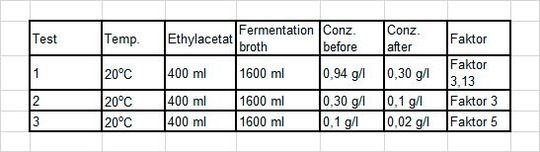
Shaking tests can be used to determine the required theoretical stages. The customer used a ratio of 1/4. The final concentration (loss) of the active ingredient in the fermentation broth was set to < 0,05 g/l.
Tab. 1: Shaking test 1/4
(Source: CINC)
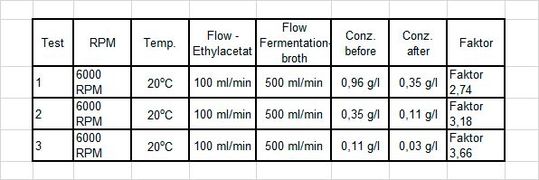
Piloting with laboratory scale annular centrifugal contactors (ACC) size V02: The process was piloted with 3 CINC lab. scale centrifuges V02. Each centrifuge is a centrifugal extractor and mixes both liquids for the mass transfer outside the rotor and separates the liquids inside the rotor. Each unit represents one theoretical stage. The phase separation achieved was excellent and the liquid ratio was given by the customer with 1/5. The extraction efficiency was measured after each unit.
Tab. 2: V02 Piloting 1/5 ( Ethylacetat / fermentation broth) at 1000 g
(Source: CINC)
Scale up calculation
The required residence time for a complete separation of both liquids inside the rotor was calculated with the max. achievable flow rate at the tested 1000 g.
The volume of the lab scale rotor is 140 ml.
Residence time = rotor volume / flow rate = 140 / 600 x 60 = 14 sec.
Flow rate required is 3500 l/h = 58,3 l/min.
Required rotor volume = flow rate / 60 x 14 = 13,6 l
The CS 250 has a rotor volume of 20 l and is the next available size.
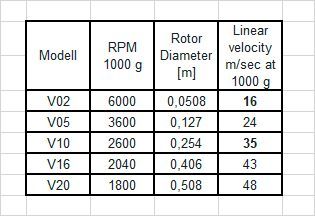
Linear velocity at 1000g = 6000 RPM with a CS 50 (radius 25 mm) = 16 m / sec
Linear velocity at 1000g = 6000 RPM with a CS 250 (radius 125 mm) = 35 m / sec
Tab. 3 Linear Velocity as a function of the mixing intensity
(Source: CINC)
The linear velocity (mixing intensity) will be intensified at the same g-force (1000 g) with increasing radius because the outer rotor speed is 2 x pi x r x RPM / 60.
Process
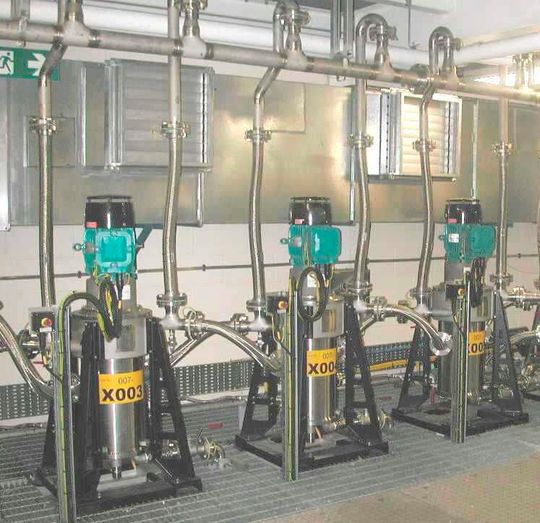
The process was installed with 3 x V10 in the EEx Zone 1 with the safety features (vibration, bearing noise, level control and RPM sensor) and 30 mbar Nitrogen blanket.
Fig. 5: Process scale three stage counter current extraction.
(Source: CINC)
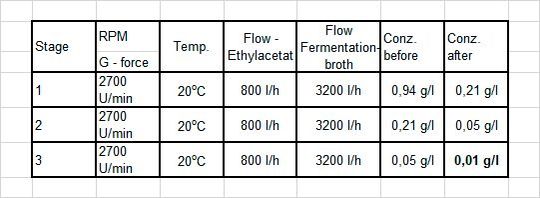
Startup results Tab. 4: V10 ratio 1 / 4 at 1000 g
(Source: CINC)
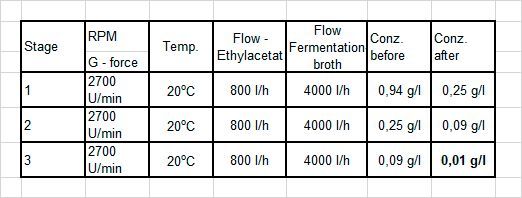
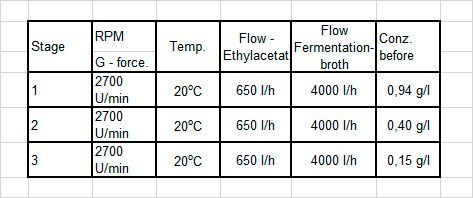
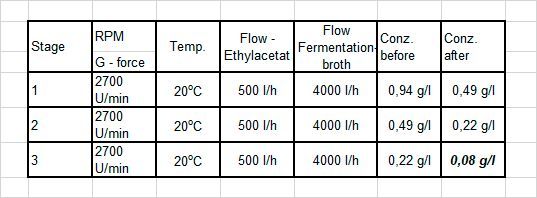
The max. concentration after the extraction was given to < 0,05 g/l. At the ratio 1/4 this value was far excided. To minimize the solvent required different ratios had to be tested.
Startup results Tab. 5: V10 ratio 1 / 5 at 1000 g
(Source: CINC)
Startup results Tab. 6: V10 ratio 1/6 at 1000 g
(Source: CINC)
Startup results Tab. 7: V10 ratio 1/8 at 1000 g
(Source: CINC)
Process Conclusions
The shaking test is always the beginning and the basis of the implementation of an extraction process. The gained data allow the researcher to start with first calculations concerning suitable solvent, solvent ratio and the required theoretical extraction stages. Based on this data CINC can prepare a pilot scale set up with the required theoretical stages. During the trials with the pilot scale equipment at the customers site, several different set ups will be tested, to find the most economical process configuration. The scale up to process equipment size is a little pessimistic due to the intensified mixing at the process scale units. In this example the customer calculated that the process would be very economical with 3 CINC centrifugal extractors. The pilot test results could be topped by the process scale units and allow a 33 % reduction of solvent.
ACC Conclusions
Annular centrifugal contactor (ACC) designs of this type are a significant improvement over traditional methods of liquid-liquid processing. Increased productivity from continuous or simultaneous multiple step processes as well as improved finished product quality, higher yield and better process control is realized. Rapid intensive mixing followed by efficient separation prevents significant product loss at the liquid-liquid interface and from unwanted reactions resulting from prolonged contact times.
Multistage separations and extractions utilizing annular centrifugal contactors not only minimize water / solvent and liquid reagent usage but also occupy a minimum of floor space compared to the alternatives. Low maintenance due to moderate operating speeds and ease of cleaning means downtime is reduced thereby maintaining high process efficiency. Due to the compact size of centrifugal extractors they are ideal tools for modular plants. Modularization aims to divide entire production lines into smaller entities called modules. A modular plant suited in a standard ISO format container is a typical example for such plants. [11; 12]
References:
[1] S. Lier et al., ChemBioEng Rev. 2016, 3 (1), 16–25. DOI:
https://doi.org/10.1002/cben.201500027
[2] B. Seyfang et al., ChemEngineering 2019, 3 (1), 17. DOI:
https://doi.org/10.3390/chemengineering3010017
[3] I. Vural-Gursel, The chemical plant of tomorrow and the future: process-design intensification
at different production Scales, Ph.D. Thesis, Technical University Eindhoven 2015.
[4] B. Schuur et al., Chem. Eng. Process. 2012, 55, 8–19. DOI:
https://doi.org/10.1016/j.cep.2012.02.008
[5] D. S. Webster et al., Performance of Centrifugal Mixer-Settler in the Reprocessing of Nuclear
Fuel, Technical Report, Savannah River National Laboratory, Jackson, SC 1967.
DOI: https://doi.org/10.2172/4572443
[6] D. H. Meikrantz, US Patent 4 959 158, 1989.
[7] CINC Deutschland GmbH & Co. KG M. Vornefeld European Patent 1923113 2007
[8] CINC Deutschland GmbH & Co. KG M. Vornefeld European Patent 3064259 2015
[9] D. H. Meikrantz et al., US Patent 5 762 800 A, 1997.
[10] B. Schuur et al., Org. Process Res. Dev. 2008, 12 (5), 950–955.
DOI: https://doi.org/10.1021/op800074w
B. Schuur et al., Chem. Eng. Sci. 2010, 65 (16), 4682–4690.
DOI: https://doi.org/10.1016/j.ces.2010.05.015
[11] C. Bramsiepe et al., Chem. Eng. Process. 2012, 51, 32–52.
DOI: https://doi.org/10.1016/j.cep.2011.08.005
[12] T. Gruetzner et al., Chem. Eng. Technol. 2016, 39 (10), 1835–1844
DOI: https://doi.org/10.1002/ceat.201600113
* The author is the CEO and owner of CINC Deutschland




:quality(80)/p7i.vogel.de/wcms/54/ae/54aece5dff672ce1651470eecd9f2589/0130138090v2.jpeg "The new Ionchromatograph “Nexera IC“ (Source: Shimadzu)")
:quality(80)/p7i.vogel.de/wcms/49/5c/495c651fabd24a437c98bde6a3d71ecc/0130060419v2.jpeg "Enfinium has successfully piloted Wasteer’s groundbreaking visual AI technology at its Ferrybridge 2 facility in West Yorkshire and Parc Adfer facility in North Wales. (Source: Chris Parkes Photographer Ltd.)")
:quality(80)/p7i.vogel.de/wcms/77/1c/771c3d385d46ede7ab736f3f7d63cb62/0130007313v2.jpeg "The laser perforated filter elements for Eaton’s DCF series enable retention ratings that were previously unattainable with conventional manufacturing methods. Thanks to automatic self-cleaning, they also provide uninterrupted operation with long service life and minimal maintenance requirements. (Source: Eaton )")
:quality(80)/p7i.vogel.de/wcms/0b/33/0b3359449325c4e66cffdb41fce11683/0129956557v2.jpeg "Aramco Senior Vice President of Digital & Information Technology Sami A. Al Ajmi, sitting right, and President of Microsoft Arabia Turki Badhris, sitting left, at a signing ceremony attended by Aramco Executive Vice President of Technology & Innovation Ahmad O. Al Khowaiter, standing right, and Vice Chair and President of Microsoft Brad Smith, standing left. (Source: Aramco )")
:quality(80)/p7i.vogel.de/wcms/64/bb/64bb4812390b6491ce0bd4fe53597086/0130333812v2.jpeg "The solar power plant produces 30 GWh per year of renewable electricity, which is self-consumed by Holcim’s industrial facilities, making it the largest floating solar power plant in Europe dedicated to self-consumption. (Source: Pixabay)")
:quality(80)/p7i.vogel.de/wcms/32/06/320643bfb6b509933012a2fd9c42504d/0130333498v2.jpeg "BASF’s X3D catalysts combine high mechanical stability with an open structure. (Source: BASF)")
:quality(80)/p7i.vogel.de/wcms/1b/ca/1bca61c846359bfd9e7998fb30b662c6/0130333482v2.jpeg "Total Energies has launched France’s first advanced plastics recycling plant, with an annual capacity of 15,000 tons, at its Grandpuits site southeast of Paris. (Source: Pixabay)")
:quality(80)/p7i.vogel.de/wcms/09/e3/09e378194b496921d2a267a6752322eb/0130333473v2.jpeg "Under the terms of the contract, KBR will provide contract management, project management and supporting technical services throughout the EPC phases of the project. (Source: KBR)")
:quality(80)/p7i.vogel.de/wcms/7a/50/7a501f6d8f87a4524dc3aaceb04eacb4/0130333829v2.jpeg "The Clear Lake facility represents Clariant's first U.S. manufacturing site dedicated to producing pharmaceutical-grade PEG excipients, marking a pivotal milestone in the company's healthcare growth strategy. (Source: Clariant)")
:quality(80)/p7i.vogel.de/wcms/26/12/261210e5920899e5c35c4f905d3be8bd/0129399814v2.jpeg "Powders used in DPI formulations are often highly potent and administered in very low doses. (Source: Ima)")
:quality(80)/p7i.vogel.de/wcms/6b/3f/6b3f057c83c494e4732337d870d52b21/0130006927v2.jpeg "Lonza will realize upfront cash proceeds of 2.2 billion dollars and retain a 40 % stake in the business, with additional preferential participation in its future exit. (Source: Lonza)")
:quality(80)/p7i.vogel.de/wcms/df/cd/dfcd0c2e0eb4b554f956e0161ae08519/0129794328v1.jpeg "The plasma fractionation facility at CSL Behring, viewed from the outside. (Source: CSL Behring)")
:quality(80)/p7i.vogel.de/wcms/df/35/df3526a6f7aba41fdd2bb2051954e0d8/0130163620v2.jpeg "The SPA, valued at more than 3 billion dollars, is one of the largest binding long-term green ammonia off-take agreements globally. (Source: Pixabay)")
:quality(80)/p7i.vogel.de/wcms/af/73/af7394d9f8900024c5ee7fca459c4eeb/0130080328v2.jpeg "Axens has signed a MOU with Airbus to strengthen their cooperation in the development and deployment of SAF, a key pillar for decarbonizing the aviation sector. (Source: Pixabay)")
:quality(80)/p7i.vogel.de/wcms/0e/19/0e19f0cf0379c3af4c2fe02629db63f1/0130079229v2.jpeg "Thyssenkrupp Uhde has been selected by CSBP to deliver its patented Envinox technology for two nitric acid plants at CSBP’s Kwinana site in Western Australia. (Source: Thyssenkrupp Uhde)")
:quality(80)/p7i.vogel.de/wcms/a6/84/a68477d4ef879cc9cedeae332ca57c49/0129893677v2.jpeg "Siemens and Caphenia sign the partnership agreement. From left to right: Nicky Ahnert, Jürgen Giegerich, Frank Knauf (all Siemens), Dr. Mark Misselhorn, Dr. Andreas Waibel (both Caphenia) (Source: Siemens)")
:quality(80)/p7i.vogel.de/wcms/1c/39/1c39433f4bb4de2e5e6c5311c3236d09/0130110254v2.jpeg "The new pumps of the Omega type series have been designed for handling water and fluids with a low solids content efficiently. (Source: KSB)")
:quality(80)/p7i.vogel.de/wcms/be/e1/bee13b8d51a419b9b8f0685e2b9d47bf/0128917673v1.jpeg "The Centerwave 6000 measures pipes from 32 to 1,600 mm. (Source: Maag Group)")
:quality(80)/p7i.vogel.de/wcms/51/7a/517a4e83c5827663b4839f5ddb98f434/0128872953v1.jpeg "The Tigron in SIL version can be flexibly configured for different safety requirements. (Source: Auma)")
:quality(80)/p7i.vogel.de/wcms/d5/72/d5728578b35b72f365f5086bc1d068da/0128662441v2.jpeg "Nikkiso Clean Energy & Industrial Gases Group has announced the launch of its new multistage process pump (MSPP 210), designed to enhance safety and reduce downtime on air separation equipment. (Source: Nikkiso Clean Energy & Industrial Gases Group)")
:quality(80)/p7i.vogel.de/wcms/60/ef/60efa975d1dd123c1afbfb6ccc060461/0130263955v2.jpeg "Aquaclean (Source: Oko-tech)")
:quality(80)/p7i.vogel.de/wcms/07/62/0762f20b1821ee2724c97989374d6397/0130257651v2.jpeg "Oleksandr Sadchykov in front of the water treatment unit (Source: Grundfos)")
:quality(80)/p7i.vogel.de/wcms/98/98/989863664c7b65e87caf74a08239d487/0130167217v2.jpeg "Keller 26KyX Level Probe (Source: © Keller Pressure)")
:quality(80)/p7i.vogel.de/wcms/64/4e/644e22b71e8d35a63f051f781eb13886/0130163451v2.jpeg "Vega will present level and pressure measurement technology for the water industry at Ifat 2026. (Source: Vega)")
:quality(80)/p7i.vogel.de/wcms/6b/cc/6bcc3d26e1c7c74d90a10bc3ca296ae1/0128362351v2.jpeg "A look into Bayer's new tablet production, Solida 1, during construction: The robots and lift columns for material handling are being installed. (Source: Bayer)")
:quality(80)/p7i.vogel.de/wcms/24/c8/24c84ab6b1bcd24468a87820a07a85aa/0128194707v2.jpeg "Ajax Equipment has supplied Binding Solutions with a feed system comprising buffer hopper, screw feeder and agitated screw feeder for a pilot plant handling iron ore and additives. (Source: Ajax Equipment )")
:quality(80)/p7i.vogel.de/wcms/1d/3e/1d3e2788eb37c1e974f36337c8d33cb5/0128191010v2.jpeg "Ajax Equipment has supplied IGI Systems with a stainless-steel conical hopper with gas purge capability, as part of a prototype Sublimation System for a low-pressure chemical vapour deposition application. (Source: Ajax Equipment)")
:quality(80)/p7i.vogel.de/wcms/19/76/1976928d7d0a2ed7c1eeba7ade8552c8/0126365603v1.jpeg "Detail of Valvedesign: It has an aktiv amd passive part (Bild: Italvacuum)")
:quality(80)/p7i.vogel.de/wcms/d0/f7/d0f7d560dfce37c8371442d5b6120e3c/0130182478v1.jpeg "The Gelsenkirchen refinery primarily manufactures fuels for vehicles and aircraft, processing roughly 12 million tonnes of crude oil per year. (Source: BP)")
:quality(80)/p7i.vogel.de/wcms/7f/96/7f9628e43c99564fa6dfd8e76149425d/0130165852v2.jpeg "Pure titanium recycling process for chlor-alkali electrolysis cells. (Source: Asahi Kasei)")
:quality(80)/p7i.vogel.de/wcms/4e/27/4e2797cb610f686f13355a5957190d92/0130164068v2.jpeg "Bilfinger experts install and inspect Electrical, Instrumentation and Control systems at customer sites. (Source: Bilfinger)")
:quality(80)/p7i.vogel.de/wcms/f8/29/f8298429c1638b949a6f76346f6709c7/0118701710v2.jpeg "Bosch Industrial Heat will be presenting sustainable steam and heat solutions for global industrial use at the Achema trade fair in Frankfurt, Germany. (Source: Bosch Industriekessel)")
:quality(80)/p7i.vogel.de/wcms/07/24/07242664ab2b1c7841c9d9d0a127670c/0116045959.jpeg "A look inside the GEA machine room. (Bild: Magnavale)")
:quality(80)/p7i.vogel.de/wcms/c9/79/c979a20b32395ddfa93fe7ead90578a0/0108386061.jpeg "Production residues, lime, salt and suspended solids quickly clog the pipes. (Source:©Tanakorn - stock.adobe.com)")
:quality(80)/p7i.vogel.de/wcms/9e/5c/9e5c92d942ed046a27562d6e3d730c92/0103483548.jpeg "It is almost ten metres high and extends over three floors: the world's first multiple dividing wall column is located in the new technical centre at the University of Ulm. (Bild: Eberhardt, kiz Universität Ulm)")
:quality(80)/p7i.vogel.de/wcms/7c/77/7c77e24fdcc9e1511e8e711eff161e28/0130175489v2.jpeg "The milestone confirms the fast pace of development of Eni’s deep water gas projects offshore East Kalimantan. (Source: Unsplash )")
:quality(80)/p7i.vogel.de/wcms/b3/2f/b32fb9f5aa54e9cb6c92e4b6c8665263/0130163018v2.jpeg "The decision to take emergency collective action was made following an extraordinary meeting of IEA Member governments, convened by the IEA Executive Director to assess market conditions amid the conflict in the Middle East and consider the options to address supply disruptions. (Source: © Sashkin - stock.adobe.com)")
:quality(80)/p7i.vogel.de/wcms/85/d2/85d2cb02c4ae45a99454b5405b0f2489/0130149909v2.jpeg "IEA Executive Director Fatih Birol issued a statement on the meeting of G7 Energy Ministers at its IEA headquarters in Paris. (Source: © Marko - stock.adobe.com)")
:quality(80)/p7i.vogel.de/wcms/a8/4e/a84e8039a90a5cf4751d01ebcf6ba1a9/0127510172v2.jpeg "After six years, Achemasia, the international trade fair and innovation forum for sustainable chemical production, has returned with renewed vigor, bringing together global expertise, Chinese innovation, and a shared commitment to a greener industrial future—according to the organizers of the fair. (Source:PROCESS China)")
:quality(80)/p7i.vogel.de/wcms/17/c7/17c703445f134eb3d7ecc7918dda2762/0124596096v2.jpeg "Achema Middle East will launch in Saudi Arabia in 2026. (Bild: Dechema/ Hannibal)")
:quality(80)/p7i.vogel.de/wcms/2a/2c/2a2cffc07f51019065387cd63241b5ce/0119463370v1.jpeg "The Injecta 36 fills and seals RTU (Ready-to-Use) syringes at high speed. The image shows the robotic arm. (Source: IMA)")
:quality(80)/p7i.vogel.de/wcms/b1/7e/b17ea8c62ccafad1d1fb072d6199bbd6/0118578446.jpeg "“Star in the ring”: Vegapuls 6X radar level sensors are the solution of choice for Renolit for many applications on the way to the perfect plastic product. (Source: © MR Design - stock.adobe.com; Vega)")
:quality(80)/p7i.vogel.de/wcms/77/9d/779db435e7f9d79bafe16101008a9cfa/0130263548v2.jpeg "The Kingdom of Saudi Arabia, the UAE and Turkey are three core countries in the region that are actively incorporating the plastics circular economy with the assistance of the chemical recycling technology. (Source: © Anastasiia - stock.adobe.com)")
:quality(80)/p7i.vogel.de/wcms/a0/a3/a0a3cec0d4f46ed33f66ac24b1e03938/0130149916v2.jpeg "Bapco Energies serves notice of Force Majeure on its Group operations. (Source: © Design_Stock - stock.adobe.com)")
:fill(fff,0)/images.vogel.de/vogelonline/companyimg/107800/107832/65.jpg "logoDueperthal.jpg ()")
:fill(fff,0)/images.vogel.de/vogelonline/companyimg/2000/2093/65.jpg "Glatt_Logo_ND4c-RGB (5x3cm).jpg ()")
:fill(fff,0)/images.vogel.de/vogelonline/companyimg/101800/101879/65.jpg "ITV_LogoOrizzontale-per-il-web.jpg ()")
:quality(80)/p7i.vogel.de/wcms/39/0f/390fb9f196a4def807f342cbbfb76b3f/0125419929v2.jpeg "The Munson Rotary Continuous Mixer features a stationary inlet and outlet, a rotating drum with smooth interior surfaces, and proprietary mixing flights that achieve uniformity rapidly at low cost. (Source: Munson Machinery)")
:quality(80)/p7i.vogel.de/wcms/0d/71/0d71f7612334811e13a5cb2bec52839f/0126357401v2.jpeg "Nutraceutical Research Sciences, a private-label manufacturer of nutraceuticals and novel ingredients has developed proprietary manufacturing processes that rely on a model 700-TS-50-SS Rotary Batch Mixer from Munson Machinery. (Source: Munson Machinery)")