On a recent visit to evaluate several level transmitters on chemical storage applications at a new combined cycle power plant, Magnetrol-Ametek had the opportunity to work with the EPC firm, plant personnel and the chemical supplier. This provided an interesting look at the level instrumentation package for the chemical storage side of things from an engineering perspective, as well as from a daily operations point of view.
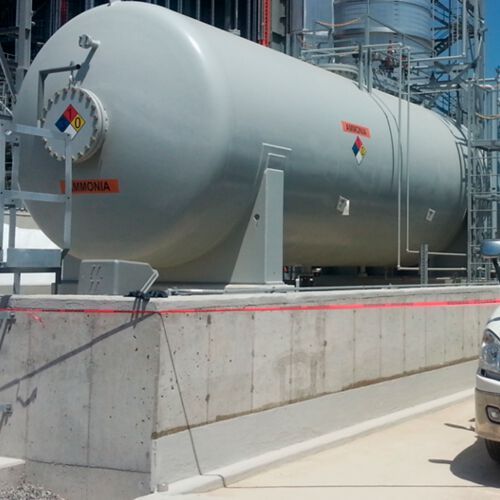
Chemical storage tanks can be horizontal or vertical vessels six to ten feet in diameter/height. It is not uncommon to see some type of non-contact level transmitter installed to provide level indication to the control room with a local display at the base of the tank.
(Source: Magnetrol)
Although important measurements, the ammonia, acid and caustic storage tanks are not difficult level applications for Magnetrol and Orion Instruments by any stretch. However, we found that small nuances on how the applications are monitored relative to technology can have a dramatic effect on the day-to-day practicality and reliability of the type of instrument(s) used. Additionally, there are safety considerations when replenishing these chemicals, which can be addressed simultaneously with inventory monitoring by implementing a few simple, cost-effective modifications to the instrumentation package.
These chemical storage tanks can be horizontal or vertical vessels six to ten feet in diameter/height, with the ammonia storage tank usually the largest of the three. It is not uncommon to see some type of non-contact level transmitter (Ultrasonic being the most prevalent) installed to provide level indication to the control room with a local display at the base of the tank, either in series with the 4-20 mA transmitter output or repeated from the control room. The signal to the control room tracks inventory, acts as a high alarm for overfill protection and establishes the resupply interval. The local display facilitates monitoring the offload of chemicals from the supplier’s truck.
There are a number of level technologies you could throw at these applications. Our preference is Through-Air (Non-Contact) Radar or Guided Wave (Contact) Radar on the acid and caustic tanks and the latter for the ammonia storage. This doesn’t imply non-contact Ultrasonic Level transmitters or other technologies are not up to the task. Simply put, radar is indifferent to the changes in the contents of the vapor space of these vessels occurring throughout the course of the day.
Oftentimes, these changes affect the Ultrasonic burst causing what we refer to as a nuisance alarm, e.g., it loses the signal intermittently or the level indication becomes erratic only to recover about the time a technician arrives on the scene. These types of issues are difficult to isolate since they are intermittent and not linked to an installation or configuration anomaly or hard fault in the instrument. If a competitively priced technology that does not require calibration and is unaffected by changing process conditions is available, we would take that path. Radar meets these three criteria.
Performance Perspectives from the I&C Team
Discussions with the I&C technician and chemical supplier during the evaluation process were confined to reliability, remote indication and performance verification of the level transmitter. Both preferred an independent visual indication along the lines of a Magnetic Level Indicator (MLI) on all three tanks. From the technician’s perspective it allows for easy verification of the level transmitter’s performance and adds a layer of redundancy in case the transmitter was out of commission for whatever reason. We have a lot of confidence in our instrumentation hitting the mark right out of the gate, but we have to admit it is nice to have a second opinion on the reading following initial commissioning. Sticking these tanks is usually not an option during normal operation.
Level Gauge Readability During Product Transfer
The chemical supplier’s insight focused on readability during the transfer of product from the truck to the tank. Even though he normally offloads a fixed quantity of material which the vessel should accommodate based on level indications prior to dispatch, knowing the level during the transfer process is a safety measure to prevent overfilling. His comment was that MLIs can be read easily from a distance with the occasional glance while managing other tasks, whereas, he had to be on top of an LCD-type display to monitor progress. This was particularly important when working with the ammonia storage tank.
Considerations When Top Filling
One item worth pointing out that would simplify the commissioning of the instrument is the close proximity of the top-fill piping to the instrument mounting nozzle on the smaller acid and caustic tanks. Since non-contact technologies are ubiquitous on these applications and rely on projecting a circular or elliptical signal footprint perpendicular to the surface of the material being measured, locating the instrument nozzle as far away from the turbulence generated while top filling is the ideal.
Furthermore, such close proximity allows the spray pattern created as the chemical enters the vessel to interact with the transmitted beam, which could cause a loss of signal during the fill process leaving the supplier blind as to the remaining space in the vessel. Tweaking the instrument’s configuration to overcome such obstacles is possible with time and patience. On the flipside, separating these two entry points during the design phase of the vessels would eliminate any potential problems without adding cost or extending the commissioning time. The present nozzle/fill line configuration is another point to argue the case for an MLI or opting for Guided Wave Radar technology to eliminate any potential interference and excessive turbulence near the transmitter.
Date: 08.12.2025
Naturally, we always handle your personal data responsibly. Any personal data we receive from you is processed in accordance with applicable data protection legislation. For detailed information please see our privacy policy.
Consent to the use of data for promotional purposes
I hereby consent to Vogel Communications Group GmbH & Co. KG, Max-Planck-Str. 7-9, 97082 Würzburg including any affiliated companies according to §§ 15 et seq. AktG (hereafter: Vogel Communications Group) using my e-mail address to send editorial newsletters. A list of all affiliated companies can be found here
Newsletter content may include all products and services of any companies mentioned above, including for example specialist journals and books, events and fairs as well as event-related products and services, print and digital media offers and services such as additional (editorial) newsletters, raffles, lead campaigns, market research both online and offline, specialist webportals and e-learning offers. In case my personal telephone number has also been collected, it may be used for offers of aforementioned products, for services of the companies mentioned above, and market research purposes.
Additionally, my consent also includes the processing of my email address and telephone number for data matching for marketing purposes with select advertising partners such as LinkedIn, Google, and Meta. For this, Vogel Communications Group may transmit said data in hashed form to the advertising partners who then use said data to determine whether I am also a member of the mentioned advertising partner portals. Vogel Communications Group uses this feature for the purposes of re-targeting (up-selling, cross-selling, and customer loyalty), generating so-called look-alike audiences for acquisition of new customers, and as basis for exclusion for on-going advertising campaigns. Further information can be found in section “data matching for marketing purposes”.
In case I access protected data on Internet portals of Vogel Communications Group including any affiliated companies according to §§ 15 et seq. AktG, I need to provide further data in order to register for the access to such content. In return for this free access to editorial content, my data may be used in accordance with this consent for the purposes stated here. This does not apply to data matching for marketing purposes.
Right of revocation
I understand that I can revoke my consent at will. My revocation does not change the lawfulness of data processing that was conducted based on my consent leading up to my revocation. One option to declare my revocation is to use the contact form found at https://contact.vogel.de. In case I no longer wish to receive certain newsletters, I have subscribed to, I can also click on the unsubscribe link included at the end of a newsletter. Further information regarding my right of revocation and the implementation of it as well as the consequences of my revocation can be found in the data protection declaration, section editorial newsletter.
After surveying each application and visiting with the I&C department and chemical supplier, we reviewed the various options with the engineering team. Our collaboration yielded three options to improve the reliability and enhance the day-to-day functionality of the instrumentation package.
Three Options to Improve Reliability and Functionality
The easiest modification was to replace the originally specified Ultrasonic technology with an entry level Through-Air Radar (Magnetrol Model R82), an easy fix to improve reliability by eliminating the vapor space issues noted above without adding to the overall cost. The balance of the inventory management scheme remained the same, i.e., remote LCD indication and so forth.
Taking things a step further, we considered incorporating a Guided Wave Radar (Magnetrol Eclipse Model 706) in place of the non-contact technologies. The Guided Wave Radar would add cost to the instrument itself as compared to an Ultrasonic or entry level Through-Air Radar. However, if we leverage its remote transmitter option in lieu of purchasing an independent remote indicator, we can offset most of the additional cost by eliminating the secondary display and its associated costs: wiring, mounting, configuring, etc.
Another benefit to this approach is more flexibility in the instrument nozzle mounting location relative to the vessel top fill piping arrangement. The Guided Wave Radar is a contact measurement whose sensing element can ignore turbulence and the chemical spray pattern previously mentioned. This added benefit not only simplifies commissioning of the instrument but separates the measurement from the tank dynamics for improved reliability.
Lastly, we looked at including some of the “wish list” items the I&C technician and chemical supplier noted and added a visual indicator (Orion Instruments Atlas or Aurora models) for level verification, redundant and diverse measurement technologies and improved readability during normal plant operation. This approach does add cost to the instrumentation package even when taking into account the elimination of peripheral items included in a minimal installation.
Aside from the ammonia storage tanks, which traditionally have the process connections in place to accommodate an externally mounted device, adding similar process connections to the acid and caustic tanks would bump up the cost of the vessel as well. In the grand scheme of things, the additional costs are minor compared to the long-term benefit, but it is something that needs to be taken into consideration for chemical storage monitoring.




:quality(80)/p7i.vogel.de/wcms/54/f4/54f4b4e2a86b203e0dfd84221602bdb5/0130367283v2.jpeg "Anybotics' Anymal robot combines depth cameras, LiDAR, thermal imaging, acoustic sensors, and gas detectors into a single inspection round. (Source: Anybotics)")
:quality(80)/p7i.vogel.de/wcms/e9/64/e964996410967c124c2cf01a8623068e/0130285341v1.jpeg "Geht unter die Oberfläche: Die Offshore-Ölförderung erfordert hochenergetische Pumpen – doch diese sind im Wesentlichen eine Black Box. Bisher zumindest. (Source: Kistler Group)")
:quality(80)/p7i.vogel.de/wcms/54/ae/54aece5dff672ce1651470eecd9f2589/0130138090v2.jpeg "The new Ionchromatograph “Nexera IC“ (Source: Shimadzu)")
:quality(80)/p7i.vogel.de/wcms/49/5c/495c651fabd24a437c98bde6a3d71ecc/0130060419v2.jpeg "Enfinium has successfully piloted Wasteer’s groundbreaking visual AI technology at its Ferrybridge 2 facility in West Yorkshire and Parc Adfer facility in North Wales. (Source: Chris Parkes Photographer Ltd.)")
:quality(80)/p7i.vogel.de/wcms/1e/15/1e15b0e20cf5ede83e0749260dfda733/0130465044v2.jpeg "Energy X has recently announced the successful commissioning of a first-of-its-kind, U.S.-based lithium production facility at Project Lonestar, marking a major milestone toward commercial-scale domestic lithium production. (Source: Pixabay)")
:quality(80)/p7i.vogel.de/wcms/36/36/36369e6e59d4c660893cc04a4d257cfc/0130465035v2.jpeg "Wacker has successfully completed the second expansion phase at its production site in Panagarh, India. In addition to silicone rubber, the site now also operates a production complex (left) for silicone emulsions. (Source: Wacker)")
:quality(80)/p7i.vogel.de/wcms/1f/1e/1f1eba3731af22e1d9946e2897f134da/0130464799v2.jpeg "Aerial view of the BASF production site in Zhanjiang, China. (Source: BASF )")
:quality(80)/p7i.vogel.de/wcms/64/bb/64bb4812390b6491ce0bd4fe53597086/0130333812v2.jpeg "The solar power plant produces 30 GWh per year of renewable electricity, which is self-consumed by Holcim’s industrial facilities, making it the largest floating solar power plant in Europe dedicated to self-consumption. (Source: Pixabay)")
:quality(80)/p7i.vogel.de/wcms/41/c9/41c96e0244221ad38daa73bdd8231477/0130477173v2.jpeg "The „ORBITA‑L“-system is designed for filling and capping non‑injectable liquid products. (Source: Marchesini)")
:quality(80)/p7i.vogel.de/wcms/7a/50/7a501f6d8f87a4524dc3aaceb04eacb4/0130333829v2.jpeg "The Clear Lake facility represents Clariant's first U.S. manufacturing site dedicated to producing pharmaceutical-grade PEG excipients, marking a pivotal milestone in the company's healthcare growth strategy. (Source: Clariant)")
:quality(80)/p7i.vogel.de/wcms/26/12/261210e5920899e5c35c4f905d3be8bd/0129399814v2.jpeg "Powders used in DPI formulations are often highly potent and administered in very low doses. (Source: Ima)")
:quality(80)/p7i.vogel.de/wcms/6b/3f/6b3f057c83c494e4732337d870d52b21/0130006927v2.jpeg "Lonza will realize upfront cash proceeds of 2.2 billion dollars and retain a 40 % stake in the business, with additional preferential participation in its future exit. (Source: Lonza)")
:quality(80)/p7i.vogel.de/wcms/df/35/df3526a6f7aba41fdd2bb2051954e0d8/0130163620v2.jpeg "The SPA, valued at more than 3 billion dollars, is one of the largest binding long-term green ammonia off-take agreements globally. (Source: Pixabay)")
:quality(80)/p7i.vogel.de/wcms/af/73/af7394d9f8900024c5ee7fca459c4eeb/0130080328v2.jpeg "Axens has signed a MOU with Airbus to strengthen their cooperation in the development and deployment of SAF, a key pillar for decarbonizing the aviation sector. (Source: Pixabay)")
:quality(80)/p7i.vogel.de/wcms/0e/19/0e19f0cf0379c3af4c2fe02629db63f1/0130079229v2.jpeg "Thyssenkrupp Uhde has been selected by CSBP to deliver its patented Envinox technology for two nitric acid plants at CSBP’s Kwinana site in Western Australia. (Source: Thyssenkrupp Uhde)")
:quality(80)/p7i.vogel.de/wcms/a6/84/a68477d4ef879cc9cedeae332ca57c49/0129893677v2.jpeg "Siemens and Caphenia sign the partnership agreement. From left to right: Nicky Ahnert, Jürgen Giegerich, Frank Knauf (all Siemens), Dr. Mark Misselhorn, Dr. Andreas Waibel (both Caphenia) (Source: Siemens)")
:quality(80)/p7i.vogel.de/wcms/1c/39/1c39433f4bb4de2e5e6c5311c3236d09/0130110254v2.jpeg "The new pumps of the Omega type series have been designed for handling water and fluids with a low solids content efficiently. (Source: KSB)")
:quality(80)/p7i.vogel.de/wcms/be/e1/bee13b8d51a419b9b8f0685e2b9d47bf/0128917673v1.jpeg "The Centerwave 6000 measures pipes from 32 to 1,600 mm. (Source: Maag Group)")
:quality(80)/p7i.vogel.de/wcms/51/7a/517a4e83c5827663b4839f5ddb98f434/0128872953v1.jpeg "The Tigron in SIL version can be flexibly configured for different safety requirements. (Source: Auma)")
:quality(80)/p7i.vogel.de/wcms/60/ef/60efa975d1dd123c1afbfb6ccc060461/0130263955v2.jpeg "Aquaclean (Source: Oko-tech)")
:quality(80)/p7i.vogel.de/wcms/07/62/0762f20b1821ee2724c97989374d6397/0130257651v2.jpeg "Oleksandr Sadchykov in front of the water treatment unit (Source: Grundfos)")
:quality(80)/p7i.vogel.de/wcms/98/98/989863664c7b65e87caf74a08239d487/0130167217v2.jpeg "Keller 26KyX Level Probe (Source: © Keller Pressure)")
:quality(80)/p7i.vogel.de/wcms/64/4e/644e22b71e8d35a63f051f781eb13886/0130163451v2.jpeg "Vega will present level and pressure measurement technology for the water industry at Ifat 2026. (Source: Vega)")
:quality(80)/p7i.vogel.de/wcms/6b/cc/6bcc3d26e1c7c74d90a10bc3ca296ae1/0128362351v2.jpeg "A look into Bayer's new tablet production, Solida 1, during construction: The robots and lift columns for material handling are being installed. (Source: Bayer)")
:quality(80)/p7i.vogel.de/wcms/24/c8/24c84ab6b1bcd24468a87820a07a85aa/0128194707v2.jpeg "Ajax Equipment has supplied Binding Solutions with a feed system comprising buffer hopper, screw feeder and agitated screw feeder for a pilot plant handling iron ore and additives. (Source: Ajax Equipment )")
:quality(80)/p7i.vogel.de/wcms/1d/3e/1d3e2788eb37c1e974f36337c8d33cb5/0128191010v2.jpeg "Ajax Equipment has supplied IGI Systems with a stainless-steel conical hopper with gas purge capability, as part of a prototype Sublimation System for a low-pressure chemical vapour deposition application. (Source: Ajax Equipment)")
:quality(80)/p7i.vogel.de/wcms/19/76/1976928d7d0a2ed7c1eeba7ade8552c8/0126365603v1.jpeg "Detail of Valvedesign: It has an aktiv amd passive part (Bild: Italvacuum)")
:quality(80)/p7i.vogel.de/wcms/0c/a1/0ca135e0486c9af90a0552aea85de88c/0130439525v2.jpeg "Qatar Energy expects the damage to its Ras Laffan Industrial City caused by missile strikes, which occurred on Wednesday 18 March 2026, and in the early hours of Thursday 19 March 2026, to cost about 20 billion dollars a year in lost revenue. (Source: Pixabay)")
:quality(80)/p7i.vogel.de/wcms/d0/f7/d0f7d560dfce37c8371442d5b6120e3c/0130182478v1.jpeg "The Gelsenkirchen refinery primarily manufactures fuels for vehicles and aircraft, processing roughly 12 million tonnes of crude oil per year. (Source: BP)")
:quality(80)/p7i.vogel.de/wcms/7f/96/7f9628e43c99564fa6dfd8e76149425d/0130165852v2.jpeg "Pure titanium recycling process for chlor-alkali electrolysis cells. (Source: Asahi Kasei)")
:quality(80)/p7i.vogel.de/wcms/f8/29/f8298429c1638b949a6f76346f6709c7/0118701710v2.jpeg "Bosch Industrial Heat will be presenting sustainable steam and heat solutions for global industrial use at the Achema trade fair in Frankfurt, Germany. (Source: Bosch Industriekessel)")
:quality(80)/p7i.vogel.de/wcms/07/24/07242664ab2b1c7841c9d9d0a127670c/0116045959.jpeg "A look inside the GEA machine room. (Bild: Magnavale)")
:quality(80)/p7i.vogel.de/wcms/c9/79/c979a20b32395ddfa93fe7ead90578a0/0108386061.jpeg "Production residues, lime, salt and suspended solids quickly clog the pipes. (Source:©Tanakorn - stock.adobe.com)")
:quality(80)/p7i.vogel.de/wcms/9e/5c/9e5c92d942ed046a27562d6e3d730c92/0103483548.jpeg "It is almost ten metres high and extends over three floors: the world's first multiple dividing wall column is located in the new technical centre at the University of Ulm. (Bild: Eberhardt, kiz Universität Ulm)")
:quality(80)/p7i.vogel.de/wcms/7c/77/7c77e24fdcc9e1511e8e711eff161e28/0130175489v2.jpeg "The milestone confirms the fast pace of development of Eni’s deep water gas projects offshore East Kalimantan. (Source: Unsplash )")
:quality(80)/p7i.vogel.de/wcms/b3/2f/b32fb9f5aa54e9cb6c92e4b6c8665263/0130163018v2.jpeg "The decision to take emergency collective action was made following an extraordinary meeting of IEA Member governments, convened by the IEA Executive Director to assess market conditions amid the conflict in the Middle East and consider the options to address supply disruptions. (Source: © Sashkin - stock.adobe.com)")
:quality(80)/p7i.vogel.de/wcms/85/d2/85d2cb02c4ae45a99454b5405b0f2489/0130149909v2.jpeg "IEA Executive Director Fatih Birol issued a statement on the meeting of G7 Energy Ministers at its IEA headquarters in Paris. (Source: © Marko - stock.adobe.com)")
:quality(80)/p7i.vogel.de/wcms/a8/4e/a84e8039a90a5cf4751d01ebcf6ba1a9/0127510172v2.jpeg "After six years, Achemasia, the international trade fair and innovation forum for sustainable chemical production, has returned with renewed vigor, bringing together global expertise, Chinese innovation, and a shared commitment to a greener industrial future—according to the organizers of the fair. (Source:PROCESS China)")
:quality(80)/p7i.vogel.de/wcms/17/c7/17c703445f134eb3d7ecc7918dda2762/0124596096v2.jpeg "Achema Middle East will launch in Saudi Arabia in 2026. (Bild: Dechema/ Hannibal)")
:quality(80)/p7i.vogel.de/wcms/2a/2c/2a2cffc07f51019065387cd63241b5ce/0119463370v1.jpeg "The Injecta 36 fills and seals RTU (Ready-to-Use) syringes at high speed. The image shows the robotic arm. (Source: IMA)")
:quality(80)/p7i.vogel.de/wcms/b1/7e/b17ea8c62ccafad1d1fb072d6199bbd6/0118578446.jpeg "“Star in the ring”: Vegapuls 6X radar level sensors are the solution of choice for Renolit for many applications on the way to the perfect plastic product. (Source: © MR Design - stock.adobe.com; Vega)")
:quality(80)/p7i.vogel.de/wcms/09/e3/09e378194b496921d2a267a6752322eb/0130333473v2.jpeg "Under the terms of the contract, KBR will provide contract management, project management and supporting technical services throughout the EPC phases of the project. (Source: KBR)")
:quality(80)/p7i.vogel.de/wcms/77/9d/779db435e7f9d79bafe16101008a9cfa/0130263548v2.jpeg "The Kingdom of Saudi Arabia, the UAE and Turkey are three core countries in the region that are actively incorporating the plastics circular economy with the assistance of the chemical recycling technology. (Source: © Anastasiia - stock.adobe.com)")
:fill(fff,0)/images.vogel.de/vogelonline/companyimg/107800/107832/65.jpg "logoDueperthal.jpg ()")
:fill(fff,0)/p7i.vogel.de/companies/68/07/6807ad98568ce/logo-elementar-rgb.jpeg "logo-elementar-rgb (Elementar Analysensysteme GmbH)")
:fill(fff,0)/images.vogel.de/vogelonline/companyimg/2000/2093/65.jpg "Glatt_Logo_ND4c-RGB (5x3cm).jpg ()")
:quality(80)/p7i.vogel.de/wcms/c1/ed/c1ed89188a8fdb351601e36204d4c38b/0125059797v2.jpeg "Smart Echo Supervision reduces and often eliminates the need for intervention against false echoes. However, when intervention is required, it can be performed quickly and easily through a graphical user interface, simply by right clicking an echo to suppress it. (Source: Emerson)")
:quality(80)/p7i.vogel.de/wcms/de/56/de567a18d20b770efccb05d472c45a62/0127607608v2.jpeg "Malema has recently announced the global launch of the new Malema M-3100 Series Clamp-On Ultrasonic Flow Meter. (Source: Malema)")