No gas and still little hope: Chlorine manufacturing is under enormous pressure caused by skyrocketing energy costs. Production in Europe is declining and local competitiveness is at risk, says industry association Euro Chlor. Old-world chlorine is mostly produced as part of integrated chemical value chains. But for how much longer?
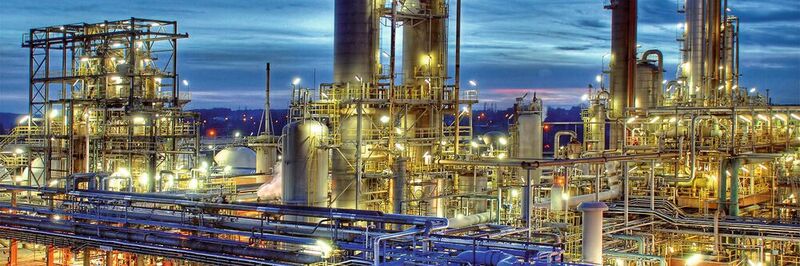
Dark clouds are gathering over the industry: The energy crisis threatens chlorine chemistry, as here at the Vynova site in Tessenderlo, Belgium.
(Picture: Vynova)
Industry associations admonish, threaten and complain — we have become accustomed to this. It is part of the business of the lobbyists to throw themselves into the breach on behalf of their industries, sometimes with exaggerated pathos.
And yet, in 2022, the voices sound different, more dramatic: “Our competitiveness is indeed threatened,” explains Wouter Bleukx, Chairman from 2020 to 2022 of Euro Chlor, the association of chlor-alkali plant operators in Europe (a sector group of the European chemical association Cefic). Are the lights going out at Europe’s industrial plants?
Gallery
It might come as a surprise that it is chlorine chemistry, of all industries, that is using drastic words to warn of the winter of discontent. After all, chlor-alkali electrolysis is an electrochemical process that does not use fossil fuels — neither natural gas nor naphtha — as raw materials and, given emission-neutral electricity, would also be relatively easy to defossilize.
Nevertheless, dark clouds are brewing. Even though salt, the most important raw material for chlorine production, will not be in short supply in the foreseeable future, electricity already is. And even where power is not scarce, it is expensive. For the first time, imports into the EU are outstripping exports — in terms of sheer product volume as well as product value.
Accordingly, the outgoing Euro Chlor chairman (whose term of office exactly spanned the pandemic of 2020–22) is a little ambivalent at his last Euro Chlor general assembly in September 2022 in Munich. “Chlorine production has recovered after the Covid-19 crisis, and intensive efforts are helping to secure access to energy at competitive costs,” Bleukx explains. While the association has accomplished much despite the pandemic — as evidenced in part by the fact that there has been no chlorine transportation accident in the past decade — 2022 is the first time the industry could conceivably end for good.
The Facts of Chlorine Production:
Mercury cell process: Chlorine electrolysis between a titanium anode and a mercury cathode (at which the sodium produced forms the eponymous sodium amalgam). No longer best available technology (BAT) due to mercury emissions and high energy consumption, and only allowed to operate in the EU up to 2027.
Membrane cell electrolysis: The membrane process uses a chlorine-resistant cation exchange membrane approximately 0.1 mm thick, which enables high product purity with lower energy input. About two-thirds of the chlorine electrolysis plants worldwide use this relatively new method.
Diaphragm cell electrolysis: In the diaphragm process, electrolysis takes place along an asbestos or PTFE diaphragm. The use of asbestos is no longer in line with BAT and the purity of the caustic soda is also limited. The process plays only a minor role in the EU, but is still widely used in the USA, for example.
Euro Chlor: Euro Chlor is the association of chlor-alkali operators in Europe. Founded in 1969, the Brussels-based association now has 39 member companies, which together account for 97 percent of the European chlorine chemical industry. Euro Chlor is part of the European chemical industry association Cefic. Every three years, the association organizes a technology conference, most recently in Warsaw in May 2022.
Energy is Key to Industrial Production - Not Only for Chlorine
Europe is losing competitiveness at breakneck speed, and there is no end in sight. With the Repower EU program as the latest milestone, the time of raw materials and energy from Russia is running out, while consumers and industry alike continue to wait for real alternatives. No wonder that the Euro Chlor Commission defined energy as the Achilles’ heel of Europe’s industry as early as April 2022. Accordingly, the need for renewable and flexible power supply is enormous.
As expected, the industry rejects the idea of simply cutting back production and thus consumption. EU officials, too, know that chemistry is a crucial and integral part of almost every value chain, and have assured the industry that the ‘masters of molecules’ will be among the last to be disconnected from the grid.
Naturally, however, no one knows how things can and should continue. Fortunately for European chlorine producers, the industry is small-scale and distributed over a wide area. Unlike for example in the U.S., the transport of chlorine in larger volumes hardly plays a role in Europe. The chemical is mostly produced in integrated industrial sites directly for local consumption.
A total of 62 plants in the EU produced about 9,645,000 metric tons of chlorine in 2021, 4.6 percent more than in the coronavirus year of 2020. The membrane process has become the dominant technology, with 84.5 percent of the market, ahead of diaphragm cells (11.5 percent) and the remaining 4.0 percent covers chlorine-alcoholate production, hydrochloric acid conversion to chlorine, metal production and chlorine and caustic production without hydrogen as a by-product.
What About Sustainability? Euro Chlor's Ten Year Plan
The companies would actually have liked to talk about another issue, since in 2021 Euro Chlor had just given itself a new sustainability program for the next decade. This includes new performance indicators that not only help to make economic and technological aspects measurable, but also include, for example, the sector’s carbon footprint and its contribution to grid load balancing.
One bright spot for the chlorine industry is a very special gas that has so far not played a major role for the sector: Hydrogen is currently on everyone’s agenda. The gas is a by-product of the chlorine electrolysis process, just like caustic soda. The chlorine producers themselves have no use for it, but the molecule could become a coveted resource for the energy industry and as a raw material for the production of chemicals. Every unused ton of hydrogen from chlorine production therefore hurts operators more and more.
Date: 08.12.2025
Naturally, we always handle your personal data responsibly. Any personal data we receive from you is processed in accordance with applicable data protection legislation. For detailed information please see our privacy policy.
Consent to the use of data for promotional purposes
I hereby consent to Vogel Communications Group GmbH & Co. KG, Max-Planck-Str. 7-9, 97082 Würzburg including any affiliated companies according to §§ 15 et seq. AktG (hereafter: Vogel Communications Group) using my e-mail address to send editorial newsletters. A list of all affiliated companies can be found here
Newsletter content may include all products and services of any companies mentioned above, including for example specialist journals and books, events and fairs as well as event-related products and services, print and digital media offers and services such as additional (editorial) newsletters, raffles, lead campaigns, market research both online and offline, specialist webportals and e-learning offers. In case my personal telephone number has also been collected, it may be used for offers of aforementioned products, for services of the companies mentioned above, and market research purposes.
Additionally, my consent also includes the processing of my email address and telephone number for data matching for marketing purposes with select advertising partners such as LinkedIn, Google, and Meta. For this, Vogel Communications Group may transmit said data in hashed form to the advertising partners who then use said data to determine whether I am also a member of the mentioned advertising partner portals. Vogel Communications Group uses this feature for the purposes of re-targeting (up-selling, cross-selling, and customer loyalty), generating so-called look-alike audiences for acquisition of new customers, and as basis for exclusion for on-going advertising campaigns. Further information can be found in section “data matching for marketing purposes”.
In case I access protected data on Internet portals of Vogel Communications Group including any affiliated companies according to §§ 15 et seq. AktG, I need to provide further data in order to register for the access to such content. In return for this free access to editorial content, my data may be used in accordance with this consent for the purposes stated here. This does not apply to data matching for marketing purposes.
Right of revocation
I understand that I can revoke my consent at will. My revocation does not change the lawfulness of data processing that was conducted based on my consent leading up to my revocation. One option to declare my revocation is to use the contact form found at https://contact.vogel.de. In case I no longer wish to receive certain newsletters, I have subscribed to, I can also click on the unsubscribe link included at the end of a newsletter. Further information regarding my right of revocation and the implementation of it as well as the consequences of my revocation can be found in the data protection declaration, section editorial newsletter.
Chlorine Production also Means Hydrogen Output
Euro Chlor companies currently produce around three billion cubic meters of hydrogen, of which around 85 percent is currently used, the lion’s share for steam generation (35.7 percent) or for the production of ammonia, aniline, hydrogen peroxide or other chemical building blocks (20.8 percent). It should nevertheless also not be forgotten that around 40,000 metric tons of hydrogen are vented unused into the atmosphere. This is not much in comparison with the total European production of millions of tons of hydrogen, but it is still 40,000 tons of one of the most sought-after molecules in this time of energy transition.
Can chlorine chemistry really become the nucleus of a new electrolysis value creation? The industry is in a favorable position, as it already has years of experience with big electrolysis plants that are significantly larger than the typical container modules of H2 startups. And not only that: Since electrolysis stacks can be operated relatively flexibly with fluctuating amounts of electricity, the industry can contribute to grid stabilization — an aspect that could become even more important in view of fluctuating renewable energy supplies.
The difficulties are in fact more likely to be on the side of the user industries, which would have to get used to a fluctuating raw material supply — absolutely uncharted territory for thoroughly integrated chemical sites.
New Chairman in Troubled Times: Setting the Course for Chlorine
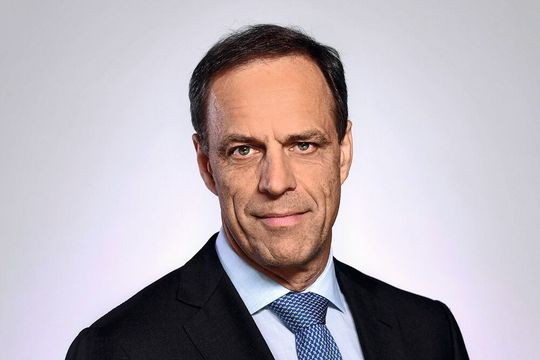
In troubled times: Vynova manager Johan Van Den Broeck takes over as the chairman of Euro Chlor.
(Picture: MICHEL@WIEGANDT.BE/Vynova)
However, these prospects should concern Wouter Bleukx a little less: At the General Assembly of European Chlorine Chemistry in Munich in September, Johan Van Den Broeck, Executive Vice President Commercial at Vynova, a group in which the former Inovyn chlorine chemistry operations were bundled, was elected as the new Chairman. Over the next two years, the Belgian manager intends to work to make Euro Chlor a sustainable and competitive player in the international chemical industry, and is promoting speaking with one voice among companies.
Energy processes are crucial to this, as is an understanding by policymakers of the sector’s role as a supplier to virtually all value chains. However, all these plans would be waste paper if the blackout of the industry really comes at the turn of the year. Those who want to change need courage — but above all they have to stay alive long enough. n




:quality(80)/p7i.vogel.de/wcms/54/f4/54f4b4e2a86b203e0dfd84221602bdb5/0130367283v2.jpeg "Anybotics' Anymal robot combines depth cameras, LiDAR, thermal imaging, acoustic sensors, and gas detectors into a single inspection round. (Source: Anybotics)")
:quality(80)/p7i.vogel.de/wcms/e9/64/e964996410967c124c2cf01a8623068e/0130285341v1.jpeg "Geht unter die Oberfläche: Die Offshore-Ölförderung erfordert hochenergetische Pumpen – doch diese sind im Wesentlichen eine Black Box. Bisher zumindest. (Source: Kistler Group)")
:quality(80)/p7i.vogel.de/wcms/54/ae/54aece5dff672ce1651470eecd9f2589/0130138090v2.jpeg "The new Ionchromatograph “Nexera IC“ (Source: Shimadzu)")
:quality(80)/p7i.vogel.de/wcms/49/5c/495c651fabd24a437c98bde6a3d71ecc/0130060419v2.jpeg "Enfinium has successfully piloted Wasteer’s groundbreaking visual AI technology at its Ferrybridge 2 facility in West Yorkshire and Parc Adfer facility in North Wales. (Source: Chris Parkes Photographer Ltd.)")
:quality(80)/p7i.vogel.de/wcms/7e/1f/7e1f3996f5b0ceaa2cd63e8f42c46e8b/0130491098v2.jpeg "At a glance: Plant engineering projects from across the globe. (Source: © Andi - stock.adobe.com)")
:quality(80)/p7i.vogel.de/wcms/1e/15/1e15b0e20cf5ede83e0749260dfda733/0130465044v2.jpeg "Energy X has recently announced the successful commissioning of a first-of-its-kind, U.S.-based lithium production facility at Project Lonestar, marking a major milestone toward commercial-scale domestic lithium production. (Source: Pixabay)")
:quality(80)/p7i.vogel.de/wcms/36/36/36369e6e59d4c660893cc04a4d257cfc/0130465035v2.jpeg "Wacker has successfully completed the second expansion phase at its production site in Panagarh, India. In addition to silicone rubber, the site now also operates a production complex (left) for silicone emulsions. (Source: Wacker)")
:quality(80)/p7i.vogel.de/wcms/1f/1e/1f1eba3731af22e1d9946e2897f134da/0130464799v2.jpeg "Aerial view of the BASF production site in Zhanjiang, China. (Source: BASF )")
:quality(80)/p7i.vogel.de/wcms/3b/86/3b86c49f99e3638ed9f42c6cc7732950/0130491017v2.jpeg "Turning liquids into powders enables storage at room-temperature. (Source: Glatt)")
:quality(80)/p7i.vogel.de/wcms/84/78/8478fcee08360056b226cb8d5032d50c/0130489771v2.jpeg "Saharsh Davuluri will assume the role of Chief Executive Officer and Managing Director, effective immediately, as the company moves into its next stage of CDMO growth. (Source: Neuland Laboratories)")
:quality(80)/p7i.vogel.de/wcms/ab/c2/abc21b4affa79498712fe95c16991828/0130489183v2.jpeg "Prange Pharma recently announced the successful completion of the acquisition of the MSD Animal Health manufacturing site in Aprilia, Italy. (Source: Pixabay)")
:quality(80)/p7i.vogel.de/wcms/41/c9/41c96e0244221ad38daa73bdd8231477/0130477173v2.jpeg "The „ORBITA‑L“-system is designed for filling and capping non‑injectable liquid products. (Source: Marchesini)")
:quality(80)/p7i.vogel.de/wcms/80/ae/80ae5dcaef8b78989454ddba5eb2f6a7/0130485693v2.jpeg "The Global Impact Coalition has recently announced that Siemens has joined the coalition as a member. (Source: Siemens)")
:quality(80)/p7i.vogel.de/wcms/df/35/df3526a6f7aba41fdd2bb2051954e0d8/0130163620v2.jpeg "The SPA, valued at more than 3 billion dollars, is one of the largest binding long-term green ammonia off-take agreements globally. (Source: Pixabay)")
:quality(80)/p7i.vogel.de/wcms/af/73/af7394d9f8900024c5ee7fca459c4eeb/0130080328v2.jpeg "Axens has signed a MOU with Airbus to strengthen their cooperation in the development and deployment of SAF, a key pillar for decarbonizing the aviation sector. (Source: Pixabay)")
:quality(80)/p7i.vogel.de/wcms/0e/19/0e19f0cf0379c3af4c2fe02629db63f1/0130079229v2.jpeg "Thyssenkrupp Uhde has been selected by CSBP to deliver its patented Envinox technology for two nitric acid plants at CSBP’s Kwinana site in Western Australia. (Source: Thyssenkrupp Uhde)")
:quality(80)/p7i.vogel.de/wcms/1c/39/1c39433f4bb4de2e5e6c5311c3236d09/0130110254v2.jpeg "The new pumps of the Omega type series have been designed for handling water and fluids with a low solids content efficiently. (Source: KSB)")
:quality(80)/p7i.vogel.de/wcms/be/e1/bee13b8d51a419b9b8f0685e2b9d47bf/0128917673v1.jpeg "The Centerwave 6000 measures pipes from 32 to 1,600 mm. (Source: Maag Group)")
:quality(80)/p7i.vogel.de/wcms/51/7a/517a4e83c5827663b4839f5ddb98f434/0128872953v1.jpeg "The Tigron in SIL version can be flexibly configured for different safety requirements. (Source: Auma)")
:quality(80)/p7i.vogel.de/wcms/60/ef/60efa975d1dd123c1afbfb6ccc060461/0130263955v2.jpeg "Aquaclean (Source: Oko-tech)")
:quality(80)/p7i.vogel.de/wcms/07/62/0762f20b1821ee2724c97989374d6397/0130257651v2.jpeg "Oleksandr Sadchykov in front of the water treatment unit (Source: Grundfos)")
:quality(80)/p7i.vogel.de/wcms/98/98/989863664c7b65e87caf74a08239d487/0130167217v2.jpeg "Keller 26KyX Level Probe (Source: © Keller Pressure)")
:quality(80)/p7i.vogel.de/wcms/64/4e/644e22b71e8d35a63f051f781eb13886/0130163451v2.jpeg "Vega will present level and pressure measurement technology for the water industry at Ifat 2026. (Source: Vega)")
:quality(80)/p7i.vogel.de/wcms/79/31/7931cc94924b4c2ebc7087e9cec2f801/0130490720v2.jpeg "The new Pulsar Model R80 solids antenna delivers improved measurement capability through its high-frequency signal, narrow beam angle, and advanced configuration software. (Source: Ametek )")
:quality(80)/p7i.vogel.de/wcms/6b/cc/6bcc3d26e1c7c74d90a10bc3ca296ae1/0128362351v2.jpeg "A look into Bayer's new tablet production, Solida 1, during construction: The robots and lift columns for material handling are being installed. (Source: Bayer)")
:quality(80)/p7i.vogel.de/wcms/24/c8/24c84ab6b1bcd24468a87820a07a85aa/0128194707v2.jpeg "Ajax Equipment has supplied Binding Solutions with a feed system comprising buffer hopper, screw feeder and agitated screw feeder for a pilot plant handling iron ore and additives. (Source: Ajax Equipment )")
:quality(80)/p7i.vogel.de/wcms/1d/3e/1d3e2788eb37c1e974f36337c8d33cb5/0128191010v2.jpeg "Ajax Equipment has supplied IGI Systems with a stainless-steel conical hopper with gas purge capability, as part of a prototype Sublimation System for a low-pressure chemical vapour deposition application. (Source: Ajax Equipment)")
:quality(80)/p7i.vogel.de/wcms/0f/11/0f11c60729f25db0ca0d301d9d4ca0ee/0130485703v2.jpeg "The signatories of the Joint Biomethane Declaration, leading European industry associations, are calling to scale biomethane as an important building block of the EU’s reindustrialization, energy security, and transition to climate neutrality. (Source: Pixabay)")
:quality(80)/p7i.vogel.de/wcms/0c/a1/0ca135e0486c9af90a0552aea85de88c/0130439525v2.jpeg "Qatar Energy expects the damage to its Ras Laffan Industrial City caused by missile strikes, which occurred on Wednesday 18 March 2026, and in the early hours of Thursday 19 March 2026, to cost about 20 billion dollars a year in lost revenue. (Source: Pixabay)")
:quality(80)/p7i.vogel.de/wcms/d0/f7/d0f7d560dfce37c8371442d5b6120e3c/0130182478v1.jpeg "The Gelsenkirchen refinery primarily manufactures fuels for vehicles and aircraft, processing roughly 12 million tonnes of crude oil per year. (Source: BP)")
:quality(80)/p7i.vogel.de/wcms/f8/29/f8298429c1638b949a6f76346f6709c7/0118701710v2.jpeg "Bosch Industrial Heat will be presenting sustainable steam and heat solutions for global industrial use at the Achema trade fair in Frankfurt, Germany. (Source: Bosch Industriekessel)")
:quality(80)/p7i.vogel.de/wcms/07/24/07242664ab2b1c7841c9d9d0a127670c/0116045959.jpeg "A look inside the GEA machine room. (Bild: Magnavale)")
:quality(80)/p7i.vogel.de/wcms/c9/79/c979a20b32395ddfa93fe7ead90578a0/0108386061.jpeg "Production residues, lime, salt and suspended solids quickly clog the pipes. (Source:©Tanakorn - stock.adobe.com)")
:quality(80)/p7i.vogel.de/wcms/9e/5c/9e5c92d942ed046a27562d6e3d730c92/0103483548.jpeg "It is almost ten metres high and extends over three floors: the world's first multiple dividing wall column is located in the new technical centre at the University of Ulm. (Bild: Eberhardt, kiz Universität Ulm)")
:quality(80)/p7i.vogel.de/wcms/20/36/20366ffa57a841882fd165e4dc885c09/0130491929v2.jpeg "With the US and Israel jointly firing the first shot on Iran, the world is now witnessing major cascading effects—from soaring global oil and gas prices, to industry leaders declaring force majeure, and even predictions that the war could trigger a global economic recession! (Source: © FOYSAL - stock.adobe.com)")
:quality(80)/p7i.vogel.de/wcms/7c/77/7c77e24fdcc9e1511e8e711eff161e28/0130175489v2.jpeg "The milestone confirms the fast pace of development of Eni’s deep water gas projects offshore East Kalimantan. (Source: Unsplash )")
:quality(80)/p7i.vogel.de/wcms/b3/2f/b32fb9f5aa54e9cb6c92e4b6c8665263/0130163018v2.jpeg "The decision to take emergency collective action was made following an extraordinary meeting of IEA Member governments, convened by the IEA Executive Director to assess market conditions amid the conflict in the Middle East and consider the options to address supply disruptions. (Source: © Sashkin - stock.adobe.com)")
:quality(80)/p7i.vogel.de/wcms/a8/4e/a84e8039a90a5cf4751d01ebcf6ba1a9/0127510172v2.jpeg "After six years, Achemasia, the international trade fair and innovation forum for sustainable chemical production, has returned with renewed vigor, bringing together global expertise, Chinese innovation, and a shared commitment to a greener industrial future—according to the organizers of the fair. (Source:PROCESS China)")
:quality(80)/p7i.vogel.de/wcms/17/c7/17c703445f134eb3d7ecc7918dda2762/0124596096v2.jpeg "Achema Middle East will launch in Saudi Arabia in 2026. (Bild: Dechema/ Hannibal)")
:quality(80)/p7i.vogel.de/wcms/2a/2c/2a2cffc07f51019065387cd63241b5ce/0119463370v1.jpeg "The Injecta 36 fills and seals RTU (Ready-to-Use) syringes at high speed. The image shows the robotic arm. (Source: IMA)")
:quality(80)/p7i.vogel.de/wcms/b1/7e/b17ea8c62ccafad1d1fb072d6199bbd6/0118578446.jpeg "“Star in the ring”: Vegapuls 6X radar level sensors are the solution of choice for Renolit for many applications on the way to the perfect plastic product. (Source: © MR Design - stock.adobe.com; Vega)")
:quality(80)/p7i.vogel.de/wcms/09/e3/09e378194b496921d2a267a6752322eb/0130333473v2.jpeg "Under the terms of the contract, KBR will provide contract management, project management and supporting technical services throughout the EPC phases of the project. (Source: KBR)")
:quality(80)/p7i.vogel.de/wcms/77/9d/779db435e7f9d79bafe16101008a9cfa/0130263548v2.jpeg "The Kingdom of Saudi Arabia, the UAE and Turkey are three core countries in the region that are actively incorporating the plastics circular economy with the assistance of the chemical recycling technology. (Source: © Anastasiia - stock.adobe.com)")
:fill(fff,0)/p7i.vogel.de/companies/61/f9/61f9439b7cbe4/logo-edl.png "logo-edl (EDL Anlagenbau Gesellschaft mbH)")
:fill(fff,0)/p7i.vogel.de/companies/66/9f/669f700d3b118/cac-2023-poslogo-idea-ahead.png "cac-2023-poslogo-idea-ahead (CAC ENGINEERING GMBH)")
:fill(fff,0)/p7i.vogel.de/companies/68/c8/68c815bc8fe81/prominent-logo-300x300.jpeg "prominent-logo-300x300 (ProMinent GmBH)")
:quality(80)/p7i.vogel.de/wcms/ea/27/ea277a637ba9c1e35d9db2eab11efc98/0107044959.jpeg "In troubled times: Vynova manager Johan Van Den Broeck takes over as the chairman of Euro Chlor.(Source: MICHEL@WIEGANDT.BE/Vynova)")
:quality(80)/p7i.vogel.de/wcms/d7/04/d7047710fe8bd63debf43ecc356f7bd7/0107044962.jpeg "Dark clouds are gathering over the industry: The energy crisis threatens chlorine chemistry, as here at the Vynova site in Tessenderlo, Belgium.(Source: Vynova)")
:quality(80)/images.vogel.de/vogelonline/bdb/1801600/1801615/original.jpg "Chlorine production in Europe - in this case Neolyse Ibbenbüren - declined slightly in 2019 due to lower demand from the chemical industry. (Neolyse Ibbenbüren)")
:quality(80)/p7i.vogel.de/wcms/8e/cd/8ecd73af7c9b800af677f23c3d9e1287/0107094026.jpeg "Shell to Start Building Europe’s Largest Renewable Hydrogen Plant: Shell Nederland and Shell Overseas Investments, subsidiaries of Shell, have taken the final investment decision to build Holland Hydrogen I, which will be Europe’s largest renewable hydrogen plant once operational in 2025.(Source: Shell)")
:quality(80)/p7i.vogel.de/wcms/2a/a4/2aa402475ba217a91afbc79dd9b7cc83/0107098121.jpeg "One of the Largest Green H2 Production Plants to be Developed in Europe: HH2E and Met Group have established a joint project company for building one of the largest production plants for green hydrogen in Germany. On completion, the project is expected to produce more than 60,000 tons of green hydrogen annually.(Source: Shawn Hempel - stock.adobe.com)")
:quality(80)/p7i.vogel.de/wcms/a6/84/a6840354cc35f120413b507ff5bbd8a4/0107097274.jpeg "ExxonMobil to Build One of the World’s Largest CCS Projects in USA: With an aim to reduce industry emissions, ExxonMobil has plans to develop a hydrogen production plant along with one of the world’s largest CCS projects at its Baytown site in Texas, USA.(Source: photogrfx - stock.adobe.com)")
:quality(80)/p7i.vogel.de/wcms/7a/64/7a643f8cb394feeaaddbb839479f5853/0107098132.jpeg "Vertex Hydrogen to Build UK’s First Large-Scale Low Carbon Hydrogen Plant: In a recent report by Vertex Hydrogen, the company has provided the details of developing the low carbon hydrogen production project in the UK. Under the project, natural gas, refinery fuel gas will be converted into low carbon hydrogen and carbon dioxide will be captured and permanently stored under the sea bed.(Source: magann - stock.adobe.com)")
:quality(80)/p7i.vogel.de/wcms/2a/78/2a7893e5bb719c73aa7052c6b8f25d77/0107372127.jpeg "With the aim of fostering standardization, BASF has been openly sharing its PCF calculation methodology with suppliers, customers and peers. (Source: ipopba - stock.adobe.com)")
:quality(80)/p7i.vogel.de/wcms/a3/f5/a3f5afe3cb87c621959d31e3a7defce9/0103551756.jpeg "Top 10 Countries in the Chemical Industry(Source: Pixabay)")
:quality(80)/p7i.vogel.de/wcms/22/75/2275c25f7b0dcff749d626b9bfdf6846/0103541690.jpeg "10. Italy: 53 million euros in sales in 2020. (Source: Pixabay)")
:quality(80)/p7i.vogel.de/wcms/b0/95/b0956a369a5315826c804b4d8774be14/0103550850.jpeg "9. Brazil: 54 million euros in sales in 2020. (Source: Pixabay)")
:quality(80)/p7i.vogel.de/wcms/59/cc/59cc24565d33f1e7fbe13b1aaefab613/0103550844.jpeg "8. Taiwan: 66 million euros in sales in 2020. (Source: Pixabay)")
:quality(80)/p7i.vogel.de/wcms/7f/96/7f9628e43c99564fa6dfd8e76149425d/0130165852v2.jpeg "Pure titanium recycling process for chlor-alkali electrolysis cells. (Source: Asahi Kasei)")
:quality(80)/p7i.vogel.de/wcms/38/e6/38e673c6f6a43848834edcf10fe63f27/0125068527v2.jpeg "Ion-exchange membrane process for chlor-alkali electrolysis. (Source: Asahi Kasei)")